
Oct 13, 2026
By Transpire Insight
Description
According to a research report published by Transpire Insight, the building thermal insulation market size is projected to grow from USD 32.4 billion in 2026 to USD 52.6 billion by 2035, at a CAGR of 6.3% during the forecast period 2027-2035. Rapid urban development, strict building energy standards, escalating heating-and-cooling costs, and corporate ESG commitments drive the adoption of thermal insulation materials across new construction and renovation projects.
Introduction
The building thermal insulation market plays a key role in reducing carbon footprints and cutting operational energy costs. Valued at around $37 billion in 2026, the sector is experiencing steady, code-driven growth across both residential and commercial applications. Rising interest in stone wool, glass wool, and high-performance polyisocyanurate (PIR) panels reflects a broader structural shift toward building envelope decarbonization, indoor thermal comfort, and localized climate resilience.
Recent Development News
March 2026: Kingspan Insulated Panels North America introduced the Leo-Klip™ Fastening System to lower installation costs and streamline thermal envelope integration on commercial roofs.
July 2026: Saint-Gobain completed the acquisition of a major glass-fiber manufacturing plant to reinforce its supply chain for building-envelope and high-performance continuous insulation solutions.
Stay Ahead of Emerging Opportunities with Expert Market Insights by Transpire Insight
Transpire Insight provides comprehensive, data-driven market intelligence to support smarter business decisions. Our research is rooted in comprehensive analysis, authoritative predictions, and industry expertise, enabling organizations to make informed decisions in rapidly evolving markets. We provide in-depth analysis of market segmentation, competitive positioning, regional trends, and emerging investment opportunities in high-growth areas. We blend accuracy with actionable intelligence, helping companies uncover new growth avenues, strengthen strategic decision-making, and stay ahead in a dynamic market.
Building Thermal Insulation Market Size & Statistics
The Market Size for Building Thermal Insulation Was Estimated to be Worth USD 32.4 Billion in 2026.
The Market Size is Going to Expand at a CAGR of 6.3% between 2026 and 2035.
The Building Thermal Insulation Market Size is anticipated to reach USD 52.6 Billion by 2035.
Europe is projected to drive the highest demand during the forecast period, accounting for 37.3% of the building thermal insulation market.
Asia-Pacific is projected to grow the fastest during the forecast period at a CAGR of 7.2% in the building thermal insulation market.
Regional Growth and Demand Analysis by Transpire Insight
Europe remains the anchor of demand because regulation there turns insulation into a compulsory expense rather than a discretionary one. The recast Energy Performance of Buildings Directive, the Renovation Wave and the European Green Deal push owners of older residential and commercial buildings to upgrade walls, roofs and floors. Glass wool and mineral wool suppliers such as Saint-Gobain Isover, Knauf Insulation and Rockwool benefit from this steady retrofit pipeline. Germany, France, the UK, Italy and the Nordic countries lead consumption, backed by mature construction sectors and a strong preference for high-performance materials. Residential buildings account for the largest end-use share, and renovation activity is expected to keep regional demand stable.
Asia Pacific is growing faster because construction volumes are rising alongside tougher energy-efficiency rules. China's building energy-efficiency mandates and large urban infrastructure programs, India's tightening Energy Conservation Building Code and Japan's net-zero building retrofit agenda are converting policy into real procurement. India is expected to record the highest country-level growth, and expanded polystyrene is the largest product segment in the region. players are responding with local capacity: Kingspan and Saint-Gobain are both expanding regional manufacturing to serve local specifications and reduce import exposure. Rising incomes, smart city projects, and cooling-driven demand in tropical climates add further momentum.
Top 15 Trends in the Building Thermal Insulation Market
Tightening codes like the EU's EPBD recast and India's ECBC make insulation mandatory, creating steady, long-term demand across new construction and existing building renovation projects.
Ageing building stock pushes owners toward deep retrofits, where wall, roof, and floor insulation upgrades cut heating and cooling bills and help meet decarbonization targets.
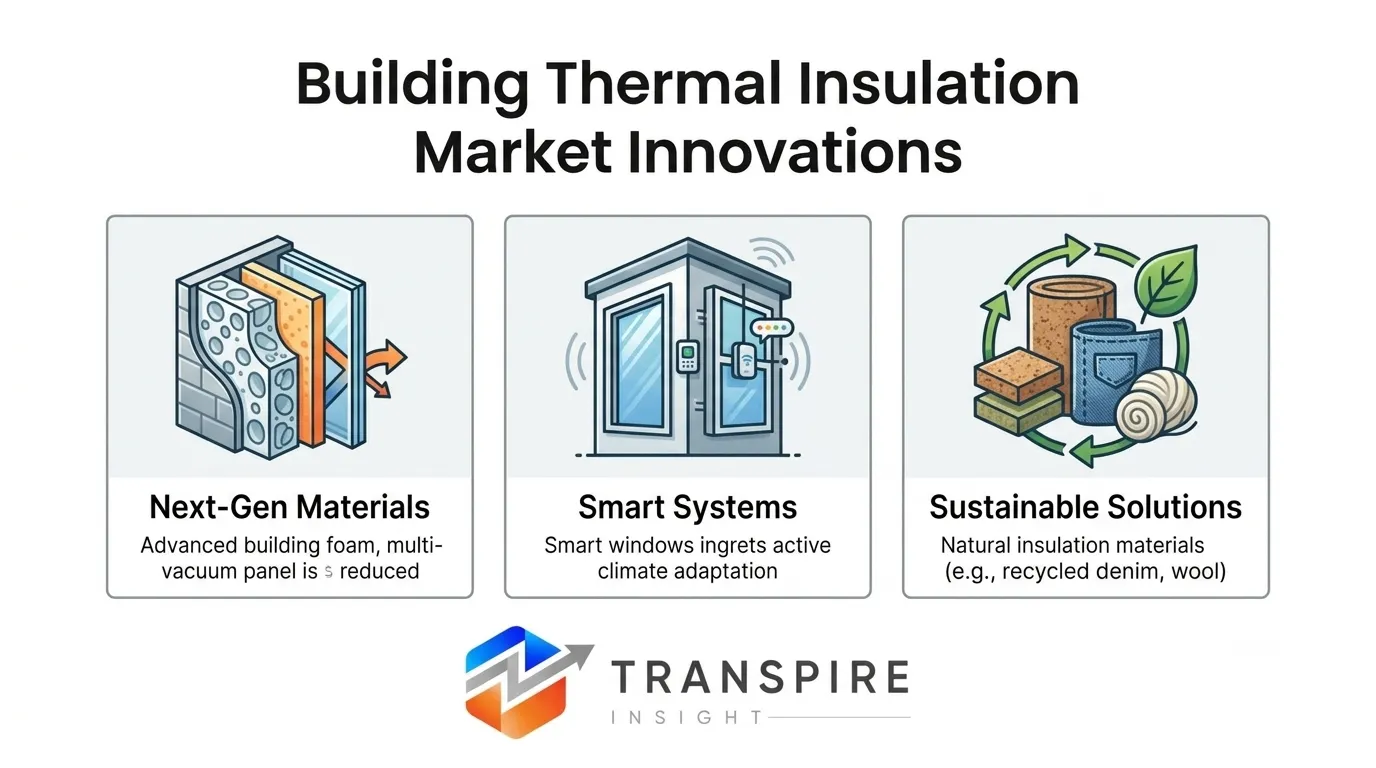
Builders increasingly choose hemp, cellulose, and wood-fibre insulation because these renewable materials store carbon, regulate moisture naturally, and support green building certifications and sustainability commitments.
Aerogel blankets and vacuum insulation panels deliver very low thermal conductivity in thin profiles, making them valuable for space-constrained retrofits and premium commercial building projects.
Manufacturers of polyurethane and phenolic foams are reformulating with low-GWP blowing agents and recyclable chemistries to satisfy tightening environmental regulations and rising green building expectations.
Some providers embed temperature and moisture sensors within insulation layers, enabling real-time performance tracking, early fault detection, and better maintenance planning for large commercial buildings.
List of Top 25 Companies Leading the Building Thermal Insulation Market
1. Kingspan Group
World-leading developer of advanced polyisocyanurate (PIR) high-efficiency insulated wall panel technology.
Founded: 1965 | HQ: Kingscourt, Ireland.
Why It Ranks: Holds leadership in high-performance insulated panels and rigid board manufacturing.
Regional Dominance: Maintains a dominant market position across Europe and North America.
Product Line: Kooltherm, OPTIM-R vacuum insulation panels, and Therma PIR insulation boards.
2. Owens Corning
Pioneered mass-market fiberglass technology and produces iconic PINK fiberglass building insulation.
Founded: 1938 | HQ: Toledo, Ohio, USA.
Why It Ranks: Unrivaled brand equity and production capacity across Western residential construction markets.
Regional Dominance: Enjoys a strong primary market leadership share across North America.
Product Line: PINK NextGen Fiberglas, FOAMULAR XPS insulation, and Thermafiber mineral wool.
3. Saint-Gobain
building materials giant offering comprehensive multi-material thermal and acoustic envelopes.
Founded: 1665 | HQ: Courbevoie, France.
Why It Ranks: Operates an extensive international production and distribution network for construction solutions.
Regional Dominance: Holds leading light-construction market shares across Europe and South America.
Product Line: ISOVER glass wool, Weber facade insulation systems, and Celotex PIR boards.
4. ROCKWOOL A/S
World leader in fire-safe, fully recyclable stone wool building thermal insulation systems.
Founded: 1937 | HQ: Hedehusene, Denmark.
Why It Ranks: Dominates stone wool insulation markets due to premium fire resistance.
Regional Dominance: Strong presence across Europe, expanding rapidly into Asia-Pacific and India.
Product Line: Rockwool Comfortbatt, Thermal Wrap, and Frontrock external wall insulation systems.
5. BASF SE
chemical leader providing fundamental raw materials and high-efficiency polyurethanes.
Founded: 1865 | HQ: Ludwigshafen, Germany.
Why It Ranks: Key chemical supplier behind expandable polystyrene and polyurethane insulation foams.
Regional Dominance: Leads technical chemical supply chains across Europe and the Americas.
Product Line: Neopor EPS, Styrodur XPS, and Elastospray spray polyurethane foam formulations.
6. Knauf Insulation
Innovator of ECOSE Technology using bio-based binder chemistry for mineral wool.
Founded: 1932 | HQ: Iphofen, Germany.
Why It Ranks: Primary European contender in eco-friendly glass and stone wool insulation.
Regional Dominance: Maintains massive market exposure across Central, Eastern, and Western Europe.
Product Line: Earthwool insulation batts, Thermo-Mesh, and Urbanscape green roof systems.
7. Johns Manville (Berkshire Hathaway)
Key North American producer of premium glass fiber and rigid PIR insulation.
Founded: 1858 | HQ: Denver, Colorado, USA.
Why It Ranks: Backed by parent giant Berkshire Hathaway with extensive commercial roof market share.
Regional Dominance: Primary operational focus and distribution dominance across the United States.
Product Line: AP Foil-Faced Polyiso, GoBoard backer boards, and formaldehyde-free fiberglass batts.
8. Huntsman Corporation
Leading producer of MDI chemistry essential for polyurethane foam insulation.
Founded: 1970 | HQ: The Woodlands, Texas, USA.
Why It Ranks: Major chemical backbone provider for spray foam insulation contractors.
Regional Dominance: Maintains strong chemical supply footprints in North America and Asia.
Product Line: TEROL polyols, Rubinate MDI, and Building Solutions spray polyurethane systems.
9. Carlisle Companies Inc.
Premier single-ply roofing and energy-efficient building envelope system developer.
Founded: 1917 | HQ: Scottsdale, Arizona, USA.
Why It Ranks: Captures widespread commercial building insulation market share across non-residential roofing.
Regional Dominance: Enjoys solid leadership across North American commercial construction sectors.
Product Line: Hunter XCI polyiso panels, Sure-Seal EPDM membranes, and continuous insulation.
10. BEWI ASA
European leader in sustainable packaging and expanded polystyrene (EPS) building components.
Founded: 1980 | HQ: Trondheim, Norway.
Why It Ranks: Controls closed-loop recycling networks for EPS insulation products across Europe.
Regional Dominance: Strong manufacturing market share in Northern and Western European territories.
Product Line: EPS insulation boards, XPS foundation slabs, and Insulated Concrete Formwork (ICF).
Conclusion
Building codes require buildings to use less energy in their operation, meaning insulating materials are no longer being used as an efficiency option, but are necessary components of the structure. The rigid foam, stone wool, and bio-based composites are the key innovations that have taken the lead in the rigid foam industry, which is expected to expand steadily in the long run. These high-performance insulation systems will continue to play a key role in achieving decarbonization goals, lowering heating expenses in the interior, and designing climate-proof buildings.


Send us a brief description of your challenge and we'll get back to you within 24 hours.

 inquiry@transpireinsight.com
 APAC:+91 7666513636
 Address


