
Sep 28, 2026
By Transpire Insight
Description
According to a research report published by Transpire Insight, the brain imaging modalities market size is projected to grow from USD 15.49 billion in 2026 to USD 25.28 billion by 2035, at a CAGR of 5.9% during the forecast period 2027-2035. Rising neurological disorders, aging demographics, AI integration in neuro-diagnostics, expanding clinical applications, and demand for non-invasive functional brain mapping accelerate brain imaging adoption.
Introduction
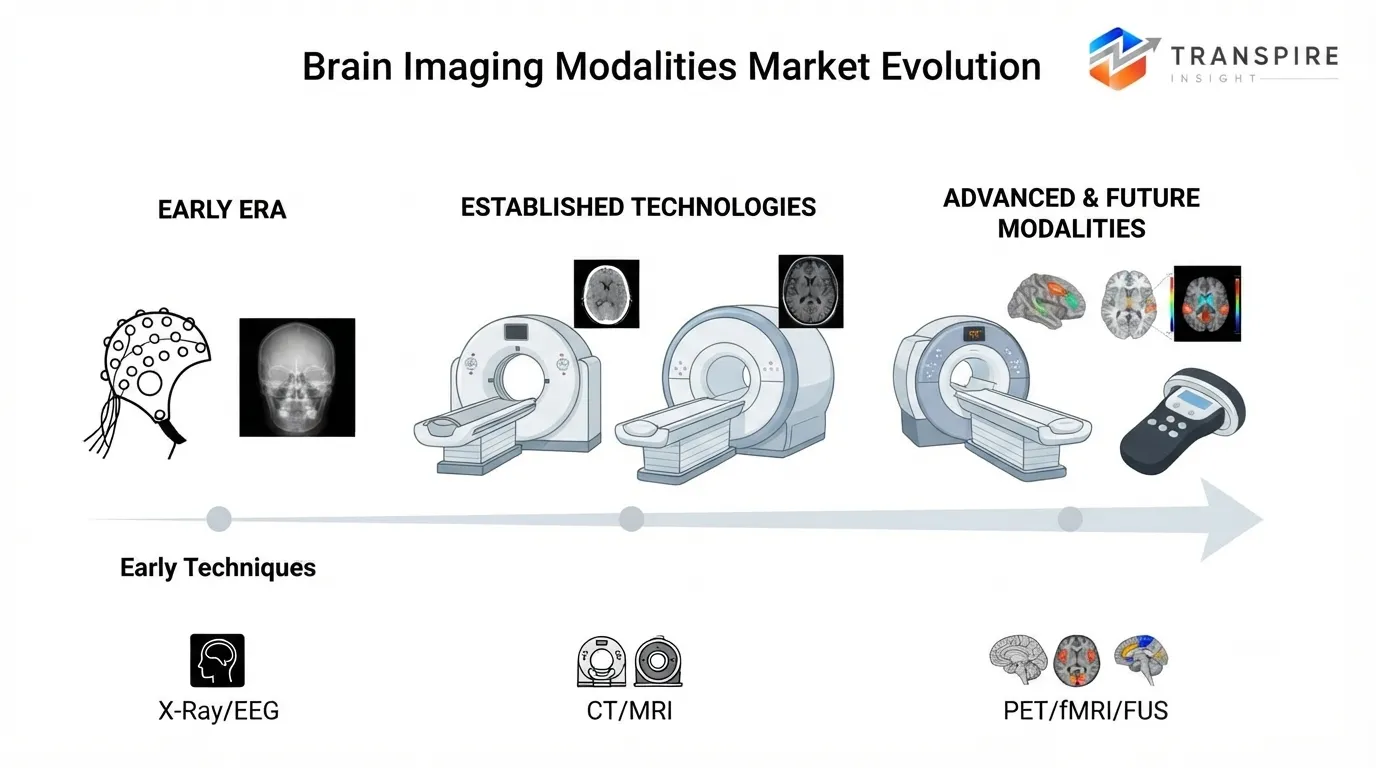
The brain imaging modalities market plays a vital role in modern neuroscience and clinical neurology, enabling accurate diagnosis of brain tumors, strokes, and neurodegenerative conditions. Encompassing technologies like MRI, CT, PET, SPECT, fMRI, and EEG, the market expands through high-resolution structural and metabolic mapping. Increasing healthcare investments, coupled with AI integration, continue to boost diagnostic accuracy, personalized neuro-therapeutics, and non-invasive brain interventions globally.
Recent Development News
May 2026: Siemens Healthineers launched the MAGNETOM Flow.Ace, a helium-independent 1.5T MRI system featuring DryCool technology and AI workflow automation to enhance accessible neuroimaging.
March 2026: Leading neurotech providers introduced integrated cloud-native AI diagnostic platforms for rapid, real-time automated brain stroke triage in emergency clinical setups.
Stay Ahead of Emerging Opportunities with Expert Market Insights by Transpire Insight
Transpire Insight provides comprehensive, data-driven market intelligence to support smarter business decisions. Our research is rooted in comprehensive analysis, authoritative predictions, and industry expertise, enabling organizations to make informed decisions in rapidly evolving markets. We provide in-depth analysis of market segmentation, competitive positioning, regional trends, and emerging investment opportunities in high-growth areas. We blend accuracy with actionable intelligence, helping companies uncover new growth avenues, strengthen strategic decision-making, and stay ahead in a dynamic market.
Brain Imaging Modalities Market Size & Statistics
The Market Size for Brain Imaging Modalities Was Estimated to be Worth USD 15.49 Billion in 2026.
The Market Size is Going to Expand at a CAGR of 5.9% between 2026 and 2035.
The Brain Imaging Modalities Market Size is anticipated to reach USD 25.28 Billion by 2035.
North America is projected to drive the highest demand during the forecast period, accounting for 42% of the brain imaging modalities market.
Asia-Pacific is projected to grow the fastest during the forecast period at a CAGR of 9.4% in the brain imaging modalities market.
Regional Growth and Demand Analysis by Transpire Insight
North America's leadership in the brain imaging modalities market rests on a combination of dense MRI, CT, and PET installed capacity, strong reimbursement frameworks, and aggressive investment in AI-enabled diagnostics. GE HealthCare's acquisition of IMACTIS, a US-based firm specializing in computer-assisted interventional radiology, illustrates how major players are consolidating navigation and imaging capabilities to strengthen their technological edge in the region. Similarly, Philips' AI-enabled MR 5300 system, unveiled at the Radiological Society of North America's annual meeting and cleared by the FDA, reflects how North American manufacturers are pushing AI-powered image reconstruction and diagnostic accuracy to the forefront of clinical practice. High neurological disease prevalence, well-established hospital radiology networks, and continuous R&D funding reinforce the region's position as the largest revenue contributor, even as growth in absolute dollar terms is expected to moderate relative to emerging markets.
Asia-Pacific's rapid expansion is being driven by a rising burden of stroke, dementia, and other neurological disorders alongside expanding healthcare infrastructure and government-backed diagnostic initiatives. Japan continues to lead the region in technological sophistication, with strong clinical adoption of high-end MRI and PET systems, while China is scaling domestic manufacturing capacity to reduce reliance on imported imaging equipment. In India, the growing incidence of stroke and dementia, combined with improving access to advanced imaging in urban hospital networks, is opening significant opportunities for both established multinational vendors and regional manufacturers. Rising disposable income, expanding insurance coverage, and increased government funding for research and diagnostic infrastructure across South Korea, China, and India are collectively positioning Asia-Pacific as the region with the steepest demand curve for brain imaging modalities going forward.
Top 15 Trends in the Brain Imaging Modalities Market
Radiology departments are embedding AI algorithms into MRI and CT workflows to speed lesion detection, reduce reading time, and improve diagnostic accuracy for neurological conditions.
Growing incidence of stroke, Alzheimer's, Parkinson's, and epilepsy is pushing hospitals to steadily expand imaging capacity, fueling strong demand for advanced brain diagnostic equipment.
Compact, portable imaging units are now reaching emergency rooms, ambulances, and rural clinics, enabling faster stroke assessment and neurological triage outside traditional hospital radiology departments.
Combined PET-MRI scanners deliver simultaneous metabolic and structural brain data, improving diagnostic precision for tumors and dementia while notably reducing overall patient scanning session time.
Advanced imaging biomarkers now enable earlier detection of amyloid plaques and tau proteins, supporting timely Alzheimer's diagnosis and far better-targeted treatment planning for patients globally.
Leading manufacturers are acquiring specialized navigation and interventional radiology firms to strengthen product portfolios, enhance surgical precision, and expand minimally invasive brain procedure offerings worldwide.
List of Top 25 Companies Leading the Brain Imaging Modalities Market
pioneer in advanced high-field MRI systems and hybrid PET-CT neuroimaging platforms.
Founded: 1847 | HQ: Erlangen, Germany
Why It Ranks: Market leader in high-resolution brain scanner market share and ongoing innovations.
Regional Dominance: Strongest footprint across Europe and North America with growing Asia-Pacific presence.
Product Line: MAGNETOM MRI series, Biograph PET/CT, and SOMATOM CT scanners.
Innovator in ultra-low helium magnetic resonance imaging and AI-driven image reconstructions.
Founded: 1892 | HQ: Chicago, Illinois, USA.
Why It Ranks: Comprehensive portfolio across structural and functional neurological diagnostic solutions.
Regional Dominance: Dominates North America while expanding heavily into emerging markets.
Product Line: SIGNA MRI platforms, Revolution CT, and AIR Recon DL software.
Leading developer of smart, helium-free MR systems and spectral diagnostic CT platforms.
Founded: 1891 | HQ: Amsterdam, Netherlands.
Why It Ranks: Recognized for patient-centric workflow automation and high-speed diagnostic scan capabilities.
Regional Dominance: Major presence across Western Europe, North America, and key Asia-Pacific hubs.
Product Line: BlueSeal Helium-Free MRI, Spectral CT, and IntelliSpace Neuro Informatics.
Premier provider of ultra-high-resolution CT scanners and advanced cerebral angiography systems.
Founded: 1930 | HQ: Otawara, Tochigi, Japan.
Why It Ranks: Industry-leading low-dose radiation imaging technology dedicated to acute stroke interventions.
Regional Dominance: Dominant across Japan and broader East Asia, expanding in Western markets.
Product Line: Aquilion ONE CT series, Vantage Galan MRI, and Alphenix systems.
Integrates open-MRI tech with AI informatics following major legacy healthcare system acquisitions.
Founded: 1934 | HQ: Tokyo, Japan.
Why It Ranks: Versatile portfolio of open-architecture MRIs and compact diagnostic imaging systems.
Regional Dominance: Powerful presence in Asia-Pacific and expanding market share in North America.
Product Line: Echelon Synergy MRI, FCT Pixel CT, and SYNAPSE PACS.
Specialist in dedicated, ergonomic musculoskeletal and targeted low-field brain MRI devices.
Founded: 1982 | HQ: Genoa, Italy.
Why It Ranks: Premier niche innovator for dedicated and accessible extremity and head imaging.
Regional Dominance: Strong direct market control in Southern Europe and Latin America.
Product Line: Magnifico Open MRI, O-scan, and MyLab diagnostic ultrasound platforms.
Pioneer in near-infrared spectroscopy (NIRS) for functional optical brain activity mapping.
Founded: 1875 | HQ: Kyoto, Japan.
Why It Ranks: Renowned for advanced functional neuroimaging, optical topographs, and angiography suites.
Regional Dominance: Market powerhouse in Japan and high clinical adoption across Asia.
Product Line: LABNIRS functional NIRS system, Trinias angiography, and LIGHTSPEED platforms.
authority in clinical electroencephalography (EEG) and neurophysiological brain monitoring systems.
Founded: 1951 | HQ: Tokyo, Japan.
Why It Ranks: World-standard EEG systems crucial for intraoperative, intensive care, and epilepsy diagnosis.
Regional Dominance: Dominates Japanese medical tech with extensive worldwide hospital distribution network.
Product Line: Neurofax EEG series, Polysomnography systems, and airSeries monitoring tools.
Key provider of neurodiagnostic solutions including long-term EEG and brain monitoring equipment.
Founded: 1989 | HQ: Middleton, Wisconsin, USA.
Why It Ranks: Vital player in pediatric, newborn, and adult neurological evaluation equipment.
Regional Dominance: Market leader in hospital pediatric units across the US and European regions.
Product Line: Quantum Amplifiers, Nicolet EEG, and Brain Monitor clinical suites.
World leader in stereotactic radiosurgery and magnetoencephalography (MEG) brain imaging tech.
Founded: 1972 | HQ: Stockholm, Sweden.
Why It Ranks: Unmatched accuracy in non-invasive functional mapping for complex neurosurgical treatment planning.
Regional Dominance: Strong clinical adoption in North American, European, and East Asian academic centers.
Product Line: Leksell Gamma Knife, Elekta Neuromag MEG, and Unity MR-Linac.
Conclusion
Ultra-high field systems, low-field point-of-care devices, and the integration of AI are major drivers of change for the brain imaging modalities market. Prominent industry players keep leading the way with sustainable helium-free platforms and quantitative biomarkers for early neurological diagnostics. With the growing need for personalized, non-invasive neuro-care, technological progress will continue to advance in a joint effort, and brain imaging will become a fundamental pillar of modern medicine and neuroscience.


Send us a brief description of your challenge and we'll get back to you within 24 hours.

 inquiry@transpireinsight.com
 APAC:+91 7666513636
 Address


