
Oct 06, 2026
By Transpire Insight
Description
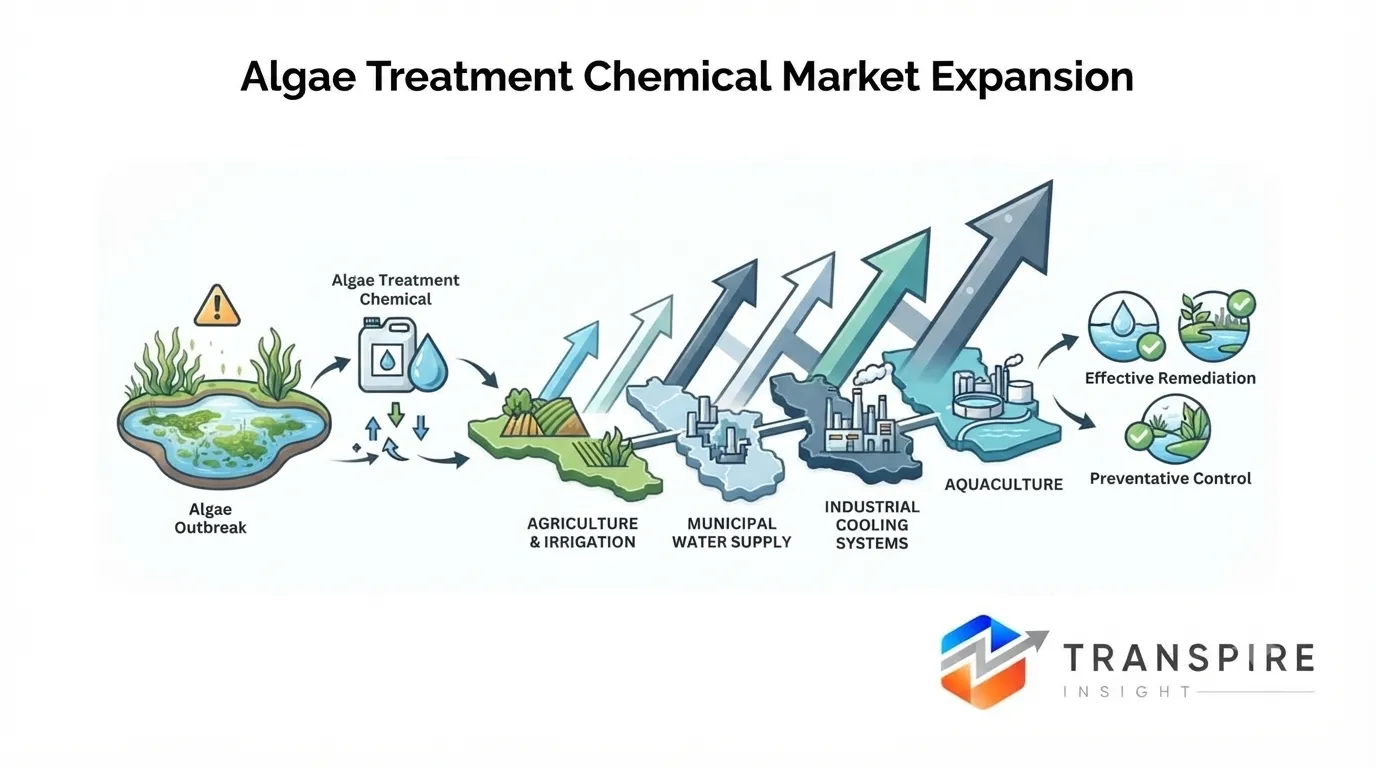
According to a research report published by Transpire Insight, the algae treatment chemical market size is projected to grow from USD 3.87 billion in 2026 to USD 5.47 billion by 2035, at a CAGR of 5.03% during the forecast period 2027-2035. The market grows due to the increasing need for water purification in municipal wastewater, the growth of aquaculture facilities, the deterioration of harmful algal blooms because of climate change, and strict regulations for municipal wastewater treatment.
Introduction
As industries, municipalities, and agricultural sectors turn to more efficient ways to control biofouling and HABs, the Algae Treatment Chemical Market is rapidly expanding. Enhanced nutrient pollution in water bodies due to increasing urbanization and industrialization has led to the need for specific chemical treatment. As regulations increasingly focus on environmental safety, today's treatment chemistry is rapidly moving toward eco-friendly, biodegradable, and non-toxic algaecides to help maintain aquatic environments in a healthy and safe manner and to provide clean water for the world.
Recent Development News
January 2026: Solvay introduced a new line of eco-friendly, peroxide-based oxidizers designed for use in large freshwater reservoirs to remove toxic algal blooms without the generation of hazardous chemical residues in water for drinking purposes.
May 2026: BASF SE partnered with advanced water technology organizations to apply chelated copper and quaternary ammonium products that are formulated specifically for industrial cooling towers and commercial aquaculture ponds.
Stay Ahead of Emerging Opportunities with Expert Market Insights by Transpire Insight
Transpire Insight provides comprehensive, data-driven market intelligence to support smarter business decisions. Our research is rooted in comprehensive analysis, authoritative predictions, and industry expertise, enabling organizations to make informed decisions in rapidly evolving markets. We provide in-depth analysis of market segmentation, competitive positioning, regional trends, and emerging investment opportunities in high-growth areas. We blend accuracy with actionable intelligence, helping companies uncover new growth avenues, strengthen strategic decision-making, and stay ahead in a dynamic market.
Algae Treatment Chemical Market Size & Statistics
The Market Size for Algae Treatment Chemical Was Estimated to be Worth USD 3.87 Billion in 2026.
The Market Size is Going to Expand at a CAGR of 5.03% between 2026 and 2035.
The Algae Treatment Chemical Market Size is anticipated to reach USD 5.47 Billion by 2035.
North America is projected to drive the highest demand during the forecast period, accounting for 41.2% of the algae treatment chemical market.
Asia-Pacific is projected to grow the fastest during the forecast period at a CAGR of 7% in the algae treatment chemical market.
Regional Growth and Demand Analysis by Transpire Insight
North America's market is the biggest market, as its water quality rules are among the strictest in the world. The EPA-imposed U.S. Clean Water Act places treatment obligations on treatment facilities and industrial operators, leaving municipal utilities, recreation officials, and lake managers on constant treatment plans. Suppliers have responded by providing new products. SePRO's SeClear is an EPA-registered algaecide that also complexes phosphorus, the nutrient that can cause future blooms. The company also provides AI-driven satellite monitoring, providing continuous insights into waterbody health.
Pollution regulation, industrial water requirements, and urban infrastructure development are growing in tandem, driving the highest growth in Asia Pacific. There is increasing usage of algaecides in aquaculture and surface water treatment, and with increasing public health awareness, commercial aquatic centres are adding to the demand for algaecides. Consumers are also increasingly choosing brands that offer milder chemistries such as peroxide-based, copper-free granular algaecides certified for use in drinking water by SePRO. Regional operators are continually being driven towards sustainable and effective industrial wastewater treatment solutions.
Top 15 Trends in the Algae Treatment Chemical Market
Warmer temperatures and nutrient runoff are intensifying harmful algal blooms, pushing utilities, lake managers, and aquaculture operators toward more frequent, proactive algaecide applications across regions.
Operators favor peroxide-based, copper-free algaecides because they oxidize algae and cyanotoxins while avoiding copper accumulation in sediments, making them suitable for sensitive drinking water reservoirs.
Products like SeClear combine algae control with phosphorus binding, addressing the nutrient driving regrowth, lengthening treatment intervals, and reducing follow-up applications needed by lake managers.
Satellite imagery and AI models deliver continuous insight into waterbody health, helping operators detect blooms early and schedule targeted treatments before algae reach nuisance levels.
Tightening water quality and nutrient-pollution rules, including the U.S. Clean Water Act, require treatment facilities and industrial operators to control algal growth, sustaining demand.
Desalination plants in water-scarce regions need algae pre-treatment to prevent biofouling, protect costly membrane filters, and create new demand for specialized algae-treatment chemical solutions.
List of Top 25 Companies Leading the Algae Treatment Chemical Market
1. Ecolab Inc.
Delivers advanced chemical treatment formulations for industrial and municipal water applications.
Founded: 1923 | HQ: Saint Paul, Minnesota, USA.
Why It Ranks: Unrivaled footprint and comprehensive digital water management service platform integration.
Regional Dominance: North America and Europe across industrial and commercial water sectors.
Product Line: Purate chlorine dioxide generators, Algaecide 24, and customized cooling water treatments.
2. Solvay S.A.
Pioneers specialty chemical solutions and hydrogen peroxide formulations for environmental remediation.
Founded: 1863 | HQ: Brussels, Belgium.
Why It Ranks: Market leadership in green oxidative chemistries and non-persistent bio-based treatments.
Regional Dominance: Europe and North America in eco-conscious municipal treatment markets.
Product Line: INTEROX hydrogen peroxide, peracetic acid formulations, and aquatic oxidizing agents.
3. BASF SE
Provides comprehensive specialty chemical portfolios tailored for water treatment and aquaculture infrastructure.
Founded: 1865 | HQ: Ludwigshafen, Germany.
Why It Ranks: Robust research capabilities and massive chemical production scale driving adoption.
Regional Dominance: Europe and Asia-Pacific industrial water and agricultural channels.
Product Line: Zetag flocculants, Sokalan dispersants, and specialized aquatic algaecide additives.
4. Veolia Environnement S.A.
Executes end-to-end water management services utilizing specialized algae mitigation chemical treatment solutions.
Founded: 1853 | HQ: Aubervilliers, France.
Why It Ranks: leadership in operational municipal water services and circular water management.
Regional Dominance: Europe and Latin America across public municipal water utilities.
Product Line: Hydrex 6000 series algaecides, specialty coagulants, and chemical dosing systems.
5. Kemira Oyj
Manufactures tailored inorganic and organic chemical solutions for municipal and industrial water treatment.
Founded: 1920 | HQ: Helsinki, Finland.
Why It Ranks: Market-leading position in raw water coagulation and municipal bloom suppression chemistry.
Regional Dominance: Europe and North America in drinking water purification systems.
Product Line: PAX aluminum coagulants, Fennocide biocide blends, and specialized water treatment polymers.
6. Lonza Group AG
Formulates advanced microbial control and water sanitization chemicals for recreational and industrial uses.
Founded: 1897 | HQ: Basel, Switzerland.
Why It Ranks: Dominant position in commercial swimming pool hygiene and industrial algaecide formulations.
Regional Dominance: North America and Europe across recreational and surface water markets.
Product Line: Applied Biochemists Cutrine-Plus, Applied Biochemists Aquashade, and HTH sanitizers.
7. Evonik Industries AG
Produces high-performance specialty oxidants used in sustainable water treatment and algae remediation.
Founded: 2007 | HQ: Essen, Germany.
Why It Ranks: Cutting-edge hydrogen peroxide and peracetic acid innovation for residue-free treatment solutions.
Regional Dominance: Europe and North America across high-grade water recycling facilities.
Product Line: PERACLEAN peracetic acid, active oxygen formulations, and custom water clarifiers.
8. Suez Water Technologies & Solutions
Develops specialized chemical technologies to control biological fouling and algal growth in industrial systems.
Founded: 1860 | HQ: Paris, France.
Why It Ranks: Extensive technical service network and proprietary biological fouling mitigation chemical technologies.
Regional Dominance: Europe and the Middle East across seawater desalination and industrial plants.
Product Line: Spectrus biological control agents, KlarAid coagulants, and customized biocide packages.
9. Kurita Water Industries Ltd.
Engineers specialized chemical water treatment products for power plants, electronics manufacturing, and municipal systems.
Founded: 1949 | HQ: Tokyo, Japan.
Why It Ranks: Technical supremacy in industrial cooling tower preservation and Asia-Pacific market dominance.
Regional Dominance: Asia-Pacific region, particularly in East Asia industrial production hubs.
Product Line: Kuriverter bio-control agents, Kuriflout flocculants, and aquatic microalgaecide treatments.
10. Nouryon
Supplies essential specialty chemicals including chelating agents and surfactants for water purification processes.
Founded: 1926 | HQ: Amsterdam, Netherlands.
Why It Ranks: Industry-standard chelating technologies that optimize copper algaecide stability and performance.
Regional Dominance: Europe and North America in specialized agricultural and chemical distribution.
Product Line: Dissolvine chelating agents, Armohib corrosion inhibitors, and specialized quaternary surfactants.
Conclusion
The algae treatment chemical market is undergoing a strategic transformation, as the market needs to strike a balance between immediate performance requirements and strict ECO-safety standards. Municipal water needs are increasing, climate changes in the world are causing more algal outbreaks, and market leaders are innovating quickly. Competitive success will be determined by the shift to oxidative blends and chelated formulations that are environmentally friendly, sustainable, long-term bio-control in industry, agriculture, and public water infrastructure worldwide.


Send us a brief description of your challenge and we'll get back to you within 24 hours.

 inquiry@transpireinsight.com
 APAC:+91 7666513636
 Address


