
Oct 12, 2026
By Transpire Insight
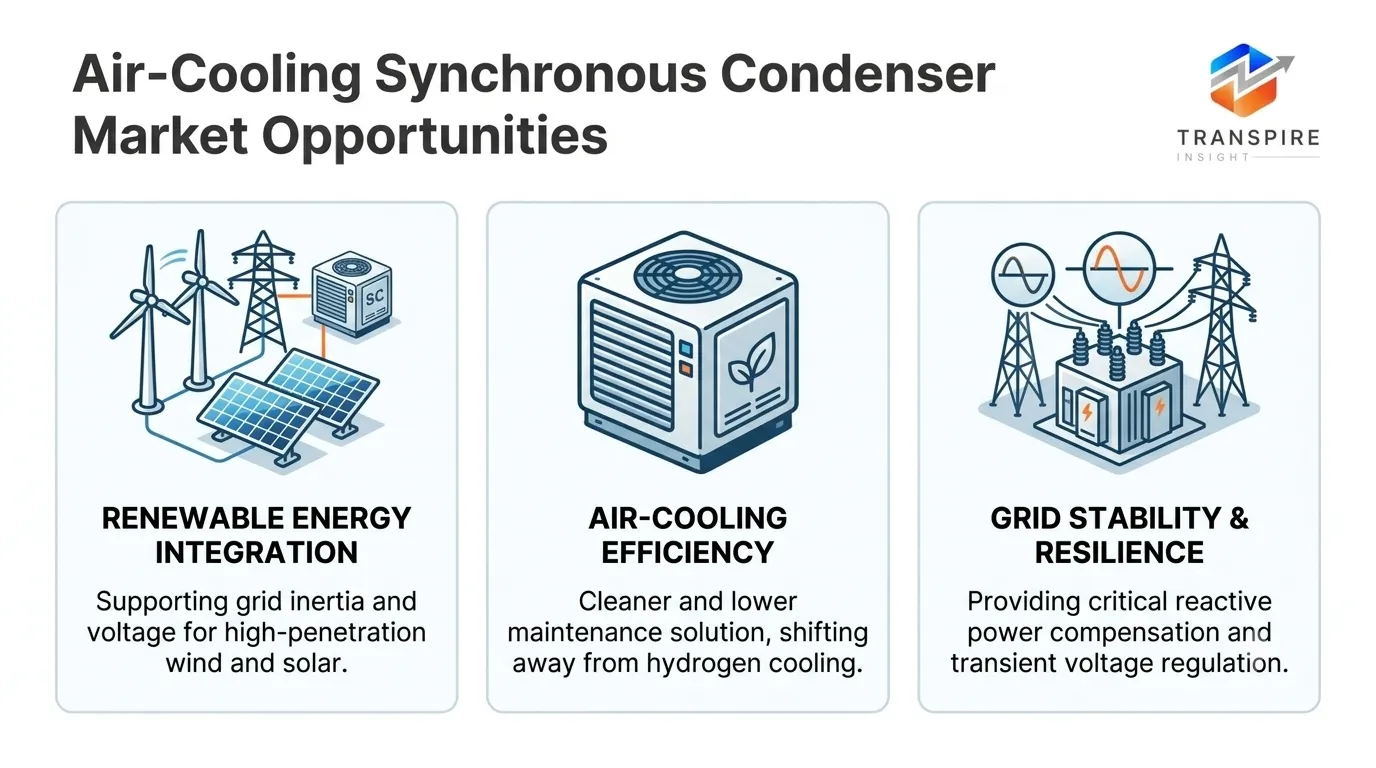
Description
According to a research report published by Transpire Insight, the air-cooling synchronous condenser market size is projected to grow from USD 845.6 billion in 2026 to USD 1135.2 billion by 2035, at a CAGR of 4.5% during the forecast period 2027-2035. When fossil fuel plants are phased out, they remove grid inertia. Air-cooled synchronous condensers are used to supply the required reactive power, short-circuit strength, and voltage regulation without the use of precious water.
Introduction
As power grids come to include more intermittent solar and wind power, the air-cooling synchronous condenser market is growing rapidly. Passive inertia traditionally was achieved by spinning generators on fossil-fuel plants, and with their retirement, power system stability is reduced. Clean, water-free rotational inertia and dynamic reactive power from air-cooled synchronous condensers. The technology is invaluable for grid stabilization, remote renewable installations, and to avert blackouts in dry regions all over the world.
Recent Development News
June 2026: Siemens Energy showcased specialized digital grid-control frameworks designed to optimize air-cooled synchronous condenser response times across high-demand renewable transmission corridors.
September 2026: GE Vernova contracted with Mersen to supply advanced air-cooled current transmission systems for high-capacity synchronous condensers supporting major Saudi energy initiatives.
Stay Ahead of Emerging Opportunities with Expert Market Insights by Transpire Insight
Transpire Insight provides comprehensive, data-driven market intelligence to support smarter business decisions. Our research is rooted in comprehensive analysis, authoritative predictions, and industry expertise, enabling organizations to make informed decisions in rapidly evolving markets. We provide in-depth analysis of market segmentation, competitive positioning, regional trends, and emerging investment opportunities in high-growth areas. We blend accuracy with actionable intelligence, helping companies uncover new growth avenues, strengthen strategic decision-making, and stay ahead in a dynamic market.
Air-Cooling Synchronous Condenser Market Size & Statistics
The Market Size for Air-Cooling Synchronous Condenser Was Estimated to be Worth USD 845.6 Billion in 2026.
The Market Size is Going to Expand at a CAGR of 4.5% between 2026 and 2035.
The Air-Cooling Synchronous Condenser Market Size is anticipated to reach USD 1135.2 Billion by 2035.
North America is projected to drive the highest demand during the forecast period, accounting for 36% of the air-cooling synchronous condenser market.
Asia-Pacific is projected to grow the fastest during the forecast period at a CAGR of 8% in the air-cooling synchronous condenser market.
Regional Growth and Demand Analysis by Transpire Insight
North America remains the growth driver for demand, with utilities in the U.S. and Canada looking to upgrade their grid-support equipment fleet as they upgrade their aging thermal generation plants. Investment in upgrading and expanding transmission infrastructure and a movement toward minimizing water use are directing utilities toward air-cooled designs rather than water-cooled designs. GE and ABB have been among the players to advance static-frequency-converter (SFC) synchronous condenser solutions for enhanced voltage stability in areas where wind and solar power is prevalent, and regulatory focus on energy-efficient, low-maintenance systems is facilitating that change. Japan is next, with substantial investment in flexible AC transmission systems for parts of the Baltic region and grid-stabilization projects closely following suit in Europe, led by Germany, France and Italy.
An unprecedented level of grid expansion in China and India's target to reach 500 GW of non-fossil fuel electricity capacity is driving growth in Asia-Pacific. Similar efforts are found in South Korea and Japan, where investments in modernization and integration of offshore wind are driving utilities to scale up their use of reactive power support. New and remanufactured condenser opportunities are growing with Southeast Asian government-supported grid-interconnection programs, and regional players like Mitsubishi Electric and Toshiba Energy Systems are stoking growth in their condenser portfolios to satisfy both the demand of the utility and industrial sectors.
Top 15 Trends in the Air-Cooling Synchronous Condenser Market
Rising Renewable Energy Integration Driving Reactive Power Demand
Growing solar and wind capacity is destabilizing grids, pushing utilities to deploy air-cooled synchronous condensers that reliably supply reactive power and maintain stable voltage networks.
Grid Modernization Investments Accelerating Condenser Installations Globally
Aging transmission infrastructure across developed economies is prompting utilities to modernize grids, driving substantial investment in new air-cooled synchronous condenser installations to strengthen reactive capacity.
Retrofitting Aging Synchronous Condensers with Static Frequency Converters
Utilities worldwide are retrofitting older synchronous condensers with static frequency converters instead of pony motors, improving startup control, reducing mechanical wear, and extending operational lifespan.
Rising Deployment of Modular, Containerized Synchronous Condensers
Manufacturers are increasingly offering modular, containerized synchronous condenser units that shorten installation timelines, simplify transportation, and suit decentralized energy systems, microgrids, and remote industrial applications.
Rise of Digitally Controlled Condensers with Predictive Maintenance
Digitally controlled synchronous condensers embedded with sensors and predictive maintenance software are gaining traction, helping operators anticipate failures early, cut downtime, and lower long-term costs.
Expansion of Transmission Infrastructure in Emerging Economies
Rapid industrialization and urbanization across China, India, and Southeast Asia are expanding transmission networks, creating strong demand for air-cooled synchronous condensers to stabilize connected grids.
Top 25 Companies Leading the Market
Leading supplier of large-scale synchronous condenser systems for transmission grids.
Founded: 2020 (Spin-off) | HQ: Munich, Germany.
Why It Ranks: Holds a massive market share backed by extensive high-voltage transmission integration expertise.
Regional Dominance: Europe and North America.
Product Line: Custom air-cooled synchronous condensers and integrated high-voltage grid stabilization solutions.
Premier energy hardware manufacturer providing utility-scale grid inertia solutions worldwide.
Founded: 2024 (Spin-off) | HQ: Cambridge, Massachusetts, USA.
Why It Ranks: Dominates large turnkey energy stabilization contracts across multiple transmission regions.
Regional Dominance: North America and the Middle East.
Product Line: High-capacity air-cooled synchronous condensers, static starters, and system controllers.
pioneer in heavy power electronics, automation, and electrical grid technology.
Founded: 1988 | HQ: Zürich, Switzerland.
Why It Ranks: Unmatched technological lineage in brushless air-cooled synchronous condenser systems.
Regional Dominance: Europe and Asia-Pacific.
Product Line: Air-cooled synchronous condenser packages, excitation systems, and digital power controls.
Leading provider of grid stability, power quality, and transmission infrastructure technologies.
Founded: 2020 | HQ: Zürich, Switzerland.
Why It Ranks: Superior modular synchronous condenser systems featuring advanced short-circuit current support capability.
Regional Dominance: Asia-Pacific and Europe.
Product Line: Synchronous Condenser Systems (SCS), flywheels, and hybrid STATCOM condenser packages.
Multi-industrial giant producing heavy power machinery and high-voltage grid stability equipment.
Founded: 1921 | HQ: Tokyo, Japan.
Why It Ranks: High reliability standards and dominance across Asian grid stabilization infrastructure markets.
Regional Dominance: Asia-Pacific.
Product Line: Air-cooled synchronous condensers, hydrogen-cooled units, and specialized static exciters.
Major manufacturer of electric motors, generators, and grid power solutions.
Founded: 1961 | HQ: Jaraguá do Sul, Brazil.
Why It Ranks: Dominant manufacturing scale in large synchronous machines across the Americas.
Regional Dominance: South America and Latin America.
Product Line: Custom air-cooled synchronous condensers, utility generators, and industrial motors.
Power management leader providing specialized electrical infrastructure and grid protection equipment.
Founded: 1911 | HQ: Dublin, Ireland.
Why It Ranks: Expansive regional utility network relationships and advanced grid-edge distribution capabilities.
Regional Dominance: North America.
Product Line: Medium-voltage air-cooled synchronous condensers and utility reactive power systems.
Infrastructure giant producing advanced power generation hardware and heavy grid apparatus.
Founded: 1875 | HQ: Tokyo, Japan.
Why It Ranks: Decades of expertise engineering heavy rotating machinery for severe climatic conditions.
Regional Dominance: East Asia and Southeast Asia.
Product Line: Air-cooled synchronous condensers, heavy utility generators, and digital grid controls.
Major state-owned power equipment manufacturer leading large-scale utility infrastructure project deployment.
Founded: 2004 | HQ: Shanghai, China.
Why It Ranks: Massive domestic market capture driving high-volume production of grid condensers.
Regional Dominance: Mainland China and Central Asia.
Product Line: High-voltage air-cooled synchronous condensers, turbogenerators, and transmission systems.
energy tech leader specializing in flexible power generation and balancing systems.
Founded: 1834 | HQ: Helsinki, Finland.
Why It Ranks: Strong portfolio integration connecting grid stability equipment with distributed renewable networks.
Regional Dominance: Europe and Africa.
Product Line: Modular air-cooled synchronous condensers and hybrid grid stability integration systems.
Conclusion
Air-cooled synchronous condensers are no longer just a nuisance on the grid but are playing a vital role in current energy systems that seek to reduce carbon emissions. These machines provide the grid with the required physical inertia and reactive power without needing cooling water, thus eliminating many critical issues with grid stability due to the increased renewable energy take-up. As technology continues to evolve, led by equipment manufacturers, air-cooled synchronous condensers will become a key component of water-efficient, resilient transmission networks globally.


Send us a brief description of your challenge and we'll get back to you within 24 hours.

 inquiry@transpireinsight.com
 APAC:+91 7666513636
 Address


