
Oct 12, 2026
By Transpire Insight
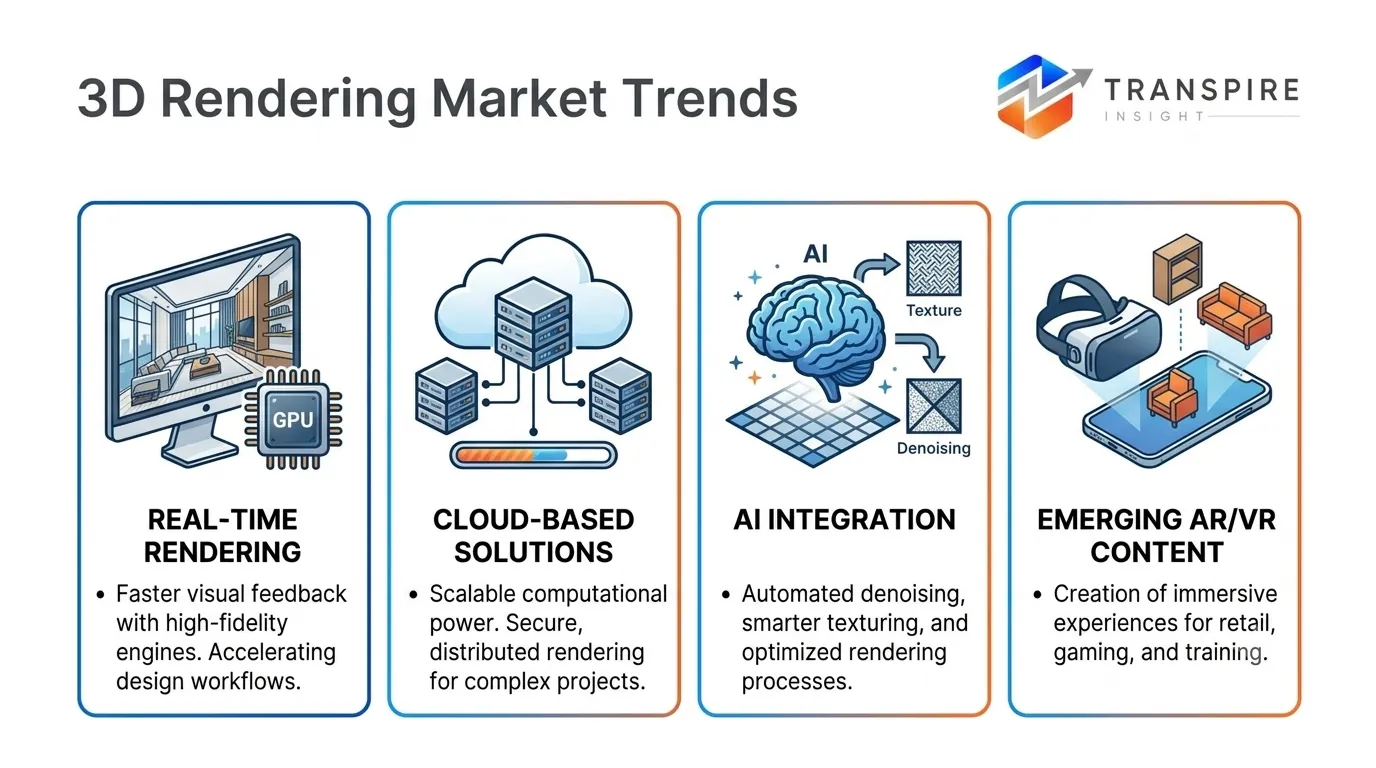
Description
According to a research report published by Transpire Insight, the 3D rendering market size is projected to grow from USD 5.79 billion in 2026 to USD 22.35 billion by 2035, at a CAGR of 20.11% during the forecast period 2027-2035. Rapid adoption of real-time GPU rendering, expanding digital twins in AEC, rising demand for immersive entertainment, and AI-driven automation accelerate 3D rendering software market expansion.
Introduction
The 3D rendering market transforms industries by converting digital models into lifelike visuals and real-time interactive scenes. Accelerated by high-performance GPUs, AI automation, and cloud streaming, rendering platforms are essential across architectural visualization, media and entertainment, automotive prototyping, and e-commerce. As demand for real-time collaboration and digital twins grows, the market delivers critical operational efficiencies, reducing product time-to-market and enhancing visual communication.
Recent Development News
May 2026: NVIDIA posted record professional visualization revenue driven by massive enterprise demand for AI-accelerated real-time path tracing.
August 2026: Real estate and construction sectors reported a major surge in digital twin rendering and 360-degree virtual walkthrough adoption.
Stay Ahead of Emerging Opportunities with Expert Market Insights by Transpire Insight
Transpire Insight provides comprehensive, data-driven market intelligence to support smarter business decisions. Our research is rooted in comprehensive analysis, authoritative predictions, and industry expertise, enabling organizations to make informed decisions in rapidly evolving markets. We provide in-depth analysis of market segmentation, competitive positioning, regional trends, and emerging investment opportunities in high-growth areas. We blend accuracy with actionable intelligence, helping companies uncover new growth avenues, strengthen strategic decision-making, and stay ahead in a dynamic market.
3D Rendering Market Size & Statistics
The Market Size for 3D Rendering Was Estimated to be Worth USD 5.79 Billion in 2026.
The Market Size is Going to Expand at a CAGR of 20.11% between 2026 and 2035.
The 3D Rendering Market Size is anticipated to reach USD 22.35 Billion by 2035.
North America is projected to drive the highest demand during the forecast period, accounting for 77% of the 3D rendering market.
Asia-Pacific is projected to grow the fastest during the forecast period at a CAGR of 26.8% in the 3D rendering market.
Regional Growth and Demand Analysis by Transpire Insight
North America remains the demand anchor for 3D rendering because software holds the largest component share at 77.3%. The technology stack is closely tied to US-headquartered NVIDIA hardware. Chaos Vantage performs best on NVIDIA RTX GPUs, and both D5 Render and Chaos Vantage have added support for NVIDIA's DLSS 4 upscaling and frame interpolation. Vendors are also embedding AI directly into established products. Chaos integrated its Veras AI visualization tool into Enscape, V-Ray and Corona and moved to a credit-based hybrid licensing model. Chaos and Zero Density also previewed real-time ray tracing for virtual studios and XR, showing how rendering demand is spreading beyond architecture into broadcast.
Asia Pacific is where the fastest growth is concentrated. India is posting the highest country-level CAGR and services the fastest-growing component. Demand is supported by rapid urbanization, infrastructure expansion, and growth in gaming and entertainment across China, Japan, South Korea, and India. Vendors are localizing and lowering entry barriers for this audience. D5 Render added Japanese language localization, Chaos launched a free Community Edition of V-Ray for Blender for learning, teaching, and personal projects, and Enscape became available on Mac. These moves widen the user base among students, freelancers, and smaller design studios.
Top 15 Trends in the 3D Rendering Market
Generative AI Embedded Directly into Rendering Software
Vendors are embedding generative AI directly into rendering tools, letting designers ideate, enhance images, and create video instantly, which shortens concept cycles and cuts post-production.
Real-Time Path Tracing Replacing Offline Rendering Workflows
Real-time path tracing delivers near-offline lighting accuracy at interactive speeds, allowing architects to adjust materials and illumination instantly, reducing test renders and trial-and-error during reviews.
Cloud-Based Rendering with Scalable on-Demand GPU Capacity
Cloud rendering gives studios scalable GPU capacity on demand, removing heavy hardware investments and enabling remote teams to collaborate on large scenes, benefiting smaller firms.
Architectural Visualization Driving Demand Across Construction Projects
Architecture, engineering, and construction firms use rendering for design reviews, client approvals, and marketing, making architecture the largest industry vertical and a steady demand driver.
Virtual Production and XR Studios Adopting Ray Tracing
Broadcast and virtual studio teams are adopting ray-traced engines for live environments and XR video walls, extending rendering beyond architecture and film into real-time workflows.
Credit-Based Hybrid Licensing and Unified Software Subscriptions
Vendors are moving toward unified licensing and credit-based hybrid models, bundling AI features into existing products, which simplifies purchasing and lets users scale spending flexibly.
List of Top 25 Leading Companies in the 3D Rendering Market
Autodesk
Industry pioneer leading high-end architectural, engineering, and media design tools.
Founded: 1982 | HQ: San Francisco, California, USA.
Why It Ranks: Dominates architectural visualization and VFX media creation workflows.
Regional Dominance: Holds extensive multi-industry enterprise coverage across North America.
Product Line: 3ds Max, Maya, Arnold, Revit.
Chaos
leader providing photorealistic rendering technology across architecture and design.
Founded: 1997 | HQ: Sofia, Bulgaria.
Why It Ranks: Standardizes high-end ray tracing for design visualization and production.
Regional Dominance: Strong presence across architectural design studios throughout Europe.
Product Line: V-Ray, Corona Renderer, Vantage, Scans.
Adobe
Creative software giant expanding heavily into 3D material authoring pipelines.
Founded: 1982 | HQ: San Jose, California, USA.
Why It Ranks: Unifies photorealistic texture workflows with enterprise digital asset creation.
Regional Dominance: Dominates corporate design and creative media globally.
Product Line: Adobe Substance 3D, Substance Painter, Substance Designer.
NVIDIA
Hardware and software titan revolutionizing real-time neural path tracing rendering.
Founded: 1993 | HQ: Santa Clara, California, USA.
Why It Ranks: Controls underlying GPU computing power and metaverse simulation infrastructure.
Regional Dominance: Dominates enterprise graphics hardware and cloud compute.
Product Line: NVIDIA Omniverse, RTX GPUs, OptiX, Iray.
Epic Games
Gaming powerhouse driving real-time virtual production and spatial rendering.
Founded: 1991 | HQ: Cary, North Carolina, USA.
Why It Ranks: Converts real-time gaming engines into architectural and cinematic renderers.
Regional Dominance: Massive user adoption across North American visual arts sectors.
Product Line: Unreal Engine, Twinmotion, RealityCapture.
Unity Technologies
Leading real-time 3D platform powering interactive visualization and gaming.
Founded: 2004 | HQ: San Francisco, California, USA.
Why It Ranks: Enables cross-platform real-time interactive rendering and augmented spatial apps.
Regional Dominance: Deep market footprint across interactive digital media.
Product Line: Unity Engine, Unity Industry, Pixyz Software.
Maxon Computer
Essential developer of motion graphics and procedural 3D rendering platforms.
Founded: 1986 | HQ: Friedrichsdorf, Germany.
Why It Ranks: Powers premier broadcasting, motion graphics, and film visual effects.
Regional Dominance: Widespread enterprise adoption across European visual post-production.
Product Line: Cinema 4D, Redshift Renderer, ZBrush.
Blender Foundation
Premier open-source platform democratizing full-suite 3D creation and rendering.
Founded: 2002 | HQ: Amsterdam, Netherlands.
Why It Ranks: Delivers high-performance production rendering completely free, without licensing costs.
Regional Dominance: open-source community across indie and enterprise.
Product Line: Blender (Cycles, EEVEE, Grease Pencil).
Luxion (KeyShot)
Specialized developer of intuitive real-time ray-tracing industrial design renderers.
Founded: 2003 | HQ: Costa Mesa, California, USA.
Why It Ranks: Streamlines rapid product visualization directly for industrial engineering teams.
Regional Dominance: Highly prevalent in North American automotive and consumer electronics.
Product Line: KeyShot, KeyShot Web, KeyVR.
SideFX
Industry benchmark for procedural simulation and complex FX production rendering.
Founded: 1987 | HQ: Toronto, Ontario, Canada.
Why It Ranks: Unrivaled procedural framework for large-scale cinematic visual impacts.
Regional Dominance: Strong hold across North American cinematic visual effects houses.
Product Line: Houdini, Mantra Renderer, Karma Renderer.
Conclusion
The 3D rendering market is undergoing rapid evolution, driven by real-time ray tracing, AI automation, and cloud collaboration. Key industry leaders continue expanding beyond traditional media, embedding visualization engines into architectural BIM, digital twins, and industrial manufacturing pipelines. As demand for photorealistic interactivity surges, the synergy between advanced GPU computing and smart rendering algorithms will remain the primary catalyst shaping the industry's future growth trajectory.


Send us a brief description of your challenge and we'll get back to you within 24 hours.

 inquiry@transpireinsight.com
 APAC:+91 7666513636
 Address


