
Aug 19, 2026
By Transpire Insight
Description
According to a research report published by Transpire Insight, The Carbon Fiber Reinforced 3D Printing Polymers Market size is projected to Grow from USD 534.94 Million in 2025 to USD 1340.15 Million by 2035, at a CAGR of 9.5% during the forecast period 2026-2035. The Carbon Fiber Reinforced 3D Printing Polymers Market is seeing growth due to the increased utilization of carbon fiber reinforced thermoplastics for the creation of light-weight and stronger parts than conventional polymers. The industry is receiving an impetus from the increasing adoption of additive manufacturing in industries including aerospace, automotive, robotics, defense, industrial machines, and tooling where weight saving and quick fabrication of complex parts are required. Increasing use of carbon fiber reinforced nylon, PEEK, PEKK, PPS and other engineering thermoplastic materials and continuous fiber 3D printing technologies is contributing towards the growth of the market.
Introduction
The Carbon Fiber Reinforced 3D Printing Polymers Market includes advanced polymer materials reinforced with carbon fibers that offer a unique blend of lightweight and excellent strength, stiffness, stability and resistance to mechanical stress for 3D printed components. Such polymer materials are gradually taking additive manufacturing beyond just prototyping as they allow manufacturers to develop functional parts capable of withstanding harsh operating environments. Carbon fibers can be combined with engineering polymers like nylon, PEEK, PEKK, PPS and other thermoplastic materials in chopped or continuous form, providing the necessary performance characteristics depending on the application requirements. Increased adoption in aerospace, automotive, robotics, defense, industrial equipment, tooling, drones and custom manufacturing industries drives the market growth, while advances in continuous fiber 3D printing, automated fiber placement, topology optimization and high temperature polymer materials create new possibilities.
Recent Development News
Stay Ahead of Emerging Opportunities with Expert Market Insights by Transpire Insight
The insights that have been shared through this blog are based on intensive market research carried out by Transpire Insight, an advisor that works with many organizations. Thanks to the analysis of extensive data, forecasts made by our specialists, and industry intelligence, our reports allow clients to find strategic growth opportunities in dynamically developing industries. For all those who would like to get more detailed information regarding market segmentation, competitive analysis, regional outlooks, and future investment tendencies, there is no doubt that our full report will be of great value.
Download the exclusive Carbon Fiber Reinforced 3D Printing Polymers Market sample report today to uncover expert insights, emerging trends, and the opportunities defining the future of the industry.
Carbon Fiber Reinforced 3D Printing Polymers Market Size & Statistics
Regional Growth and Demand Analysis by Transpire Insight:
The Carbon Fiber Reinforced 3D Printing Polymers Market is currently led by North America, with 39% share of market revenue in 2025. The region is leading due to early adoption of industrial additive manufacturing, advanced production of aerospace and defense products, developed automotive manufacturing, and availability of 3D-printing and advanced material companies. The major contribution comes from the United States, with manufacturers adopting carbon-fiber reinforced polymers to make lightweight and rigid, durable and geometrical complex components for use in airplanes, cars, robotics, tooling, and industrial machines.
Why North America is leading: The region features a well-developed system which connects 3D-printing technology producers, composite material manufacturers, aerospace and automotive original equipment manufacturers (OEM), research organizations, and industrial customers. Such a system is accelerating the process of commercialization of advanced carbon-fiber polymers and is helping in transitioning from prototyping to functional manufacturing.
The fastest growing region during the forecast period will be Asia-Pacific due to growth of manufacturing industries in China, Japan, South Korea, and India, investments into additive manufacturing, and increasing demand for lightweight materials in automotive, aerospace, electronics, and industrial applications.
Top 15 Trends in the Carbon Fiber Reinforced 3D Printing Polymers Market
Proceed to Checkout to purchase the exclusive Carbon Fiber Reinforced 3D Printing Polymers Market report and gain instant access to in-depth market intelligence, strategic analysis, and future growth opportunities.
The application of continuous fiber reinforcement is considered a significant development in additive manufacturing since it allows achieving much higher levels of strength and rigidity when compared to polymer-only additive manufacturing processes. Moreover, it is now frequently used for manufacturing structural elements, tools, fixtures, robots' parts, as well as other lightweight industrial parts.
The use of metals has been increasingly replaced by carbon fiber reinforced polymer whenever there is a possibility of doing so since it reduces weight which in turn leads to increased efficiency and maneuverability. The low density together with high mechanical properties of these materials makes them ideal for the aerospace, automobile, drone, robotics, and industrial sectors.
One of the most common composite materials available for industrial 3D printing is carbon fiber reinforced nylon. This is attributed to the fact that carbon fiber reinforced nylon is easier to process and is more rigid and stronger than conventional nylon material. The usage of carbon fiber reinforced nylon is on the rise in prototype components, jigs and fixtures, housings, and replacement parts.
High performance thermoplastics like PEEK and PEKK are currently being used more often in combination with carbon fiber to form composite materials that can withstand harsh thermal, mechanical, and chemical environments. These types of composite materials are especially applicable to industries like aerospace, automotive, and energy. While there may be higher processing needs compared to common thermoplastics, developments in high-temperature printers have helped drive their adoption.
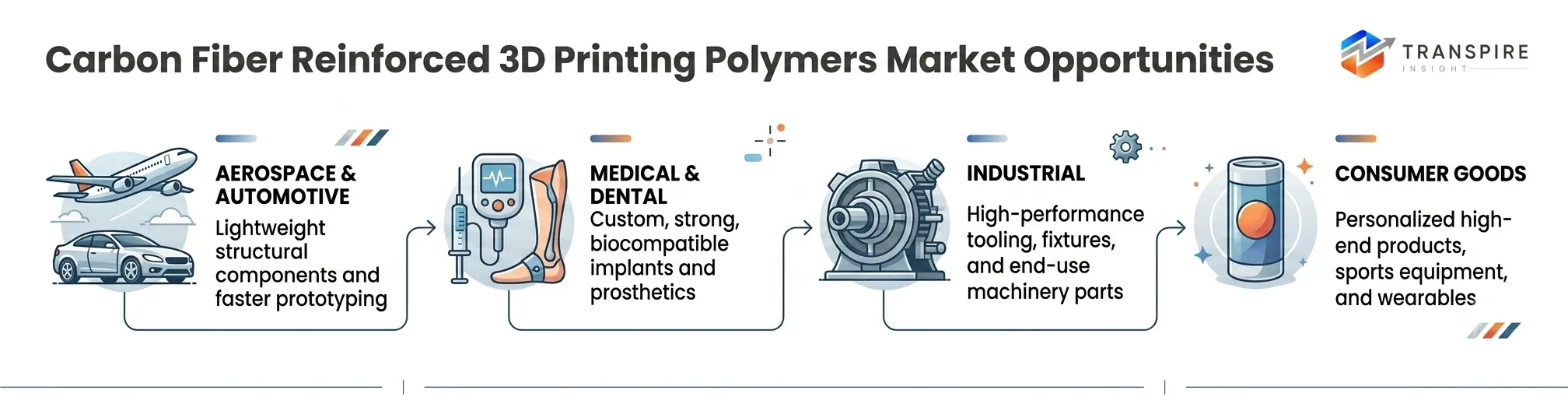
It is becoming common practice for aerospace and defense organizations to consider the use of carbon fiber reinforced polymers in their brackets, ducts, enclosures, molds, UAV parts, and other such structural applications. Using additive manufacturing in this field makes it possible to create complex geometries while minimizing the use of materials and parts.
There has been the increased use of carbon fiber reinforced 3D printed polymers for use in tooling, fixtures, prototypes, ducts, brackets, covers, and select production parts by automotive companies. Such materials have the advantage of having good stiffness and low mass and also allow for the rapid creation of bespoke shapes. With the increase in demand for electric vehicles, such materials become even more interesting as they can reduce vehicle mass.
Top 25 Companies Leading the Carbon Fiber Reinforced 3D Printing Polymers Market
Customize the exclusive Carbon Fiber Reinforced 3D Printing Polymers Market report today to receive tailored insights, country-specific analysis, and business-focused market intelligence.
1. Stratasys Ltd.
Stratasys is an additive manufacturing company specializing in polymer 3D printing technologies, advanced materials, software, and production solutions for industrial applications.
Founded: 1989 | Headquarters: Eden Prairie, Minnesota, USA & Rehovot, Israel
Why It Ranks: Stratasys ranks highly due to its extensive polymer 3D printing ecosystem and advanced composite-material capabilities, including carbon-fiber-reinforced materials for demanding applications.
Regional Dominance: North America and Europe are major markets, with expanding adoption across Asia-Pacific.
Product Line: FDM thermoplastics, PolyJet photopolymers, engineering polymers, carbon-fiber-reinforced materials, and production-grade additive manufacturing solutions.
Recent Development: Stratasys continues expanding its advanced materials portfolio and composite printing capabilities to support production tooling, aerospace, automotive, and industrial applications.
2. 3D Systems Corporation
3D Systems provides additive manufacturing hardware, software, materials, and production services across industrial, aerospace, automotive, healthcare, and dental applications.
Founded: 1986 | Headquarters: Rock Hill, South Carolina, USA
Why It Ranks: Its broad experience in polymer and composite additive manufacturing, combined with application-specific materials, gives the company a strong position in advanced 3D printing.
Regional Dominance: North America is a major market, supported by strong operations in Europe and Asia-Pacific.
Product Line: SLS powders, SLA resins, Figure 4 materials, engineering polymers, composite materials, and specialized production materials.
Recent Development: The company continues to develop application-specific materials and additive manufacturing solutions focused on stronger, lighter, and production-ready components.
3. Markforged Holding Corporation
Markforged develops industrial 3D printers and materials that combine advanced polymers with continuous carbon fiber and other reinforcement fibers.
Founded: 2013 | Headquarters: Waltham, Massachusetts, USA
Why It Ranks: Markforged is particularly influential in carbon-fiber-reinforced 3D printing because its technology enables continuous fiber reinforcement to be integrated directly into printed components.
Regional Dominance: North America is its primary market, with growing industrial adoption in Europe and Asia-Pacific.
Product Line: Onyx® carbon-fiber-reinforced nylon, continuous carbon fiber, fiberglass, Kevlar®, and industrial composite 3D printing systems.
Recent Development: Markforged continues to improve its Digital Forge platform and composite printing ecosystem, emphasizing automated manufacturing, industrial applications, and production-quality composite parts.
4. BASF SE
BASF is a chemical manufacturer producing polymers, specialty chemicals, and advanced materials used in additive manufacturing and numerous industrial sectors.
Founded: 1865 | Headquarters: Ludwigshafen, Germany
Why It Ranks: BASF's expertise in polymer chemistry and engineering materials supports the development of high-performance feedstocks and composite materials for 3D printing.
Regional Dominance: Europe remains a core region, with substantial operations throughout North America and Asia-Pacific.
Product Line: Ultrafuse® filaments, engineering polymers, metal-polymer feedstocks, thermoplastic materials, and specialty additive manufacturing materials.
Recent Development: BASF continues developing advanced polymer and composite materials designed to improve mechanical performance, processability, and industrial applicability.
5. Evonik Industries AG
Evonik is a specialty chemicals company with extensive expertise in high-performance polymers and materials for additive manufacturing.
Founded: 2007 | Headquarters: Essen, Germany
Why It Ranks: The company is recognized for its specialized polymer powders and filaments, including materials suitable for demanding additive manufacturing applications.
Regional Dominance: Europe is a key market, with significant presence across North America and Asia-Pacific.
Product Line: INFINAM® thermoplastic powders, filaments, photopolymer materials, PA 12, specialty polymers, and advanced additive manufacturing feedstocks.
Recent Development: Evonik continues to expand its INFINAM® materials portfolio, focusing on application-specific polymers and improved performance for industrial 3D printing.
6. Arkema S.A.
Arkema is a French specialty materials manufacturer producing advanced polymers and high-performance materials for demanding industrial applications.
Founded: 2004 | Headquarters: Colombes, France
Why It Ranks: Arkema's expertise in advanced polymers and its portfolio of high-performance materials make it an important supplier for composite and additive manufacturing applications.
Regional Dominance: Europe is a major region, supported by significant operations in North America and Asia-Pacific.
Product Line: Nylon-11 powders, specialty polymers, advanced resins, photopolymer materials, and high-performance thermoplastic solutions.
Recent Development: Arkema continues developing advanced polymer materials with improved strength, durability, temperature resistance, and processing characteristics for additive manufacturing.
7. Solvay S.A.
Solvay is a Belgian specialty materials and chemicals company known for high-performance polymers used in aerospace, automotive, healthcare, electronics, and industrial applications.
Founded: 1863 | Headquarters: Brussels, Belgium
Why It Ranks: Solvay has strong expertise in high-performance polymers such as PEEK, PPS, and other materials that can be reinforced with carbon fiber for demanding 3D printing applications.
Regional Dominance: Europe and North America are important markets, while Asia-Pacific provides significant growth opportunities.
Product Line: KetaSpire® PEEK, Ryton® PPS, Udel® PSU, Torlon® PAI, and other high-performance polymer materials and composites.
Recent Development: Solvay continues to advance lightweight high-performance polymer solutions for additive manufacturing, particularly for aerospace and other applications requiring high temperature and mechanical performance.
8. SABIC
SABIC is a chemicals and advanced materials company producing engineering thermoplastics and specialty materials for automotive, electronics, healthcare, aerospace, and industrial applications.
Founded: 1976 | Headquarters: Riyadh, Saudi Arabia
Why It Ranks: SABIC is an important participant because of its broad engineering thermoplastic portfolio and development of materials suitable for additive manufacturing and composite applications.
Regional Dominance: The company has a strong presence in the Middle East, Europe, North America, and Asia-Pacific.
Product Line: ULTEM™ PEI, LEXAN™ polycarbonate, NORYL™ resins, specialty thermoplastics, and additive manufacturing-grade materials.
Recent Development: SABIC continues developing high-performance thermoplastics and composite solutions that support lightweighting, thermal resistance, and advanced manufacturing applications.
9. Victrex plc
Victrex is a UK-based specialist in PAEK and PEEK polymer technologies, supplying high-performance materials for aerospace, automotive, electronics, energy, and medical applications.
Founded: 1993 | Headquarters: Thornton Cleveleys, Lancashire, UK
Why It Ranks: Victrex has strong expertise in PEEK and related high-performance polymers, which are increasingly important for carbon-fiber-reinforced additive manufacturing.
Regional Dominance: Europe is a key market, complemented by substantial activity in North America and Asia-Pacific.
Product Line: VICTREX® PEEK, PAEK polymers, reinforced PEEK compounds, and advanced polymer solutions for demanding applications.
Recent Development: Victrex continues to expand advanced PEEK and PAEK material applications, including additive manufacturing and composite components requiring high temperature, chemical, and mechanical resistance.
10. Ensinger GmbH
Ensinger is a German engineering plastics specialist that develops and manufactures high-performance thermoplastics, composites, semi-finished products, and machined components.
Founded: 1966 | Headquarters: Nufringen, Germany
Why It Ranks: Ensinger's expertise in engineering plastics and fiber-reinforced compounds positions it well in advanced polymer and composite manufacturing applications.
Regional Dominance: Europe is a core market, with a broad international presence across North America and Asia-Pacific.
Product Line: TECATRON® PPS, TECAPEEK® PEEK, TECASON® PPSU, carbon-fiber-reinforced engineering plastics, and other high-performance polymer compounds.
Recent Development: Ensinger continues expanding its portfolio of carbon-fiber-reinforced and high-performance thermoplastic materials, supporting lightweight components and demanding industrial applications.
Schedule a meeting with our market experts to discuss the exclusive Carbon Fiber Reinforced 3D Printing Polymers Market report and identify the best research solution for your organization.
Conclusion
The market of Carbon Fiber Reinforced 3D Printing Polymers is evolving with more emphasis being placed on lightweight yet highly strong and stiff materials which are durable and flexible in terms of design. The market is gaining traction due to the efforts of companies like Stratasys Ltd., 3D Systems Corporation, Markforged Holding Corporation, BASF SE, Evonik Industries AG, Arkema S.A., Solvay S.A., SABIC, Victrex plc, and Ensinger GmbH, which are introducing innovative thermoplastics, carbon fiber materials in continuous and chopped forms, high-performance polymers, and additive manufacturing technologies. Diverse applications in aerospace, automotive industry, defense systems, robotics, tooling, drones, and machines offer new prospects for composite 3D printing. Possible trends in the future development of the market include continuous-fiber reinforcement, high-temperature polymers, AI-based process optimization, topology optimized designs, sustainable composite feeds, and increased use of carbon-fiber reinforced materials in industrial production.


Send us a brief description of your challenge and we'll get back to you within 24 hours.

 inquiry@transpireinsight.com
 APAC:+91 7666513636
 Address


