
Sep 05, 2026
By Transpire Insight

Description
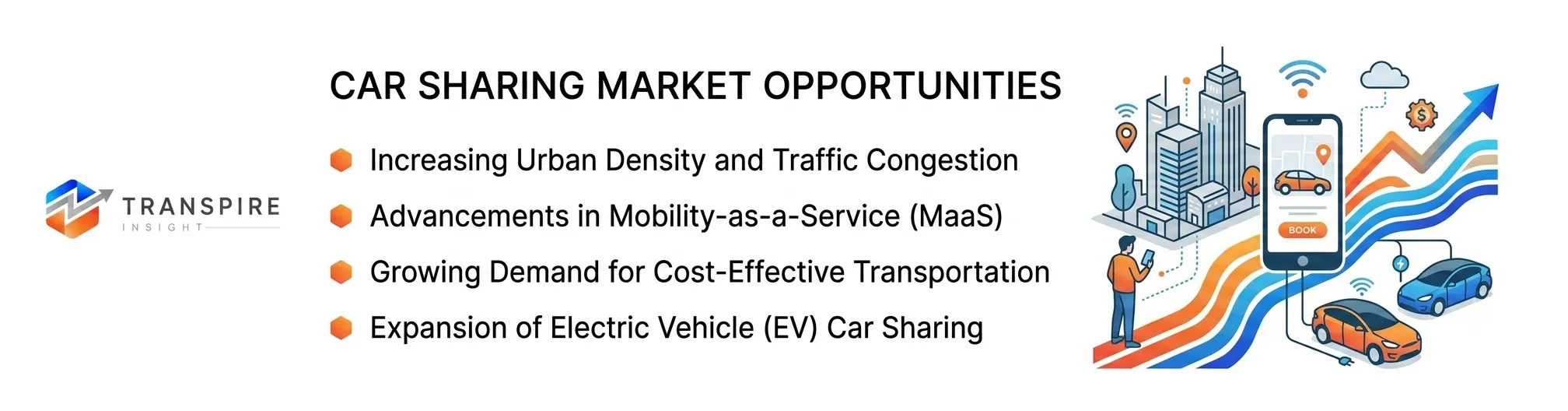
According to a research report published by Transpire Insight, the car sharing market size is projected to grow from USD 19.6 billion in 2026 to USD 43.25 billion by 2035, at a CAGR of 27.30% during the forecast period 2027-2035. Rising vehicle ownership costs, urban congestion, rapid smartphone adoption, and strict municipal carbon emission mandates drive urban commuters away from personal vehicle ownership toward flexible, app-based shared mobility models globally.
Introduction
The car sharing market is undergoing rapid transformation, becoming a critical pillar of modern urban transportation. As city dwellers increasingly prioritize access to usage over asset ownership, digitally integrated car sharing ecosystems provide cost-effective, flexible mobility solutions. Driven by advancements in telematics, keyless mobile access, and accelerating electric vehicle adoption, the industry addresses environmental sustainability and urban parking gridlock while offering personalized alternatives to traditional car rentals and ride-hailing platforms worldwide.
Recent Development News
Stay Ahead of Emerging Opportunities with Expert Market Insights by Transpire Insight
Transpire Insight provides comprehensive, data-driven market intelligence to support smarter business decisions. Our research is rooted in comprehensive analysis, authoritative predictions, and industry expertise, enabling organizations to make informed decisions in rapidly evolving markets. In-depth analysis of market segmentation, competitive positioning, regional trends, and emerging investment opportunities in high-growth areas. We blend accuracy with actionable intelligence, empowering companies to uncover new avenues for growth, bolster strategic decision-making, and stay ahead in a dynamic market.
Car Sharing Market Size & Statistics
Regional Growth and Demand Analysis by Transpire Insight
Europe's lead rests on an unusually tight alignment between regulation and business model. Cities including London, Paris, Berlin, and Amsterdam have established low-emission zones that structurally advantage shared EV fleets over privately owned combustion vehicles, and this regulatory pressure has directly shaped how operators build their networks. These regulatory conditions reduce operator acquisition risk and accelerate fleet electrification timelines, which explains why European fleets skew EV faster than any other region. The competitive landscape is also consolidating quickly: Stellantis completed the full integration of Share Now into its Free2move platform, creating a single system with access to over 10,000 shared vehicles across Europe and the U.S., a clear sign that scale, not fragmentation, is now the winning strategy in mature markets.
Asia Pacific's growth story is being written by density, not policy mandates. Rapid urbanization, increasing smartphone penetration, and rising disposable incomes in emerging economies like India and Southeast Asia are pulling first-time users into shared mobility platforms at a pace mature markets can't match. Government policies across the region emphasize smart city development and green mobility solutions, promoting electric shared vehicles and investments in urban transit infrastructure, giving local operators tailwinds that European players had to fight regulators for. On the ground, local players such as Ola in India and Grab in Southeast Asia lead innovation in micro-mobility and ride-hailing services, leveraging AI and data analytics to compress the gap between demand and fleet availability, a model increasingly copied elsewhere.
Top 15 Trends in the Car Sharing Market
Car-sharing operators are increasingly electrifying fleets to cut emissions, meet regulatory mandates, and attract environmentally conscious users seeking affordable, reliable, low-carbon, short-distance urban mobility solutions.
Leading operators are merging platforms and forming strategic alliances to expand vehicle networks, reduce operating costs, and strengthen competitive positioning across fragmented regional car-sharing markets.
Artificial intelligence powers dynamic pricing, predictive maintenance, and smart routing, helping car-sharing operators boost fleet utilization, minimize downtime, and consistently improve overall customer satisfaction levels.
Companies increasingly adopt corporate car-sharing programs to reduce fleet ownership costs, simplify employee mobility, and support sustainability goals while offering flexible, on-demand daily transportation benefits.
Seamless smartphone apps now enable contactless booking, keyless vehicle unlocking, and instant payments, making car sharing faster, safer, and more convenient for everyday urban commuters.
Car-sharing platforms are integrating with buses, trains, and micromobility options, offering commuters seamless multimodal journeys and reducing reliance on privately owned personal cars across cities.
List of Top 25 Companies Leading the Car Sharing Market
Pioneer in membership-based car sharing operating across major university campuses worldwide.
Founded: 2000 | HQ: Boston, Massachusetts, USA.
Why It Ranks: Market leader with widespread institutional integration across North American university campuses.
Regional Dominance: Strong operational footprint concentrated across North America and key European cities.
Product Line: Station-based hourly rentals and dedicated round-trip vehicle sharing.
Premier peer-to-peer marketplace letting hosts monetize their private personal vehicles globally.
Founded: 2009 | HQ: San Francisco, California, USA.
Why It Ranks: Asset-light P2P marketplace model drives fast international expansion without inventory costs.
Regional Dominance: Dominant consumer platform spanning North America, the United Kingdom, and Australia.
Product Line: Peer-to-peer vehicle rentals and host insurance protection services.
Digitally enables instant keyless smartphone access for peer-to-peer vehicle sharing globally.
Founded: 2009 | HQ: San Francisco, California, USA.
Why It Ranks: Keyless connect device technology allows instant contactless rentals for urban commuters.
Regional Dominance: Established market presence across major North American and Western European cities.
Product Line: Contactless P2P sharing and proprietary Getaround Connect hardware devices.
Stellantis mobility subsidiary combining car sharing, subscriptions, and rental options seamlessly.
Founded: 2016 | HQ: Paris, France.
Why It Ranks: Substantial OEM fleet backing enables rapid deployment across major international markets.
Regional Dominance: Widespread enterprise presence across key European and North American urban centers.
Product Line: Free-floating sharing, short-term rentals, and long-term vehicle subscription plans.
Formed by merging Car2Go and DriveNow, now operating under Stellantis Free2move.
Founded: 2019 | HQ: Berlin, Germany.
Why It Ranks: Major pioneer of flexible free-floating vehicle sharing across European urban metros.
Regional Dominance: High service coverage and dense operational presence throughout major European markets.
Product Line: Premium free-floating inner-city hourly vehicle and electric car sharing.
Longest-running car sharing operator in North America offering station and free-floating options.
Founded: 1994 | HQ: Montreal, Quebec, Canada.
Why It Ranks: Exceptionally strong public-transit alignment and high consumer loyalty in Canadian markets.
Regional Dominance: Unmatched municipal service footprint across major Canadian metros and French cities.
Product Line: Hybrid station-based round trips and FLEX free-floating vehicle rentals.
Dominant peer-to-peer car sharing platform operating across emerging South Asian markets.
Founded: 2013 | HQ: Bengaluru, Karnataka, India.
Why It Ranks: Early mover advantage in adapting peer-to-peer asset monetization to dense populations.
Regional Dominance: Massive user adoption and operational scale across India and Southeast Asia.
Product Line: P2P self-drive car sharing and host fleet management software.
One of Eastern Europe's largest car sharing providers by fleet capacity.
Founded: 2015 | HQ: Moscow, Russia.
Why It Ranks: Dynamic pricing tech and aggressive fleet scaling drive massive high-density usage.
Regional Dominance: Extensive market reach across high-density urban areas in Eastern Europe.
Product Line: Minute-by-minute free-floating vehicle sharing and corporate commuter mobility options.
Shared mobility division of traditional car rental giant Sixt mobility ecosystem.
Founded: 2019 | HQ: Pullach, Germany.
Why It Ranks: Cross-integration within a single app offering rentals, sharing, and ride-hailing services.
Regional Dominance: Solid market penetration across Central and Western European metropolitan areas.
Product Line: On-demand free-floating car sharing, electric vehicles, and daily rental services.
Germany's largest car sharing network operated directly by national railway Deutsche Bahn.
Founded: 2001 | HQ: Frankfurt, Germany.
Why It Ranks: Seamless integration with national railway stations creates unmatched first-and-last-mile utility.
Regional Dominance: Strategic station-based presence anchored at transit hubs across Germany.
Product Line: Station-based rail-integrated car sharing and regional electric mobility fleets.
Conclusion
The car sharing market is positioned for sustained growth as urban infrastructure adapts to green mobility and reduced private car dependency. Strategic shifts toward electrified, peer-to-peer, and multimodal networks are reshaping traditional transportation paradigms globally. Backed by corporate investments, technological telematics upgrades, and favorable public policies, leading companies are expanding accessible, keyless fleets. Ultimately, car sharing will remain a fundamental driver of sustainable, smart urban environments, delivering cost-effective mobility while optimizing urban transit ecosystems across world regions.


Send us a brief description of your challenge and we'll get back to you within 24 hours.

 inquiry@transpireinsight.com
 APAC:+91 7666513636
 Address


