
Aug 01, 2026
By Transpire Insight
Description
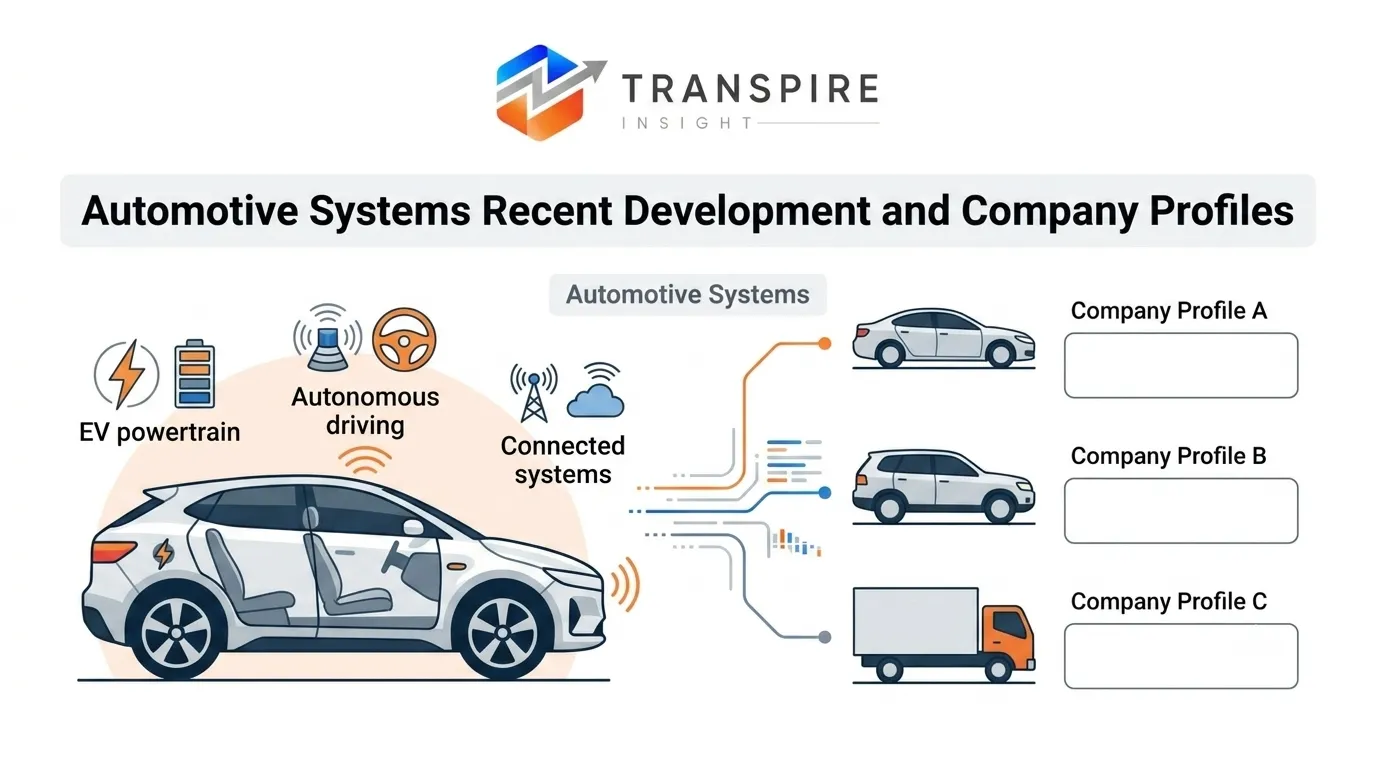
According to a research report published by Transpire Insight, the automotive systems market size is projected to grow from USD 431.14 million in 2026 to USD 749.18 million by 2035, at a CAGR of 6.9% during the forecast period 2026-2035. Driven by strict emissions regulations, rapid EV/hybrid integration, surging consumer demand for vehicle safety/ADAS technologies, and the industry-wide transformation toward software-defined architectures and AI cockpits.
Introduction
The automotive systems market represents the foundational ecosystem of integrated mechanical, electrical, and digital components driving modern vehicle operations. Encompassing everything from powertrain and chassis hardware to sophisticated software-defined vehicle (SDV) architectures and Advanced Driver Assistance Systems (ADAS), it underpins critical automotive functions. Rapid technological evolution is shifting the market from traditional isolated hardware components toward interconnected, AI-driven digital platforms. Consequently, automotive systems serve as the core engine powering safety, electrification, energy efficiency, and next-generation smart mobility across the transportation landscape.
Recent Development News
Stay Ahead of Emerging Opportunities with Expert Market Insights by Transpire Insight
Transpire Insight provides comprehensive, data-driven market intelligence to support smarter business decisions. Our research is rooted in comprehensive analysis, authoritative predictions, and industry expertise, enabling organizations to make informed decisions in rapidly evolving markets. In-depth analysis of market segmentation, competitive positioning, regional trends, and emerging investment opportunities in high-growth areas. We blend accuracy with actionable intelligence, empowering companies to uncover new avenues for growth, bolster strategic decision-making, and stay ahead in a dynamic market.
Download the exclusive Automotive Systems Market sample report today to uncover expert insights, emerging trends, and the opportunities defining the future of the industry.
Automotive Systems Market Size & Statistics
Regional Growth and Demand Analysis by Transpire Insight
In North America, the market is segmented into the U.S., Canada, and Mexico, each presenting unique opportunities and challenges shaped by their level of technological adoption and regulatory environment. The United States offers strong opportunities in advanced automotive technologies and innovations, while Canada and Mexico contribute significantly to vehicle manufacturing and assembly. Key European markets include the UK, Germany, France, Italy, and the Rest of Europe, where the automotive sector's focus on sustainability and regulatory compliance around emissions is driving demand for more value-added, advanced automotive systems. Metastat Insight Metastat Insight
Asia-Pacific's growth is being propelled by rapid economic expansion in the region, which is driving rising automobile ownership. Broader globalization trends and rising disposable incomes in emerging markets are increasing demand for personal vehicles, which in turn is driving demand for higher-quality automotive systems, a dynamic most visible in Asia-Pacific. Continuous innovation, the rise of autonomous vehicles, artificial intelligence integration, and energy-efficiency demands are expected to sustain growth going forward.
Top 15 Trends in the Automotive Systems Market
Proceed to Checkout to purchase the exclusive Automotive Systems Market report and gain instant access to in-depth market intelligence, strategic analysis, and future growth opportunities.
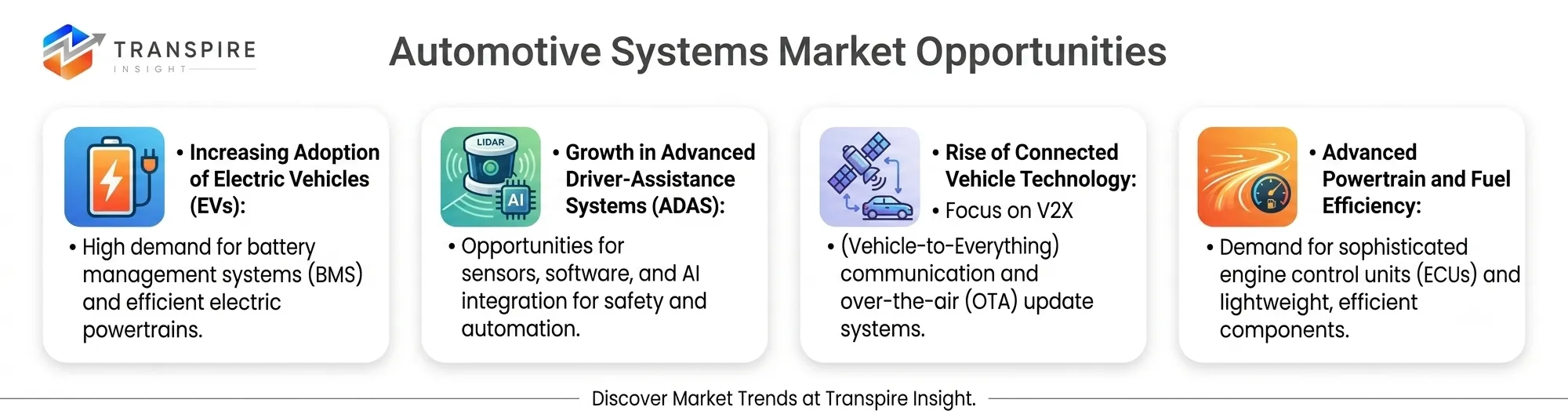
Automakers are shifting toward software-defined vehicles with centralized computing architectures, enabling over-the-air updates, improved functionality, and long-term monetization opportunities for OEMs.
Rising ADAS-equipped vehicle demand drives adoption of adaptive cruise control, automatic emergency braking, lane departure warning, and collision avoidance across regulated markets.
Chassis technology is shifting toward electronically controlled steer-by-wire and brake-by-wire systems, gaining traction in premium vehicles like Tesla Cybertruck and Mercedes EQS.
A looming DRAM shortage from AI data-center demand could push automotive-grade memory prices up 70–100%, disrupting production and forcing agile sourcing.
Vehicle interiors are moving upmarket with soft-touch surfaces, advanced infotainment controls, and motorized/heated seats becoming standard, particularly strong demand in China.
Asia Pacific leads the market due to rapid economic growth in China and India, a rising middle class, and increasing consumer demand for smart, connected vehicles.
List of Top 25 Companies Leading the Automotive Systems Market
Customize the exclusive Automotive Systems Market report today to receive tailored insights, country-specific analysis, and business-focused market intelligence.
1. Robert Bosch GmbH
World’s largest automotive supplier producing comprehensive systems from braking to AI-driven mobility.
Founded: 1886 | HQ: Gerlingen, Germany.
Why It Ranks: Unrivaled scale, heavy R&D investment, and dominant position across mobility sectors.
Regional Dominance: Europe and North America, with massive manufacturing operations expanding globally across Asia.
Product Line: Powertrains, ABS/ESP braking, ADAS sensors, steering systems, integrated software, and e-axles.
2. Denso Corporation
technology leader specializing in thermal management and advanced electrification control hardware.
Founded: 1949 | HQ: Kariya, Aichi, Japan.
Why It Ranks: Deep Toyota lineage combined with cutting-edge power electronics and thermal innovation.
Regional Dominance: Asia-Pacific, holding massive market penetration across Japanese and Asian OEM supply chains.
Product Line: Thermal control systems, powertrain electronics, inverters, ADAS sensors, and automotive semiconductors.
3. ZF Friedrichshafen AG
Specialist in driveline, chassis, active safety, and integrated vehicle motion control technologies.
Founded: 1915 | HQ: Friedrichshafen, Germany.
Why It Ranks: Comprehensive engineering mastery in heavy mechanical systems, transmissions, and autonomous platforms.
Regional Dominance: Europe and North America, maintaining major commercial and passenger vehicle contracts.
Product Line: Transmissions, e-drives, steering systems, chassis modules, radar sensors, and safety electronics.
4. Hyundai Mobis
Primary technology supplier for Hyundai Motor Group, specializing in integrated automotive modules.
Founded: 1977 | HQ: Seoul, South Korea.
Why It Ranks: Rapid expansion into electric vehicle chassis modules, digital cockpits, and autonomous driving.
Regional Dominance: Asia-Pacific, with rapidly expanding market presence in the Americas and Europe.
Product Line: EV powertrain modules, braking systems, steering components, digital cockpits, and headlights.
5. Magna International
Highly diversified supplier capable of complete vehicle engineering and contract manufacturing.
Founded: 1957 | HQ: Aurora, Ontario, Canada.
Why It Ranks: Exceptional breadth of system manufacturing, structural design capabilities, and complete vehicle assembly.
Regional Dominance: North America, with strong operational footprints across Europe and growing Asian facilities.
Product Line: Body structures, powertrains, seating systems, active vision systems, mechatronics, and complete vehicles.
6. Aisin Corporation
Major drivetrain and powertrain component creator heavily aligned with hybrid vehicle architectures.
Founded: 1965 | HQ: Kariya, Aichi, Japan.
Why It Ranks: Market leadership in automatic transmissions, eAxles, and critical vehicle structural systems.
Regional Dominance: Asia-Pacific, with expansive supply networks serving automotive original equipment manufacturers.
Product Line: Automatic transmissions, hybrid eAxles, brake systems, body components, and engine-related equipment.
7. Continental AG
Pioneer in electronic braking, digital cockpits, vehicle networking, and tire technologies.
Founded: 1871 | HQ: Hanover, Germany.
Why It Ranks: Strong portfolio across software architecture, autonomous vehicle sensing, and chassis electronics.
Regional Dominance: Europe, backed by extensive international presence across North America and Asia-Pacific.
Product Line: Digital cockpits, safety electronics, RADAR/LiDAR sensors, electronic braking, and connectivity architecture.
8. Forvia (Faurecia + Hella)
Combined force specializing in interior systems, sustainable mobility, and automotive lighting technologies.
Founded: 2022 | HQ: Nanterre, France.
Why It Ranks: Sixth-largest player delivering advanced electronics, interior setups, and clean mobility.
Regional Dominance: Europe, maintaining substantial market share across North American and Chinese automakers.
Product Line: Automotive lighting, interior cockpits, seating structures, emissions control systems, and electronic modules.
9. Aptiv PLC
Technology enterprise focusing exclusively on electrical architecture and software for smart vehicles.
Founded: 1994 | HQ: Dublin, Ireland.
Why It Ranks: Unrivaled focus on central computing, high-speed data wiring, and safety-critical software.
Regional Dominance: North America and Europe, alongside rapidly accelerating integration into Chinese electric vehicle production.
Product Line: Signal and power distribution, zonal domain controllers, ADAS software, and connectivity solutions.
10. Hitachi Astemo
Joint venture combining automotive system operations of Hitachi and Honda Motor Company.
Founded: 2021 | HQ: Tokyo, Japan.
Why It Ranks: Integrated expertise in advanced powertrain solutions, electric motors, and chassis control.
Regional Dominance: Asia-Pacific, supported by significant operational facilities across North America and Europe.
Product Line: Electric vehicle motors, inverters, suspension systems, hydraulic braking, and engine control units.
Schedule a meeting with our market experts to discuss the exclusive Automotive Systems Market report and identify the best research solution for your organization.
Conclusion
The automotive systems market stands at a critical juncture as electrification, software integration, and regional shifts redefine competitiveness. Leading Tier-1 suppliers are increasingly pivoting toward software-defined architectures and high-efficiency powertrains to maintain market leadership. While challenges around supply chain volatility and transitioning ICE infrastructure remain, long-term opportunities in Level 2+ autonomy and digital cockpits promise a strong trajectory. Ultimately, companies that combine hardware mastery with agile software integration will shape the future landscape of mobility.


Send us a brief description of your challenge and we'll get back to you within 24 hours.

 inquiry@transpireinsight.com
 APAC:+91 7666513636
 Address


