
Sep 08, 2026
By Transpire Insight
Description
According to a research report published by Transpire Insight, the automotive AI simulation and synthetic data generation market size is projected to grow from USD 1.61 billion in 2026 to USD 30.15 billion by 2035, at a CAGR of 13.7% during the forecast period 2027-2035. Rapid ADAS and autonomous vehicle (AV) expansion, software-defined vehicle adoption, mandatory safety validation, and high costs of physical testing drive automakers toward simulation and synthetic data generation to safely validate rare corner-case scenarios.
Introduction
The automotive AI simulation and synthetic data generation market is rapidly expanding as automakers shift toward software-defined architectures. Validating Level 2+ to Level 4 autonomous systems requires trillions of miles of driven scenarios, an impossible task using physical road fleets alone. AI-driven simulation platforms and synthetic data generation bridge this gap by synthetically replicating edge cases, extreme weather, and complex urban environments in photorealistic digital twin sandboxes. This drastically lowers R&D costs while accelerating safety compliance and time-to-market.
Recent Development News
Stay Ahead of Emerging Opportunities with Expert Market Insights by Transpire Insight
Transpire Insight provides comprehensive, data-driven market intelligence to support smarter business decisions. Our research is rooted in comprehensive analysis, authoritative predictions, and industry expertise, enabling organizations to make informed decisions in rapidly evolving markets. In-depth analysis of market segmentation, competitive positioning, regional trends, and emerging investment opportunities in high-growth areas. We blend accuracy with actionable intelligence, empowering companies to uncover new avenues for growth, bolster strategic decision-making, and stay ahead in a dynamic market.
Automotive AI Simulation and Synthetic Data Generation Market Size & Statistics
Regional Growth and Demand Analysis by Transpire Insight
North America's leadership stems from its concentration of advanced simulation software vendors, GPU infrastructure providers, and active autonomous-vehicle testing programs. Applied Intuition, headquartered in the region, has reported running tens of millions of simulations annually while expanding its office footprint, and NVIDIA's DRIVE Sim platform anchors much of the synthetic data pipeline used by automakers and Tier-1 suppliers. The presence of established autonomous-driving programs such as Waymo, Cruise, Aurora, and Zoox sustains steady demand for high-volume synthetic validation data, while US-based Tier-1 suppliers continue investing in in-house virtual validation infrastructure to meet safety and cybersecurity compliance requirements.
Asia-Pacific's rapid expansion is driven by China's dominant automotive production base and its accelerated rollout of electric and autonomous vehicles, supported by strong government backing for smart mobility programs. Chinese automakers and technology firms are scaling investment in high-performance computing and virtual validation infrastructure to test perception and decision-making AI models using synthetic datasets, while Japan, South Korea, and India are similarly expanding AI and simulation capabilities to support growing domestic ADAS and autonomous-vehicle development pipelines. This buildout of regional simulation and synthetic data infrastructure positions Asia-Pacific to close the gap with North America over the coming years.
Top 15 Trends in the Automotive AI Simulation and Synthetic Data Generation Market
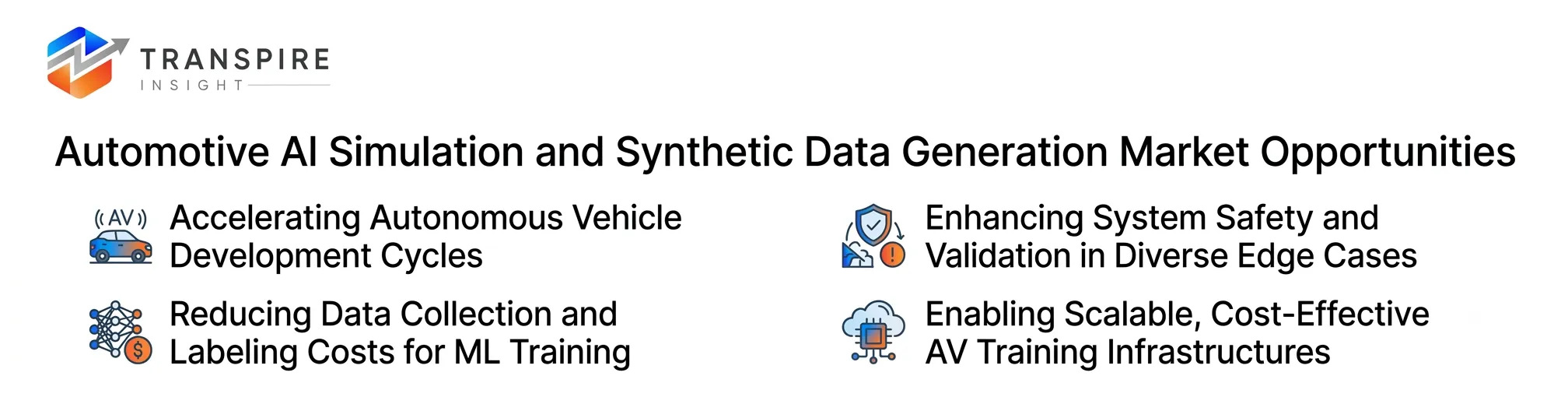
Rising ADAS and Autonomous Vehicle Validation Demand
Automakers increasingly require extensive virtual simulation testing to validate ADAS and autonomous driving software, reducing reliance on costly, time-consuming physical road testing and prototype vehicles.
Growth of Cloud-Based Simulation-as-a-Service Platforms
Cloud-based simulation platforms let OEMs and Tier-1 suppliers scale computing power on demand, share simulation assets across regions, and accelerate iteration without on-premises hardware investment.
Expansion of Digital Twin Adoption in Vehicle Development
Digital twin technology enables engineers to build detailed virtual replicas of vehicles and components, allowing continuous testing, predictive maintenance, and design refinement across development cycles.
Increased Use of Photorealistic Synthetic Sensor Data
Synthetic data generation now produces highly photorealistic camera, radar, and LiDAR datasets, helping train perception models on rare, hazardous scenarios too dangerous to capture physically.
Growing Demand for Certified Virtual validation frameworks
Regulators and safety bodies increasingly require certified virtual validation frameworks to approve autonomous systems, pushing simulation vendors to build standardized, auditable testing and compliance methodologies.
Integration of Generative AI in Scenario Generation
Generative AI models now automatically create diverse, realistic driving scenarios and edge cases, accelerating dataset creation while reducing manual scenario design effort for simulation engineers.
Top 25 Companies Leading the Automotive AI Simulation and Synthetic Data Generation Market
1. NVIDIA
World-leading platform provider of Omniverse and DRIVE Sim for end-to-end autonomous validation.
Founded: 1993 | HQ: Santa Clara, California, USA.
Why It Ranks: Unrivaled GPU compute infrastructure paired with photorealistic neural rendering and world models.
Regional Dominance: North America, Western Europe, and East Asia.
Product Line: NVIDIA Omniverse, NVIDIA DRIVE Sim, NVIDIA Cosmos.
2. Siemens Digital Industries Software
industrial software giant providing deep physics-based simulation for automotive development.
Founded: 1847 | HQ: Munich, Germany.
Why It Ranks: Comprehensive digital twin suite covering vehicle dynamics, acoustics, and sensor software.
Regional Dominance: Europe, North America, and Asia-Pacific.
Product Line: Simcenter Prescan, Simcenter Amesim, Siemens Xcelerator.
3. Ansys (Synopsys)
Engineering simulation leader specializing in optical, electromagnetic, and autonomous system safety validation.
Founded: 1970 | HQ: Canonsburg, Pennsylvania, USA.
Why It Ranks: Gold-standard physics accuracy for radar, LiDAR, and camera sensor-level simulation.
Regional Dominance: (North America, Europe, Asia-Pacific).
Product Line: Ansys AVxcelerate, Ansys SPEOS, Ansys HFSS.
4. Applied Intuition
High-growth physical AI company delivering end-to-end software for autonomous systems.
Founded: 2017 | HQ: Mountain View, California, USA.
Why It Ranks: Fast market adoption, petabyte-scale synthetic data engines, and deep OEM integration.
Regional Dominance: North America, Japan, Europe.
Product Line: Simian, Spectral, Orbis, Synthetic Data Engine.
5. dSPACE
Key provider of hardware-in-the-loop (HIL) and software-in-the-loop (SIL) automotive testing environments.
Founded: 1988 | HQ: Paderborn, Germany.
Why It Ranks: Essential testing hardware and software standard used by virtually every major OEM.
Regional Dominance: Europe, North America, Asia-Pacific.
Product Line: AURELION, SCALEXIO, SIMPHERA.
6. Dassault Systèmes
3D virtual universe leader driving collaborative product design and vehicle digital twins.
Founded: 1981 | HQ: Vélizy-Villacoublay, France.
Why It Ranks: Enterprise-grade 3EXPERIENCE platform used for holistic automotive design and simulation.
Regional Dominance: Western Europe, North America, East Asia.
Product Line: 3DEXPERIENCE Platform, CATIA, SIMULIA.
7. The MathWorks
Developer of MATLAB and Simulink, foundational tools for mathematical modeling and control systems.
Founded: 1984 | HQ: Natick, Massachusetts, USA.
Why It Ranks: Industry-standard model-based design software for embedded automotive control logic.
Regional Dominance: North America, Western Europe, Asia-Pacific.
Product Line: MATLAB, Simulink, Automated Driving Toolbox.
8. Synopsys
Silicon-to-software technology leader enabling virtual prototyping for auto chips and ADAS.
Founded: 1986 | HQ: Sunnyvale, California, USA.
Why It Ranks: Dominates automotive electronic system design and virtual ECU software validation workflows.
Regional Dominance: North America, East Asia, Europe.
Product Line: Virtualizer, Saber, Silver, VDKs.
9. Altair Engineering
Computational intelligence leader offering high-performance physics simulation and AI tools for automotive.
Founded: 1985 | HQ: Troy, Michigan, USA.
Why It Ranks: Strong portfolio across structural crash simulation, sensor optimization, and AI modeling.
Regional Dominance: North America, Europe, Asia-Pacific.
Product Line: Altair HyperWorks, Altair PhysicsAI, Feko.
10. Hexagon (MSC Software)
Reality technology and sensor-to-software leader focused on autonomous driving virtual simulation platforms.
Founded: 1992 | HQ: Stockholm, Sweden.
Why It Ranks: Integrated real-world geospatial capture with high-fidelity virtual traffic and scenario generation.
Regional Dominance: Europe, North America, Asia-Pacific.
Product Line: VTD (Virtual Test Drive), Adams, VIRES.
Conclusion
The automotive AI simulation and synthetic data generation market has evolved from an exploratory testing alternative into a critical prerequisite for software-defined vehicle validation. As Level 2+ and Level 4 systems proliferate, physical testing alone cannot safely scale to handle unpredictable edge-case scenarios. Powered by physical AI, Generative AI, and digital twins, synthetic data enables rapid, cost-effective, and safe platform testing. This industry will remain central to driving autonomous transportation safety forward.


Send us a brief description of your challenge and we'll get back to you within 24 hours.

 [email protected]
 APAC:+91 7666513636
 Address


