
Sep 02, 2026
By Transpire Insight
Description
According to a research report published by Transpire Insight, the Artificial Intelligence Generated Content (AIGC) market size is projected to grow from USD 35.6 billion in 2026 to USD 108.4 billion by 2035, at a CAGR of 30.12% during the forecast period 2026-2035. The market for automated digital content creation is propelled by the exponential growth of enterprise demand for digital content that is often produced automatically. The aggressive growth is fuelled by rapid progress in multimodal foundation models, increasing cloud capabilities, tremendous cost advantages, and growing demand for personalized real-time media from consumers.
Introduction
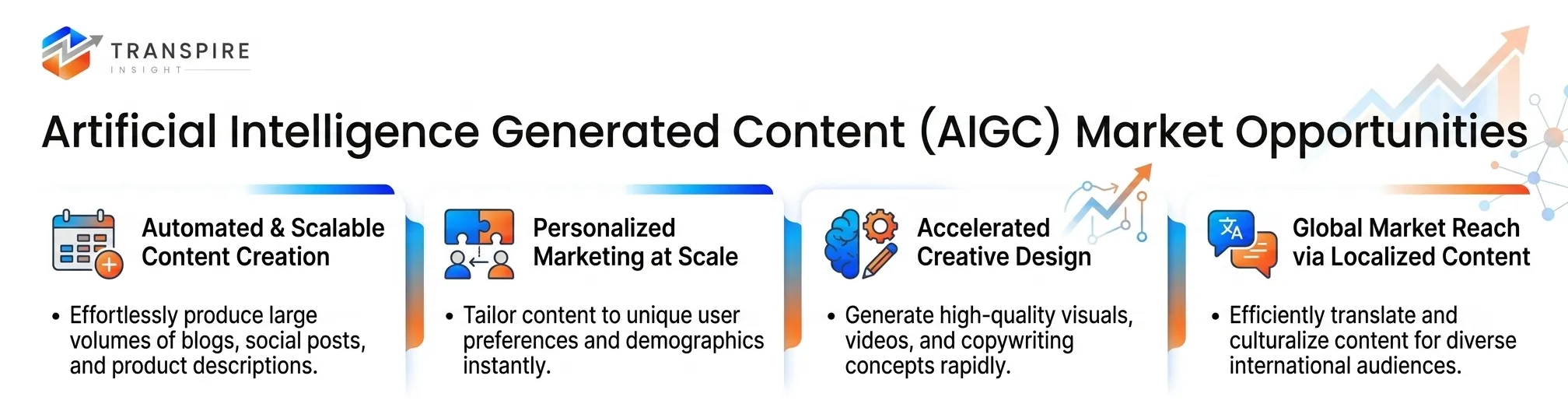
Artificial Intelligence Generated Content (AIGC) is a revolutionary shift in the digital media landscape that affects the world. Artificial Intelligence Generated Content (AIGC) is a paradigm shift in the digital media landscape. The functionalities of AIGC are mainly based on deep learning architecture, multimodal foundational models, and Natural Language Processing, which can automatically generate high-quality text, image, sound, code, and video assets. In just a few months, companies spanning marketing, entertainment, software, and e-commerce industries are quickly adopting AIGC tools to boost efficiency in the production process, reduce operational expenses, and produce hyper-personalized user experiences at a massive scale. With the further development of multimodal generation capabilities, AIGC is essentially transforming the way digital media is ideated, created, and disseminated in the creative industries from around the world.
Recent Development News
Stay Ahead of Emerging Opportunities with Expert Market Insights by Transpire Insight
Transpire Insight provides comprehensive, data-driven market intelligence to support smarter business decisions. Our research is rooted in comprehensive analysis, authoritative predictions, and industry expertise, enabling organizations to make informed decisions in rapidly evolving markets. In-depth analysis of market segmentation, competitive positioning, regional trends, and emerging investment opportunities in high-growth areas. We blend accuracy with actionable intelligence, empowering companies to uncover new avenues for growth, bolster strategic decision-making, and stay ahead in a dynamic market.
Artificial Intelligence Generated Content (AIGC) Market Size & Statistics
Regional Growth and Demand Analysis by Transpire Insight
North America continues to anchor the AIGC market on the strength of its mature enterprise tech ecosystem and early AI investment cycles. Adobe's Firefly platform, now embedded across Creative Cloud workflows used by over 30 million creative professionals, exemplifies how deeply generative tools have penetrated mainstream production pipelines in the region. Parallel momentum from OpenAI's Sora, Google's Veo, and Anthropic's Claude API has pushed enterprises toward multimodal, agentic content systems, with hyperscaler services like Azure OpenAI Service and Amazon Bedrock lowering the barrier for firms to deploy frontier models without building their own GPU infrastructure. Regulatory clarity around content authenticity and commercial safety, an area Adobe has actively marketed, has further reassured large marketing and media organizations wary of copyright exposure.
Asia-Pacific's rapid ascent is driven by aggressive digitalization and coordinated public-private AI strategy across China, Japan, South Korea, and India. Singapore's Infocomm Media Development Authority partnered with major AI labs to launch a national AIGC training and certification framework, while India's National AI Mission has folded AIGC modules directly into student and SME skilling programs. This institutional push, paired with mobile-first digital ecosystems and a booming creator economy, is compressing the adoption gap with North America. Localized, multilingual content generation is emerging as a defining regional demand driver, as enterprises across the region prioritize AI tools tuned to local languages and cultural context over generic Western-built platforms.
Top 15 Trends in the AIGC Market
Multimodal Generative AI Platforms
Sora, Veo 2, and Firefly increasingly combine text, image, video, and audio generation, letting enterprises build unified, end-to-end content production pipelines within one platform today.
Agentic AI-Driven Content Workflows
Adobe's Firefly Workflow Builder and GenStudio let AI agents interpret campaign briefs, compile assets, and run batch content production autonomously, reducing manual creative bottlenecks significantly.
Text-to-Video Generation Gaining Enterprise Traction
OpenAI's Sora, Google's Veo 2, and Runway Gen-3 now produce broadcast-quality video directly from text prompts, cutting traditional production costs by seventy to ninety percent.
Enterprise Adoption of Generative AI Accelerating
Enterprise AIGC spend is projected to rise sharply, from roughly $380,000 to over $2.1 million per Fortune 500 company by 2034, showing mainstream adoption clearly.
Certification-Based AIGC Skilling Ecosystems Expanding
Singapore's IMDA and platforms like OpenAI, Adobe Firefly, and Stability AI now offer structured AIGC certification tracks, standardizing creative AI proficiency across enterprise hiring pipelines.
Regulatory Frameworks Like the EU AI Act Shaping Adoption
The EU AI Act and NIST's risk-management framework now give procurement teams standardized guardrails, shaping how enterprises evaluate, deploy, and govern generative AI content tools.
List of Top 25 Companies Leading the AIGC Market
1. OpenAI
Pioneered large language models and sparked the modern generative AI mass commercialization.
Founded: 2015 | HQ: San Francisco, California, USA.
Why It Ranks: Sets industry benchmarks with foundational GPT models and ChatGPT enterprise platform.
Regional Dominance: Holds leading market share across North America and Western European digital markets.
Product Line: Offers ChatGPT, GPT-4o, DALL-E 3, Sora video engine, and enterprise APIs.
2. Microsoft
Integrates generative AI capabilities across enterprise software suites and cloud ecosystem.
Founded: 1975 | HQ: Redmond, Washington, USA.
Why It Ranks: Unmatched enterprise distribution reach powered by Copilot across business environments.
Regional Dominance: Commands corporate productivity software dominance throughout North America and Western Europe.
Product Line: Copilot Pro, Azure OpenAI Service, GitHub Copilot, and Microsoft 365 Copilot.
3. Alphabet (Google)
Advances multimodal AI systems across search, cloud, and creative enterprise services.
Founded: 1998 | HQ: Mountain View, California, USA.
Why It Ranks: Unrivaled technical research infrastructure driving cutting-edge Gemini multimodal AI ecosystem developments.
Regional Dominance: Dominates web search and consumer digital platforms across all continents.
Product Line: Gemini Advanced, Imagen 3, Veo video model, and Vertex AI suite.
4. Adobe
Embeds commercially safe generative AI tools into industry-standard digital creative suites.
Founded: 1982 | HQ: San Jose, California, USA.
Why It Ranks: Standard platform for creative professionals integrating Firefly directly into existing workflows.
Regional Dominance: Dominates creative professional and agency software markets across North America and Europe.
Product Line: Adobe Firefly, Photoshop Generative Fill, Premiere Pro AI, and Express suite.
5. Anthropic
Focuses on safety-first aligned large language models for enterprise content generation workflows.
Founded: 2021 | HQ: San Francisco, California, USA.
Why It Ranks: Leading alternative for enterprise reasoning, long-context analysis, and safe code generation.
Regional Dominance: Strong presence in North American corporate, financial, and tech ecosystem sectors.
Product Line: Claude 3.5 Sonnet, Claude Enterprise, developer APIs, and Constitutional AI frameworks.
6. Meta
Champions open-source foundational AI models driving open developer ecosystems forward.
Founded: 2004 | HQ: Menlo Park, California, USA.
Why It Ranks: Llama open model series powers worldwide open-source generative AI enterprise development.
Regional Dominance: Mass consumer reach across social platforms throughout the Americas, Europe, and Asia.
Product Line: Meta AI assistant, Llama open models, AI Studio, and Segment Anything.
7. Nvidia
Powers foundational hardware infrastructure and software platforms enabling all AIGC applications.
Founded: 1993 | HQ: Santa Clara, California, USA.
Why It Ranks: Monopolizes the enterprise GPU computing market essential for training state-of-the-art AIGC models.
Regional Dominance: Controls AI hardware supply chain across Americas, Europe, and Asia-Pacific.
Product Line: NeMo framework, Picasso generative engine, DGX Cloud, and enterprise AI GPUs.
8. Midjourney
Defines artistic standards in text-to-image synthesis through hyper-realistic generative model outputs.
Founded: 2021 | HQ: San Francisco, California, USA.
Why It Ranks: Industry benchmark for visual aesthetics, artistic control, and community-driven image generation.
Regional Dominance: digital artist adoption across North America, Europe, and major Asian hubs.
Product Line: Midjourney v6 web platform, Discord bot engine, and image creation tools.
9. Stability AI
Pioneered accessible open-source text-to-image and multimodal media generation foundational models.
Founded: 2019 | HQ: London, United Kingdom.
Why It Ranks: Open weights enable customizable image, video, and audio workflows for developers.
Regional Dominance: High adoption across European tech hubs and open-source developer communities.
Product Line: Stable Diffusion 3, Stable Video Diffusion, Stable Audio, and developer APIs.
10. Runway
Leads creative industry revolution in generative AI video synthesis and post-production.
Founded: 2018 | HQ: New York City, New York, USA.
Why It Ranks: Pioneer in professional text-to-video, image-to-video, and automated cinematic visual editing workflows.
Regional Dominance: Market leader in Hollywood, North American media, and video production studios.
Product Line: Gen-2, Gen-3 Alpha, Motion Brush, and Runway Studios generative video tools.
Conclusion
The Artificial Intelligence Generated Content (AIGC) market has emerged as a key component of the digital economy. The presented AIGC platforms are reshaping creative productivity in both enterprise and consumer markets as foundation models evolve from single-mode synthesis to a more uniform multimodal paradigm. New regulations and technology are improving tracking of the source of content and making for sustainable growth. The future holds the promise of even greater adoption of cloud-based platforms, edge devices, and enterprise workflows, making AIGC an essential force in commercial media creation, marketing, and technological innovation globally.


Send us a brief description of your challenge and we'll get back to you within 24 hours.

 inquiry@transpireinsight.com
 APAC:+91 7666513636
 Address


