
Aug 27, 2026
By Transpire Insight
Description
According to a research report published by Transpire Insight, the Antibody Drug Conjugates (ADCs) market size is projected to grow from USD 19.5 billion in 2026 to USD 50.3 billion by 2035, at a CAGR of 13.2% during the forecast period 2026-2035. This is driven by increased incidence of cancer, the more precise targeting of the tumor than conventional chemotherapy, accelerated regulatory approvals, and advanced bioconjugation technologies that enhance therapeutic index and payload delivery safety profiles, all through market expansion efforts by large pharmaceutical mergers, as well as by biopharma companies.
Introduction
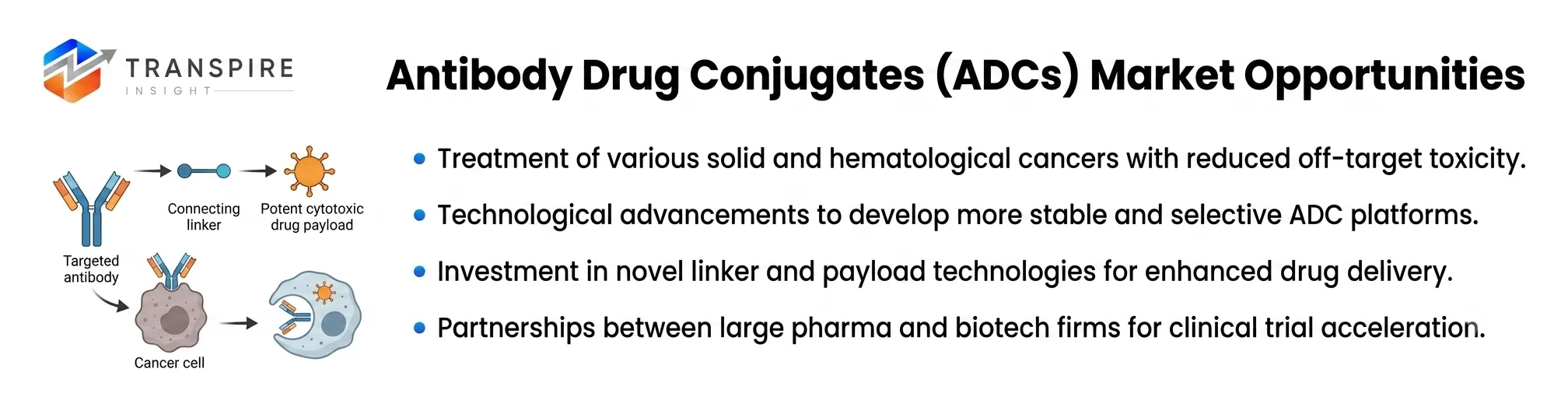
Antibody-Drug Conjugates (ADCs), also known as targeted biopharmaceuticals, are a novel class of drugs that combine potent cytotoxic agents with tumor-targeting antibodies to selectively deliver the drugs to tumor cells with minimal damage to healthy cells. Combining the selectivity of monoclonal antibodies with toxic chemical agents via stable linkers, ADCs have transformed modern oncology. The market is on a path of unprecedented commercial development, boasting strong clinical trial pipelines, growing therapeutic indications beyond hematologic malignancies to solid tumors, and strategic partnerships between pharmaceutical leaders to create novel linker-payload platforms that offer enhanced efficacy and reduced toxicity.
Recent Development News
Stay Ahead of Emerging Opportunities with Expert Market Insights by Transpire Insight
Transpire Insight provides comprehensive, data-driven market intelligence to support smarter business decisions. Our research is rooted in comprehensive analysis, authoritative predictions, and industry expertise, enabling organizations to make informed decisions in rapidly evolving markets. In-depth analysis of market segmentation, competitive positioning, regional trends, and emerging investment opportunities in high-growth areas. We blend accuracy with actionable intelligence, empowering companies to uncover new avenues for growth, bolster strategic decision-making, and stay ahead in a dynamic market.
Download the exclusive Antibody Drug Conjugates (ADCs) Market sample report today to explore expert insights, key trends, and emerging opportunities shaping the future of the industry.
Antibody Drug Conjugates (ADCs) Market Size & Statistics
Regional Growth and Demand Analysis by Transpire Insight
The North American region will continue to be the largest market for ADC therapeutics. Its status as the largest market is due to its favorable regulatory landscape and its various regulatory initiatives, which include fast-track approval and breakthrough therapy categorisations, which reduce development times by up to 20%, as well as its advanced infrastructure for producing complex sterile injectable products and its strong analytics capabilities for the quality control process. Meanwhile, the use of ADCs continues to be introduced in hospital and outpatient settings, with the U.S. Food and Drug Administration (FDA) accelerating drug-antibody ratio and linker stability data review, reducing the median time to 10 months compared to 14 months previously. The region is seeing growth due to increasing demand for next-gen payload classes, a series of high-capacity M&A moves, and favorable FDA approval activity.
Asia Pacific will see the fastest growth during the forecast period. The region is bucking the trend of declining cancer incidence and is witnessing growth, driven by targeted therapies, expanding healthcare infrastructure, and oncology diagnostics that are facilitating market entry. The region's addressable base is growing, as India is projected to deliver the highest country-level CAGR from 2025 to 2035, while China is expected to shift its focus from a manufacturing hub to an originator. Companies are aggressively driving expansion by price cuts, local deals, and regulatory clearance, and the introduction of new products such as Kadcyla and Enhertu is driving market uptake in Asia. Meanwhile, the region is being established as an innovation hotspot, not just a growth market, for the ADC industry, with Chinese developers accounting for 54% of all bispecific ADC products and 38% of all dual-payload ADC products.
Top 15 Trends in the ADC Market
Proceed to checkout to purchase the exclusive Antibody Drug Conjugates (ADCs) Market report and get instant access to detailed market insights, strategic analysis, and future growth opportunities.
Bispecific ADCs
The world's first approved bispecific ADC recently launched, dual-targeting constructs improving efficacy and reducing resistance versus single-target designs.
China-Originated ADCs
Four China-originated ADCs secured NMPA approval between 2025 and H1 2026, reshaping competitive dynamics and licensing flows.
Mega Licensing Deals
Landmark acquisitions like Pfizer-Seagen ($43B) and AbbVie-ImmunoGen ($10.1B) show ADCs are now a core pharma growth pillar.
Dual-Payload ADCs
Chinese labs pioneer combining two mechanisms of action on one antibody vehicle, boosting potency against resistant or heterogeneous tumors.
Indication Expansion Beyond Cancer
Companies like Avidity use RNA-based payloads (antibody-oligonucleotide conjugates) for rare neuromuscular diseases, not oncology.
CDMO/Manufacturing Buildout
Conjugation and purification services hold roughly 40% market share as the highest-value, most specialized ADC manufacturing step.
List of Top 25 Companies Leading the ADC Market
Customize the exclusive Antibody Drug Conjugates (ADCs) Market report to receive insights tailored to your needs, including country-specific analysis and business-focused market intelligence.
1. Daiichi Sankyo
Pioneered proprietary DXd topoisomerase-I technology that powers blockbuster bioconjugate therapies worldwide.
Founded: 1899 | HQ: Tokyo, Japan.
Why It Ranks: Co-developed market-leading Enhertu and controls highly scalable topoisomerase-I payload platforms.
Regional Dominance: Strongest in Asia-Pacific while aggressively capturing market share in North America.
Product Line: Enhertu (trastuzumab deruxtecan), Datroway (datopotamab deruxtecan), and patritumab deruxtecan.
2. AstraZeneca
biopharmaceutical giant driving major clinical expansions in precision oncology therapies.
Founded: 1999 | HQ: Cambridge, United Kingdom.
Why It Ranks: Co-commercializes top-selling ADCs through landmark multi-billion-dollar strategic alliances.
Regional Dominance: Dominant commercial presence across Europe, North America, and Asia-Pacific markets.
Product Line: Enhertu, Datroway, and extensive investigational next-generation clinical ADC candidates.
3. Roche (Genentech)
Early pioneer in targeted antibody therapies with foundational commercial ADC successes.
Founded: 1896 | HQ: Basel, Switzerland.
Why It Ranks: Commercialized the pioneer HER2-targeted ADC Kadcyla and the hematologic treatment Polivy globally.
Regional Dominance: Established commercial dominance across European and North American healthcare systems.
Product Line: Kadcyla (ado-trastuzumab emtansine) and Polivy (polatuzumab vedotin-piqq).
4. Pfizer
Expanded ADC leadership through the massive acquisition of biotechnology pioneer Seagen.
Founded: 1849 | HQ: New York, USA.
Why It Ranks: Possesses industry-leading commercial portfolio and manufacturing scale following the Seagen merger.
Regional Dominance: Market leader in North America with extensive pharmaceutical distribution channels.
Product Line: Adcetris, Padcev, Tivdak, Besponsa, and Mylotarg commercial portfolio.
5. Gilead Sciences
Leading biopharmaceutical innovator focused on transformative oncology and anti-viral drugs.
Founded: 1987 | HQ: Foster City, California, USA.
Why It Ranks: Holds flagship TROP2-directed ADC Trodelvy following its acquisition of Immunomedics.
Regional Dominance: Dominant market footprint in North America and rapidly expanding throughout Europe.
Product Line: Trodelvy (sacituzumab govitecan-hziy) and novel preclinical ADC pipelines.
6. AbbVie
Biomedical leader strengthening solid tumor pipeline via strategic acquisitions and partnerships.
Founded: 2013 | HQ: North Chicago, Illinois, USA.
Why It Ranks: Acquired ImmunoGen to gain commercial asset Elahere for ovarian cancer.
Regional Dominance: Strong commercial force across North American and European healthcare networks.
Product Line: Elahere (mirvetuximab soravtansine) and investigational c-Met-targeting ADC pipelines.
7. Astellas Pharma
Major Japanese pharmaceutical firm driving breakthrough targeted therapies in urological oncology.
Founded: 2005 | HQ: Tokyo, Japan.
Why It Ranks: Co-developed Padcev, establishing first-line standard of care for urothelial carcinoma.
Regional Dominance: Dominant leadership across Asia-Pacific and North American urology oncology markets.
Product Line: Padcev (enfortumab vedotin) and experimental solid tumor ADC candidates.
8. Takeda Pharmaceutical
Asia's largest pharmaceutical company with established oncology commercialization infrastructure.
Founded: 1781 | HQ: Tokyo, Japan.
Why It Ranks: Maintains long-term commercial rights and co-development partnerships for Adcetris globally.
Regional Dominance: Significant market penetration in Japan, Asia-Pacific, and European regions.
Product Line: Adcetris (brentuximab vedotin) across multiple approved lymphoma indications.
9. ADC Therapeutics
Commercial-stage biotechnology firm dedicated exclusively to targeted antibody-drug conjugate development.
Founded: 2011 | HQ: Lausanne, Switzerland.
Why It Ranks: Developed proprietary PBD dimer toxin payloads for hematologic cancer applications.
Regional Dominance: Strong clinical footprint across European and United States oncology centers.
Product Line: Zynlonta (loncastuximab tesirine-lpyl) for relapsed diffuse large B-cell lymphoma.
10. Merck & Co.
pharmaceutical power advancing ADC pipelines through strategic cross-border licensing deals.
Founded: 1891 | HQ: Rahway, New Jersey, USA.
Why It Ranks: Inked multi-billion-dollar co-development agreements with Kelun-Biotech for novel candidates.
Regional Dominance: market presence anchored heavily by North American commercial networks.
Product Line: Sacituzumab tirumotecan (MK-2870) and investigational ADC combination regimens.
Schedule a meeting with our market experts to discuss the exclusive Antibody Drug Conjugates (ADCs) Market report and find the right research solution for your business.
Conclusion
The Antibody-Drug Conjugate (ADC) market is witnessing a significant paradigm shift and is becoming an integral part of modern targeted oncology. Advances in site-specific targeting and the development of a new generation of classes of payloads, other than classical tubulin inhibitors, and strategic biopharma multi-billion dollar deals have enabled ADCs to become a substitute for traditional chemotherapy in a wide range of solid tumor cancer indications. With regulatory bodies speeding up approval processes for biomarker-directed therapeutics, key market players will continue to seek to optimise therapeutic indices, payload resistance, and to set first-line combination standards of care for ADC molecules, making them a major component of precision medicine in the next decade.


Send us a brief description of your challenge and we'll get back to you within 24 hours.

 inquiry@transpireinsight.com
 APAC:+91 7666513636
 Address


