
Sep 02, 2026
By Transpire Insight
Description
According to a research report published by Transpire Insight, the activated carbon market size is projected to grow from USD 8.6 billion in 2026 to USD 14.10 billion by 2035, at a CAGR of 9.1% during the forecast period 2026-2035. Strict environmental mandates, particularly regarding PFAS water remediation and industrial emission controls, drive significant market demand. Rapid urbanization and accelerating industrialization across emerging Asian economies further boost consumption across municipal water treatment, pharmaceutical purification, and advanced air filtration applications.
Introduction
The activated carbon market plays a vital role in modern environmental management, industrial processing, and municipal sanitation. Valued for its extraordinary surface area and exceptional adsorption capabilities, activated carbon is essential for eliminating volatile organic compounds, heavy metals, and emerging contaminants like PFAS from liquid and gas streams. Driven by stringent international pollution regulations and growing industrial activity across North America and Asia, the market is expanding rapidly. Ongoing innovations in sustainable renewable raw materials, such as coconut shells, continue to solidify its utility.
Recent Development News
Stay Ahead of Emerging Opportunities with Expert Market Insights by Transpire Insight
Transpire Insight provides comprehensive, data-driven market intelligence to support smarter business decisions. Our research is rooted in comprehensive analysis, authoritative predictions, and industry expertise, enabling organizations to make informed decisions in rapidly evolving markets. In-depth analysis of market segmentation, competitive positioning, regional trends, and emerging investment opportunities in high-growth areas. We blend accuracy with actionable intelligence, empowering companies to uncover new avenues for growth, bolster strategic decision-making, and stay ahead in a dynamic market.
Download the exclusive Activated Carbon Market sample report today to explore expert insights, key trends, and emerging opportunities shaping the future of the industry.
Activated Carbon Market Size & Statistics
Regional Growth and Demand Analysis by Transpire Insight
Asia Pacific's leadership stems from a powerful combination of raw material advantage and industrial scale. The region is home to major coconut-shell activated carbon producers across Sri Lanka, Indonesia, and the Philippines, giving it a structural edge in both production and export capacity. China and India anchor demand through large-scale municipal water treatment investment and expanding manufacturing bases, while widespread untreated wastewater discharge across the region continues to open significant opportunity for purification solutions. Rapid urbanization, rising industrial output, and tightening environmental compliance standards across these economies are reinforcing the region's dual role as both top producer and top consumer of activated carbon globally.
North America's accelerating momentum is being driven by a distinctly regulatory-led demand story. The United States has implemented rigorous PFAS and mercury removal standards, compelling municipalities and industrial facilities to adopt advanced granular and powdered activated carbon filtration at scale. Domestic producers, including Cabot Corporation and Calgon Carbon, are expanding manufacturing capacity to reduce reliance on imports and meet this compliance-driven surge. Growing automotive-sector demand, an aging population requiring pharmaceutical-grade carbon applications, and heightened environmental scrutiny are collectively positioning North America as the market's fastest-accelerating region despite its smaller overall base.
Top 15 Trends in the Activated Carbon Market
Tightening environmental regulations, particularly in the United States, are compelling municipalities and industries to adopt advanced activated carbon filtration systems for contaminant removal.
Producers across Sri Lanka, Indonesia, and the Philippines are scaling output to meet rising demand for high-adsorption, renewable feedstock-based carbon products.
Expanding urban populations and industrial wastewater volumes are pushing governments to invest heavily in water treatment facilities reliant on activated carbon filtration.
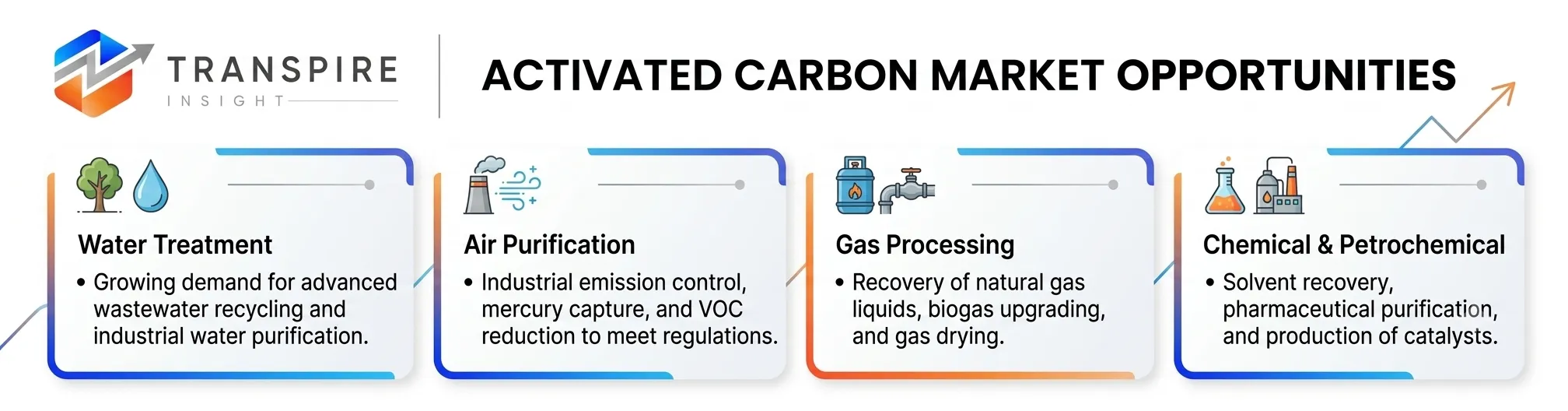
Stricter industrial emission standards are driving uptake of gas-phase activated carbon for controlling volatile organic compounds and airborne pollutants across manufacturing facilities.
Manufacturers are increasingly turning to renewable raw materials like coconut shells and agricultural waste to reduce environmental impact and meet sustainability commitments.
Activated carbon's adsorption properties make it essential for extracting gold from ore, sustaining steady demand from mining operations in resource-rich economies.
List of Top 25 Companies Leading the Activated Carbon Market
Leading innovator in granular activated carbon and municipal water purification solutions.
Founded: 1942 | HQ: Pittsburgh, Pennsylvania, USA.
Why It Ranks: World leader in PFAS removal technologies with extensive reactivation facility network.
Regional Dominance: Holds dominant market position across North America and key European industrial sectors.
Product Line: FILTRASORB granular carbon, powdered activated carbon, and specialized reactivation services equipment.
specialty chemical supplier offering high-performance activated carbon solutions across industries.
Founded: 1882 | HQ: Boston, Massachusetts, USA.
Why It Ranks: Boasts over 400 specialized carbon grades engineered for ultra-pure purification requirements.
Regional Dominance: Maintains significant market influence across North America, South America, and Europe.
Product Line: DARCO powdered carbon, NORIT granular products, and extruded gas purification media.
The world's largest manufacturer of sustainable coconut shell-based activated carbon products worldwide.
Founded: 1916 | HQ: Kalmar, Sweden.
Why It Ranks: Drives ESG innovation through extensive eco-friendly sourcing and distribution channels.
Regional Dominance: Dominates European market operations while expanding footprint across Asia and Americas.
Product Line: AquaSorb liquid carbon, EcoSorb coconut products, and Resinex ion exchange resins.
Major Sri Lankan exporter specialized in high-grade coconut shell activated carbons globally.
Founded: 1973 | HQ: Colombo, Sri Lanka.
Why It Ranks: Recognized for environmentally friendly raw material sourcing and superior energy storage carbons.
Regional Dominance: Strong market presence across Asia-Pacific, North America, Europe, and Middle Eastern regions.
Product Line: Premium coconut activated carbon, ultracapacitor carbon, and customized air treatment products.
Premier developer of high-performance specialty chemicals and specialty activated carbon media.
Founded: 2015 | HQ: North Charleston, South Carolina, USA.
Why It Ranks: Unmatched leader in automotive evaporative emission control systems and energy storage.
Regional Dominance: Dominates automotive recovery segment across North America, China, and European markets.
Product Line: Nuchar wood-based activated carbon, automotive canisters, and specialized chemical purifiers.
Major Japanese provider of coal- and coconut-based activated carbons and materials.
Founded: 1949 | HQ: Osaka, Japan.
Why It Ranks: Synergized parent company capabilities with Jacobi Carbons to create reach.
Regional Dominance: Maintains top-tier market share across Japan, East Asia, and broader Asia-Pacific.
Product Line: Granular coal carbons, coconut adsorption media, and molecular sieve carbon products.
Historic European enterprise delivering tailored environmental carbon filtration solutions for industry.
Founded: 1919 | HQ: Frankfurt, Germany.
Why It Ranks: Exceptional technical expertise in solvent recovery and complex gas treatment applications.
Regional Dominance: Deep operational roots and heavy market penetration across Central and Eastern Europe.
Product Line: Desorex gas carbons, DonauSorb liquid filtration media, and mobile adsorption units.
Diversified chemical pioneer expanding footprint through strategic functional material acquisitions.
Founded: 1926 | HQ: Tokyo, Japan.
Why It Ranks: Parent company of Calgon Carbon, forming the world's largest activated carbon network.
Regional Dominance: Leading market presence across Japan, Asia-Pacific, North America, and European hubs.
Product Line: Advanced carbon materials, synthetic adsorbents, high-purity resins, and industrial filters.
German manufacturer specializing in high-quality activated carbons and specialized filter vessels.
Founded: 1990 | HQ: Kirchhundem, Germany.
Why It Ranks: Renowned for flexible delivery logistics and custom-tailored carbon solutions for municipalities.
Regional Dominance: Strong commercial distribution throughout Germany, Western Europe, and Eastern European territories.
Product Line: Extruded pelletized carbons, powdered activated carbon, and specialized biogas filtration systems.
trader and supplier of high-grade activated carbon and industrial minerals.
Founded: 2007 | HQ: West Palm Beach, Florida, USA.
Why It Ranks: Expansive supply chain network providing bulk distribution capabilities to major utilities.
Regional Dominance: Strong presence across North American municipal markets and Latin American industrial hubs.
Product Line: Coal-based granular carbon, coconut shell carbon, and custom spent carbon reactivations.
Conclusion
The activated carbon market is growing at a steady rate throughout the world, driven by stringent environmental regulations, increased municipal water demand, and growing industrial activities. The sectors that use these products are seeing regulatory pressure on persistent pollutants such as PFAS and contaminants, and industry leaders are looking to expand capacity, utilize sustainable raw materials, and build infrastructure for renewables. Looking ahead, strategic partnerships, technological advancements in specialty adsorbents, and sustainable methods of coconut and wood activation will be key factors in who leads the pack, making activated carbon a vital component in the worldwide shift towards cleaner industrial processes and environmental sustainability.


Send us a brief description of your challenge and we'll get back to you within 24 hours.

 inquiry@transpireinsight.com
 APAC:+91 7666513636
 Address


