
Sep 17, 2026
By Transpire Insight
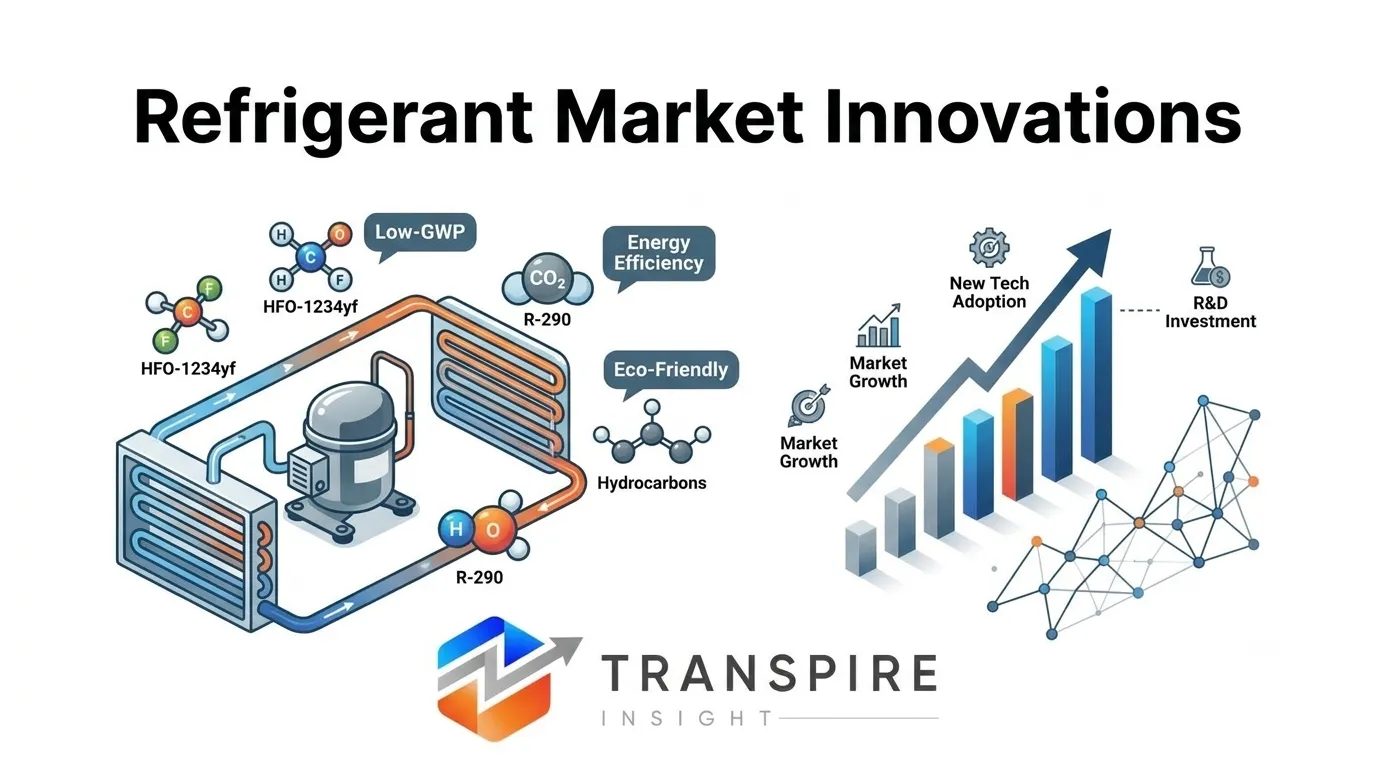
Rising cooling demand, stricter environmental regulations and the global shift toward lowglobalwarmingpotential refrigerants are transforming the refrigerant industry, creating a powerful transition-driven growth cycle for manufacturers, technology providers and the broader HVACR ecosystem.
The global cooling industry is facing a major paradox: demand for air conditioning and refrigeration is rising rapidly, yet many of the refrigerants traditionally used in cooling equipment are being phased down because of their environmental impact. As temperatures rise, urbanization expands and coldchain infrastructure grows, the world needs more cooling capacity at the same time that governments and manufacturers are pushing the industry toward refrigerants with lower global warming potential.
This transition is reshaping the global refrigerant market. Hydrofluorocarbons (HFCs) remain important across the installed base, but regulations under the Kigali Amendment, the U.S. AIM Act and Europe's FGas framework are accelerating the adoption of lowerGWP alternatives. Hydrofluoroolefins (HFOs), hydrocarbons such as propane and isobutane, and inorganic refrigerants such as ammonia and carbon dioxide are gaining importance across different applications.
The pressure is evident across the cooling ecosystem. Demand is increasing for residential air conditioners, commercial refrigeration, industrial cooling, heat pumps, coldstorage facilities and automotive air conditioning. At the same time, equipment manufacturers must redesign systems, qualify alternative refrigerants, improve energy efficiency and comply with changing regulatory requirements.
For the refrigerant sector, however, the same transition is creating a major growth opportunity. Every new cooling system requires a compatible refrigerant, while the replacement and servicing of existing equipment creates recurring aftermarket demand. The shift toward lowGWP technologies is therefore not simply reducing demand for older refrigerants; it is creating a new market for alternative chemistries, blends, equipment redesign, recovery systems and specialized services.
Market Statistics
The global refrigerants market was valued at approximately USD 7.44 billion in 2025 and is projected to reach around USD 15.05 billion by 2035, expanding at a CAGR of 7.3% from 2026 to 2035. North America held the largest regional share in 2025, while AsiaPacific is benefiting from strong cooling demand, urbanization and expanding appliance penetration.
Key Numbers Behind the Refrigerant Growth
Why the Refrigerant SuperCycle Started
The current refrigerant growth cycle is the result of four forces converging at the same time: rising cooling demand, environmental regulation, the transition toward lowGWP refrigerants and expansion of refrigeration and coldchain infrastructure.
Rising Cooling Demand
The first major force is the growing global requirement for cooling.
Urbanization, rising incomes, higher temperatures and expanding commercial infrastructure are increasing demand for air conditioners, chillers, refrigerators and other cooling equipment.
Emerging economies are particularly important because millions of households and businesses are still increasing their access to modern cooling systems. At the same time, established markets are replacing older equipment with more efficient systems.
This creates a direct relationship between the expansion of the global cooling stock and refrigerant consumption.
The more airconditioning and refrigeration equipment installed around the world, the greater the requirement for refrigerants during initial charging, maintenance, servicing and replacement.
Environmental Regulation
The second major force is regulation.
The Kigali Amendment to the Montreal Protocol is driving the global phasedown of HFCs, while the United States and European Union have introduced additional measures to reduce highGWP refrigerant use.
The U.S. AIM Act establishes a phasedown framework for HFC production and consumption, while Europe's FGas regulations are pushing the market toward lowerGWP alternatives.
These policies are changing the economics of the refrigerant industry. Manufacturers are no longer competing only on cooling performance and price; they increasingly need to provide products that meet increasingly strict environmental requirements.
LowGWP Technology Transition
The transition away from highGWP refrigerants is creating a new technology cycle.
HFOs, hydrocarbons, ammonia and carbon dioxide are gaining importance as alternatives across different applications. Propane and isobutane offer very low GWP characteristics, while ammonia and CO2 remain important for industrial and commercial refrigeration.
HFObased refrigerants and blends are also gaining traction in applications where manufacturers need a combination of low GWP, performance and compatibility with modern equipment.
This means the refrigerant industry is experiencing a shift in product mix rather than simply a decline in older product categories.
Cold Chain and Industrial Refrigeration
The fourth major force is the expansion of refrigeration infrastructure.
Food processing, supermarkets, pharmaceutical distribution, temperaturecontrolled logistics and industrial storage all require reliable refrigeration.
The pharmaceutical cold chain is particularly important because temperaturesensitive vaccines, biologics and medicines require controlled environments throughout storage and transportation.
Industrial refrigeration is also expanding across food processing, chemical manufacturing and largescale coldstorage facilities.
This creates recurring demand for refrigerants as systems are installed, maintained, repaired and eventually replaced.
These factors create a reinforcing cycle:
More cooling demand → more HVACR installations → greater refrigerant consumption → stricter environmental regulation → faster lowGWP transition → more equipment redesign and replacement → greater demand for nextgeneration refrigerants.
The unusual part of this cycle is that environmental regulation is not simply restricting the market. It is actively creating a new market for alternative refrigerants and the equipment designed around them.
The Technology Squeeze Behind the Refrigerant Boom
The HFC Transition Problem
HFCs remain important because a large installed base of air conditioners, refrigerators and industrial cooling systems still relies on them.
However, their high global warming potential is creating pressure for phasedown.
The result is a complicated transition. Manufacturers must continue supporting existing equipment while simultaneously developing and supplying lowerGWP alternatives.
This creates a twotrack market in which legacy refrigerants generate servicing and replacement demand while nextgeneration refrigerants drive new equipment sales.
The HFC market itself is therefore being reshaped rather than disappearing immediately. One current industry assessment estimates the global HFC refrigerant market at USD 4.8 billion in 2025, with growth continuing through 2035 even as lowerGWP alternatives gain market share.
The LowGWP Problem
LowGWP refrigerants offer environmental advantages, but their adoption can require changes to equipment design, safety systems and servicing practices.
Hydrocarbon refrigerants such as propane and isobutane are highly flammable, while ammonia has toxicity considerations. CO2 systems operate at high pressures.
These characteristics mean that refrigerant substitution is not always a simple oneforone replacement.
Manufacturers may need to redesign compressors, heat exchangers, valves, sensors and safety systems to work effectively with alternative refrigerants.
This increases the value of specialized engineering expertise and creates opportunities for companies supplying compatible equipment and components.
The Supply Problem
The refrigerant transition is also creating a supplychain challenge.
Manufacturers must scale production of new refrigerants quickly enough to support equipment manufacturers, distributors and service providers while maintaining availability of legacy products for existing installations.
This is creating investment opportunities across refrigerant manufacturing capacity, chemical feedstocks, blending facilities, distribution networks and recovery systems.
Companies that can secure reliable production and distribution of lowGWP refrigerants are increasingly positioned to capture the transition.
The Recovery and Recycling Problem
As highGWP refrigerants are phased down, recovery and recycling are becoming increasingly important.
Existing systems cannot simply release refrigerants into the atmosphere when equipment is serviced or replaced. Refrigerant recovery, reclamation and responsible disposal are becoming more important parts of the HVACR ecosystem.
This creates an additional aftermarket opportunity for recovery equipment, reclamation services, specialized distributors and refrigerantmanagement technologies.
The market is therefore expanding beyond refrigerant production into a broader circular ecosystem.
The Economics: Who Is Making Money?
The refrigerant transition is creating opportunities across the entire cooling ecosystem.
LowGWP Refrigerant Manufacturers
Chemical companies producing HFOs, lowerGWP blends and natural refrigerants are among the biggest beneficiaries.
Companies such as Honeywell, Chemours, Arkema, Daikin, SRF, Gujarat Fluorochemicals and other refrigerant producers are participating in the transition toward nextgeneration refrigerants.
HVAC Equipment Manufacturers
Equipment manufacturers benefit because refrigerant transitions frequently require new system designs.
Air conditioners, chillers, heat pumps, refrigerators and industrial refrigeration systems increasingly need to be optimized for specific lowGWP refrigerants.
This creates opportunities for companies that can combine refrigerant chemistry with efficient equipment design.
Chemical and Fluorochemical Suppliers
Refrigerant production depends on specialized chemical feedstocks, fluorochemical technologies and advanced manufacturing processes.
Suppliers with strong chemical infrastructure can benefit as the industry shifts from legacy HFCs toward highervalue lowGWP products.
Recovery and Recycling Companies
The transition creates a growing need for refrigerant recovery, reclamation and recycling.
Companies capable of recovering refrigerants from existing systems and returning suitable material to the supply chain can benefit from tightening environmental requirements and the need to manage legacy refrigerants responsibly.
Distributors and Service Providers
Refrigerant distributors and HVAC service companies can benefit from recurring demand created by installation, maintenance, repair and retrofit activity.
Companies with access to multiple refrigerant types can be particularly valuable as customers transition between legacy and nextgeneration products.
The Challenges
The rapid transformation of the refrigerant market is accompanied by several operational hurdles.
The first is the cost of transition. LowGWP refrigerants may require new equipment designs, new components, updated safety systems and specialized technician training.
The second challenge is regulatory fragmentation. Different countries and regions are moving through refrigerant transitions at different speeds, creating a complicated compliance environment for global manufacturers.
The third challenge is safety. Natural refrigerants can offer very low GWP but may introduce flammability, toxicity or highpressure considerations. This means that refrigerant selection must balance environmental performance with safety and system efficiency.
The industry also faces a skilledlabor challenge. Technicians need training to safely handle new refrigerants, particularly A2L refrigerants, hydrocarbons, ammonia and CO2 systems.
At the same time, manufacturers need to invest heavily in new production capacity, research, testing and certification.
These pressures could increase transition costs in the short term, but they are also creating opportunities for companies that can provide compliant refrigerants, equipment and services at scale.
Top 5 Beneficiary Countries of the Refrigerant Opportunity
The United States is positioned to capture significant refrigeranttransition demand because of its enormous installed base of HVAC and refrigeration equipment and its strong regulatory push toward lowerGWP refrigerants.
The AIM Act is accelerating the HFC phasedown while creating demand for alternative refrigerants and compatible HVAC equipment.
The U.S. also has a large aftermarket servicing ecosystem, creating opportunities across refrigerant production, distribution, equipment replacement and recovery.
China is one of the world's most important HVAC manufacturing centers and has a massive domestic cooling market.
Largescale airconditioner production, expanding refrigeration infrastructure and rising domestic cooling demand make China strategically important to the global refrigerant supply chain.
Its manufacturing ecosystem also gives domestic chemical and equipment companies an opportunity to scale lowGWP technologies.
India is emerging as a major growth market because rising temperatures, urbanization, higher household incomes and expanding commercial infrastructure are increasing demand for cooling.
The country's refrigeration market is also benefiting from pharmaceutical logistics, food processing, cold storage and modern retail.
AsiaPacific is already a major refrigerant market, while India is identified as one of the region's fastergrowing country markets.
Japan combines advanced HVAC technology, a mature appliance industry and strong expertise in refrigerant chemistry and energyefficient cooling.
Japanese companies have played an important role in developing and commercializing lowerGWP refrigerant systems, particularly in air conditioning and heatpump applications.
The country's technological capabilities position it to benefit from the continued shift toward highefficiency and environmentally improved cooling systems.
Germany is positioned to benefit from Europe's aggressive refrigerant transition.
The European regulatory framework is pushing manufacturers and users toward lowerGWP alternatives, increasing demand for natural refrigerants, HFObased products and compatible equipment.
Germany's strong industrial base, engineering capabilities and refrigeration technology ecosystem make it an important market for the next generation of cooling technologies.
How Long Can the Refrigerant SuperCycle Last?
The refrigerant transition supercycle could remain strong for several years because the global cooling stock will continue expanding even as the composition of refrigerants changes.
The underlying demand for cooling is unlikely to disappear. Instead, the market is expected to move from a traditional consumptiondriven model toward a technologytransition model.
Existing HFCbased equipment will continue to require servicing and replacement refrigerants, while new systems will increasingly use lowerGWP alternatives.
This creates overlapping demand cycles.
As new regulations take effect, equipment manufacturers will increasingly redesign product lines. New refrigerants will require new compressors, heat exchangers, controls, safety systems and technician training.
The market could therefore remain structurally attractive even after the initial regulatory transition slows.
The next phase of growth is likely to shift from simply supplying refrigerant gases toward a broader ecosystem of lowGWP chemistry, highefficiency equipment, recovery and recycling, digital monitoring and specialized servicing.
The boom may therefore evolve rather than abruptly end, shifting from regulationdriven replacement toward normal coolingdemand growth and recurring aftermarket consumption.
Conclusion
The global transition toward cleaner and lowerGWP cooling is creating an unexpected growth engine for the refrigerant industry.
Rising temperatures, urbanization, expanding airconditioning adoption, coldchain development and industrial refrigeration demand are increasing the need for cooling, while environmental regulations are simultaneously transforming the refrigerants used to provide that cooling.
This is opening opportunities for lowGWP refrigerant manufacturers, HVAC equipment companies, chemical suppliers, recovery and recycling businesses, distributors and specialized service providers.
Investments in HFOs, hydrocarbons, ammonia, CO2 systems, refrigerant recovery and nextgeneration HVAC equipment are further strengthening the ecosystem.
Although highGWP refrigerants will gradually lose market share, the overall need for refrigerants will continue to expand as the global cooling stock grows.


Send us a brief description of your challenge and we'll get back to you within 24 hours.

 inquiry@transpireinsight.com
 APAC:+91 7666513636
 Address


