
Sep 17, 2026
By Transpire Insight
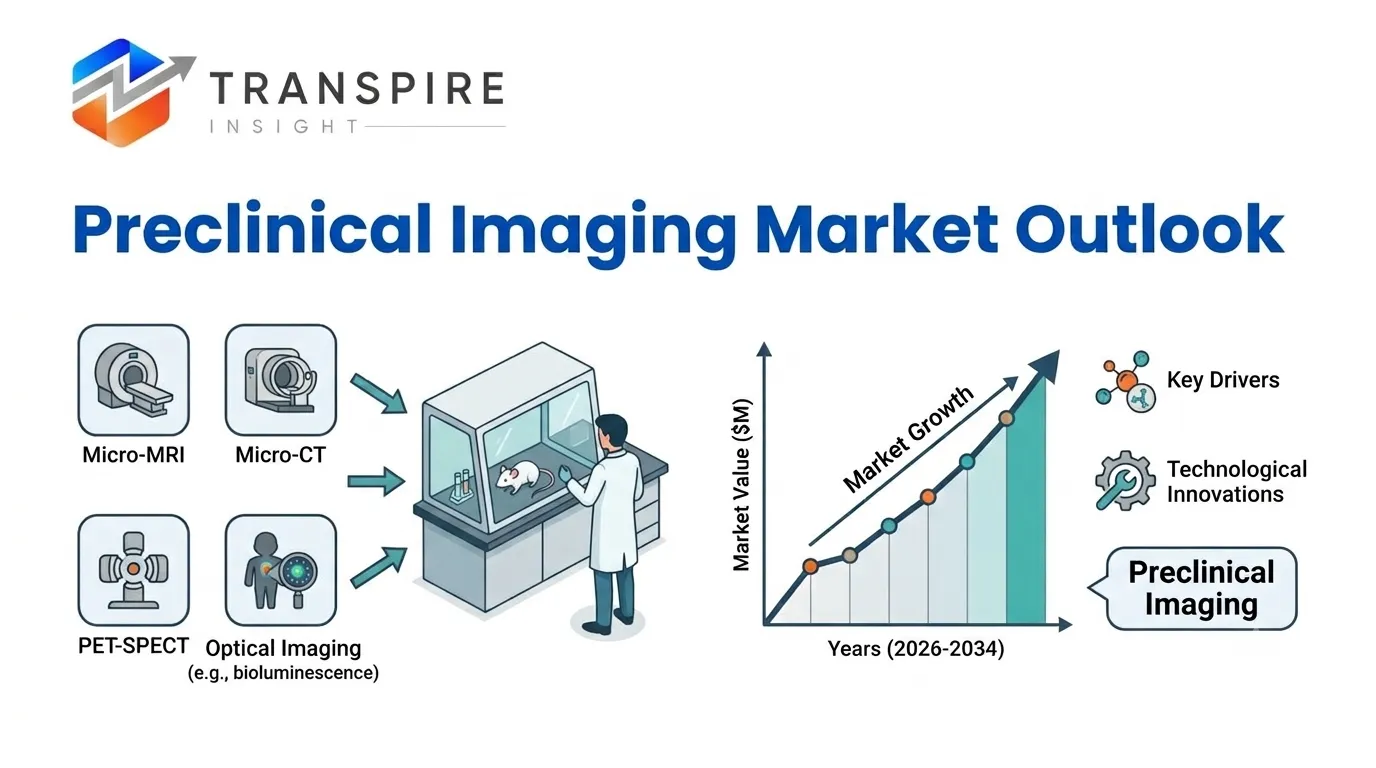
Rising pharmaceutical R&D, growing demand for non-invasive disease monitoring, advances in multimodal imaging and AI-powered image analysis are expanding the role of preclinical imaging, creating a powerful growth cycle for imaging technology providers and research organizations.
The global life sciences industry is facing a major challenge: pharmaceutical and biotechnology companies need to develop safer and more effective therapies faster, yet drug development remains expensive, time-consuming and highly dependent on the quality of preclinical research. As researchers seek better ways to understand disease progression, drug distribution and treatment response before clinical trials, advanced preclinical imaging is becoming an increasingly important research tool.
Preclinical imaging allows researchers to visualize biological processes inside living animal models without repeatedly sacrificing the animals. Technologies such as optical imaging, micro-CT, micro-MRI, PET, SPECT, ultrasound and multimodal platforms can provide information on anatomy, physiology, metabolism, biodistribution and therapeutic response. This makes imaging increasingly valuable in oncology, neurology, cardiology, infectious disease research and drug development.
The market is also benefiting from the broader shift toward translational research. Researchers increasingly want preclinical models to produce data that can better inform human clinical development. Longitudinal imaging allows the same animal to be monitored over time, helping researchers observe disease progression and treatment response while improving the amount of information obtained from individual studies.
For the preclinical imaging sector, however, the opportunity is even broader. The growth of pharmaceutical pipelines, increasing investment in biomedical research, adoption of multimodal imaging, demand for high-resolution visualization and integration of artificial intelligence are creating a powerful combination of growth drivers.
Market Statistics
The global preclinical imaging market size was valued at approximately USD 3.42 billion in 2025 and is projected to reach around USD 6.85 billion by 2034, expanding at a CAGR of 8.0% from 2026 to 2034. North America accounted for approximately 40.64% of the global market in 2025.
Key Numbers Behind the Preclinical Imaging Growth
Why the Preclinical Imaging Super-Cycle Started
The current preclinical imaging growth cycle is the result of several forces converging at the same time: rising drug-development activity, increasing demand for non-invasive research, growth in translational medicine, advances in multimodal imaging and rapid adoption of artificial intelligence.
- Rising Drug Discovery Activity
Pharmaceutical and biotechnology companies continue to invest heavily in research and development as they develop new drugs, biologics and advanced therapies. Preclinical imaging plays an important role in this process because researchers need to understand how potential therapies affect disease models before moving into human studies.
Imaging can provide information about tumor progression, organ function, drug biodistribution, metabolic activity and treatment response. As pharmaceutical pipelines become increasingly complex, researchers need more sophisticated tools to generate quantitative information from preclinical models.
The growing investment in drug development is therefore directly increasing demand for imaging systems, imaging reagents, software and specialized research services. Grand View Research identifies increasing investments in drug development as one of the factors supporting market expansion.
- Growth of Translational Research
A second major driver is the increasing focus on translational research.
Researchers are seeking preclinical models that can provide more clinically relevant information and help bridge the gap between laboratory discoveries and human trials. Imaging is particularly valuable because many modalities can measure biological changes repeatedly over time.
Instead of relying only on endpoint measurements, researchers can use longitudinal imaging to follow disease progression and therapeutic response in the same animal. This can generate richer datasets and improve understanding of how treatments behave during the course of a study.
The expansion of translational research initiatives is therefore turning preclinical imaging from a specialized laboratory technology into an increasingly important component of modern biomedical research.
- Demand for Non-Invasive Disease Monitoring
Traditional preclinical research often relies heavily on tissue collection and endpoint analysis. Advanced imaging provides another approach by allowing researchers to visualize biological processes in living subjects.
Optical imaging, MRI, CT, PET, SPECT and ultrasound can provide complementary information about anatomy, physiology and molecular activity. This is particularly valuable in oncology and neurological research, where disease progression and treatment response can change significantly over time.
The ability to monitor these changes non-invasively is increasing the value of preclinical imaging in drug discovery and disease-model research. The demand for non-invasive imaging techniques has been identified as a key growth factor for the market.
- Artificial Intelligence and Multimodal Imaging
Artificial intelligence is becoming another important growth catalyst.
Modern preclinical imaging systems can generate large volumes of high-resolution images and quantitative datasets. Researchers increasingly need software capable of processing these datasets, identifying patterns and extracting measurements efficiently.
AI-assisted image analysis can support segmentation, classification, quantification and longitudinal comparison. At the same time, multimodal systems can combine different imaging techniques to provide a more comprehensive picture of disease biology.
The integration of AI with multimodal imaging is therefore creating a new layer of value beyond the imaging hardware itself. Industry analysis already identifies AI-powered multimodal systems and data analytics as important trends shaping the market.
These factors create a reinforcing cycle:
More drug-development activity → more preclinical studies → greater need for non-invasive monitoring → more imaging data → greater demand for AI and multimodal analysis → higher value of preclinical imaging → further investment in imaging infrastructure.
The unusual part of this cycle is that preclinical imaging is becoming increasingly important not simply as an imaging technology, but as a data-generation and decision-support platform for drug development.
The Technology Squeeze Behind the Preclinical Imaging Boom
- Multimodal Imaging Problem
Researchers increasingly need more than a single view of disease biology.
Optical imaging can provide sensitive visualization of molecular and cellular activity, while CT and MRI can provide detailed anatomical information. PET and SPECT can support functional and molecular imaging, while ultrasound can provide real-time imaging capabilities.
Each modality has different strengths and limitations. As research questions become more complex, combining modalities can provide a more complete understanding of disease and treatment response.
Multimodal imaging platforms are therefore becoming increasingly important because they can combine anatomical, functional and molecular information within a single research workflow. Market research identifies optical imaging, nuclear imaging, micro-MRI, micro-CT, ultrasound and other modalities as important components of the preclinical imaging ecosystem.
- Resolution and Sensitivity Problem
Preclinical research often requires imaging systems capable of detecting relatively small anatomical or biological changes.
Small-animal models can require higher spatial resolution than conventional clinical imaging systems. Researchers may also need to detect subtle molecular or functional changes before they become visible through conventional anatomical imaging.
This is increasing demand for high-resolution micro-CT, micro-MRI, PET, SPECT and optical imaging systems, as well as specialized probes and contrast agents.
The market is consequently moving toward systems that provide higher sensitivity, better spatial resolution and improved quantitative capabilities.
- Data and Software Problem
The expansion of imaging capabilities is also creating a data-management challenge.
Advanced imaging systems generate large datasets that must be reconstructed, processed, analyzed and interpreted. Researchers need software that can convert complex images into useful quantitative measurements.
This is creating opportunities for software providers, AI developers and imaging companies that can integrate image acquisition with automated analysis.
The software segment is projected to grow at an 8.5% CAGR in one current market assessment, illustrating the increasing importance of software within the broader preclinical imaging ecosystem.
- Research Capacity Problem
The growth of preclinical imaging is also constrained by the availability of specialized research infrastructure.
Advanced imaging systems require expensive equipment, specialized facilities, trained operators and technical support. Pharmaceutical companies, biotechnology companies, universities and research institutes may therefore rely on contract research organizations and specialized imaging service providers.
This creates an opportunity for service-based business models that allow researchers to access advanced imaging capabilities without making the full capital investment in equipment and infrastructure.
The Economics: Who Is Making Money?
The preclinical imaging growth cycle is creating opportunities across the entire biomedical research ecosystem.
- Imaging System Manufacturers
Manufacturers of MRI, CT, PET, SPECT, optical imaging, ultrasound and multimodal systems are positioned to benefit as pharmaceutical and academic research organizations expand imaging capabilities.
Companies such as Bruker, FUJIFILM, PerkinElmer, Thermo Fisher Scientific and other specialized imaging providers participate in different parts of the preclinical imaging ecosystem.
- Imaging Software Providers
Software is becoming increasingly important as researchers seek automated image processing, quantitative analysis and AI-assisted interpretation.
Companies capable of integrating image acquisition, reconstruction, segmentation, analysis and data visualization can capture a growing share of the value chain.
- Reagent and Contrast-Agent Suppliers
Imaging is not limited to hardware. Optical probes, fluorescent markers, contrast agents and nuclear imaging materials are essential to many research workflows.
As the number of imaging studies increases, suppliers of specialized reagents and consumables can benefit from recurring demand.
- Contract Research Organizations
CROs can benefit because pharmaceutical and biotechnology companies increasingly need specialized research capabilities without building every capability internally.
Preclinical imaging services allow drug developers to access imaging systems, trained personnel, animal models and analytical expertise through outsourced research programs.
- Pharmaceutical and Biotechnology Companies
The largest economic benefit may ultimately be realized by drug developers themselves.
Better preclinical imaging can help researchers understand therapeutic response earlier, improve disease-model characterization and generate more detailed information before clinical development.
The value is therefore not limited to the sale of imaging equipment; it extends to the potential improvement of the drug-development process.
The Challenges
The rapid expansion of the preclinical imaging market is accompanied by several operational hurdles.
Advanced imaging systems can require significant capital investment, specialized laboratory infrastructure and trained technical personnel. This can limit adoption among smaller research organizations.
Data complexity is another challenge. Multimodal imaging can generate large datasets that require sophisticated software, standardized workflows and specialized analytical expertise.
Animal-model variability can also affect research outcomes. Differences in disease models, animal characteristics and experimental protocols can make it difficult to standardize results across studies.
Regulatory and ethical considerations surrounding animal research add another layer of complexity. Researchers must balance the need for meaningful preclinical data with efforts to reduce animal use and improve research efficiency.
At the same time, imaging companies need to continue investing in higher-resolution systems, AI-based analytics, multimodal platforms and easier-to-use research workflows. The industry's ability to convert growing research demand into accessible imaging capacity will determine how quickly the market can expand.
Top 5 Beneficiary Countries of the Preclinical Imaging Opportunity
The United States is positioned to capture significant preclinical imaging demand because of its large pharmaceutical and biotechnology industry, extensive biomedical research infrastructure and strong investment in drug development.
Major universities, research institutions, pharmaceutical companies and specialized technology providers create a large installed base for advanced imaging systems. North America held the leading regional position, accounting for approximately 40.64% of the global market in 2025.
Germany has a strong pharmaceutical, biotechnology and medical-technology ecosystem, supported by extensive academic and research infrastructure.
The country's established biomedical research base creates demand for advanced imaging modalities across oncology, neurology, drug discovery and translational research.
The United Kingdom's strong university research ecosystem, pharmaceutical industry and investment in biomedical sciences make it an important market for preclinical imaging.
Research institutions and biotechnology companies are increasingly focused on translational medicine, precision medicine and advanced disease modeling, creating demand for sophisticated imaging technologies.
Japan combines a mature pharmaceutical and life-sciences industry with advanced medical technology capabilities.
Its established research infrastructure and growing focus on oncology, neuroscience, regenerative medicine and drug development support demand for preclinical imaging systems.
India is emerging as one of the most attractive growth markets for preclinical imaging as pharmaceutical R&D, biotechnology research and contract research activity expand.
The country's preclinical imaging market is projected to grow from approximately USD 35.0 million in 2025 to USD 63.2 million by 2033, representing a 7.7% CAGR from 2026 to 2033. This places India among the faster-growing national markets within the broader preclinical imaging landscape.
How Long Can the Preclinical Imaging Super-Cycle Last?
The preclinical imaging growth cycle could remain strong for several years because pharmaceutical and biotechnology companies will continue investing in drug discovery, translational research and advanced disease models.
Even as imaging technology becomes more established, the market is likely to evolve rather than abruptly slow. Growth can increasingly shift from first-time hardware purchases toward software, services, reagents, upgrades, multimodal platforms and AI-assisted analytics.
The installed base of imaging systems will also create recurring opportunities. Researchers will require maintenance, software upgrades, new probes, contrast agents, replacement equipment and analytical services.
At the same time, the expansion of next-generation imaging technologies will create new research applications. AI-assisted image analysis, multimodal imaging, high-resolution systems and longitudinal monitoring could expand the amount of biological information researchers can obtain from each study.
The cycle may therefore evolve from a hardware-driven market into a broader imaging-as-a-research-platform ecosystem, where equipment, software, reagents, services and data analytics work together.
Conclusion
The growing complexity of drug discovery and biomedical research is creating an unexpected growth engine for the preclinical imaging industry.
Rising pharmaceutical R&D spending, increasing demand for non-invasive disease monitoring, expansion of translational research, advances in multimodal imaging and rapid adoption of artificial intelligence are increasing the value of imaging in preclinical studies.
This is opening opportunities for imaging-system manufacturers, software companies, reagent suppliers, CROs and specialized research-service providers.
Investments in high-resolution imaging, multimodal platforms, AI-based image analysis and specialized research infrastructure are further strengthening the ecosystem.
Although pharmaceutical research priorities will continue to change, the need to understand disease biology and therapeutic response before clinical trials will remain fundamental.
The industry's next major opportunity may therefore not simply be selling another imaging machine, but building the integrated imaging, software, data and research infrastructure required to turn preclinical images into better drug-development decisions.


Send us a brief description of your challenge and we'll get back to you within 24 hours.

 inquiry@transpireinsight.com
 APAC:+91 7666513636
 Address


