
Jul 24, 2026
By Transpire Insight
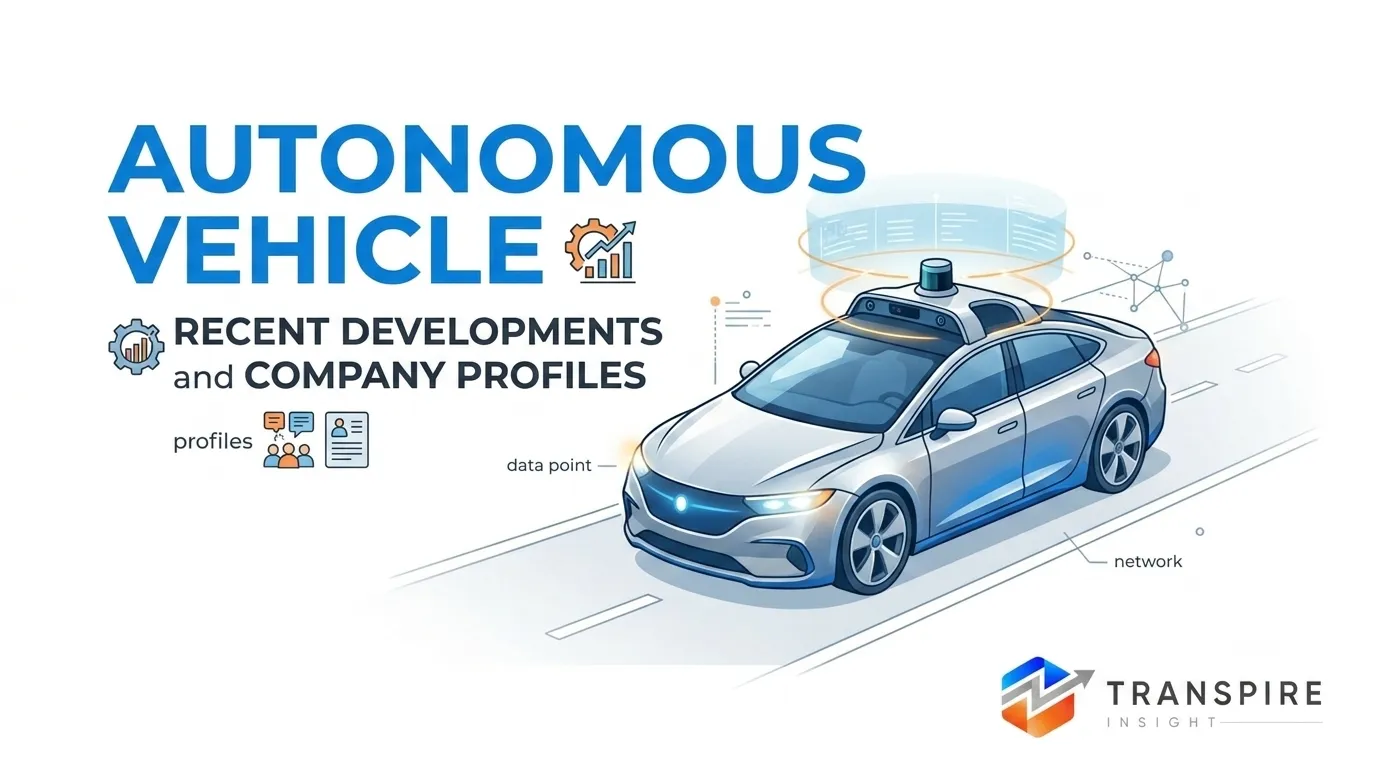
Tesla Expands Robotaxi Operations and Accelerates Autonomous Driving Rollout, Escalating Competition with Waymo and Mobileye
According to Transpire Insights, a market research and consulting firm with more than 7 years of experience tracking autonomous driving technologies, artificial intelligence, connected mobility, transportation infrastructure, and emerging automotive markets, Tesla's Robotaxi expansion comes at a pivotal moment for the global transportation industry. The Global Autonomous Vehicle Market size was worth around USD 87.3 billion in 2025 and is projected to grow around USD 408.5 billion by 2033, at a CAGR of approximately 21.28% during the forecast period from 2026 to 2033.
The global automotive industry entered a new phase this year as Tesla accelerated the deployment of its Robotaxi platform, a fully autonomous mobility service designed to transform urban transportation. The announcement positions Tesla in direct competition with Waymo's autonomous ride-hailing network, Mobileye's self-driving ecosystem, and several global automakers investing heavily in next-generation autonomous driving technologies.
The expansion signals a broader shift toward AI-powered transportation, where artificial intelligence becomes the primary decision-making system behind vehicle navigation, safety, and mobility services rather than a supporting feature operating in the background
Industry analysts view the Robotaxi expansion as one of the most significant developments in the automotive industry since the commercialization of advanced driver-assistance systems. Tesla's autonomous mobility platform combines artificial intelligence, neural networks, high-performance computing, cameras, sensors, and real-time connectivity into a unified ecosystem designed for the next generation of transportation.
Tesla Bets on the Future of Autonomous Mobility
For decades, the automotive industry has been defined by engine performance, vehicle design, safety features, and fuel efficiency. The rise of artificial intelligence is now reshaping those priorities.
Tesla's Robotaxi platform leverages advanced AI systems capable of analyzing road conditions, identifying obstacles, interpreting traffic environments, and making real-time driving decisions. The platform is designed to support future transportation networks where vehicles can operate with minimal human intervention.
According to Tesla's vision, transportation is being transformed from a driver-controlled activity into an intelligent mobility experience capable of understanding complex road environments and autonomously performing transportation tasks.
The Robotaxi initiative forms part of Tesla's broader effort to create an AI-powered transportation ecosystem that extends beyond vehicle manufacturing and into mobility services.
Why the Robotaxi Expansion Matters
Tesla's expansion into autonomous ride-hailing comes at a time when artificial intelligence is driving unprecedented growth across the automotive and transportation industries.
The broader autonomous vehicle industry is also experiencing significant momentum. Industry estimates indicate that the global autonomous driving software market could grow from approximately USD 2.3 billion in 2025 to more than USD 7.06 billion by 2033, driven by increasing deployment of AI-powered navigation systems, autonomous driving platforms, real-time vehicle intelligence, and connected transportation technologies.
At the same time, Robotaxi services are emerging as one of the fastest-growing segments within the mobility industry. According to Transpire Insights leading transportation research firms, autonomous ride-hailing services could account for 36% of urban mobility trips by 2033, as operators expand commercial deployments across major metropolitan areas.
The rise of artificial intelligence is further accelerating investments across the transportation sector. Global spending on AI-powered mobility solutions is projected to exceed USD 19.6 billion annually by the end of the decade as governments, automakers, and technology providers increase investments in autonomous transportation, smart city infrastructure, fleet automation, and intelligent traffic management systems.
The convergence of artificial intelligence, advanced computing, connected vehicle ecosystems, and next-generation mobility services is creating one of the most significant transformations in transportation history.
Competitive Analysis
Transpire Insights forecasts indicate that the global autonomous vehicle industry is expected to witness substantial expansion throughout the forecast period as artificial intelligence, connectivity, and mobility services continue transforming transportation.
Similarly, the Robotaxi market is projected to expand from approximately USD 1.25 billion in 2025 to nearly USD 231.8 billion by 2033 at a CAGR of approx.. 92.1%, reflecting increasing demand for autonomous ride-hailing and mobility-as-a-service solutions.
The Advanced Driver Assistance Systems (ADAS) market is also expected to experience significant growth as manufacturers continue integrating increasingly sophisticated autonomous technologies into vehicle platforms.
Tesla's expansion into Robotaxi services positions the company to capitalize on one of the most transformative opportunities within the global transportation industry.
Financial Impact
Tesla's expansion into autonomous mobility could have far-reaching implications for the global automotive industry and the future of transportation.
The company remains among the world's most valuable automotive manufacturers and continues benefiting from investor confidence in electric vehicles, artificial intelligence, and autonomous driving technologies.
The opportunity extends far beyond vehicle manufacturing. According to Transpire Insights, global spending on autonomous transportation technologies is projected to grow from approximately USD 103.9 billion in 2025 to more than USD 1.19 trillion by 2033, reflecting the rapid adoption of self-driving technologies across passenger transportation, logistics, and commercial mobility services.
Autonomous mobility is expected to become a major driver of transportation investment. Transpire Insights forecasts investments in AI-powered transportation infrastructure, intelligent mobility platforms, autonomous software systems, and connected vehicle ecosystems will increase significantly throughout the forecast period.
The autonomous vehicle segment is also emerging as a substantial growth opportunity. Transpire Insights forecasts autonomous vehicles could account for approximately 47% of newly manufactured vehicles by 2033, while autonomous mobility services continue expanding globally.
A Direct Challenge to Traditional Transportation Models
Traditional transportation systems have remained largely unchanged for decades.
However, the growing importance of artificial intelligence is creating opportunities for a fundamentally different mobility model.
Conventional transportation depends heavily on human drivers. Autonomous mobility platforms aim to reduce reliance on human intervention through advanced AI systems capable of continuous learning and decision-making.
With Robotaxi services, Tesla is attempting to redefine what consumers and businesses expect from transportation. Industry observers believe the company's expertise in artificial intelligence, software integration, and vehicle technology could allow it to challenge traditional transportation models where vehicle ownership remains the primary mode of mobility.
The expansion has already influenced market sentiment, with investors closely monitoring how autonomous transportation could affect automotive manufacturers, ride-hailing companies, logistics providers, and mobility service operators.
NVIDIA's Role in the Autonomous Vehicle Transformation
NVIDIA has emerged as one of the most influential technology providers within the autonomous vehicle ecosystem
The company's DRIVE platform provides the computing power required for advanced autonomous driving systems, enabling vehicle manufacturers to process vast amounts of sensor data and execute real-time driving decisions.
NVIDIA executives have repeatedly described autonomous vehicles as one of the most important applications of artificial intelligence.
The company's automotive solutions support AI training, simulation, autonomous driving development, and intelligent vehicle operations.
This growing collaboration between automotive manufacturers and AI technology providers highlights an important industry trend: autonomous vehicles are becoming as much a computing challenge as an automotive challenge.
Major Technology Brands Move Quickly
The industry response to autonomous mobility has been immediate.
Several leading automotive manufacturers and technology companies have accelerated investments in self-driving technologies, intelligent transportation systems, and AI-powered mobility services.
Companies including Mercedes-Benz, BMW, General Motors, Toyota, Baidu, Mobileye, Aurora Innovation, Zoox, and numerous automotive suppliers continue developing autonomous driving platforms designed to compete in the rapidly expanding market.
These initiatives indicate that major industry participants view autonomous mobility as a significant long-term growth opportunity.
Industry analysts expect additional partnerships, technology launches, and commercial deployments over the coming years as competition within the autonomous vehicle sector intensifies.
Market Impact: The Beginning of an Autonomous Transportation Race
Tesla's Robotaxi expansion highlights a broader transformation occurring across the transportation industry.
Artificial intelligence is increasingly becoming a central component of vehicle design, mobility services, logistics operations, and transportation infrastructure.
As a result, automakers are racing to develop technologies capable of supporting autonomous navigation, intelligent decision-making, predictive safety systems, and connected mobility experiences.
The shift has implications for multiple industries, including automotive manufacturing, semiconductors, artificial intelligence, cloud computing, telecommunications, logistics, insurance, and smart city infrastructure.
Organizations capable of delivering scalable autonomous mobility solutions are expected to gain strategic advantages as transportation continues evolving.
The Key Players Shaping the Autonomous Vehicle Market
Founded: 2003
Headquarters: Austin, Texas, United States
Tesla has evolved from an electric vehicle manufacturer into one of the world's leading artificial intelligence and autonomous mobility companies. Through Full Self-Driving technology, AI infrastructure, and Robotaxi initiatives, Tesla continues positioning itself at the forefront of autonomous transportation.
Founded: 2009
Headquarters: Mountain View, California, United States
Waymo is widely recognized as one of the pioneers of autonomous driving technology. The company operates commercial autonomous ride-hailing services and continues expanding its self-driving mobility ecosystem through advanced AI, mapping systems, and sensor technologies.
Founded: 1999
Headquarters: Jerusalem, Israel
Mobileye has become a global leader in advanced driver-assistance systems and autonomous driving technologies. Its vision-based mobility solutions support vehicle manufacturers worldwide.
Founded: 1993
Headquarters: Santa Clara, California, United States
NVIDIA plays a critical role in autonomous driving through its DRIVE computing platform, artificial intelligence technologies, and automotive software ecosystem. Its solutions support numerous autonomous vehicle development programs globally.
Transpire Insights Expert View
According to Transpire Insights analysis, Tesla's Robotaxi expansion represents more than a mobility service launch; it marks a strategic attempt to redefine the future architecture of transportation.
"The automotive industry is entering a transformation comparable to the digital revolution that reshaped communication and computing over the past two decades. Historically, transportation leadership was determined by manufacturing scale, engineering excellence, and brand strength. The next phase of competition will be driven by artificial intelligence, autonomous capabilities, software ecosystems, data intelligence, and mobility innovation."
"The autonomous vehicle market is creating opportunities far beyond vehicle manufacturing. Semiconductor companies, cloud computing providers, AI developers, telecommunications operators, mapping companies, cybersecurity firms, and infrastructure developers are all expected to benefit from the growing adoption of autonomous mobility technologies."
Conclusion
Tesla's expansion of Robotaxi operations represents one of the most significant milestones in the evolution of autonomous transportation. As artificial intelligence continues reshaping mobility, competition among Tesla, Waymo, Mobileye, NVIDIA, Baidu, and other industry leaders is expected to intensify.
The autonomous vehicle market stands at the intersection of automotive innovation, artificial intelligence, cloud computing, advanced semiconductors, and smart transportation infrastructure. While challenges related to regulation, safety, and scalability remain, the industry's long-term outlook continues to strengthen.
According to Transpire Insights, the convergence of autonomous driving technologies, AI-powered mobility solutions, connected transportation ecosystems, and intelligent infrastructure will play a central role in shaping the future of global transportation over the coming decade.


Send us a brief description of your challenge and we'll get back to you within 24 hours.

 inquiry@transpireinsight.com
 APAC:+91 7666513636
 Address


