
Oct 10, 2026
By Transpire Insight
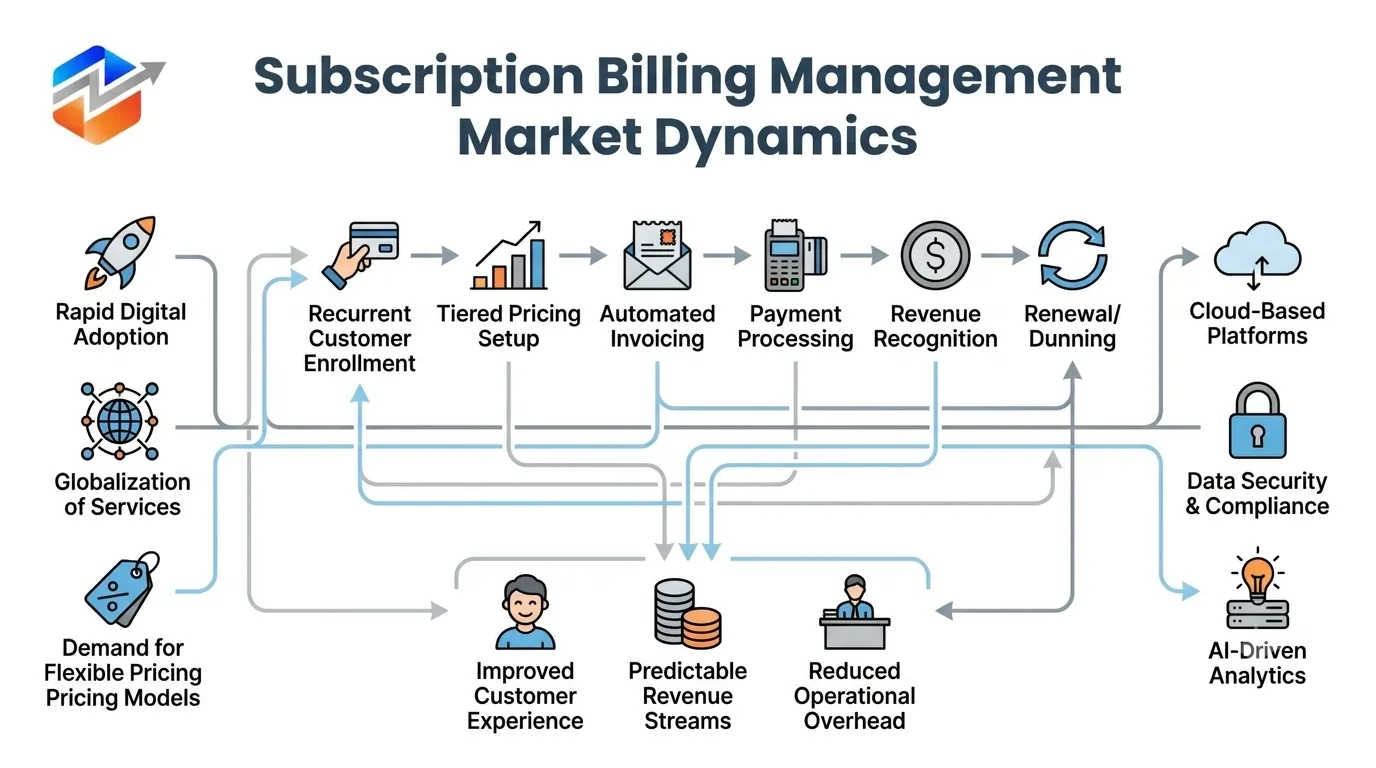
The global Subscription Billing Management Market is expanding as businesses move from one-time transactions toward recurring, usage-based, tiered, and hybrid monetization models. Cloud software, artificial intelligence, connected products, digital services, and consumption-based pricing are increasing the need for billing platforms capable of handling complex pricing structures and automated revenue operations.
Subscription Billing Management Market Overview
The Subscription Billing Management Market covers software and services used to manage recurring customer relationships, subscription plans, invoicing, payments, usage-based pricing, revenue recognition, renewals, upgrades, downgrades, taxation, and revenue operations.
Modern platforms increasingly connect billing with:
Transpire Insights estimates that the global Subscription Billing Management Market was valued at approximately USD 8.18 billion in 2025, increased to around USD 9.46 billion in 2026, and could reach nearly USD 21.85 billion by 2033,
Latest Global Market Developments
Cloud services, AI applications, connected products, and digital platforms increasingly charge according to actual consumption rather than only fixed subscription periods. ISG identifies consumption processing and flexible pricing as major forces shaping recurring-billing technology in 2026.
Billing platforms are increasingly using AI for churn prediction, payment-anomaly detection, revenue recovery, pricing analysis, and automated dunning.
Anthropic reported approximately $3.8 billion of 2025 revenue from customers paying according to their use of Claude, compared with approximately $789 million in subscription revenue, illustrating the commercial importance of consumption-based monetization for AI services.
Cloud-based billing allows businesses to launch new pricing structures without maintaining extensive internal billing infrastructure.
Modern solutions increasingly cover the complete quote-to-cash cycle instead of simply generating invoices.
International subscriptions require support for multiple currencies, payment methods, tax regimes, renewals, refunds, and local payment preferences.
Automated billing validation and reconciliation can help companies identify missed charges, incorrect discounts, failed payments, and contract discrepancies.
ISG's 2026 assessment evaluates 19 recurring-billing providers and identifies growing demand around AI-driven offerings, connected products, flexible pricing, and integrated financial operations.
Why Subscription Billing Management Matters?
Subscription businesses cannot scale efficiently when pricing, invoicing, payments, customer entitlements, and revenue recognition are managed through disconnected systems.
Billing platforms can support:
As business models become more complicated, billing infrastructure increasingly becomes a core component of commercial operations.
Key Factors Driving the Market
1. Expansion of SaaS
Software companies increasingly depend on recurring revenue, creating continuous demand for automated subscription-management infrastructure.
2. Usage-Based Pricing
AI, cloud infrastructure, APIs, cybersecurity, and connected services are increasingly charging customers according to consumption.
3. Digital Payments
Greater digital-payment adoption makes automated recurring transactions more practical.
4. AI-Based Revenue Operations
AI can analyze customer payment behavior, churn risk, pricing performance, and revenue anomalies.
5. Global Subscription Expansion
Companies increasingly sell subscriptions across multiple countries, creating greater billing and taxation complexity.
Five High-Potential Markets
1. United States
The U.S. remains a major subscription economy with large SaaS, streaming, cloud, fintech, and digital-service industries.
2. United Kingdom
The U.K. offers strong demand from software, financial services, media, digital commerce, and subscription businesses.
3. Germany
Germany provides opportunities across industrial SaaS, enterprise software, manufacturing subscriptions, and digital services.
4. India
India represents a high-growth opportunity because of its rapidly expanding SaaS ecosystem, digital payments infrastructure, and technology-startup base.
5. Singapore
Singapore serves as an important regional hub for software, fintech, cloud services, and cross-border digital businesses across Southeast Asia.
Competitive Landscape
Top 5 Companies
ISG's 2026 evaluation identifies Zuora, Stripe, and BillingPlatform among the leading providers and assesses 19 vendors across recurring-billing capabilities.
Opportunities for Small Investors
Challenges & Restraints
Complex integrations, cybersecurity requirements, payment failures, tax regulations, data privacy, pricing complexity, migration costs, and interoperability can slow adoption.
Businesses also need billing systems capable of handling increasingly complicated combinations of subscriptions, usage charges, credits, discounts, and contracts.
Conclusion
The Subscription Billing Management Market is moving beyond conventional recurring invoicing toward AI-assisted monetization and flexible revenue infrastructure.
Usage-based AI services provide a particularly important example of this transition, while 2026 industry research shows continued movement toward integrated billing, consumption processing, and flexible pricing.
For software vendors, fintech companies, investors, and enterprise technology providers, opportunities increasingly lie in combining billing with AI, revenue analytics, payment orchestration, taxation, and usage metering.


Send us a brief description of your challenge and we'll get back to you within 24 hours.

 inquiry@transpireinsight.com
 APAC:+91 7666513636
 Address


