
Oct 10, 2026
By Transpire Insight
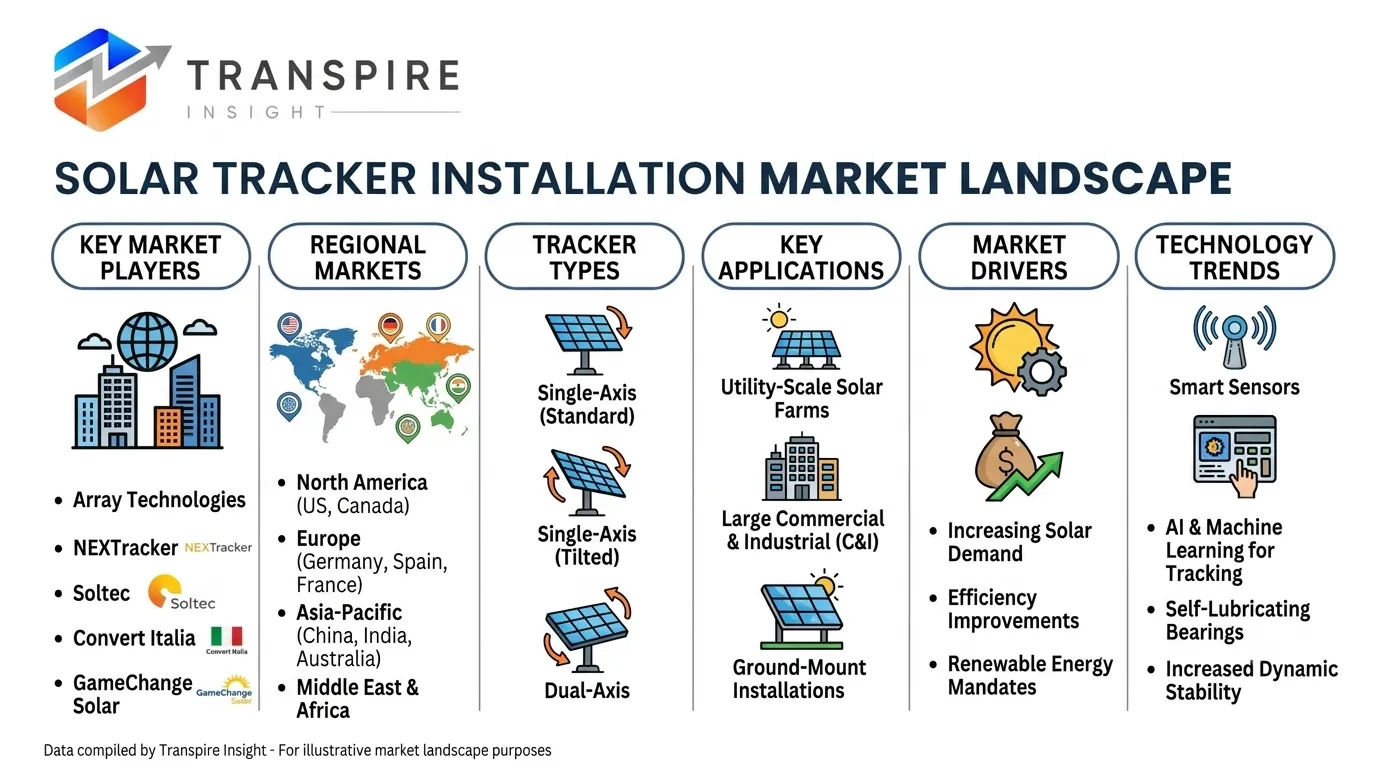
The Solar Tracker Installation Market is expanding as utility-scale photovoltaic developers seek higher energy yields, improved production profiles, and better utilization of available land. Tracker systems are increasingly incorporating weather-responsive stowing, terrain adaptation, intelligent controllers, and more advanced mechanical architectures.
Solar Tracker Installation Market Overview
The Solar Tracker Installation Market covers engineering, procurement, installation, commissioning, integration, and associated services for solar-tracking systems used primarily in utility-scale photovoltaic projects.
Major systems include:
Transpire Insights estimates the global Solar Tracker Installation Market at approximately USD 8.24 billion in 2025, increasing to USD 10.18 billion in 2026 and reaching nearly USD 29.95 billion by 2033, representing an estimated CAGR of 16.65%.
Latest Global Market Developments
TaiyangNews reported global solar-tracker deployment of approximately 112 GW in 2024, highlighting the increasing role of tracking technology in utility-scale PV.
Modern systems increasingly respond to wind conditions, diffuse light, structural loads, and site-specific production conditions rather than simply following a fixed astronomical path.
The industry is experimenting with longer tracker rows, improved torque-tube designs, distributed drive systems, and more robust mechanical configurations.
High-wind conditions can place significant loads on tracker structures, encouraging predictive and responsive stowing strategies.
India installed approximately 27 GW of solar capacity in the first half of 2026, up substantially from the previous year.
Large-scale projects represented approximately 83% of India's installed solar capacity at that time.
Tracker economics are generally strongest where large projects can justify the additional equipment and installation complexity.
New tracker architectures increasingly accommodate uneven terrain, reducing grading requirements and potentially improving project economics.
Why Solar Tracker Installation Matters?
Solar trackers increase panel exposure to sunlight by changing the orientation of modules during the day.
The commercial value comes from improving:
Tracking can therefore become particularly attractive in large-scale solar projects where additional energy generation can justify increased mechanical and installation costs.
Key Factors Driving the Market
1. Utility-Scale Solar Expansion
Large solar farms provide the principal addressable market for tracker systems.
2. Higher Energy Yield
Tracking systems can increase energy production compared with fixed-tilt systems depending on location and design.
3. Declining Solar Costs
As PV module and system costs decline, developers increasingly optimize project-level energy output.
4. Intelligent Controls
Advanced controllers can improve tracker performance under changing weather and site conditions.
5. Renewable-Energy Targets
Government clean-energy programs continue to support large-scale solar deployment.
Five High-Potential Markets
1. United States
The U.S. remains a major tracker market because of extensive utility-scale PV deployment and favorable solar resources in several regions.
2. China
China's enormous solar buildout creates significant opportunities for tracking technologies, particularly in utility-scale projects.
3. India
India is becoming increasingly important as solar capacity expands rapidly. The country installed 27 GW during the first half of 2026 alone.
4. Brazil
Brazil's strong solar resource and large utility-scale and distributed PV sector create opportunities for tracker deployment.
5. Australia
Australia offers substantial potential because of high solar irradiation and large-scale renewable-energy projects.
Competitive Landscape
Top 5 Companies
Opportunities for Small Investors
Challenges & Restraints
Tracker installation can increase project complexity because of structural engineering, civil works, electrical integration, wind loads, terrain conditions, and maintenance requirements.
Other challenges include:
Conclusion
The Solar Tracker Installation Market is becoming increasingly important as utility-scale developers seek greater energy output from large photovoltaic sites.
Tracker technology itself is becoming smarter. The 2026 industry survey highlights advances in drive architecture, structural design, terrain adaptation, and weather-responsive control.
India's rapid solar expansion further demonstrates the scale of the addressable opportunity, with 27 GW added in the first half of 2026.
For engineering companies, solar developers, component suppliers, and installation contractors, opportunities are expanding across tracker installation, intelligent controls, maintenance, structural engineering, and predictive asset management.


Send us a brief description of your challenge and we'll get back to you within 24 hours.

 inquiry@transpireinsight.com
 APAC:+91 7666513636
 Address


