
Sep 23, 2026
By Transpire Insight
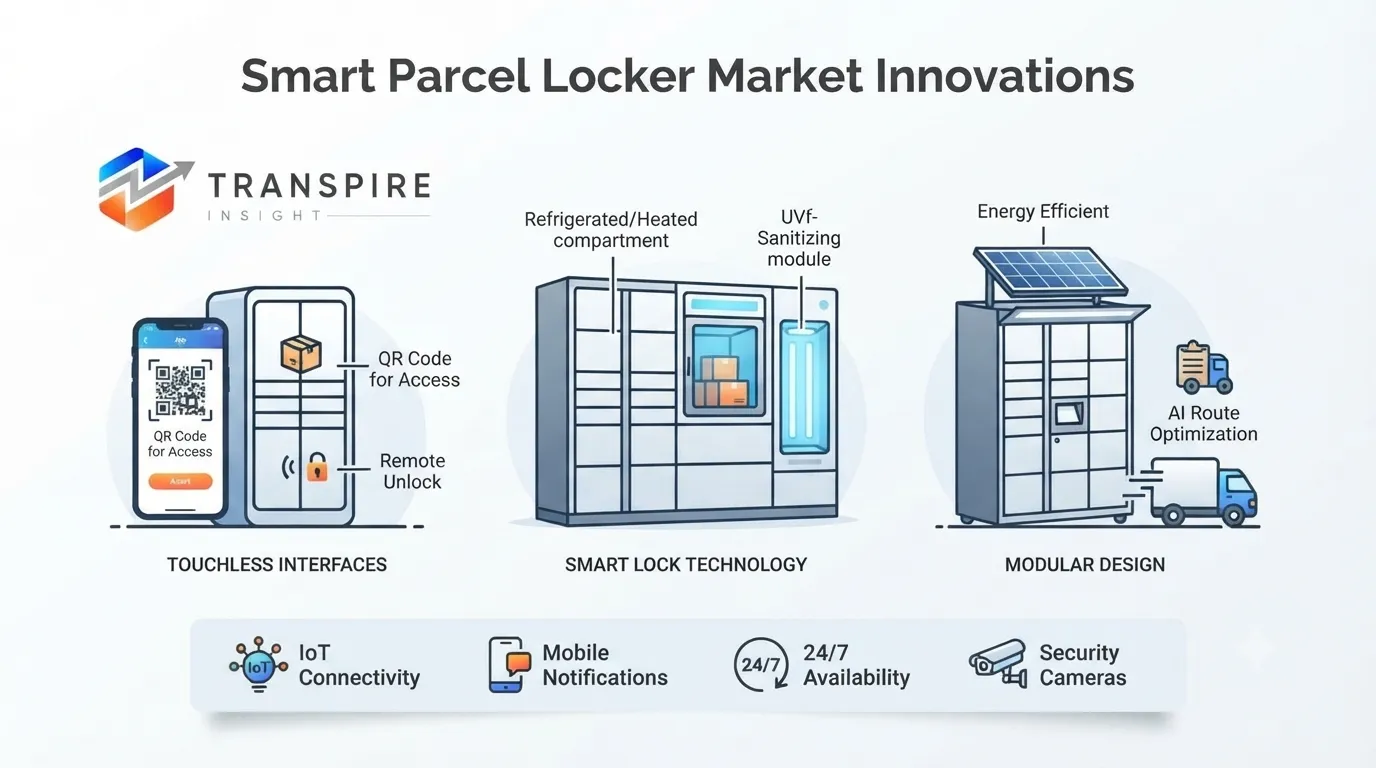
Smart parcel lockers are emerging as an important last-mile delivery solution, combining automated collection, digital access and centralized delivery points to reduce failed deliveries and improve convenience.
The global smart parcel locker market is entering a high-growth phase as e-commerce companies, logistics providers, retailers and property developers search for more efficient last-mile delivery models.
Traditional door-to-door delivery becomes increasingly difficult in densely populated cities. Drivers may encounter traffic congestion, limited parking, gated buildings and customers who are unavailable at the time of delivery.
Smart parcel lockers address some of these problems by providing secure, automated locations where consumers can collect parcels at a convenient time.
Recent estimates place the global market at approximately USD 1.4 billion in 2025, with the market potentially reaching around USD 4.5 billion by 2035 and expanding at approximately 12% CAGR. Other research estimates a higher market value depending on the definition of smart lockers and included applications.
E-commerce is creating a last-mile infrastructure problem
The commercial opportunity begins with the continuing expansion of parcel deliveries.
Online shopping has changed consumer expectations. Customers increasingly want rapid delivery, accurate tracking and flexible collection options.
For logistics companies, however, the final stage of delivery is often the most expensive and difficult.
A delivery truck may need to make multiple stops in a small area, while failed delivery attempts increase costs and emissions.
Parcel lockers consolidate multiple deliveries into a single location.
This can improve route efficiency while giving consumers greater flexibility.
Market Size
The global smart parcel locker market is estimated at approximately USD 1.4 billion in 2025 and could reach nearly USD 4.5 billion by 2035, representing annual growth of around 12%. Current studies place the 2025 market between approximately USD 1.4 billion and USD 1.9 billion depending on scope.
Residential adoption is increasing
Residential developments are becoming an important application.
Apartment buildings can struggle with large parcel volumes, particularly during holiday periods or major e-commerce sales events.
Smart lockers provide a centralized delivery location within or near residential communities.
Residents can receive a notification, authenticate through a mobile application or code and collect their package when convenient.
Property developers can also benefit because parcel lockers can improve building logistics without requiring individual deliveries to every apartment.
Retailers are integrating lockers with omnichannel commerce
Parcel lockers are also increasingly connected to retail strategies.
Customers can order products online and collect them from a locker near a store, transit hub or shopping center.
This model supports buy-online-pick-up-in-store and related fulfillment strategies.
For retailers, lockers can reduce pressure on customer-service counters and provide additional opportunities to bring online customers into physical locations.
The ability to combine retail and logistics infrastructure is expected to support adoption.
Technology is making lockers smarter
Modern lockers are increasingly software-driven.
RFID, mobile applications, cloud platforms, electronic authentication and remote monitoring allow operators to manage large networks of lockers.
Cloud-based systems can provide information about locker availability, package status, access events and maintenance requirements.
Biometric authentication is also being evaluated for selected environments, although mobile and code-based access remain more common.
Technology allows lockers to become part of a broader logistics platform rather than functioning simply as physical storage cabinets.
Outdoor lockers are expanding the addressable market
Indoor lockers are useful in apartment buildings, offices and retail environments, but outdoor systems can significantly expand deployment opportunities.
Outdoor lockers can be installed near transit stations, supermarkets, universities, parking areas and community centers.
Weather resistance, security and power requirements become important considerations.
Modular designs can also allow operators to expand capacity as parcel volumes increase.
Fresh-food lockers could open another market
The smart-locker concept is moving beyond conventional parcels.
Temperature-controlled lockers can support grocery and food delivery, allowing consumers to collect products without being present during delivery.
This creates an opportunity for refrigerated and specialized locker systems.
The segment requires additional infrastructure and temperature monitoring, but the underlying value proposition remains similar: centralized delivery combined with flexible consumer collection.
Logistics companies are becoming major customers
Courier and logistics companies are among the most important potential adopters.
A locker network can help carriers consolidate multiple deliveries and reduce repeated delivery attempts.
The business model can also involve shared locker infrastructure, in which multiple carriers use the same network.
This can improve asset utilization and make deployment economics more attractive.
Cities are becoming an important growth market
Urbanization is another major driver.
Dense cities have limited curb space, traffic congestion and high delivery costs.
Smart parcel lockers can shift some deliveries away from individual addresses toward centralized collection points.
Municipalities may also see benefits from reduced delivery traffic in selected locations.
However, successful deployment requires careful site selection, consumer awareness and integration with local transportation patterns.
Key challenges
The market still faces several barriers.
Initial installation costs can be significant, particularly for large outdoor networks.
Location is another challenge. A locker must be convenient enough for consumers to use regularly.
Interoperability between carriers and locker operators can also influence adoption.
Security remains critical because lockers hold valuable goods. Operators must provide reliable authentication, monitoring and protection against physical tampering.
Finally, consumer behavior can limit adoption in areas where home delivery remains inexpensive and convenient.
Competitive landscape
The competitive market includes locker manufacturers, logistics companies, postal organizations, technology providers and specialized last-mile platforms.
Companies compete through hardware reliability, software capabilities, network density, security, ease of integration and operating economics.
Top 10 Companies in Smart Parcel Locker Market
Headquarters: Paris, France
Quadient is a major provider of parcel locker and automated delivery solutions. Its technology portfolio supports parcel management for residential and commercial environments and positions the company well as delivery networks become more automated.
Headquarters: Stamford, Connecticut, USA
Pitney Bowes has extensive expertise in mailing, shipping and parcel technology. Its established logistics capabilities provide a strong foundation for participating in the growing automated parcel-delivery ecosystem.
Headquarters: Viljandi, Estonia
Cleveron specializes in automated parcel terminals and retail logistics technology. Its focus on automated pickup and delivery supports the expansion of locker-based fulfillment models.
Headquarters: Linz, Austria
KEBA develops automated parcel and logistics systems used by postal and delivery organizations. Its engineering expertise and European presence provide opportunities in the growing smart-locker market.
Headquarters: Kraków, Poland
InPost has developed one of the best-known parcel-locker networks in Europe. Its large installed network provides a strong competitive advantage and demonstrates the scalability of locker-based last-mile delivery.
Outlook: Could smart lockers become standard last-mile infrastructure?
Smart parcel lockers are likely to become an increasingly important component of urban delivery systems.
Their strongest advantage is the ability to consolidate multiple deliveries into centralized locations while giving customers control over collection times.
As e-commerce expands, retailers and logistics providers will continue searching for ways to reduce last-mile costs.
The next stage of market development will likely involve stronger software integration, shared networks, refrigerated lockers, retail partnerships and smarter location planning.
If operators can build dense and convenient networks, smart parcel lockers could evolve from a specialized delivery option into a standard component of last-mile infrastructure.


Send us a brief description of your challenge and we'll get back to you within 24 hours.

 inquiry@transpireinsight.com
 APAC:+91 7666513636
 Address


