
Oct 07, 2026
By Transpire Insight
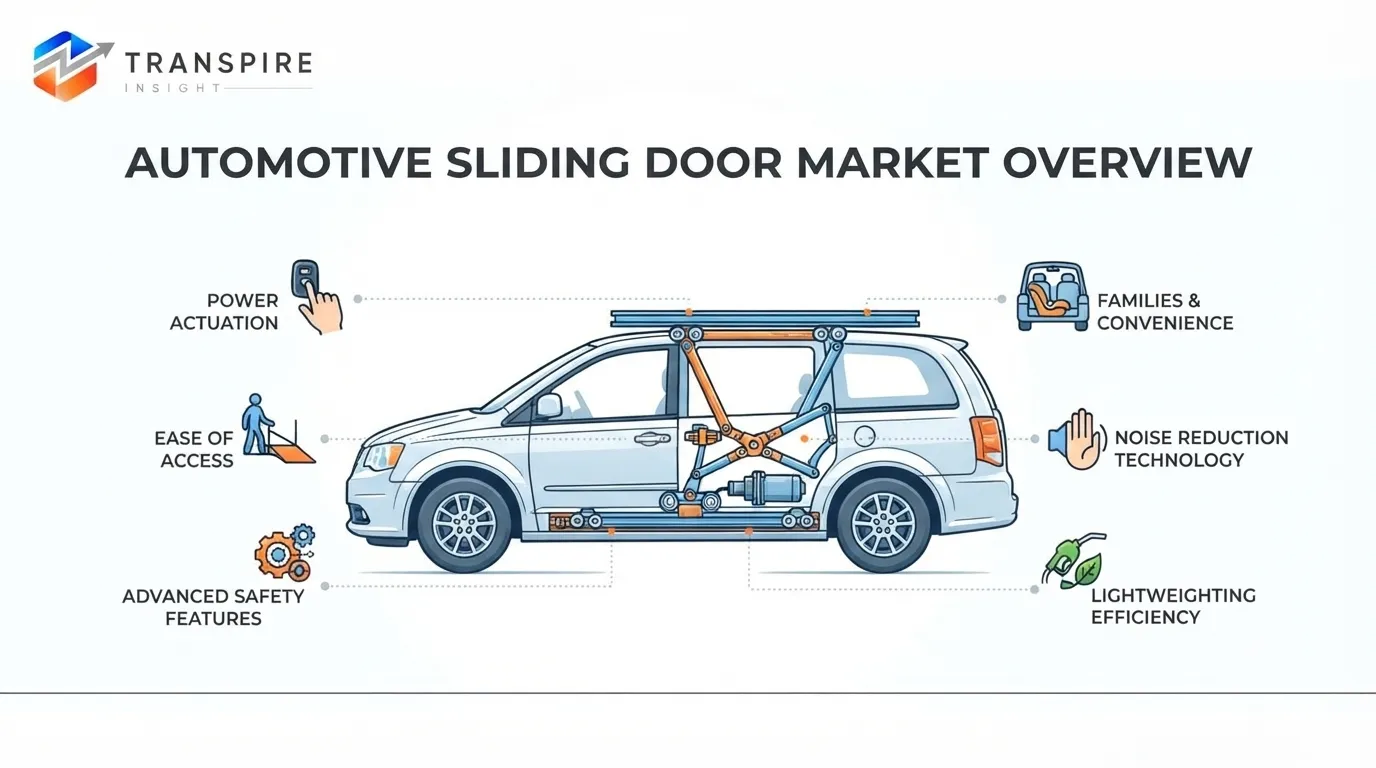
Automotive sliding doors are evolving from conventional manually operated access systems into sophisticated mechatronic modules combining electric motors, sensors, control units, anti-pinch mechanisms, intelligent access systems, and lightweight structural components. Their ability to open parallel to the vehicle body makes them particularly valuable in vans, minivans, commercial vehicles, mobility-focused vehicles, and increasingly in new vehicle architectures where passenger accessibility and space efficiency are important.
The transition toward electrified vehicles, connected mobility, automated access, and premium interior experiences is creating new opportunities for power and smart sliding-door systems. Manufacturers are focusing on quieter motors, compact drive units, obstacle detection, hands-free operation, remote activation, lightweight construction, and improved durability to meet the changing requirements of passenger and commercial vehicle manufacturers.
Market Size
According to Transpire Insight, the global Automotive Sliding Door Market was valued at approximately USD 13.49 billion in 2025 and is projected to reach approximately USD 17.64 billion by 2033, expanding at a CAGR of 3.41% from 2026 to 2033. The market includes manual, power, automatic, dual, lightweight, and smart sliding-door systems used across passenger vehicles, vans, SUVs, commercial vehicles, and electric vehicles.
The market is being shaped by increasing demand for convenient vehicle access, growth in commercial vans and people-moving vehicles, electrification, advanced driver-assistance technologies, and the integration of electronic controls into vehicle body systems.
Sliding Doors Provide a Distinct Packaging Advantage
The fundamental advantage of an automotive sliding door is its movement pattern. Unlike conventional hinged doors that require a large outward swing, sliding doors move horizontally along the side of the vehicle.
This architecture is particularly valuable in narrow parking spaces and crowded urban environments. Passengers can enter or leave a vehicle without requiring significant clearance beside the vehicle.
AISIN's power sliding door systems are designed around this principle, with drive units integrated into the door or floor structure. The company notes that the architecture can broaden cabin space and has been adopted across different vehicle types, including microcars, compact vehicles, minivans, and one-box vehicles.
For commercial vans, the same characteristic can improve loading and unloading operations because cargo can be accessed without requiring substantial side clearance.
Power Sliding Doors Are Becoming More Sophisticated
The transition from manual to power-assisted sliding doors is one of the most important trends in the market.
A power sliding door typically combines an electric motor, reduction mechanism, cable or belt mechanism, controller, sensors, latching components, and safety functions. These components allow the door to open and close through switches, remote controls, handles, or other vehicle interfaces.
AISIN's power sliding door system integrates the driving unit into the sliding door and provides automatic opening and closing. Its systems also incorporate protection against pinching or entrapment.
Mitsuba similarly develops compact power sliding door drive systems using brushless motors and integrated controllers. Its technology allows the motor to operate a cable mechanism that moves the door, while the compact architecture helps preserve passenger-compartment space.
These developments indicate that the market is moving toward smaller, quieter, and more electronically controlled door modules.
Smart Sliding Doors Are Creating a New Product Category
Smart sliding doors extend powered operation by adding sensors, connectivity, intelligent access functions, and automated control.
Modern vehicle-access systems can allow users to activate doors through key fobs, touch-sensitive handles, smartphones, proximity systems, or hands-free mechanisms.
Continental's Smart Autonomous Door technology combines hands-free access with automatic door operation and obstacle detection. The company describes applications for automated vehicles in which doors need to open and close without direct physical interaction from passengers.
The integration of Bluetooth Low Energy, ultra-wideband, near-field communication, and vehicle communication networks provides additional possibilities for future access systems.
As vehicles become more software-defined, the door is increasingly being treated as an electronically managed vehicle subsystem rather than an isolated mechanical component.
Anti-Pinch and Obstacle Detection Are Central to Safety
Safety remains one of the most important requirements in powered sliding-door systems.
Because motors can generate significant force, manufacturers must ensure that the door does not continue closing when it encounters an obstacle. Sensors and control algorithms can detect resistance and trigger a reversal or stopping mechanism.
AISIN's power sliding door systems include automatic reverse functionality when resistance is detected during closing.
Magna also incorporates anti-pinch and obstacle-detection technologies into its power sliding-door systems. The company describes its systems as combining motors, electronics, sensors, and intelligent controls to provide safe automated door operation.
Continental has also developed anti-pinch functionality for power-closure systems and uses control algorithms to regulate door movement.
As doors become more automated, these safety functions will remain essential for meeting vehicle safety expectations.
Commercial Vans Are Important Growth Platforms
Commercial vans represent one of the most significant application areas for sliding doors.
Delivery vehicles, service vans, passenger shuttles, fleet vehicles, and logistics vehicles frequently operate in environments where vehicles must stop close to buildings, loading areas, sidewalks, or other vehicles.
A conventional hinged door may require significant lateral clearance, whereas a sliding door can be opened alongside the vehicle.
This makes powered sliding systems particularly relevant to last-mile delivery fleets. Fleet operators can benefit from easier access and potentially reduced physical effort during repeated loading and unloading operations.
The continued expansion of e-commerce and urban delivery networks is therefore creating opportunities for durable, high-cycle sliding-door systems.
Electric Vehicles Are Creating New Packaging Requirements
Vehicle electrification is influencing door-system design in several ways.
Electric vehicles require manufacturers to optimize weight, packaging, energy consumption, and electronic architecture. Sliding-door drive systems therefore need to become increasingly compact and efficient.
Mitsuba states that its power sliding door drive system can be used in both conventional internal-combustion and next-generation electrified vehicles. The company also emphasizes compactness, lightweight construction, quiet operation, and power efficiency.
The transition toward EV platforms can also create opportunities for new vehicle formats, including electric vans, shuttle vehicles, autonomous mobility platforms, and purpose-built commercial vehicles.
These vehicles may place greater emphasis on automated access, making intelligent sliding doors increasingly relevant.
Lightweight Door Systems Are Gaining Importance
Vehicle manufacturers are continuously seeking opportunities to reduce weight while maintaining structural integrity, safety, durability, and functionality.
Sliding doors can be relatively complex because they include rails, rollers, cables, motors, control systems, latches, and reinforcement structures. Reducing the weight of these components can therefore contribute to overall vehicle efficiency.
Brose has developed door-system architectures incorporating lightweight carrier plates and fiber-reinforced plastics. The company states that its carrier solutions can reduce weight while supporting crash-performance requirements.
Lightweight materials can also help compensate for the additional mass associated with electric motors and electronic components in power-operated systems.
Compact Drive Units Improve Cabin Packaging
One of the major design priorities for sliding-door suppliers is keeping the drive mechanism compact.
A poorly packaged motor or cable system can reduce usable cabin space or interfere with interior design. Integrated door modules therefore provide a significant advantage.
AISIN's power sliding door system places the driving unit within the door, reducing the impact on cabin space.
Mitsuba also emphasizes compact drive architecture and lightweight construction. Its brushless motor system is designed to provide quiet operation while allowing flexible installation across vehicle platforms.
The development of smaller motors, efficient gear reduction, compact electronic control units, and improved cable mechanisms is therefore expected to remain an important area of innovation.
Quiet Operation Is Becoming a Premium Feature
Noise, vibration, and harshness are increasingly important factors in vehicle design.
Powered doors can produce mechanical noise during motor operation, gear engagement, cable movement, and latch activation. Premium vehicle manufacturers therefore require smooth and quiet operation.
Brushless motor technology is one approach being used to improve acoustic performance. Mitsuba's power sliding door system uses a brushless motor and highlights quiet operation as one of its product advantages.
Brose also focuses on optimized opening acoustics in its vehicle-door systems, including power-opening mechanisms designed for smooth operation.
As commercial and passenger vehicles become quieter due to electrification, acoustic performance of auxiliary systems such as doors will become increasingly noticeable.
Hands-Free Access Is Expanding
Hands-free access can be especially useful when passengers are carrying luggage, groceries, equipment, or other items.
Power doors can be activated through remote controls, smart keys, touch sensors, proximity detection, or smartphone-based access systems.
Hyundai's vehicle documentation demonstrates the integration of power sliding-door operation with smart keys and vehicle-mounted controls.
Continental's Smart Autonomous Door goes further by combining smartphone-based access with automated opening and closing. Its system supports Bluetooth Low Energy, ultra-wideband, and NFC technologies.
These features are expected to become more relevant as automakers develop connected vehicles and automated mobility platforms.
Automated Mobility Could Expand the Addressable Market
Autonomous and semi-autonomous vehicles could create new opportunities for automated door systems.
In a driverless or highly automated vehicle, passengers may not have a driver available to manually open doors. Vehicle access therefore needs to be electronically controlled and coordinated with vehicle status, passenger authentication, and surrounding conditions.
Continental specifically describes its Smart Autonomous Door as a technology relevant to automated driving, combining automated access with obstacle detection and electronic control.
Future mobility services, autonomous shuttles, airport transportation vehicles, and shared mobility fleets could therefore create demand for highly automated sliding-door architectures.
New Door Architectures Are Expanding Design Flexibility
Conventional sliding doors normally depend on rails mounted along the side of the vehicle. This can place constraints on exterior design and body architecture.
AISIN has developed a linkage-type power door system that uses a rotating-arm mechanism rather than conventional external rails. The company states that this architecture can preserve the advantages of a sliding door while providing greater flexibility in vehicle design.
This type of innovation could become increasingly relevant to premium vehicles and new vehicle platforms where exterior styling and access functionality need to coexist.
Regional Outlook
Asia Pacific
Asia Pacific is a major manufacturing and consumption center for automotive sliding-door technologies.
Japan has particularly strong expertise in power sliding systems, supported by suppliers such as AISIN and Mitsuba. AISIN notes that its power sliding door systems have been used across multiple vehicle categories in Japan and that the company has extensive experience in door-integrated power sliding systems.
China is also becoming increasingly important as domestic automakers expand electric vehicle and multipurpose vehicle production.
India represents another developing opportunity as passenger vehicles, commercial vans, electric mobility platforms, and premium vehicle features continue to evolve.
The region's extensive automotive supply chain provides manufacturers with opportunities to develop localized components, motors, electronics, sensors, and complete door modules.
North America
North America represents an important market for commercial vans, large passenger vehicles, SUVs, and mobility platforms.
The growth of last-mile delivery and fleet-based transportation creates demand for durable access systems capable of handling frequent opening and closing cycles.
Automotive suppliers such as Magna and other major Tier 1 companies are investing in mechatronic access systems that integrate motors, sensors, electronics, and software. Magna's power sliding-door systems incorporate anti-pinch and obstacle-detection technologies.
Electric commercial vehicles could further increase demand for compact and energy-efficient door mechanisms.
Europe
Europe is an important market for premium vehicles, commercial vans, passenger transportation, and advanced automotive technologies.
The region's automotive manufacturers increasingly emphasize vehicle accessibility, lightweight construction, automation, and electronic integration.
European Tier 1 suppliers such as Brose and Continental have extensive expertise in mechatronic door and access technologies. Brose develops complete door systems incorporating mechanical, electrical, electronic, sensor, and software components, while Continental focuses on electronic power-closure and autonomous-door technologies.
Latin America
Latin America represents a developing market supported by commercial vehicles, passenger transportation, and growing urban mobility.
Brazil and Mexico are particularly relevant because of their automotive manufacturing capabilities and connections with international vehicle supply chains.
Market expansion will depend on vehicle production, consumer purchasing power, commercial fleet growth, and the availability of advanced vehicle components.
Middle East & Africa
The Middle East & Africa market is developing alongside premium vehicle demand, commercial transportation, passenger mobility, and specialized fleet applications.
Large vehicles and passenger transportation systems can benefit from sliding doors because they simplify entry and exit while requiring less lateral clearance.
The adoption of advanced power systems will depend on vehicle pricing, local manufacturing capabilities, fleet requirements, and availability of service infrastructure.
Competitive Landscape
The Automotive Sliding Door Market includes major automotive Tier 1 suppliers, motor manufacturers, mechatronics companies, electronics providers, and vehicle manufacturers.
Competition is increasingly focused on complete system integration rather than individual mechanical components. Suppliers are combining motors, cables, rails, latches, sensors, control units, software, and safety functions into integrated door modules.
The market is also shifting toward electronically controlled access. Hands-free operation, smartphone connectivity, automatic opening, anti-pinch functionality, obstacle detection, and remote activation are becoming important areas of differentiation.
Electrification is further encouraging suppliers to reduce weight, improve motor efficiency, minimize packaging requirements, and integrate door systems into vehicle electronic architectures.
Top 10 Companies in the Automotive Sliding Door Market
These companies represent important portions of the automotive access, mechatronics, motor, electronics, and door-system ecosystem identified within the global market landscape.
Company Profiles
1. AISIN Corporation
AISIN is one of the most established suppliers of automotive sliding-door systems. The company developed door-integrated power sliding-door technology and has supplied systems across different vehicle categories.
Its current portfolio includes power sliding doors, linkage-type power doors, sliding-door closers, latches, smart handles, and related access technologies.
AISIN's linkage-type power door is particularly notable because it seeks to combine the access advantages of a sliding door with greater freedom in exterior vehicle design.
2. Magna International
Magna develops automotive mechatronic systems covering power doors, sliding doors, liftgates, access systems, electronics, and software.
Its power sliding-door systems integrate motor technologies and electronics with anti-pinch and obstacle-detection functions.
The company's SmartAccess platform also combines mechanical systems, software, electronic control, and vehicle-access functions to support increasingly intelligent vehicle architectures.
3. Brose Fahrzeugteile
Brose is a major automotive supplier specializing in mechatronic systems for vehicle doors and liftgates.
Its portfolio includes electrically operated side-door systems, drives, sensors, control units, latches, and obstacle-detection technologies. Brose also emphasizes lightweight door-module architectures and integrated system solutions.
The company's focus on mechanical, electrical, electronic, and sensor integration makes it an important supplier in the transition toward intelligent door systems.
4. Johnson Electric
Johnson Electric develops motion systems, motors, actuators, switches, and other components used throughout the automotive industry.
Its expertise in compact motor and actuator technologies provides opportunities across automotive closure systems, including powered access applications.
The company's focus on miniaturization, energy efficiency, and integrated motion solutions aligns with the automotive industry's broader movement toward electronically controlled vehicle functions.
5. Valeo
Valeo is a global automotive technology supplier active across electrification, driver assistance, thermal systems, visibility, and comfort technologies.
Its expertise in automotive electronics and actuators positions it within the broader vehicle-access and closure ecosystem.
As automakers increase the electronic content of vehicle body systems, suppliers with experience in sensors, control systems, and intelligent vehicle functions are positioned to participate in the development of advanced access technologies.
6. Robert Bosch
Bosch is a major automotive technology supplier with expertise spanning electronics, sensors, software, vehicle systems, and mobility technologies.
The company's extensive experience in vehicle electronics supports the integration of intelligent control functions into automotive access systems.
Bosch's broader automotive portfolio provides technological capabilities relevant to electronically controlled doors, sensors, vehicle networking, and automated functions.
7. Continental
Continental develops power-closure electronics and intelligent door technologies.
Its Power Closure portfolio includes electronic control units, one-touch activation, speed-regulated operation, remote control, automatic functions, and anti-pinch technology.
Its Smart Autonomous Door combines hands-free access, automatic door control, obstacle detection, anti-pinch functions, and communication technologies such as BLE, UWB, and NFC.
8. DENSO Corporation
DENSO is a major Japanese automotive technology supplier with expertise in electronics, motors, sensors, control systems, and vehicle components.
Its capabilities in automotive electronics and thermal, powertrain, and body systems support the industry's transition toward electronically managed vehicle functions.
The company's engineering capabilities are relevant to the development of compact, reliable electronic systems used in increasingly connected vehicles.
9. Mitsuba Corporation
Mitsuba develops motor-driven automotive systems and specifically offers a Power Sliding Door Drive System.
Its system uses a brushless motor, an integrated controller, and a cable mechanism to electrically operate sliding doors. The company emphasizes compact size, lightweight construction, high output, and quiet operation.
The system can be adapted across multiple vehicle models and is designed for both conventional and electrified vehicle architectures.
10. Hyundai Mobis
Hyundai Mobis is a major automotive component supplier associated with vehicle electronics, chassis, safety, lighting, and body technologies.
Its position within the Hyundai Motor Group ecosystem provides exposure to advanced vehicle-access and electronic body systems.
The broader adoption of power sliding doors in Hyundai vehicles demonstrates the growing importance of automated access functions. Hyundai's vehicle documentation describes power sliding-door operation through smart keys and vehicle-mounted controls.
Key Challenges Facing the Automotive Sliding Door Market
The development of advanced sliding-door systems involves several technical and commercial challenges.
The first is system complexity. A modern power sliding door may combine motors, gears, cables, rails, sensors, controllers, latches, wiring, software, and safety systems. Each component must operate reliably throughout the vehicle's service life.
Weight is another challenge. Adding motors and electronics can increase door mass, making lightweight materials and compact drive systems increasingly important.
Cost also remains a consideration. Advanced automatic and smart systems are more expensive than manual mechanisms, which can limit their adoption in entry-level vehicles.
Durability is particularly important for commercial vehicles because doors may be operated hundreds or thousands of times during intensive fleet use. Manufacturers therefore need to design systems capable of high cycle counts while maintaining consistent operation.
Cold temperatures, heat, moisture, dust, snow, vehicle inclination, vibration, and mechanical contamination can also influence door performance.
Cybersecurity is becoming relevant as doors become connected to smartphones, keyless-entry systems, vehicle networks, and software platforms. Electronic access systems must protect against unauthorized activation while retaining reliable emergency access.
Future Outlook
The future of the Automotive Sliding Door Market will increasingly be shaped by the convergence of mechanical engineering, electric motors, sensors, software, and connected vehicle technologies.
Power sliding doors are expected to remain important in minivans, commercial vans, passenger transportation vehicles, and selected SUVs. However, the technology is expanding beyond traditional applications as automakers develop new electric and autonomous vehicle platforms.
Smart access is likely to become a major area of innovation. Smartphone authentication, proximity detection, hands-free activation, obstacle recognition, automatic opening, and personalized access settings can make vehicle entry more convenient.
Autonomous mobility could further increase the importance of electronically controlled doors. Driverless shuttles and shared mobility vehicles will require reliable automated passenger access, making intelligent doors an important part of the overall vehicle architecture.
Material innovation will also remain significant. Lightweight composite carriers, compact motors, efficient electronics, and integrated mechanisms can reduce system weight without compromising functionality.
Another important trend will be the development of complete door modules. Rather than sourcing individual components separately, vehicle manufacturers can increasingly rely on suppliers capable of delivering integrated systems containing mechanical structures, motors, sensors, electronics, software, and safety functions.
The Automotive Sliding Door Market is therefore transitioning from a conventional mechanical component segment into a sophisticated mechatronic vehicle-access market. Continued growth in commercial vehicles, electrification, connected mobility, and automated transportation is expected to create new opportunities for manufacturers capable of delivering safe, lightweight, quiet, durable, and intelligent sliding-door systems through 2033.


Send us a brief description of your challenge and we'll get back to you within 24 hours.

 inquiry@transpireinsight.com
 APAC:+91 7666513636
 Address


