
Oct 09, 2026
By Transpire Insight
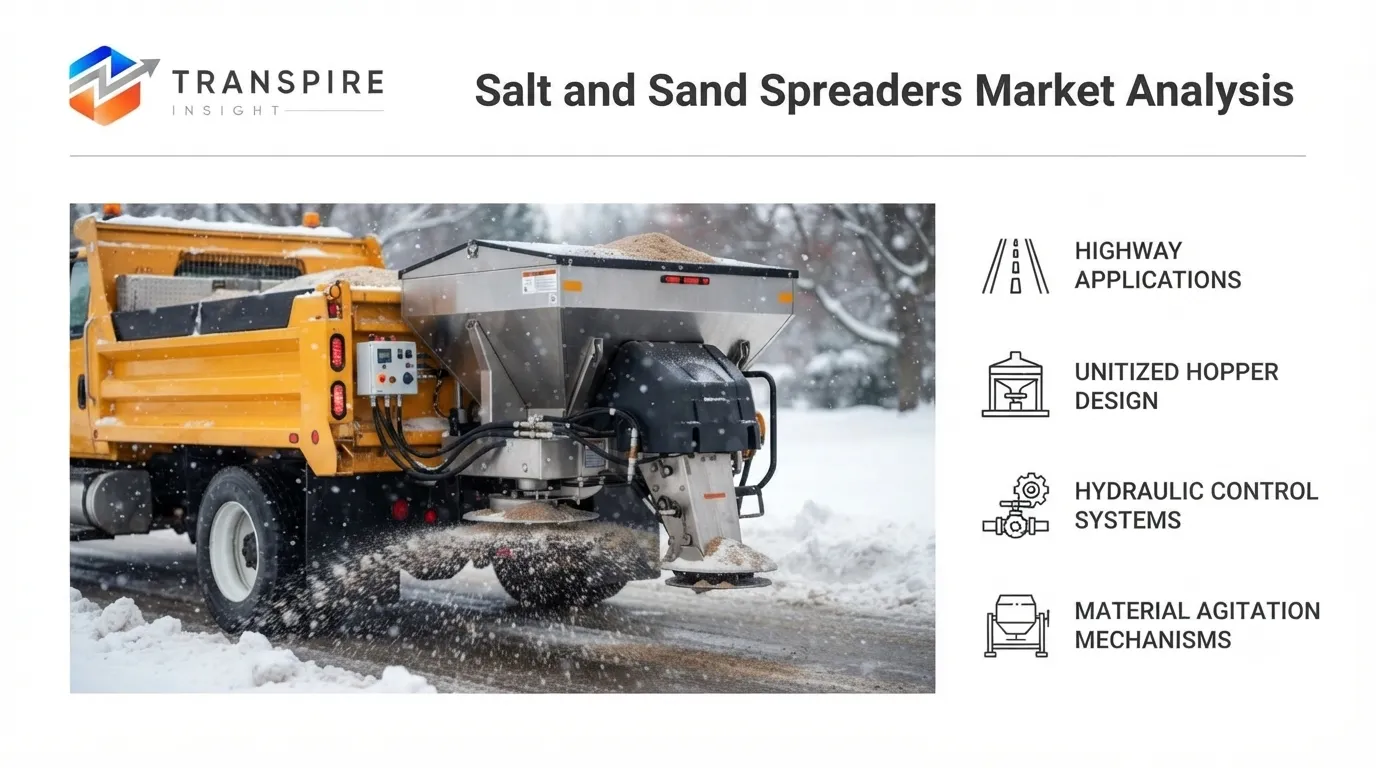
The global Salt and Sand Spreaders Market is evolving alongside winter-road maintenance requirements, municipal fleet modernization, commercial snow-management activity, and growing demand for precise application of de-icing materials. Manufacturers are increasingly integrating automated controls, telematics, weather-responsive spreading, and brine technologies to improve material efficiency while maintaining road safety.
Salt and Sand Spreaders Market Overview
The Salt and Sand Spreaders Market comprises equipment used to distribute salt, sand, grit, and blended de-icing materials across roads, parking areas, pedestrian zones, commercial properties, and other surfaces affected by snow and ice.
The market includes tailgate spreaders, hopper spreaders, V-box spreaders, walk-behind spreaders, truck-mounted systems, and tow-behind equipment. Demand comes from municipal road authorities, commercial snow-removal contractors, property-management companies, airports, industrial facilities, and private users.
Transpire Insights estimates that the global Salt and Sand Spreaders Market was approximately USD 0.51 billion in 2025 and is expected to reach nearly USD 0.66 billion by 2033, representing a forecast CAGR of approximately 3.03% between 2026 and 2033. The market is estimated to reach around USD 0.53 billion in 2026.
Industry estimates also show that the broader salt-and-sand spreading equipment category remains heavily connected to winter-weather conditions, municipal maintenance budgets, and replacement cycles. One recent industry assessment estimated the global Salt and Sand Spreaders Market at approximately USD 496 million and projected continued growth through 2031.
North America remains a major demand center because of its extensive road networks, recurring snowfall across northern states and Canadian provinces, and established municipal and commercial snow-management fleets. Europe represents another important market, particularly across Nordic countries and regions where winter road maintenance is a regular public-service requirement.
A significant shift is occurring from conventional fixed-rate material distribution toward precision spreading. Modern equipment can monitor vehicle movement, material consumption, and operating conditions while allowing operators to modify application rates according to road and weather conditions.
Latest Global Market Developments
Why Salt and Sand Spreaders Matter?
Winter precipitation creates operational risks for road authorities, businesses, transportation facilities, and property owners. Snow and ice can reduce vehicle traction, disrupt transportation, and increase the risk of accidents.
Salt and sand spreaders provide an operational mechanism for rapidly distributing de-icing or traction-enhancing materials across affected surfaces.
The importance of the equipment extends beyond basic material distribution. Modern spreaders can influence:
For municipalities, equipment reliability is particularly important because winter storms can create short periods in which large sections of a road network need to be treated rapidly.
For commercial contractors, productivity and material efficiency can directly influence operating margins. A spreader capable of covering more area with controlled application can improve fleet utilization and reduce unnecessary material consumption.
The market is therefore transitioning from a basic mechanical-equipment category toward a more technologically integrated winter road-management equipment segment.
Key Factors Driving the Salt and Sand Spreaders Market
1. Increasing Winter Road-Maintenance Requirements
Recurring snowfall and freezing conditions across North America and Europe sustain demand for equipment capable of rapidly treating roads, highways, parking areas, and commercial properties.
Municipalities require dependable equipment because winter maintenance is often performed under time-sensitive conditions.
2. Fleet Modernization
Older spreaders can experience corrosion, mechanical failures, inefficient material distribution, and limited control functionality.
Replacement programs provide manufacturers with opportunities to sell higher-capacity and digitally enabled equipment rather than simply replacing older systems with comparable units.
3. Precision Material Application
The cost of salt and other de-icing materials creates an economic incentive to apply only the required quantity.
Variable-rate spreading, vehicle-speed compensation, GPS tracking, and weather sensors can improve material management.
4. Growth of Commercial Snow-Management Services
Shopping centers, warehouses, hospitals, office complexes, airports, industrial facilities, and other large properties frequently depend on professional winter-maintenance contractors.
This creates a recurring equipment market beyond government procurement.
5. Environmental Pressure on Salt Usage
Excessive application of road salt can contribute to environmental concerns involving soil, vegetation, freshwater systems, and infrastructure corrosion.
As a result, equipment manufacturers are increasingly emphasizing controlled application, brine systems, and technologies that help operators reduce unnecessary material use.
6. Integration With Digital Fleet Management
Connected equipment can provide information about routes, application rates, material consumption, vehicle location, and operating performance.
This creates opportunities for fleet operators to manage winter maintenance using data rather than relying entirely on manual records.
Five High-Potential Markets Shaping Global Salt and Sand Spreaders
1. United States
The United States represents one of the most established markets for salt and sand spreading equipment.
The country's extensive road network and substantial snowfall across the Northeast, Midwest, and northern mountain states support demand from state transportation agencies, municipalities, airports, commercial contractors, and private property managers.
Replacement of aging equipment and adoption of GPS-enabled spreading systems create additional opportunities.
2. Canada
Canada represents a structurally important market because winter road maintenance is essential across many provinces.
Municipalities and transportation agencies require equipment capable of operating under low temperatures, heavy snowfall, and extended winter seasons.
Demand also extends to airports, industrial sites, logistics facilities, and commercial property-management operations.
3. Germany
Germany represents an important European market for professional winter road-maintenance equipment.
The country's municipal infrastructure and engineering-oriented equipment sector create demand for technologically advanced spreading systems, particularly where controlled material application and operational documentation are important.
4. Nordic Countries
Sweden, Finland, and Norway provide significant opportunities because of challenging winter conditions and established municipal snow-management systems.
Equipment requirements in these markets increasingly extend beyond simple salt spreading toward multifunctional systems capable of handling different materials and road conditions.
5. United Kingdom
The United Kingdom presents demand across local authorities, contractors, industrial facilities, airports, and commercial property operators.
The market includes both large vehicle-mounted systems and compact spreaders suitable for smaller roads, pathways, commercial premises, and specialized applications. European distribution networks provide access to a broad range of professional equipment.
Competitive Landscape
The Salt and Sand Spreaders Market is characterized by competition across equipment reliability, hopper capacity, spreading precision, corrosion resistance, control technology, dealer networks, replacement parts, and after-sales service.
North American manufacturers have traditionally maintained strong positions in municipal and commercial winter-maintenance applications, while European manufacturers have developed highly specialized equipment for road authorities and severe-weather environments.
The competitive landscape is also becoming more technology-driven. Manufacturers are integrating telematics, automated controllers, GPS-based monitoring, weather sensors, and variable-rate spreading into equipment that historically relied on relatively simple mechanical controls.
Recent industry developments demonstrate this transition. Hilltip's latest North American spreaders incorporate tracking and intelligent spreading functions, while Aebi Schmidt's new Stratos F platform combines dry and wet application technologies with digital operational monitoring.
Top 5 Companies in the Salt and Sand Spreaders Market
1. Douglas Dynamics
Douglas Dynamics is a major North American manufacturer of snow and ice management equipment, with brands including Fisher, Western, and SnowEx. Its portfolio covers multiple spreader configurations and complementary snow-removal equipment.
The company's broad dealer and service ecosystem provides an important competitive advantage in municipal and commercial fleet markets.
2. Buyers Products
Buyers Products participates in the professional snow and ice control equipment market through its SaltDogg range of spreaders.
Its portfolio includes different spreader configurations designed for pickup trucks, commercial vehicles, and larger applications, allowing the company to serve contractors and fleet operators with different capacity requirements.
3. Meyer Products
Meyer Products is an established North American snow and ice equipment manufacturer offering spreaders alongside snowplows and related winter-maintenance products.
Its market presence is supported by dealer relationships and demand from commercial contractors, municipalities, and property-maintenance operators.
4. Hilltip
Hilltip specializes in road-maintenance and snow-and-ice-control equipment and operates across European and North American markets.
Its product portfolio includes salt spreaders, combination spreaders, liquid de-icing sprayers, tracking systems, and related winter-maintenance equipment. The company's recent North American expansion demonstrates its focus on connected and intelligent spreading solutions.
5. Aebi Schmidt
Aebi Schmidt is a major international supplier of infrastructure and winter-maintenance equipment.
Its product portfolio includes spreaders and related road-maintenance technologies. The company's 2026 Stratos F development demonstrates a strategic emphasis on multifunctional equipment, wet and dry spreading, digital monitoring, and material optimization.
Other companies participating across relevant product and regional segments include TARCO, Epoke, Henderson Products, Swenson Products, Toro, Brinly-Hardy, EarthWay, and Hiniker.
Opportunities for Small Investors
The market provides several entry points for smaller manufacturers, distributors, technology providers, and service companies.
Regional Equipment Distribution
Smaller distributors can focus on underserved municipalities and commercial snow-management contractors where local service and parts availability are important.
Spreader Rental Businesses
Seasonal rental models can provide contractors with additional capacity during periods of heavy snowfall without requiring them to purchase complete fleets.
Telematics and Monitoring
Software companies can develop systems for tracking material consumption, route coverage, equipment utilization, and maintenance schedules.
Brine and Liquid-De-Icing Solutions
Businesses specializing in brine production, liquid application equipment, and pre-wetting technologies can participate in the shift toward more controlled winter-maintenance practices.
Equipment Refurbishment
Repair and refurbishment services represent an opportunity in regions where municipalities and contractors seek to extend the operating life of existing equipment rather than replace entire fleets.
Corrosion-Protection Products
Salt is highly corrosive to equipment. Specialized coatings, replacement components, wash-down systems, and corrosion-management services can therefore support the installed equipment base.
Challenges & Restraints
Seasonal Demand
Salt and sand spreaders experience highly seasonal utilization in many markets. Manufacturers and rental companies must manage inventory and production around relatively concentrated winter-demand periods.
Corrosion
Repeated exposure to salt and moisture can accelerate corrosion, increasing maintenance requirements and shortening component life if equipment is not properly maintained.
Weather Variability
Milder winters can reduce equipment utilization in particular regions, while unusually severe winters can generate sudden spikes in demand that challenge manufacturing and distribution capacity.
Material Availability and Cost
The economics of spreading equipment are connected to the availability and price of salt, sand, brine, and other de-icing materials.
High Initial Cost for Advanced Equipment
GPS-enabled systems, stainless-steel construction, automated controls, sensors, and telematics can increase equipment prices, potentially slowing adoption among smaller contractors.
Environmental Restrictions
Increasing concern over excessive salt application may encourage municipalities to reduce conventional salt use. While this can constrain demand for some traditional applications, it simultaneously creates opportunities for precision spreading, brine systems, and alternative de-icing technologies.
Conclusion
The Salt and Sand Spreaders Market is developing beyond conventional mechanical spreading equipment as municipalities, contractors, and commercial fleet operators place greater emphasis on precision, material efficiency, reliability, connectivity, and environmental performance.
North America remains an important market because of its established winter-maintenance infrastructure, while Europe continues to provide opportunities through advanced municipal equipment and increasingly sophisticated road-treatment requirements.
The emergence of intelligent controllers, GPS tracking, weather-responsive spreading, multifunctional systems, and liquid de-icing technologies is creating a new generation of winter-maintenance equipment.
Transpire Insights estimates that the global market could increase from approximately USD 0.51 billion in 2025 to USD 0.66 billion by 2033, with growth supported by fleet replacement, commercial snow-management demand, infrastructure maintenance, and the gradual adoption of connected and precision spreading technologies.
For equipment manufacturers, technology providers, distributors, and specialized service businesses, the most significant opportunities are likely to emerge where equipment engineering and digital winter-maintenance management converge.


Send us a brief description of your challenge and we'll get back to you within 24 hours.

 inquiry@transpireinsight.com
 APAC:+91 7666513636
 Address


