
Sep 23, 2026
By Transpire Insight
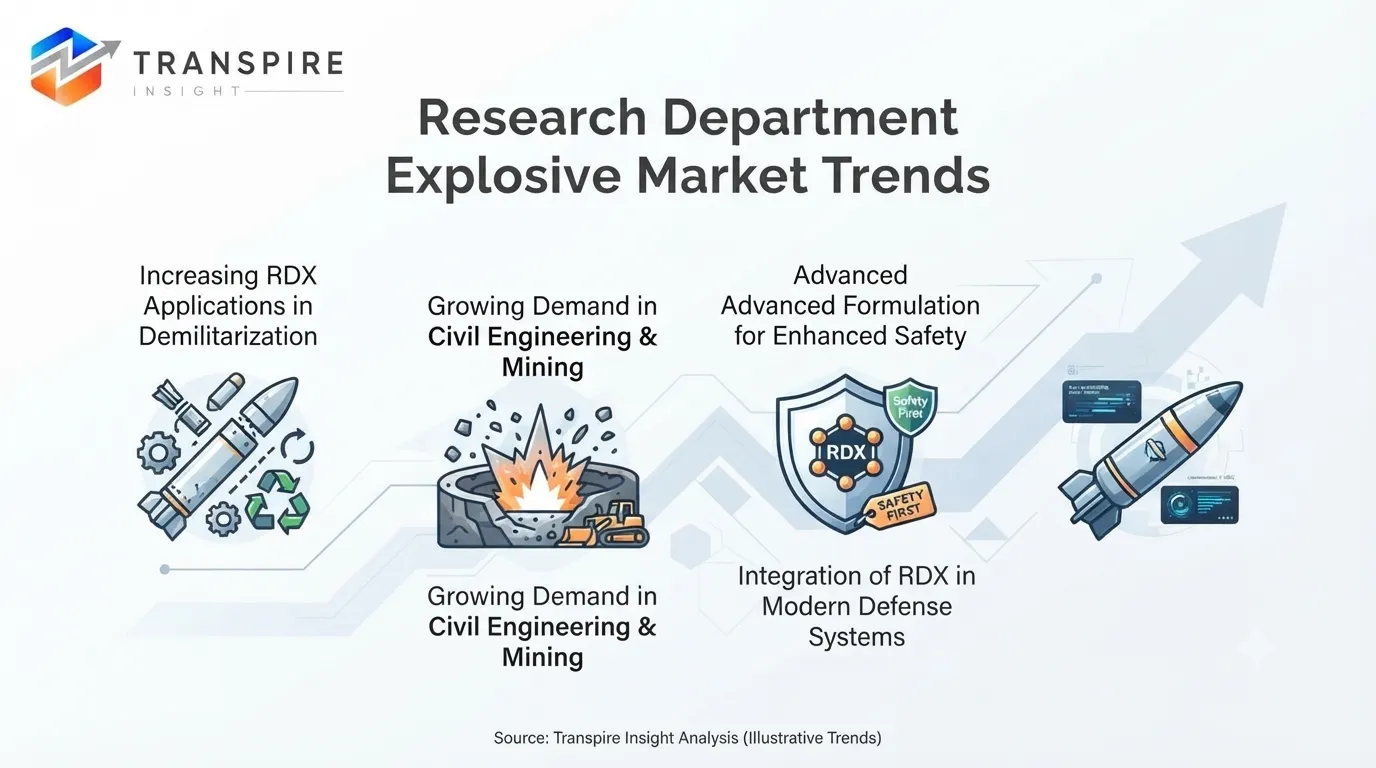
Research Department Explosive (RDX) remains an important high-energy material across defense and specialized energetic-material applications, while modernization programs and continued research are supporting demand for qualified, regulated supply chains.
The global Research Department Explosive (RDX) market is entering a period of steady development as governments modernize defense inventories, manufacturers upgrade energetic-material capabilities, and research organizations continue to evaluate high-performance materials for specialized applications.
RDX, also known as cyclonite or hexogen, is a high-energy compound used within tightly regulated defense and industrial ecosystems. Its market is influenced less by conventional consumer demand and more by government procurement, defense budgets, stockpile replacement, qualification requirements, research activity and long-term contracts.
Recent market research estimates suggest that the global RDX market was worth approximately USD 1.3 billion in 2025 and could reach around USD 2.2 billion by 2035, representing a CAGR of roughly 5.4% during the forecast period. Published estimates vary depending on whether the analysis includes only RDX material or a wider range of RDX-containing energetic products.
Defense modernization is the central growth engine
The strongest commercial opportunity for the RDX market comes from continuing defense modernization. Governments across North America, Europe and Asia Pacific are investing in replenishment, modernization and production capacity as defense priorities evolve.
Modernization does not simply mean increasing procurement volumes. It also involves replacing older inventories, improving material consistency, meeting increasingly stringent quality requirements and developing domestic or allied supply chains.
This creates opportunities for qualified producers and specialized chemical manufacturers that can satisfy demanding regulatory and quality-control requirements. Long-term government and defense-industry relationships can therefore be more important than short-term price competition.
The market is also affected by geopolitical uncertainty. Changes in defense spending can alter procurement priorities quickly, while governments increasingly emphasize secure domestic or allied sourcing for strategically important materials.
Market Size
The global Research Department Explosive (RDX) market is estimated at approximately USD 1.3 billion in 2025 and is projected to reach nearly USD 2.2 billion by 2035, expanding at an estimated 5.4% CAGR from 2026 to 2035.
Growth is expected to remain relatively stable because demand is closely linked to defense procurement cycles, strategic inventories and specialized energetic-material research rather than consumer markets.
Research and development are creating another layer of demand
RDX is also relevant to research programs focused on energetic materials. Universities, government laboratories and specialized industrial organizations continue to investigate materials that can provide predictable performance while satisfying safety, environmental and handling requirements.
This research activity creates demand for high-purity materials, analytical testing, characterization and specialized supply arrangements.
Another important trend is the development of advanced energetic-material formulations. Rather than viewing RDX as an isolated commodity, manufacturers increasingly consider it within broader materials systems in which performance, stability, manufacturability and environmental considerations must be balanced.
This creates opportunities for companies with strong chemistry capabilities, process-control expertise and specialized quality systems.
Asia Pacific is becoming increasingly important
Asia Pacific is expected to remain one of the most important regions for the RDX market because of defense modernization, domestic manufacturing investment and expanding research capabilities.
China and India represent particularly significant markets because both countries have substantial defense manufacturing ecosystems and continue to emphasize domestic capabilities for strategically important materials.
Other countries in the region are also increasing defense expenditure and developing more sophisticated procurement systems. This creates opportunities for regional suppliers, although regulatory compliance and government qualification requirements remain significant barriers to entry.
North America remains important because of its large defense-industrial base and government procurement ecosystem. Europe is also expected to see sustained demand as governments focus on defense readiness, inventory modernization and resilient supply chains.
Regulatory controls remain a defining market characteristic
Unlike conventional chemical markets, RDX is subject to extensive regulatory controls. Production, storage, transportation, handling and procurement are governed by strict national and international requirements.
This creates a market in which certification, traceability and compliance can be as important as production capacity.
Companies seeking to enter the sector face high barriers because they must establish specialized facilities, quality systems, safety programs and regulatory relationships. These requirements limit the number of qualified suppliers and support the position of established companies.
Environmental and worker-safety expectations are also becoming more important. Manufacturers are under pressure to improve process efficiency, reduce waste and maintain strict controls around potentially hazardous materials.
The competitive landscape remains specialized
Competition in the RDX market is concentrated among defense-oriented chemical manufacturers, government-linked production organizations and specialized energetic-material suppliers.
Companies compete on product consistency, purity, production reliability, regulatory qualifications, security standards and long-term supply capability.
Unlike many industrial chemical markets, the lowest price does not necessarily determine supplier selection. Customers often prioritize qualification history, reliability and the ability to meet highly specific technical and regulatory requirements.
The market is therefore expected to remain relatively consolidated, with established suppliers benefiting from high barriers to entry.
Technology and supply-chain resilience are becoming strategic priorities
Another important trend is the modernization of energetic-material production systems. Digital quality monitoring, advanced analytical techniques and improved process controls can help manufacturers achieve greater consistency and traceability.
Supply-chain resilience is equally important. Recent disruptions across global manufacturing have encouraged governments and defense companies to reconsider dependence on geographically concentrated suppliers.
This trend could support investment in domestic production capacity and strategic stockpiling.
For suppliers, the opportunity extends beyond selling RDX itself. Testing, qualification, materials research, technical services and secure logistics can all contribute to long-term commercial relationships.
Key challenges facing the RDX market
The market faces several constraints.
First, regulatory requirements substantially increase production and compliance costs. Facilities must maintain strict safety controls, while transportation and storage require specialized systems.
Second, the customer base is relatively concentrated. Defense agencies and major contractors account for a large portion of demand, making procurement cycles important to supplier revenue.
Third, substitution and formulation changes can affect demand. Research into alternative energetic materials and new formulations may reduce dependence on individual compounds in selected applications.
Finally, geopolitical changes can produce both positive and negative effects. Increased defense spending can support demand, while procurement delays or shifts in national priorities can temporarily reduce orders.
Top 10 Companies in Research Department Explosive (RDX) Market
Headquarters: Paris, France
Eurenco is an important European energetic-materials manufacturer serving defense and industrial markets. Its capabilities across explosives, propellants and energetic materials position the company strongly within European supply chains. Continued European defense investment provides opportunities for expanded production, modernization and strategic supply agreements.
Headquarters: London, United Kingdom
BAE Systems operates across a broad defense portfolio and participates in ammunition, weapons and advanced defense systems. Its large-scale defense manufacturing ecosystem gives it an important position in the downstream RDX value chain and related energetic-material requirements.
Headquarters: Reston, Virginia, USA
General Dynamics is a major U.S. defense contractor with extensive ammunition and military-systems capabilities. Its defense manufacturing operations create demand for specialized energetic materials and support its position in the broader explosives and ammunition ecosystem.
Headquarters: Düsseldorf, Germany
Rheinmetall has expanded its defense manufacturing activities as European governments increase military spending. Its ammunition and weapons businesses provide a strong downstream market for qualified energetic materials and related components.
Headquarters: Falls Church, Virginia, USA
Northrop Grumman participates in advanced defense systems, propulsion and strategic programs. Its research and manufacturing capabilities provide exposure to specialized energetic-material requirements across selected defense applications.
Outlook: Could defense modernization accelerate the RDX market?
The RDX market is expected to maintain steady growth as defense modernization, strategic stockpiling and energetic-material research remain important government priorities.
The market is unlikely to behave like a conventional high-volume chemical sector. Instead, growth will depend on government procurement, qualification requirements, supply-chain security and investments in specialized production capacity.
Companies that combine technical expertise with rigorous compliance, secure supply chains and long-term defense relationships are likely to remain best positioned. As governments increasingly prioritize resilient domestic and allied defense supply networks, qualified RDX suppliers could benefit from a sustained structural opportunity.


Send us a brief description of your challenge and we'll get back to you within 24 hours.

 inquiry@transpireinsight.com
 APAC:+91 7666513636
 Address


