
Sep 16, 2026
By Transpire Insight
From performance vehicles and SUVs to electric cars and customized passenger vehicles, rear spoilers are evolving from styling components into increasingly sophisticated aerodynamic systems designed to improve stability, efficiency and vehicle differentiation.
Global Rear Spoiler Market Overview
The global rear spoiler market is entering a technology-driven phase as automakers increasingly combine aerodynamic performance with vehicle styling, fuel efficiency and electrification requirements. Rear spoilers help manage airflow around vehicles, reduce rear lift and, depending on their design and operating conditions, improve stability and aerodynamic efficiency.
The global rear spoiler market was valued at approximately USD 5.7 billion in 2025 and is estimated to reach around USD 7.0 billion in 2026, with the market projected to reach approximately USD 11.2 billion by 2035, representing a CAGR of about 7.1% during 2026–2035. Asia Pacific remained the leading regional market, supported by high vehicle production, strong automotive manufacturing capabilities and expanding electric and hybrid vehicle production. North America is expected to record comparatively rapid growth as advanced aerodynamic technologies become more prevalent in performance and electric vehicles.
The market is increasingly being shaped by SUV and passenger-vehicle production, vehicle customization, lightweight materials, electric vehicles, active aerodynamic systems and the growing emphasis on vehicle efficiency. Passive spoilers continue to represent the largest installed base, while active spoilers are attracting increasing interest in premium, performance and electric vehicles.
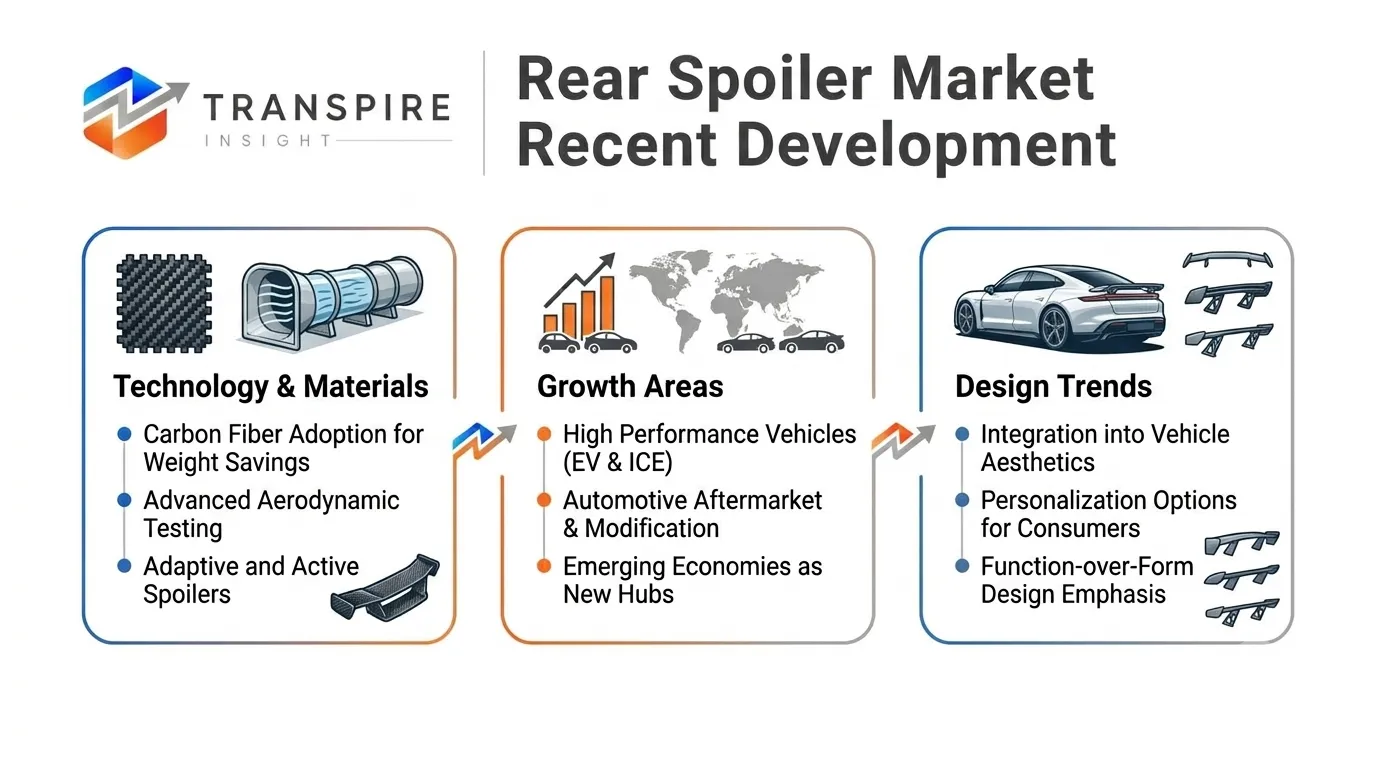
Latest Developments in the Rear Spoiler Market
Growth Drivers of the Rear Spoiler Market
The continued expansion of SUVs, crossovers and other passenger vehicles is creating a substantial addressable market for rear spoilers. Modern vehicle designs increasingly use aerodynamic elements to balance styling requirements with efficiency and stability.
The growing production of SUVs and MPVs has been identified as a major factor supporting rear spoiler demand.
Electric vehicles are creating new opportunities for aerodynamic optimization because reducing aerodynamic losses can contribute to overall vehicle efficiency and driving range.
As EV manufacturers compete on range, performance and design, spoilers can become part of broader aerodynamic packages that include underbody panels, diffusers, active grille systems and other airflow-management technologies.
Rear spoilers have traditionally been associated with performance vehicles, but their role has expanded into mainstream vehicle customization. Consumers increasingly seek sportier exterior designs and distinctive styling features.
This trend supports both factory-installed spoiler systems and aftermarket products. Vehicle personalization has been identified as an important factor supporting global market growth.
Automakers face continuing pressure to improve vehicle efficiency. Although the aerodynamic contribution of a spoiler depends heavily on vehicle design and operating conditions, aerodynamic engineering has become an important part of the industry's broader efficiency strategy.
The use of computational aerodynamic simulation and wind-tunnel testing allows manufacturers to optimize spoiler geometry for specific vehicle platforms.
Passive spoilers provide a fixed aerodynamic configuration, whereas active systems can change position or angle during operation. This creates opportunities to balance stability, drag and styling requirements across different driving conditions.
Active spoilers are particularly relevant to high-performance and premium vehicles and are increasingly being considered for advanced electric vehicle platforms.
The transition toward lightweight vehicle construction is increasing demand for materials such as carbon fiber, fiberglass and advanced polymer systems.
Reducing the mass of aerodynamic components can support broader vehicle weight-reduction strategies while enabling manufacturers to create increasingly complex shapes.
Luxury and performance vehicles often use aerodynamic components as both functional systems and design identifiers. Advanced rear wings, integrated spoilers and electronically adjustable aerodynamic devices can differentiate premium vehicles while supporting high-speed stability.
The luxury passenger-car segment is expected to experience strong growth as active and electronically adjustable spoiler systems become more widely incorporated.
Future Importance
The future of the rear spoiler market will depend on the convergence of aerodynamic engineering, electrification, lightweight construction and vehicle personalization.
Conventional fixed spoilers will remain important because they are relatively simple, cost-effective and suitable for high-volume vehicle platforms. However, advanced systems are expected to gain greater importance as automakers develop vehicles with increasingly sophisticated aerodynamic control.
The rise of EVs is particularly significant because vehicle efficiency and range are major competitive factors. This could encourage greater integration of spoilers with complete vehicle aerodynamic architectures rather than treating them as independent exterior accessories.
Why Advanced Rear Spoilers Matter
Rear spoilers can alter airflow around the vehicle and reduce aerodynamic lift under appropriate conditions, helping improve stability, particularly at higher speeds.
Aerodynamic optimization can contribute to lower aerodynamic losses. For EVs, this can be particularly relevant because reducing energy consumption can help improve driving range.
Active spoilers allow vehicle manufacturers to adjust aerodynamic behavior according to driving conditions, creating opportunities for more sophisticated vehicle dynamics.
Spoilers have become an important visual element in performance, luxury and sporty vehicle design. Integrated aerodynamic components can provide vehicles with distinctive styling while serving functional purposes.
Advanced plastics, carbon fiber and composite materials can reduce component weight while allowing manufacturers to create complex aerodynamic geometries.
Investment Opportunities
The rear spoiler market offers investment opportunities across aerodynamic components, lightweight materials, active spoiler mechanisms, injection molding, composite manufacturing, automotive electronics and aftermarket customization.
Active aerodynamic systems represent one of the most attractive technology opportunities because they combine traditional spoiler manufacturing with sensors, actuators and electronic control. Their adoption is expected to increase as premium vehicles and EVs incorporate more adaptive aerodynamic technologies.
Lightweight carbon-fiber and advanced composite spoiler manufacturing also provides opportunities for suppliers serving luxury and performance vehicles. At the high-volume end, injection-molded polymer spoilers remain attractive because of their scalability and cost efficiency.
The aftermarket represents another investment opportunity, particularly in regions where vehicle customization is strong. Digital commerce is making specialized aerodynamic components more accessible to consumers, expanding the market beyond traditional automotive dealerships.
Top 10 Companies in the Rear Spoiler Market
Major manufacturers compete through aerodynamic engineering, lightweight materials, manufacturing scale, OEM relationships and the ability to deliver customized spoiler systems for different vehicle platforms. Magna International is identified as a leading participant, with Global Market Insights estimating more than 8.2% market share in 2025.
1) Magna International Inc.
Magna International is a major global automotive supplier with capabilities spanning exterior systems, body structures, vehicle engineering and other automotive technologies. Its broad relationships with vehicle manufacturers provide a strong platform for supplying aerodynamic exterior components, including spoiler systems.
Magna was identified as the market leader in 2025, with more than 8.2% market share, according to Global Market Insights.
2) Plastic Omnium
Plastic Omnium is a major automotive supplier specializing in exterior body systems and other vehicle components. Its expertise in polymer-based automotive products provides a strong foundation for lightweight aerodynamic components.
The company's focus on exterior systems positions it to benefit from increasing demand for integrated vehicle designs and lightweight aerodynamic parts.
3) SMP Automotive
SMP Automotive develops and manufactures exterior and structural components for the automotive industry. Its capabilities across plastics, exterior modules and vehicle body components make it an important participant in the global spoiler supply chain.
4) POLYTEC Group
POLYTEC Group specializes in polymer-based components and systems for the automotive industry. Its experience with lightweight plastic components and complex exterior geometries supports applications where weight, design flexibility and manufacturing efficiency are important.
5) SRG Global
SRG Global is a major supplier of automotive exterior components and surface-finished products. Its capabilities in exterior vehicle components and manufacturing technologies provide opportunities in aerodynamic parts as automakers seek greater design integration.
Challenges & Restraints
The rear spoiler market faces several challenges despite its positive growth outlook. Cost pressure remains important, particularly for high-volume passenger vehicles where aerodynamic components must meet strict cost targets.
Material selection is another challenge. Carbon fiber and advanced composites can provide high performance and low weight but generally involve higher manufacturing costs than conventional polymer materials. Manufacturers therefore need to balance performance, aesthetics, durability and price.
Active spoiler systems introduce additional complexity because they require actuators, sensors, electronic controls and mechanical components. These systems can increase vehicle cost and introduce additional points that require validation and maintenance.
Market Expert View
The rear spoiler market is evolving from a primarily styling-oriented component category into a more sophisticated part of vehicle aerodynamic engineering. The most important shift is the growing integration of spoilers with broader aerodynamic systems.
Passive spoilers will continue to dominate high-volume applications because of their lower cost and straightforward construction. However, active systems are likely to capture increasing value as premium vehicles, performance cars and EVs adopt electronically controlled aerodynamic technologies.
The material landscape will also remain important. Manufacturers must balance lightweight construction with durability, cost and production scalability. Polymer-based injection molding is likely to remain essential for mass-market vehicles, while carbon fiber and advanced composites will continue to serve higher-performance applications.
The regional outlook is equally significant. Asia Pacific will remain the central manufacturing and consumption hub because of its enormous automotive production base, while North America offers strong growth potential through EV adoption, performance vehicles and advanced aerodynamic technologies.
Ultimately, the market's next phase will be defined by the convergence of aerodynamics, electrification, lightweight materials, electronics and intelligent vehicle control.
Conclusion
The global rear spoiler market is entering a new stage of development as automakers increasingly connect exterior design with aerodynamic performance, efficiency and vehicle technology. SUVs, passenger cars, performance vehicles and EVs are creating sustained demand for spoiler systems across both OEM and aftermarket channels.
While passive spoilers will continue to represent a significant portion of demand, active aerodynamic systems, lightweight composites and integrated vehicle designs are creating new opportunities at the higher-value end of the market.


Send us a brief description of your challenge and we'll get back to you within 24 hours.

 inquiry@transpireinsight.com
 APAC:+91 7666513636
 Address


