
Oct 07, 2026
By Transpire Insight
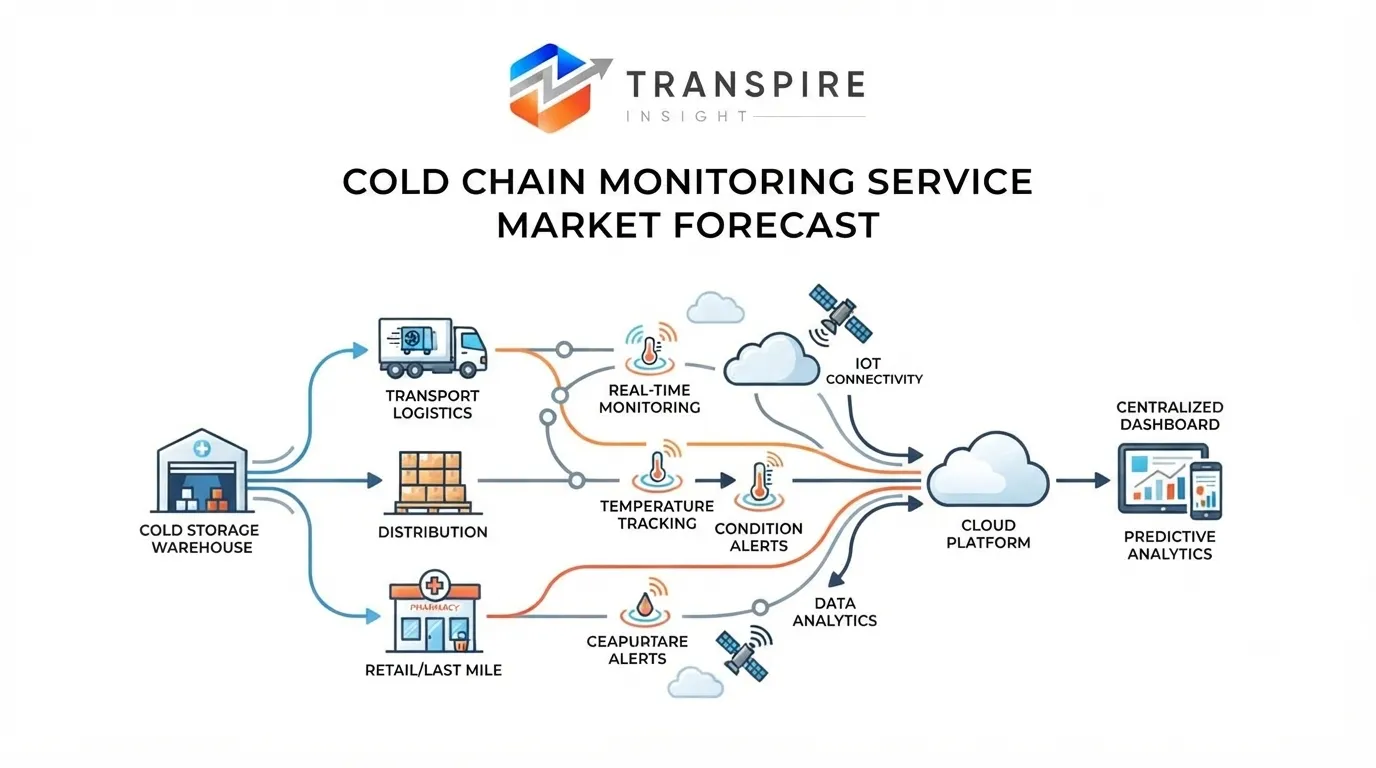
Cold chain monitoring services are becoming an essential part of temperature-sensitive supply chains as pharmaceutical products, vaccines, biologics, fresh foods, seafood, dairy products, chemicals, and other temperature-sensitive goods move through increasingly complex global distribution networks. Continuous monitoring technologies are replacing isolated manual temperature checks with connected sensors, cloud platforms, automated alerts, GPS visibility, analytics, and digital records.
The market is evolving from basic temperature logging toward real-time and predictive supply-chain intelligence. Companies are increasingly seeking systems that can identify temperature excursions while products are still in transit, provide immediate alerts, document compliance, monitor multiple environmental parameters, and help logistics teams intervene before product quality is compromised.
Market Size
According to Transpire Insight, the global Cold Chain Monitoring Service Market was valued at approximately USD 43.09 billion in 2025 and is projected to reach approximately USD 228.59 billion by 2033, expanding at a CAGR of 23.22% from 2026 to 2033. The market covers temperature monitoring, humidity monitoring, GPS tracking, real-time monitoring systems, IoT monitoring platforms, pharmaceutical logistics, food and beverage logistics, chemical transportation, agricultural supply chains, and cloud-based monitoring technologies.
The strong growth outlook reflects increasing dependence on temperature-sensitive products, stricter supply-chain visibility requirements, expanding pharmaceutical logistics, growth in online grocery and food distribution, increasing adoption of IoT sensors, and the transition from historical data logging to real-time monitoring.
Continuous Monitoring Is Replacing Periodic Temperature Checks
Traditional cold chain management often relied on manual temperature readings and data loggers that recorded conditions for later review.
While these approaches provide valuable records, they may not allow logistics teams to respond immediately when a shipment moves outside its acceptable temperature range.
Real-time monitoring changes this model by continuously transmitting information from the shipment, vehicle, warehouse, refrigerator, freezer, or cold room to a centralized platform.
Geotab describes modern cold chain monitoring as the use of real-time sensors and software to continuously track conditions such as temperature, humidity, and location for perishable goods in transit and storage.
This shift is particularly important for high-value pharmaceutical products and food shipments where a temperature excursion can result in spoilage, product rejection, regulatory complications, or financial losses.
Pharmaceutical Logistics Is a Major Market Driver
Pharmaceutical logistics represents one of the most demanding applications for cold chain monitoring.
Vaccines, biologics, blood products, cell and gene therapies, certain active pharmaceutical ingredients, and other temperature-sensitive medicines can require carefully controlled transportation and storage conditions.
The World Health Organization emphasizes that temperature monitoring is essential throughout vaccine supply chains and provides specific guidance covering temperature monitoring tools for cold rooms, refrigerators, and transportation environments.
Temperature excursions can occur during loading, transportation, customs clearance, warehouse transfers, last-mile distribution, or temporary equipment failures.
Continuous monitoring provides visibility into these events and allows responsible personnel to investigate and respond.
WHO also notes that remote temperature monitoring systems can continuously monitor vaccine temperatures, trigger alarms when conditions move outside appropriate ranges, and alert healthcare workers so corrective action can be taken faster.
Biologics and Advanced Therapies Increase Monitoring Requirements
The expansion of biologics and advanced therapies is creating additional demand for sophisticated monitoring.
Many biologic products have narrower temperature-management requirements than conventional pharmaceuticals. Cell and gene therapies can involve highly controlled logistics involving specialized packaging, cryogenic environments, chain-of-custody procedures, and time-sensitive transportation.
Monitoring services therefore increasingly need to provide more than a simple temperature reading.
Systems may need to capture location, temperature, humidity, light exposure, shock, door openings, battery status, and other conditions depending on the shipment.
Tive, for example, provides monitoring across road, ocean, air, and rail and supports temperature, humidity, light, shock, and location tracking across cold-chain applications.
This illustrates how monitoring is becoming a multidimensional logistics service rather than a standalone temperature-recording activity.
Food and Beverage Logistics Is Expanding the Addressable Market
The food and beverage industry is another major application area.
Fresh meat, seafood, dairy, fruits, vegetables, frozen foods, prepared meals, and other perishables require appropriate temperature management to preserve quality and reduce spoilage.
Cold chain monitoring allows distributors and retailers to identify temperature variations during transportation and storage.
Food traceability requirements are also increasing the importance of digital supply-chain records.
The U.S. Food and Drug Administration's Food Traceability Final Rule establishes additional recordkeeping requirements for specified foods and is intended to support faster identification and removal of potentially contaminated food from the market.
Although traceability and temperature monitoring are distinct functions, connected cold-chain platforms can contribute to a more complete digital record of a shipment's movement and environmental conditions.
E-Commerce Is Increasing Last-Mile Monitoring Requirements
The expansion of online grocery, meal-kit delivery, direct-to-consumer food distribution, and temperature-sensitive healthcare deliveries is changing cold chain requirements.
Traditional cold chains often focused on large warehouses and refrigerated trucks. Last-mile delivery introduces additional complexity because products may move between distribution centers, delivery vehicles, temporary storage locations, and consumers.
Short delivery windows do not eliminate temperature risk.
A shipment may still encounter delays caused by traffic, loading problems, vehicle failures, extreme weather, or incorrect handling.
Connected monitoring devices can provide visibility during this final stage of distribution.
This is particularly important for high-value pharmaceuticals and specialty foods where product integrity must be maintained until delivery.
IoT Sensors Are Transforming Monitoring Services
The Internet of Things is one of the central technologies driving the market.
IoT-enabled monitoring systems can connect temperature sensors, humidity sensors, GPS modules, cellular connectivity, Bluetooth devices, gateways, and cloud software.
Instead of requiring personnel to manually collect data from each shipment, connected devices can automatically transmit measurements.
This enables centralized monitoring of large fleets and distributed storage networks.
Sensitech's cold-chain solutions include real-time shipment monitoring, stationary temperature monitoring, mobile applications, and the SensiWatch platform for supply-chain visibility.
The increasing availability of low-power sensors and cellular connectivity is also making monitoring more practical across long-distance logistics networks.
Cloud Platforms Are Becoming the Central Monitoring Layer
Cloud technology allows temperature and logistics information from multiple locations to be brought into a single platform.
A centralized dashboard can provide information about shipment status, current temperature, historical conditions, alarms, and exceptions.
This is especially useful for companies operating multiple warehouses, transportation routes, distribution centers, and third-party logistics providers.
Cloud platforms also make it easier to provide different levels of access to manufacturers, logistics providers, quality teams, and customers.
Sensitech describes its SensiWatch platform as using IoT data collection and data-management tools to provide an end-to-end view of supply-chain conditions.
The increasing adoption of cloud infrastructure is therefore changing cold chain monitoring from a device-based activity into a software-enabled service.
Automated Alerts Enable Faster Intervention
A major advantage of real-time monitoring is the ability to trigger alerts when conditions approach or exceed defined thresholds.
Alerts can be delivered through dashboards, mobile applications, SMS, email, or other communication channels.
This allows personnel to investigate problems while products are still recoverable.
For example, if a refrigerated truck experiences a cooling-system failure, an automated alert can notify the logistics team before the shipment reaches a critical temperature condition.
WHO's guidance on remote temperature monitoring highlights the value of alarms and rapid notification when vaccine storage temperatures move outside the appropriate range.
The market is consequently moving from passive monitoring toward active exception management.
Predictive Analytics Could Reduce Temperature Excursions
The next stage of cold chain monitoring involves predictive analytics.
Historical temperature data, weather information, vehicle information, route conditions, refrigeration performance, and shipment characteristics can potentially be analyzed to identify patterns associated with future temperature excursions.
Predictive systems could alert logistics operators before a problem becomes severe.
For example, a platform could identify abnormal refrigeration performance and recommend maintenance before a vehicle experiences a complete cooling failure.
AI can also help prioritize alerts by distinguishing between minor variations and potentially critical events.
This can reduce alert fatigue and allow quality teams to focus their attention on the most important exceptions.
GPS Tracking Adds Location Intelligence
Temperature information becomes more useful when it is linked to location.
GPS tracking can identify where a temperature excursion occurred, which route was involved, how long a shipment remained in a specific location, and whether delays contributed to the event.
This information can support root-cause analysis.
Location data can also help logistics teams understand where shipments are currently located and whether they are approaching their expected delivery points.
For high-value pharmaceutical shipments, combining temperature, location, and time information can provide stronger chain-of-custody visibility.
Multi-Parameter Monitoring Is Expanding
Temperature remains the primary monitoring variable, but modern systems increasingly track multiple environmental and logistical parameters.
Humidity monitoring can be important for products affected by moisture.
Light sensors can identify unwanted exposure to light-sensitive goods.
Shock and vibration sensors can detect physical handling events.
Door sensors can indicate unauthorized or excessive opening of refrigerated storage spaces.
Tive's cold-chain monitoring platform, for example, combines temperature, humidity, light, shock, and location monitoring across multiple transportation modes.
This convergence is creating a broader category of shipment-condition monitoring.
Wireless Sensors Improve Deployment Flexibility
Wireless sensors can reduce installation complexity and allow monitoring devices to be placed directly inside packaging, pallets, storage areas, vehicles, or containers.
Bluetooth Low Energy technology is particularly useful for short-range communication between sensors and smartphones or gateways.
The WHO-prequalified ColdTrace Transport system from Nexleaf Analytics uses Bluetooth Low Energy sensors, smartphone connectivity, cloud uploading, and GPS-tagged trip summaries for vaccine transport monitoring.
Such systems can be particularly valuable in regions where permanent infrastructure is limited.
Pharmaceutical Compliance Supports Adoption
Regulatory expectations are an important factor behind cold chain monitoring investment.
Pharmaceutical manufacturers and logistics providers must demonstrate that temperature-sensitive products have been transported and stored under appropriate conditions.
Digital records can help quality teams document conditions throughout the supply chain.
WHO maintains technical guidance and prequalification pathways for temperature-monitoring devices used in immunization supply chains. Its E006 category includes temperature monitoring devices such as recorders, alarms, event loggers, and remote communication equipment.
The growing use of electronic records also improves the ability to investigate excursions and establish corrective actions.
Food Traceability Is Supporting Digital Supply Chains
Food supply chains are also moving toward greater digital traceability.
The FDA's Food Traceability Final Rule covers additional recordkeeping requirements for specified foods and is intended to enable faster identification and removal of potentially contaminated products. In 2026, FDA continued to publish implementation materials and information concerning the rule.
The rule's broader focus on electronic traceability reinforces the industry's movement toward digitally documented supply chains.
Cold-chain monitoring services can complement these systems by attaching environmental information to products and shipments.
Cold Storage Facilities Are Becoming More Connected
Monitoring is not limited to products in transit.
Cold rooms, refrigerators, freezers, distribution centers, warehouses, supermarkets, hospitals, pharmacies, and food-processing facilities also require temperature oversight.
Automated monitoring can continuously track multiple zones and refrigeration units.
When conditions change unexpectedly, operators can receive alerts without waiting for the next manual inspection.
WHO's current immunization supply-chain resources include temperature monitoring and mapping tools for cold-chain equipment and storage areas.
This creates opportunities for service providers offering centralized monitoring across geographically distributed facilities.
Pharmaceutical Last-Mile Distribution Is Creating New Opportunities
The final stage of pharmaceutical distribution can be particularly challenging.
Products may move from regional warehouses to hospitals, clinics, pharmacies, vaccination centers, or patients.
Smaller shipment volumes and frequent handoffs can make continuous monitoring more difficult.
Real-time devices designed for smaller shipments can provide visibility without requiring complex permanent infrastructure.
Sensitech offers product-level and real-time monitoring solutions for pharmaceutical and life-science supply chains, including Berlinger solutions designed for temperature-sensitive products.
As specialty pharmaceuticals become more important, last-mile monitoring is expected to remain a significant application.
Regional Outlook
North America
North America represents a major market for cold chain monitoring services due to its large pharmaceutical industry, extensive food distribution networks, sophisticated logistics infrastructure, and high adoption of connected technologies.
The United States has particularly strong demand for real-time monitoring across pharmaceutical, food, grocery, and logistics applications.
Regulatory requirements and digital traceability initiatives also encourage companies to maintain stronger records across supply chains.
The region's established 3PL ecosystem creates additional demand for monitoring systems that can operate across multiple carriers and facilities.
Europe
Europe has a mature pharmaceutical and food logistics industry supported by extensive cross-border trade.
The region's emphasis on product quality, pharmaceutical distribution standards, food safety, and sustainability creates demand for monitoring systems capable of maintaining reliable records.
European technology suppliers such as ELPRO and Berlinger have developed specialized monitoring technologies for pharmaceutical and life-science applications.
The growing use of cloud-based logistics platforms is also creating opportunities for integrated monitoring services.
Asia Pacific
Asia Pacific is expected to remain one of the most important expansion regions for cold chain monitoring.
The region combines large populations, growing pharmaceutical manufacturing, expanding food distribution, increasing e-commerce, and rapid digitalization.
China, India, Japan, South Korea, Australia, and Southeast Asian economies are investing in logistics infrastructure and temperature-sensitive supply chains.
India presents particularly significant opportunities because of its pharmaceutical manufacturing industry, vaccine distribution networks, food supply chains, and expanding cold-storage infrastructure.
The development of wireless and mobile monitoring solutions can support deployment in areas where traditional fixed monitoring infrastructure remains limited.
Latin America
Latin America has opportunities across food exports, agricultural supply chains, pharmaceuticals, seafood, meat, and frozen products.
The region's large agricultural and food-export industries create a strong requirement for maintaining product conditions during international transportation.
Monitoring services can help exporters document shipment conditions and identify problems during long-distance transportation.
Expansion of modern refrigerated warehousing and logistics infrastructure should create additional demand for connected monitoring technologies.
Middle East & Africa
The Middle East and Africa represent developing opportunities due to increasing pharmaceutical distribution, food imports, agricultural exports, and healthcare infrastructure investments.
Temperature-sensitive products may travel long distances under challenging environmental conditions.
Monitoring systems can provide greater visibility across these transportation networks.
Wireless devices, cellular-connected sensors, and cloud platforms can be particularly useful where permanent monitoring infrastructure is still developing.
Competitive Landscape
The Cold Chain Monitoring Service Market includes specialized cold-chain technology companies, IoT providers, telematics companies, sensor manufacturers, industrial technology companies, and logistics technology providers.
Competition is increasingly focused on complete visibility rather than standalone hardware.
Companies are combining sensors, connectivity, cloud software, analytics, GPS tracking, mobile applications, alerts, reporting, and compliance capabilities.
Sensitech provides monitoring across pharmaceutical and food supply chains, while Tive focuses on real-time condition and location monitoring across multiple transport modes.
The competitive environment is also moving toward software-as-a-service models in which customers pay for continuous visibility and analytics rather than simply purchasing monitoring devices.
Top 10 Companies in the Cold Chain Monitoring Service Market
These companies represent important technology and service providers across temperature monitoring, IoT connectivity, pharmaceutical logistics, fleet telematics, cloud platforms, and supply-chain visibility.
Company Profiles
1. Sensitech
Sensitech is a major provider of cold-chain monitoring and supply-chain visibility solutions.
Its portfolio includes real-time shipment monitoring, product-level data loggers, stationary temperature monitoring, mobile applications, and the SensiWatch platform.
The company serves pharmaceutical, life-science, food, and industrial supply chains. Its solutions are designed to provide visibility from origin through delivery and support product-quality management.
Sensitech's acquisition of Berlinger-related cold-chain capabilities has also expanded its portfolio for pharmaceutical and life-science applications.
2. Controlant
Controlant specializes in connected monitoring technologies for temperature-sensitive supply chains, particularly pharmaceutical logistics.
Its solutions combine IoT-connected monitoring devices, cloud technology, data management, and real-time visibility.
The company has built its business around continuous monitoring of temperature-sensitive products and the digitalization of pharmaceutical supply chains.
Its focus on connected logistics makes it relevant to the market's transition from retrospective data logging toward real-time visibility.
3. ORBCOMM
ORBCOMM provides IoT and asset-monitoring technologies used across transportation and logistics.
Its capabilities include fleet monitoring, asset tracking, refrigerated-asset visibility, and connected supply-chain applications.
The company combines wireless connectivity, sensors, telematics, and cloud-based platforms.
Its technology is relevant to refrigerated transportation because fleet operators need visibility into equipment status, location, and environmental conditions.
4. Emerson Electric
Emerson is a diversified industrial technology company with capabilities spanning automation, measurement, control, and refrigeration-related technologies.
Its cold-chain ecosystem includes monitoring and control technologies used across food, pharmaceutical, and industrial applications.
Emerson's broad automation portfolio enables integration between environmental sensing, control systems, analytics, and operational infrastructure.
This positioning supports the increasing convergence between refrigeration equipment and digital monitoring.
5. ELPRO-BUCHS
ELPRO specializes in environmental monitoring and data-management technologies for pharmaceuticals, healthcare, laboratories, and other temperature-sensitive applications.
Its solutions include data loggers, wireless monitoring systems, cloud platforms, sensors, and validation-oriented technologies.
The company has particular expertise in regulated environments where temperature records and monitoring accuracy are important.
Its focus on pharmaceutical and life-science applications makes it a significant participant in the specialized cold-chain monitoring ecosystem.
6. Berlinger & Co.
Berlinger develops temperature-monitoring solutions for pharmaceutical, healthcare, vaccine, and global-health applications.
Its cold-chain products include data loggers, temperature indicators, monitoring devices, and connected solutions.
Sensitech's Berlinger Cold Chain Solutions portfolio includes reusable and single-use data loggers, SmartView software, real-time monitoring devices, and solutions for pharmaceutical and life-science supply chains.
Berlinger's expertise is particularly relevant to vaccine and pharmaceutical logistics.
7. Tive
Tive provides real-time shipment monitoring and supply-chain visibility.
Its cold-chain solutions monitor temperature, humidity, light, shock, and location across road, ocean, air, and rail transportation.
The platform supports applications spanning food, perishables, pharmaceuticals, and life sciences.
Its approach reflects the market's movement toward multi-parameter shipment intelligence rather than temperature-only monitoring.
8. Roambee
Roambee provides connected supply-chain visibility using IoT sensors and cloud-based analytics.
Its solutions can monitor shipment conditions and provide visibility into location and logistics performance.
The company focuses on helping organizations understand shipment conditions in real time and manage exceptions across complex supply chains.
This model is aligned with growing demand for centralized visibility across multiple logistics providers and transportation modes.
9. Monnit
Monnit develops wireless sensing and remote-monitoring technologies.
Its solutions can be used for temperature, humidity, equipment conditions, and other environmental parameters.
Cold-storage facilities can use connected sensors to monitor refrigerators, freezers, warehouses, and other controlled environments.
The company's wireless architecture can support distributed monitoring without requiring extensive wired infrastructure.
10. Geotab
Geotab is a major connected-transportation and telematics provider.
Its cold-chain monitoring approach combines vehicle and fleet data with real-time temperature, humidity, and location information.
Geotab highlights cold-chain monitoring as a method for reducing spoilage and improving compliance and supply-chain visibility.
The integration of refrigerated-asset information with fleet telematics provides opportunities for logistics companies to manage transportation performance and product conditions through a connected platform.
Key Challenges Facing the Cold Chain Monitoring Service Market
Despite strong growth opportunities, the market faces several challenges.
High implementation costs can limit adoption among small logistics companies. Sensors, gateways, connectivity subscriptions, cloud platforms, calibration, installation, and maintenance can increase the total cost of ownership.
Connectivity gaps remain another issue. International shipments may pass through areas where cellular or other communication infrastructure is inconsistent.
Sensor accuracy and calibration are critical because incorrect measurements can result in unnecessary product rejection or missed temperature excursions.
Data interoperability is also important. Global shipments may involve manufacturers, carriers, warehouses, customs agents, distributors, and retailers using different systems.
Alert fatigue can become a problem when monitoring platforms generate excessive notifications. Intelligent prioritization is therefore increasingly important.
Cybersecurity and data privacy are growing concerns as monitoring platforms become connected to corporate systems and cloud infrastructure.
Finally, legacy infrastructure can slow adoption. Existing warehouses and refrigerated fleets may require substantial investment before they can support fully connected monitoring.
Future Outlook
The future of the Cold Chain Monitoring Service Market will be shaped by the transition from basic temperature recording toward predictive, connected, and automated supply-chain management.
IoT sensors will continue becoming smaller, more energy efficient, and easier to deploy. Wireless connectivity will allow monitoring across increasingly diverse transportation environments.
Cloud platforms will remain central to the market because they allow organizations to consolidate information from warehouses, vehicles, containers, shipments, and individual products.
Artificial intelligence is expected to become increasingly important for predicting temperature excursions, identifying refrigeration problems, analyzing routes, prioritizing alerts, and identifying recurring supply-chain weaknesses.
Another important development will be the convergence of monitoring and traceability. Companies will increasingly want to understand not only where a product is located but also what environmental conditions it experienced throughout its journey.
Pharmaceutical logistics will remain a high-value application because of the sensitivity and cost of many modern medicines. Food and beverage supply chains will continue driving large-scale deployments because of the enormous volume of temperature-sensitive products moving through global networks.
The last-mile segment is also expected to gain importance as healthcare and food distribution become increasingly decentralized.
The World Health Organization's continuing development of temperature-monitoring tools demonstrates the importance of reliable temperature data within healthcare supply chains, while its prequalification framework supports the development and evaluation of appropriate monitoring technologies.
Overall, cold chain monitoring is evolving into a comprehensive digital service combining sensors, connectivity, cloud computing, analytics, GPS, automated alerts, and compliance records. As global supply chains become more complex and organizations place greater emphasis on product integrity, real-time visibility is expected to become an increasingly standard component of temperature-sensitive logistics through 2033.


Send us a brief description of your challenge and we'll get back to you within 24 hours.

 inquiry@transpireinsight.com
 APAC:+91 7666513636
 Address


