
Aug 08, 2026
By Transpire Insight
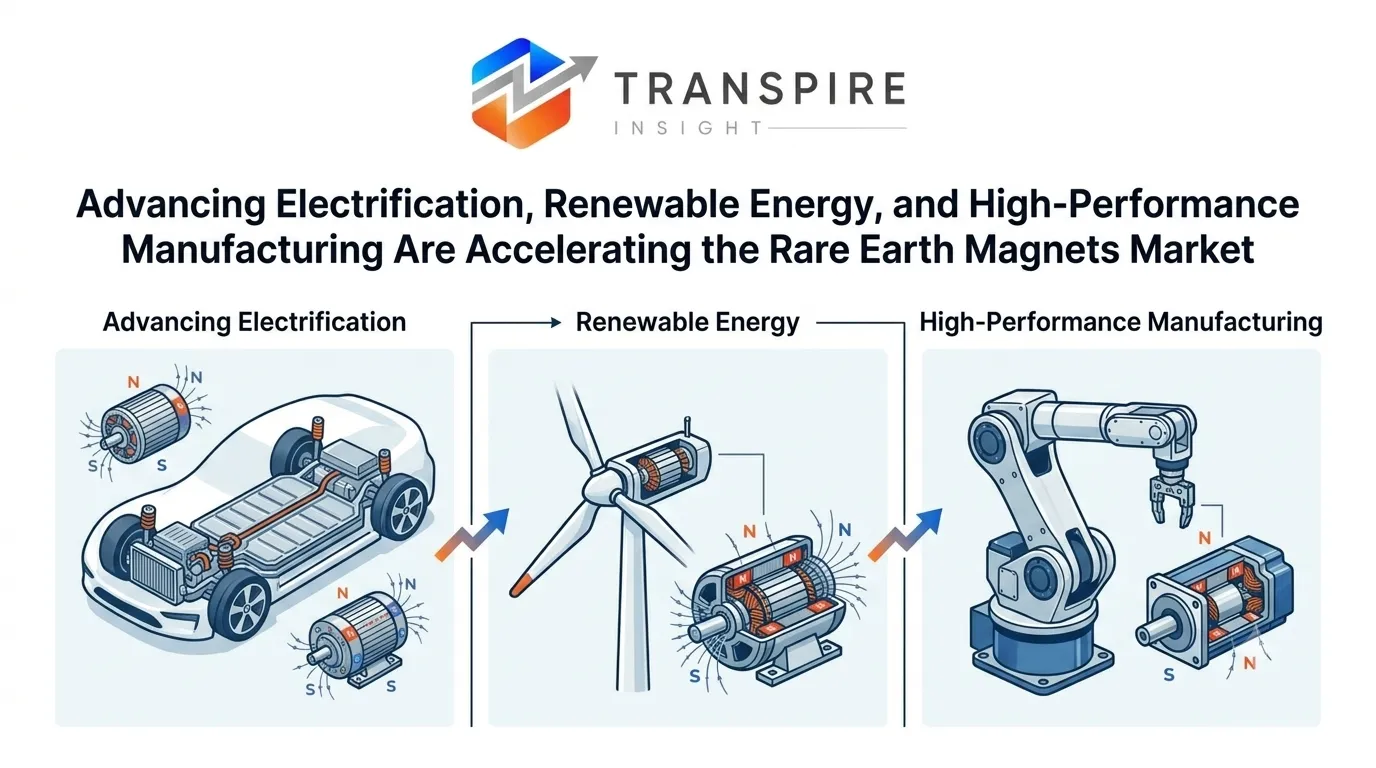
The rare earth magnets market is experiencing robust expansion as industries increasingly adopt high-performance permanent magnets to improve energy efficiency, miniaturization, and operational reliability across advanced manufacturing sectors. Rare earth magnets, particularly Neodymium-Iron-Boron (NdFeB) and Samarium-Cobalt (SmCo) magnets, have become indispensable in electric vehicles, wind turbines, industrial automation, consumer electronics, aerospace, defense, and medical equipment due to their exceptional magnetic strength, compact size, and long service life. According to Transpire Insights, accelerating electrification, rapid deployment of renewable energy infrastructure, expansion of industrial robotics, and increasing demand for precision electronic devices are creating long-term growth opportunities for the Rare Earth Magnets Market.
According to Transpire Insights, the Rare Earth Magnets Market was valued at approximately USD 18.4 billion in 2025 and is projected to reach around USD 35.9 billion by 2033, expanding at a CAGR of approximately 8.7% during the forecast period. Continuous investment in electric mobility, clean energy generation, advanced automation, and next-generation electronics is expected to sustain healthy market growth throughout the decade.
Rare earth magnets possess significantly higher magnetic energy density than conventional ferrite or alnico magnets, allowing manufacturers to produce smaller, lighter, and more efficient motors, generators, sensors, and electronic assemblies. NdFeB magnets account for nearly 85–90% of rare earth magnet demand due to their superior magnetic performance and broad applicability, while SmCo magnets remain preferred in aerospace, defense, and high-temperature industrial environments where operating temperatures may exceed 300°C.
The transition toward electric mobility is one of the strongest growth drivers for the market. electric vehicle sales surpassed 17 million units annually, with EVs representing nearly 20% of all new passenger vehicle sales worldwide. Modern permanent magnet synchronous motors (PMSMs), widely used in battery electric vehicles, typically require 1–2 kilograms of rare earth magnets depending on motor design and vehicle size. High-performance NdFeB magnets improve motor efficiency, reduce energy losses, and increase vehicle driving range, making them a preferred solution for automotive manufacturers focused on lightweight and high-efficiency powertrains.
Wind energy deployment is creating another major source of demand. Large direct-drive offshore wind turbines commonly require 500–700 kilograms of rare earth magnets per megawatt (MW) of installed capacity because permanent magnet generators eliminate the need for gearboxes while improving efficiency and reducing maintenance requirements. cumulative wind power capacity has already exceeded 1,100 GW, with offshore installations expanding rapidly across Europe, China, and North America. As governments continue investing in renewable energy infrastructure, demand for high-performance permanent magnets is expected to increase substantially.
Industrial automation and robotics are further strengthening market growth. The worldwide installed base of industrial robots now exceeds 4 million units, while annual installations continue growing across automotive, electronics, logistics, semiconductor manufacturing, and precision engineering industries. Servo motors, robotic actuators, automated guided vehicles (AGVs), collaborative robots, and high-precision motion control systems rely heavily on rare earth magnets because of their high torque density, compact dimensions, and superior energy efficiency. Compared with conventional motor technologies, permanent magnet motors can improve energy efficiency by approximately 10–20%, contributing to lower electricity consumption across industrial operations.
The consumer electronics industry also remains a significant end-use sector. Smartphones, tablets, laptops, wireless earbuds, wearable devices, gaming systems, and smart home appliances increasingly utilize miniature rare earth magnets in speakers, microphones, vibration motors, camera autofocus systems, wireless charging modules, and magnetic sensors. smartphone shipments continue exceeding 1.2 billion units annually, while wearable electronics and wireless audio devices maintain strong double-digit adoption rates in several regions, supporting sustained demand for compact high-performance magnetic materials.
Medical technology represents another important growth segment. Magnetic Resonance Imaging (MRI) systems, infusion pumps, robotic surgical equipment, hearing devices, and laboratory automation systems incorporate rare earth magnets because of their precision, stability, and reliability. The increasing adoption of advanced diagnostic imaging and minimally invasive surgical technologies continues creating new opportunities for specialized magnet manufacturers.
Supply chain security has become one of the defining themes within the industry. rare earth production remains geographically concentrated, with China accounting for approximately 65–70% of mined rare earth production and over 85–90% of rare earth magnet manufacturing capacity. Consequently, governments across North America, Europe, Japan, Australia, and South Korea are investing heavily in domestic rare earth mining, refining, recycling, and magnet production to strengthen supply chain resilience. Several large-scale projects aimed at expanding non-Chinese rare earth processing capacity are currently under development, reflecting the strategic importance of these critical materials.
Download the exclusive Rare Earth Magnets Market sample report today to uncover expert insights, emerging trends, and the opportunities defining the future of the industry.
Growing Demand Across Electric Vehicles, Renewable Energy, and Industrial Automation Is Strengthening the Rare Earth Magnets Market
The Rare Earth Magnets Market continues to expand as governments and industries accelerate investments in electrification, energy-efficient technologies, industrial automation, and advanced manufacturing. According to Transpire Insights, rare earth magnets have become strategic materials because they enable higher power density, lower energy consumption, compact product designs, and longer equipment life. Unlike conventional magnetic materials, rare earth magnets provide superior magnetic strength while occupying significantly less space, making them indispensable for next-generation electric motors, generators, sensors, medical equipment, and defense systems.
One of the largest contributors to market growth is the rapid expansion of electric mobility. Permanent magnet synchronous motors (PMSMs) remain the preferred motor technology for many battery electric vehicles because they deliver higher efficiency, superior torque, and improved acceleration. Industry studies indicate that PMSM efficiency typically reaches 95–97%, compared with 88–92% for many conventional induction motors under similar operating conditions. As automakers continue expanding EV production, demand for high-performance NdFeB magnets is expected to rise steadily across traction motors, electric power steering systems, braking systems, cooling pumps, and battery management components.
Renewable energy is another major demand generator. Offshore wind farms increasingly utilize direct-drive turbine technology because it eliminates gearbox losses while improving operational reliability. Modern offshore wind turbines commonly range between 8 MW and 18 MW in generating capacity, while several next-generation turbines are expected to exceed 20 MW. Depending on turbine design, a single offshore wind installation may require 4–10 tonnes of rare earth magnets, highlighting the growing importance of permanent magnet generators in clean energy infrastructure.
Industrial automation is also driving sustained market expansion. Manufacturing facilities worldwide continue integrating robotics, automated production lines, intelligent conveyors, collaborative robots (cobots), and precision motion-control equipment. According to international manufacturing statistics, annual industrial robot installations now exceed 500,000 units, reflecting continuous investment in smart manufacturing. Servo motors utilizing rare earth magnets deliver higher positioning accuracy, lower vibration, and energy savings of approximately 10–15%, improving both productivity and operational efficiency.
Market Analysis
Asia-Pacific dominates the market with approximately 70–75% of revenue and an even larger share of manufacturing capacity. China remains the industry's largest producer of rare earth oxides, refined materials, and finished permanent magnets. The country manufactures millions of electric motors annually while serving as the world's largest producer of electric vehicles, consumer electronics, industrial machinery, and renewable energy equipment. Japan and South Korea also play critical roles through advanced magnet processing technologies and high-value electronics manufacturing.
Europe accounts for approximately 12–15% of market demand. The region continues strengthening its rare earth supply chain through strategic investments supporting electric vehicle manufacturing, offshore wind energy, industrial automation, and defense modernization. Germany remains Europe's leading consumer because of its strong automotive, industrial machinery, and renewable energy industries
North America contributes approximately 10–12% of demand and continues investing in domestic rare earth mining, refining, and magnet manufacturing to reduce supply-chain dependence. The United States is witnessing growing demand from aerospace, defense, medical equipment, semiconductor manufacturing, and electric vehicle production.
By magnet type, Neodymium-Iron-Boron (NdFeB) magnets dominate the market with approximately 85–90% of total consumption because of their extremely high magnetic energy product and broad industrial applicability. Samarium-Cobalt (SmCo) magnets account for approximately 8–10% of demand, primarily serving aerospace, military, oil & gas, and high-temperature industrial applications where thermal stability is more important than cost.
From an application perspective, the automotive sector represents the largest end-use industry, accounting for nearly 32–36% of total market demand. Electric traction motors, anti-lock braking systems (ABS), electronic stability control, electric power steering, sensors, fuel pumps, and numerous auxiliary motors contribute significantly to magnet consumption.
The renewable energy sector contributes approximately 18–22% of demand, while consumer electronics account for nearly 15–18%. Industrial machinery, medical devices, aerospace, defense, and telecommunications collectively represent the remaining market share, with several of these segments expected to record above-average growth throughout the forecast period.
Competitive Landscape
Competition within the Rare Earth Magnets Market extends far beyond raw material availability. Leading manufacturers increasingly compete through advanced magnet technology, material efficiency, recycling capabilities, production capacity, and long-term supply agreements with automotive OEMs, wind turbine manufacturers, electronics companies, and defense contractors.
Manufacturers continue expanding production capacity to meet rising demand from electric mobility and renewable energy. Several companies have announced investments exceeding USD 100–500 million for new rare earth processing facilities, magnet manufacturing plants, and recycling operations. These investments are expected to improve supply-chain resilience while supporting growing demand.
Research and development remains one of the industry's strongest competitive differentiators. Leading magnet manufacturers typically allocate 3–5% of annual revenue toward R&D activities focused on reducing heavy rare earth dependence, improving corrosion resistance, enhancing magnetic strength, and increasing operating temperature capability. Development of dysprosium-efficient magnets and grain-boundary diffusion technologies is helping manufacturers improve performance while reducing reliance on scarce heavy rare earth elements.
Financial Impact
The Rare Earth Magnets Market generates significant economic value across mining, refining, alloy production, precision machining, motor manufacturing, renewable energy equipment, automotive systems, and electronics supply chains. Because permanent magnets improve energy efficiency throughout multiple industries, they contribute indirectly to lower operating costs, reduced carbon emissions, and improved equipment performance.
Rare earth magnet prices remain influenced by raw material availability, mining output, geopolitical developments, and downstream industrial demand. In recent years, prices for Neodymium-Praseodymium (NdPr) oxide have experienced fluctuations exceeding 20–40% annually, encouraging manufacturers to secure long-term supply agreements and invest in recycling technologies.
Recycling is becoming increasingly important from both economic and strategic perspectives. Studies suggest that end-of-life electric motors, wind turbines, and electronic equipment could eventually supply 15–25% of rare earth material requirements through advanced recycling technologies, reducing dependence on newly mined resources while improving supply security.
Technological Innovation, Supply Chain Diversification, and Sustainable Manufacturing Are Reshaping the Rare Earth Magnets Market
The Rare Earth Magnets Market is undergoing a major technological transformation as manufacturers focus on developing magnets with higher magnetic performance, improved thermal stability, reduced dependence on critical rare earth elements, and enhanced sustainability. The market is no longer driven solely by increasing demand from automotive and electronics industries but also by continuous innovation in material science, advanced manufacturing technologies, recycling processes, and digital production systems. According to Transpire Insights, the next phase of market expansion will be defined by intelligent manufacturing, supply chain localization, next-generation magnetic materials, and circular economy initiatives that improve long-term supply security while supporting decarbonization goals.
Neodymium-Iron-Boron (NdFeB) magnets continue evolving through advanced alloy optimization. Modern high-performance NdFeB magnets now achieve magnetic energy products exceeding 55 Mega Gauss Oersted (MGOe), compared with approximately 35–40 MGOe for earlier commercial generations. Higher magnetic energy density enables manufacturers to produce smaller and lighter electric motors while maintaining identical power output, directly benefiting electric vehicles, industrial robotics, and aerospace systems.
High-temperature magnet technology is also advancing rapidly. Conventional NdFeB magnets generally operate efficiently up to 150–180°C, whereas newly developed grades designed for electric vehicle traction motors can withstand operating temperatures exceeding 200°C. Samarium-Cobalt (SmCo) magnets continue serving demanding aerospace and defense applications where continuous operating temperatures may exceed 300–350°C, providing outstanding reliability under extreme conditions.
Proceed to Checkout to purchase the exclusive Rare Earth Magnets Market report and gain instant access to in-depth market intelligence, strategic analysis, and future growth opportunities.
Digital Manufacturing Is Enhancing Production Efficiency
Rare earth magnet manufacturing has become increasingly automated as producers integrate Artificial Intelligence (AI), Industrial Internet of Things (IIoT), robotics, and advanced process control systems throughout production. Modern magnet manufacturing involves powder preparation, alloy melting, sintering, machining, coating, magnetization, and precision quality inspection all of which benefit from intelligent automation.
AI-assisted manufacturing systems continuously monitor particle size distribution, sintering temperatures, material density, and magnetic properties during production. Industry studies indicate that AI-supported process optimization can improve production efficiency by approximately 12–18% while reducing material waste by nearly 10–15%. Automated quality inspection systems also improve consistency by identifying microscopic defects before finished magnets reach customers.
Robotic automation has become increasingly common within magnet production facilities. Automated powder handling, robotic machining centers, laser measurement systems, and computer-controlled coating lines improve manufacturing precision while reducing contamination risks. Several large-scale production plants now manufacture thousands of tonnes of permanent magnets annually, supported by highly automated production systems capable of maintaining strict dimensional tolerances.
Digital Twin technology is another emerging innovation. Manufacturers increasingly create virtual production models capable of simulating sintering behavior, thermal expansion, coating performance, and machining parameters before actual production begins. Early industrial applications suggest Digital Twin technology can improve production planning efficiency by 10–15% while reducing equipment downtime and accelerating new product development.
Recycling and Circular Economy Are Becoming Strategic Priorities
Supply security has become one of the industry's highest priorities due to the concentration of rare earth mining and processing capacity. Consequently, governments and manufacturers are investing heavily in recycling technologies capable of recovering valuable rare earth elements from end-of-life products.
Electric vehicle motors, wind turbine generators, hard disk drives, industrial machinery, medical devices, and consumer electronics all contain recoverable rare earth magnets. Industry estimates suggest that recycled materials could eventually supply 15–25% of rare earth demand as large volumes of electric vehicles and renewable energy equipment reach end-of-life over the coming decades.
Advanced hydrometallurgical and pyrometallurgical recycling technologies now recover over 90% of valuable rare earth elements from selected magnet waste streams. Direct magnet-to-magnet recycling processes are also attracting increasing commercial interest because they reduce energy consumption while preserving material quality.
Manufacturers are simultaneously improving coating technologies to extend magnet lifespan in demanding environments. Modern nickel, epoxy, zinc, and multi-layer protective coatings significantly improve corrosion resistance, allowing magnets to operate reliably in marine, automotive, and industrial applications for 15–25 years with minimal performance degradation.
Innovation Is Expanding Applications Across High-Growth Industries
Hydrogen energy systems represent a promising growth opportunity. Hydrogen compressors, fuel-cell vehicles, electrolyzers, and industrial hydrogen pumps require high-efficiency electric motors capable of continuous operation under demanding conditions. Permanent magnet motors reduce energy consumption while improving operational reliability throughout hydrogen production and distribution infrastructure.
The aerospace sector continues increasing magnet utilization as aircraft manufacturers pursue "More Electric Aircraft" architectures. Modern commercial aircraft contain hundreds of electric actuators, replacing traditional hydraulic systems to reduce maintenance requirements and improve fuel efficiency. High-performance permanent magnets are essential for flight control systems, auxiliary power units, electric pumps, and navigation equipment.
Medical technology is another rapidly expanding application area. MRI scanners, robotic surgical systems, precision diagnostic equipment, laboratory automation, and implantable medical devices increasingly utilize rare earth magnets because of their compact dimensions and highly stable magnetic performance. The installed base of MRI systems continues expanding, particularly across emerging healthcare markets investing in advanced diagnostic infrastructure.
Customize the exclusive Rare Earth Magnets Market report today to receive tailored insights, country-specific analysis, and business-focused market intelligence.
Future Technologies Will Drive Long-Term Market Growth
The future of the Rare Earth Magnets Market will be shaped by continuous advances in materials science, intelligent manufacturing, and strategic supply diversification. Researchers are developing heavy rare earth-free permanent magnets, nanostructured magnetic materials, bonded magnets, and additive manufacturing techniques capable of producing complex magnetic components with minimal material waste.
Three-dimensional printing of bonded permanent magnets is gaining momentum within aerospace, medical, and industrial prototype applications. Additive manufacturing enables complex geometries that are difficult to achieve using conventional machining while reducing raw material waste by approximately 20–30% for certain specialized components.
Governments are simultaneously investing in domestic rare earth supply chains. The United States, European Union, Australia, Canada, and Japan have announced multiple strategic projects supporting mining, refining, alloy production, and magnet manufacturing. Several new processing facilities under development are expected to reduce dependence on single-region supply while improving long-term availability of critical raw materials.
Leading Companies Driving Innovation and Competition in the Rare Earth Magnets Market
The Rare Earth Magnets Market is characterized by a combination of vertically integrated mining companies, advanced rare earth refiners, alloy manufacturers, and precision magnet producers. The industry remains strategically important because permanent magnets are essential for electric vehicles, renewable energy systems, industrial automation, aerospace, consumer electronics, and defense technologies. According to Transpire Insights, the top 10 manufacturers account for approximately 70–75% of high-performance rare earth magnet production, while Asia-Pacific continues serving as the primary manufacturing hub due to its integrated supply chain and extensive rare earth processing capabilities.
Headquarters: Ganzhou, China
JL MAG is one of the world's largest manufacturers of high-performance Neodymium-Iron-Boron (NdFeB) permanent magnets. The company supplies advanced magnetic materials to electric vehicle manufacturers, industrial automation companies, consumer electronics producers, renewable energy developers, and medical equipment manufacturers. During 2025, JL MAG generated annual revenue of approximately CNY 7–8 billion (around USD 1 billion) while operating production facilities capable of manufacturing over 25,000 tonnes of high-performance magnets annually.
Headquarters: Tokyo, Japan
President: Yasuhiko Saitoh
Shin-Etsu Chemical remains one of the world's leading specialty materials companies and a major producer of high-performance rare earth magnets for automotive, semiconductor, electronics, and industrial applications. The company generated annual revenue exceeding JPY 2.7 trillion (approximately USD 18–19 billion) during FY2025. Through continuous investment in advanced magnetic materials and precision manufacturing, Shin-Etsu has strengthened its position in premium magnet applications requiring exceptional reliability and dimensional accuracy.
Headquarters: Tokyo, Japan
Proterial is recognized globally for developing advanced NdFeB magnet technologies and remains one of the industry's most influential innovators. The company supplies high-performance permanent magnets to electric vehicle manufacturers, industrial robotics companies, aerospace firms, and medical device producers. The company generates annual revenue exceeding JPY 1 trillion (approximately USD 7 billion) while maintaining research centers and manufacturing facilities across Asia, Europe, and North America.
Headquarters: Hanau, Germany
VAC is one of Europe's leading manufacturers of permanent magnets, soft magnetic materials, and advanced magnetic assemblies serving automotive, aerospace, defense, renewable energy, and industrial automation sectors. The company generates annual revenue of approximately EUR 1 billion (around USD 1.1 billion) and operates manufacturing facilities across Europe, Asia, and North America.
TDK is among the world's largest electronic component manufacturers and a significant producer of magnetic materials utilized in consumer electronics, automotive systems, industrial equipment, telecommunications, and renewable energy. During FY2025, TDK generated annual revenue exceeding JPY 2.3 trillion (approximately USD 15–16 billion). The company continues expanding investments in miniaturized magnets for smartphones, wearable electronics, AI servers, industrial sensors, and electric mobility. AI-supported manufacturing systems and advanced materials research enable TDK to maintain high product quality while increasing manufacturing productivity.
Schedule a meeting with our market experts to discuss the exclusive Rare Earth Magnets Market report and identify the best research solution for your organization.
Conclusion
The Rare Earth Magnets Market has evolved into a strategic foundation for modern industrial development, enabling progress across electric mobility, renewable energy, aerospace, defense, industrial automation, medical technology, and advanced electronics. The superior magnetic performance, compact size, and exceptional energy efficiency of rare earth magnets make them indispensable for next-generation technologies that require high reliability and reduced energy consumption.
Growing investments in electric vehicles, offshore wind farms, robotics, semiconductor manufacturing, AI infrastructure, and smart manufacturing will continue expanding market opportunities throughout the coming decade. Simultaneously, advancements in recycling, digital manufacturing, AI-assisted material development, and supply chain diversification will improve both market resilience and long-term sustainability.


Send us a brief description of your challenge and we'll get back to you within 24 hours.

 inquiry@transpireinsight.com
 APAC:+91 7666513636
 Address


