
Sep 16, 2026
By Transpire Insight
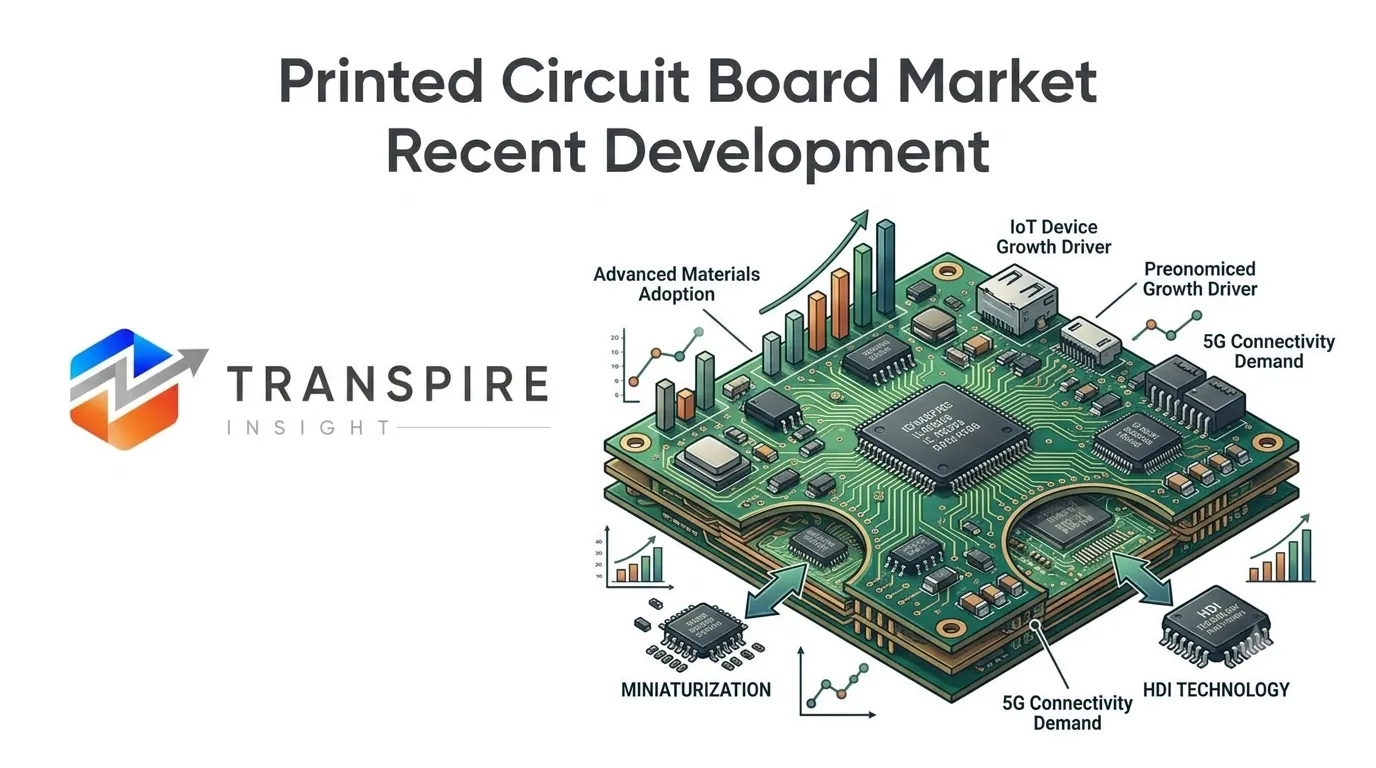
From smartphones and automobiles to AI data centers and advanced communication systems, printed circuit boards are becoming increasingly sophisticated as electronics move toward higher computing power, greater connectivity, miniaturization and improved energy efficiency.
Global Printed Circuit Board Market Overview
New York: The global printed circuit board market is entering a technology-intensive phase as demand shifts from conventional boards toward high-density interconnect (HDI), flexible, rigid-flex, high-layer-count and high-speed PCB technologies. Printed circuit boards form the physical connectivity layer between processors, memory, sensors, power systems and communication components, making them essential to virtually every modern electronic product.
The market was estimated at approximately USD 81.6 billion in 2025 and is projected to reach around USD 86.8 billion in 2026, with the market expected to approach USD 131.3 billion by 2033, representing a CAGR of approximately 5.83% during 2026–2033. Asia Pacific remains the largest regional market, supported by its concentration of electronics manufacturing, semiconductor production, PCB fabrication and component supply chains.
The growth outlook is increasingly being shaped by AI servers, data centers, electric vehicles, advanced driver-assistance systems, smartphones, 5G infrastructure, industrial automation and connected devices. At the same time, manufacturers are moving toward boards capable of handling higher signal speeds, greater power densities and tighter dimensional tolerances.
Latest Developments in the Printed Circuit Board Market
Growth Drivers of the Printed Circuit Board Market
Artificial intelligence is creating a new source of demand for advanced PCBs. AI servers and accelerator platforms require high-speed connections, sophisticated power-delivery systems, high layer counts and materials capable of maintaining signal integrity at increasingly high frequencies.
The expansion of AI computing is therefore shifting PCB demand toward higher-value products rather than simply increasing the number of boards manufactured. Data-center and computing applications are expected to remain among the fastest-growing areas of PCB demand.
Modern vehicles contain significantly more electronic systems than traditional internal-combustion vehicles. Battery-management systems, power electronics, infotainment, ADAS, radar, cameras, connectivity modules and vehicle-control systems all require PCBs.
The transition toward EVs is particularly important because high-voltage power electronics and sophisticated vehicle-control architectures require boards with improved thermal performance, reliability and electrical characteristics.
Smartphones, wearables, tablets, cameras and connected devices continue to become smaller while offering more functionality. This trend increases the need for HDI, flexible and rigid-flex boards that can accommodate more circuits within limited physical space.
Flexible PCB technology is especially valuable for foldable devices, compact camera modules, wearable electronics and other applications where conventional rigid boards are difficult to integrate.
The expansion of 5G networks and high-speed communications is creating demand for PCBs capable of handling high-frequency signals while minimizing transmission losses. Telecom infrastructure, networking equipment, antennas and related systems increasingly require advanced materials and precise PCB manufacturing.
Factories are increasingly adopting robotics, machine vision, sensors, industrial controllers and IoT-connected equipment. These systems require reliable PCBs capable of operating continuously under demanding temperature, vibration and electrical conditions.
The growth of smart manufacturing therefore provides PCB manufacturers with opportunities beyond traditional consumer electronics.
As semiconductor architectures become more sophisticated, PCB and substrate technologies must evolve alongside them. High-density connections between processors, memory and other components require advanced interconnect structures, finer geometries and improved thermal and electrical performance.
This is increasing the importance of IC substrates, HDI boards and substrate-like PCB technologies within the broader electronics ecosystem.
Future Importance
The future of the printed circuit board market will increasingly depend on the industry's ability to support high-speed computing, AI infrastructure, electric mobility, advanced telecommunications and increasingly compact electronic devices.
Traditional PCB manufacturing will remain important because consumer electronics and industrial equipment continue to require large volumes of standard boards. However, the strongest value creation is expected to come from technologically advanced products that can meet demanding requirements for signal integrity, thermal management, power density, miniaturization and reliability.
The growing intersection between PCB manufacturing and semiconductor packaging will also create opportunities for manufacturers that can develop increasingly sophisticated interconnect technologies.
Why Advanced PCB Manufacturing Matters
AI servers, GPUs, networking systems and data-center infrastructure depend on high-performance PCBs for electrical connectivity and power distribution. As AI computing expands, PCB performance becomes increasingly important to overall system performance.
EVs require sophisticated electronic control systems, battery-management technologies and power electronics. Advanced PCBs allow manufacturers to integrate these systems while maintaining reliability and thermal performance.
HDI and flexible PCB technologies allow manufacturers to place more functionality into smaller electronic products. This is essential for smartphones, wearables, medical devices, cameras and compact industrial systems.
PCB manufacturing is strategically important because boards sit between semiconductor components and finished electronic products. Increasing domestic and regional PCB capacity can reduce supply-chain dependence and improve manufacturing resilience.
Advanced PCB materials and manufacturing technologies can improve signal transmission, thermal management, electrical reliability and component density, enabling electronic products to operate at higher performance levels.
Investment Opportunities
The printed circuit board market offers investment opportunities across both conventional manufacturing and advanced technologies. High-density interconnect boards, flexible PCBs, rigid-flex products, high-speed/low-loss materials and advanced substrates are becoming increasingly attractive as electronics become more complex.
AI data centers represent another major opportunity because their high-performance computing infrastructure requires sophisticated PCBs for servers, networking systems, power-management equipment and accelerator platforms. Automotive electronics and EVs provide another long-term opportunity as electronic content per vehicle increases.
Investment opportunities also exist in PCB materials, copper-clad laminates, advanced manufacturing equipment, automated optical inspection, laser drilling, testing systems and PCB design software. The development of AI-assisted electronic design is creating an additional technology layer around the traditional PCB manufacturing ecosystem.
Top 10 Companies in the Printed Circuit Board Market
1) TTM Technologies
TTM Technologies is a major PCB manufacturer serving demanding applications across aerospace and defense, data networking, computing, medical and other technology markets. Its positioning in high-reliability and advanced PCB applications makes it an important participant in the premium end of the global PCB industry. Global Market Insights identifies TTM Technologies as a leading company in the market.
2) Unimicron Technology Corporation
Unimicron Technology is a Taiwan-based manufacturer specializing in printed circuit boards and IC substrates. The company is increasingly exposed to advanced computing applications as semiconductor and AI-system architectures require more sophisticated interconnect technologies. Its strong position in advanced PCB and substrate manufacturing places it among the important suppliers benefiting from AI hardware expansion.
3) Zhen Ding Technology Holding
Zhen Ding Technology is a major electronics manufacturing company with capabilities spanning rigid, flexible and HDI circuit technologies. Its broad manufacturing portfolio allows it to participate in consumer electronics as well as increasingly sophisticated electronic applications.
4) Ibiden Co., Ltd.
Ibiden is a Japanese technology company known for advanced PCB and semiconductor-package substrate technologies. Its expertise is particularly relevant to high-performance computing, where advanced substrates and interconnect technologies are required to support sophisticated processors.
5) AT&S
AT&S is an Austrian manufacturer focused on advanced PCB and IC-substrate technologies. The company serves applications requiring high-density interconnection and advanced electronic packaging and has manufacturing operations across several important Asian and European electronics locations.
Challenges & Restraints
The printed circuit board market faces several structural challenges despite its positive growth outlook. Raw-material costs remain a major concern because copper, resin, laminates and other inputs directly influence manufacturing economics. The sharp increase in PCB prices during 2026 demonstrates how supply disruptions and input-cost changes can quickly affect the industry.
Another challenge is the increasing technical complexity of advanced PCBs. High-layer-count, HDI and high-speed boards require sophisticated equipment, precise process control and highly trained engineering teams. Manufacturers must continuously invest in laser drilling, imaging, plating, inspection and testing capabilities.
Market Expert View
The printed circuit board market is moving beyond a volume-driven electronics manufacturing model toward a technology-driven interconnect industry. AI computing, electric vehicles, high-speed networking and advanced semiconductor packaging are changing the specifications that customers expect from PCB manufacturers.
The most important opportunity is not simply producing more boards but producing more capable boards. Manufacturers that can deliver higher layer counts, improved signal integrity, better thermal performance, finer geometries and reliable high-density connections are positioned to capture greater value.
At the same time, AI is beginning to influence the engineering process itself. The introduction of AI-powered PCB design tools demonstrates how software automation may shorten design cycles, optimize layouts and improve engineering productivity.
The next stage of industry development will therefore depend on the combination of advanced materials, manufacturing automation, AI-assisted design, semiconductor integration and geographically diversified production capacity.
Conclusion
The global printed circuit board market is entering a new phase of expansion as electronics become more powerful, connected and compact. AI data centers, electric vehicles, 5G infrastructure, consumer electronics, industrial automation and advanced semiconductor systems are creating sustained demand for increasingly sophisticated PCB technologies.
While raw-material costs, environmental requirements, supply-chain concentration and technological complexity remain important challenges, the long-term outlook remains positive. The shift toward HDI, flexible, rigid-flex, high-speed and advanced substrate technologies is creating opportunities for manufacturers to move toward higher-value applications.
As the electronics industry continues to evolve, printed circuit boards will remain a fundamental layer of the global technology ecosystem quietly connecting the processors, sensors, power systems and communication technologies that drive the next generation of digital infrastructure.


Send us a brief description of your challenge and we'll get back to you within 24 hours.

 inquiry@transpireinsight.com
 APAC:+91 7666513636
 Address


