
Oct 08, 2026
By Transpire Insight
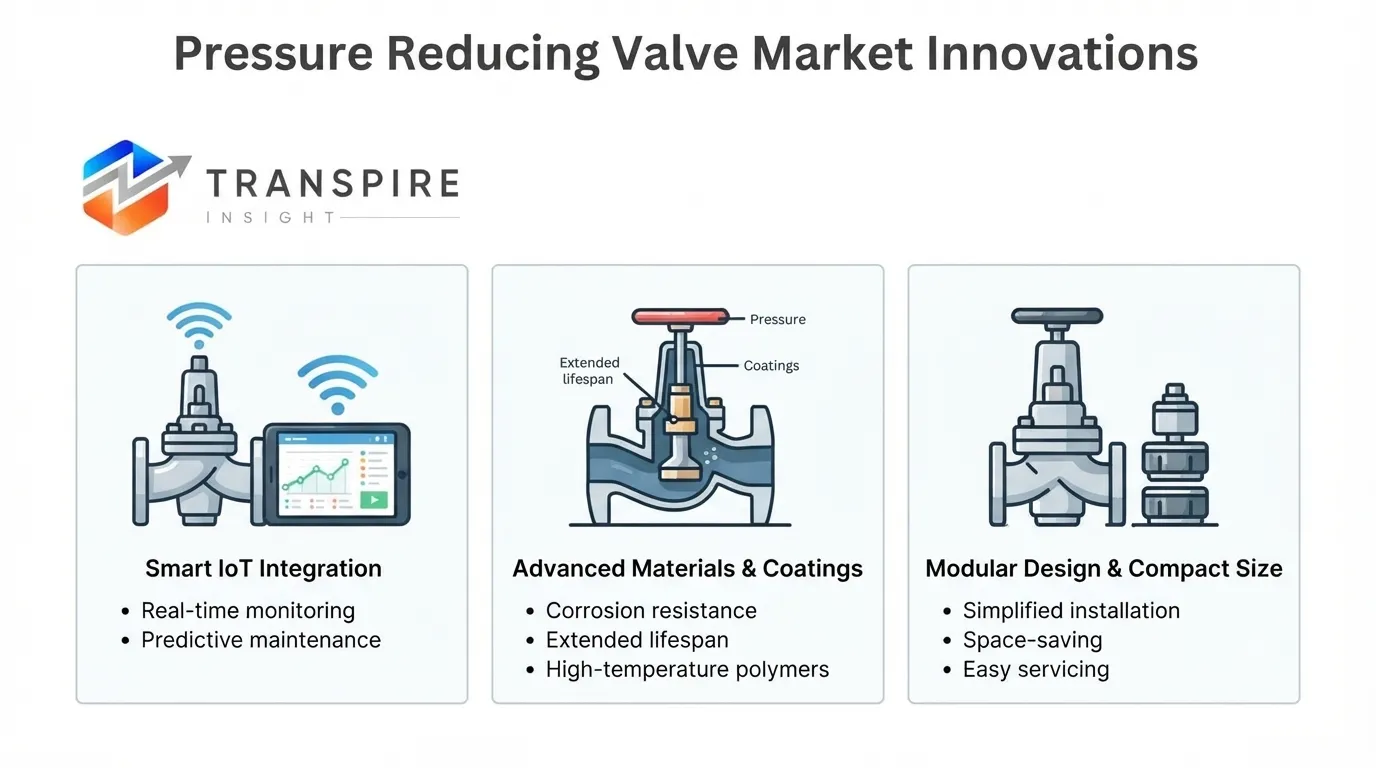
Pressure Reducing Valves are critical components in fluid-handling infrastructure because they regulate downstream pressure and protect pipelines, equipment, appliances, and process systems from excessive pressure. Their applications span water distribution, wastewater treatment, oil and gas, chemical processing, power generation, steam systems, food processing, pharmaceuticals, commercial buildings, and industrial facilities.
As infrastructure operators modernize aging networks and industries invest in more automated process-control systems, demand is shifting toward pressure reducing valves offering improved accuracy, higher flow capacity, greater durability, easier maintenance, and compatibility with advanced monitoring systems.
Market Size
Pressure reducing valves are used to lower and stabilize pressure within fluid systems. Their fundamental purpose is to protect downstream infrastructure while maintaining pressure within an operating range suitable for equipment and end-use applications.
The pressure reducing valve market is expected to increase from USD 3.5 billion in 2025 to USD 4.8 billion by 2033.
The expansion of water distribution networks, wastewater facilities, industrial plants, energy infrastructure, pipelines, and process industries is creating continuing demand for pressure-control equipment.
Water Distribution Infrastructure
Water distribution is one of the most important applications for pressure reducing valves. Municipal water networks often contain differences in elevation and pressure between various sections of a distribution system.
PRVs help reduce excessive downstream pressure and protect pipes, fittings, meters, appliances, and other equipment.
As cities modernize water infrastructure and address leakage and aging pipelines, demand for accurate pressure management is expected to increase.
Wastewater Treatment
Wastewater facilities use valves and pressure-control equipment across pumping, treatment, chemical dosing, and water-reuse processes.
The expansion of wastewater treatment infrastructure is supporting the adoption of valves designed to handle demanding environments and varying flow conditions.
Grand View Research identifies water and wastewater as an important end-use segment and expects it to grow at a 5.3% CAGR from 2026 to 2033.
Oil and Gas Applications
Pressure management is fundamental to oil and gas infrastructure. Pipelines, gas distribution systems, processing facilities, storage infrastructure, and industrial equipment require controlled pressure for safe and reliable operation.
Emerson's Fisher portfolio includes direct and pilot-operated pressure-reducing regulators for natural gas, steam, fuel, water, hydrogen, compressed air, and other process fluids.
Fisher CSB700 regulators, for example, provide pressure reduction with multiple body sizes, connections, outlet settings, and overpressure-protection options.
Industrial Process Control
Manufacturing plants use PRVs in steam, compressed air, water, gases, chemicals, and other process applications.
Stable pressure is essential for maintaining production consistency. Fluctuations can affect machinery performance, product quality, energy efficiency, and equipment life.
Industrial users therefore increasingly favor valves that provide accurate control over a broad range of flow conditions.
Steam Applications
Steam systems require carefully controlled pressure because different production processes operate at different pressure levels.
Spirax Sarco notes that lower-pressure steam is commonly required at the point of use even when steam is generated or distributed at a higher pressure. Its pressure-reducing and surplussing valves are designed to provide controlled steam pressure and can operate through self-acting or actuated configurations.
Demand for steam PRVs is therefore connected with food processing, pharmaceuticals, chemical manufacturing, textiles, paper, hospitality, and industrial heating.
Direct-Acting and Pilot-Operated Valves
The market is broadly divided between direct-acting and pilot-operated technologies.
Direct-acting valves are comparatively straightforward and can be useful in applications where simplicity, compactness, and cost efficiency are priorities. Grand View Research reports that direct-acting valves held the largest type share at 61.9% in 2025.
Pilot-operated valves can offer greater capacity and more precise control in demanding applications.
Smart Pressure Management
Digitalization is influencing the next generation of pressure-control equipment. Sensors, electronic controls, remote monitoring, and data analytics can allow operators to monitor system performance and identify abnormal pressure conditions.
Smart pressure management can support predictive maintenance and improve system visibility, particularly across large water networks and industrial plants.
Hydrogen and Alternative Fuels
The expansion of hydrogen infrastructure is opening another application area for pressure regulation.
Emerson's Fisher CS400 series, for example, includes configurations described as ready for hydrogen blends up to 25% by volume, with full hydrogen availability depending on application and factory contact.
As hydrogen production, storage, transportation, and distribution infrastructure develops, pressure-control manufacturers are expected to adapt products for new operating requirements.
Regional Outlook
Asia-Pacific represented approximately 36% of global pressure reducing valve revenue in 2025 and remains an important regional market. China accounted for a leading position within the region.
North America benefits from extensive oil and gas infrastructure, municipal water systems, industrial facilities, power generation, and process industries.
Europe is supported by industrial modernization, water infrastructure investments, energy efficiency initiatives, and stringent requirements for industrial equipment.
Latin America offers opportunities through water infrastructure, mining, energy projects, manufacturing, and municipal development.
Middle East & Africa present demand related to water scarcity management, desalination, oil and gas, power generation, and industrial development.
Competitive Landscape
The pressure reducing valve market includes large diversified automation companies, specialist valve manufacturers, steam-control companies, water technology providers, and regional manufacturers.
Competition increasingly centers on pressure accuracy, capacity, reliability, material selection, corrosion resistance, maintenance requirements, safety features, and compatibility with digital monitoring.
Top 10 Companies in Pressure Reducing Valve Market
Company Profiles
Emerson
Emerson is a major pressure-control technology provider through its Fisher and Tartarini brands. Its portfolio covers pressure-reducing regulators for natural gas, industrial applications, commercial installations, steam, hydrogen, water, and other process fluids.
Watts Water Technologies
Watts develops water-control and flow-management products used in plumbing, commercial buildings, municipal systems, and industrial applications. Pressure reducing valves are an important part of its water-management portfolio.
Spirax Sarco
Spirax Sarco specializes in steam and thermal-energy management. Its pressure-reducing valve portfolio addresses industrial steam systems where controlled downstream pressure is necessary for reliable process operation.
Honeywell
Honeywell provides industrial automation and control technologies alongside pressure-control equipment and solutions. Its valve and regulator products serve commercial and industrial fluid and gas applications.
SAMSON
SAMSON specializes in control valves, regulators, actuators, and automation technology. Its pressure-control solutions are used across process industries, energy systems, district heating, and industrial facilities.
BERMAD
BERMAD is known for hydraulic control valves used in water supply, irrigation, fire protection, industrial systems, and infrastructure. Its solutions are designed for pressure management and flow control.
CLA-VAL
CLA-VAL develops automatic control valves for waterworks, fire protection, aviation fueling, and industrial applications. Its products are designed to regulate pressure and flow in demanding infrastructure systems.
TLV
TLV focuses on steam and process-fluid technology. Its product portfolio includes steam traps, control valves, pressure-reducing equipment, and related systems used in industrial steam management.
Yoshitake
Yoshitake manufactures industrial valves and pressure-control equipment, including pressure reducing valves used in steam, water, gas, and other applications.
Cashco
Cashco specializes in pressure regulators and control valves for industrial process applications. Its portfolio includes pressure-reducing regulators designed for accurate process control.
Challenges in the Pressure Reducing Valve Market
The market faces challenges associated with raw-material costs, maintenance requirements, corrosion, pressure fluctuations, and the need for application-specific engineering.
Improper sizing or installation can reduce valve performance. Operators therefore need technical expertise to select appropriate valves based on flow, inlet pressure, outlet pressure, temperature, fluid characteristics, and required capacity.
Industrial users are also demanding longer service intervals and improved monitoring capabilities.
Future Outlook
The Pressure Reducing Valve Market is expected to increasingly combine mechanical pressure regulation with digital monitoring and automation.
Water infrastructure modernization, industrial expansion, energy projects, steam-system optimization, hydrogen infrastructure, and process automation will remain important demand drivers.
Future products are likely to emphasize compact designs, improved materials, higher flow capacity, lower maintenance requirements, remote monitoring, and greater pressure-control accuracy.
With the global market projected to reach USD 4.8 billion by 2033, pressure reducing valves will remain essential to the safe and efficient operation of fluid and gas infrastructure.


Send us a brief description of your challenge and we'll get back to you within 24 hours.

 inquiry@transpireinsight.com
 APAC:+91 7666513636
 Address


