
Oct 07, 2026
By Transpire Insight
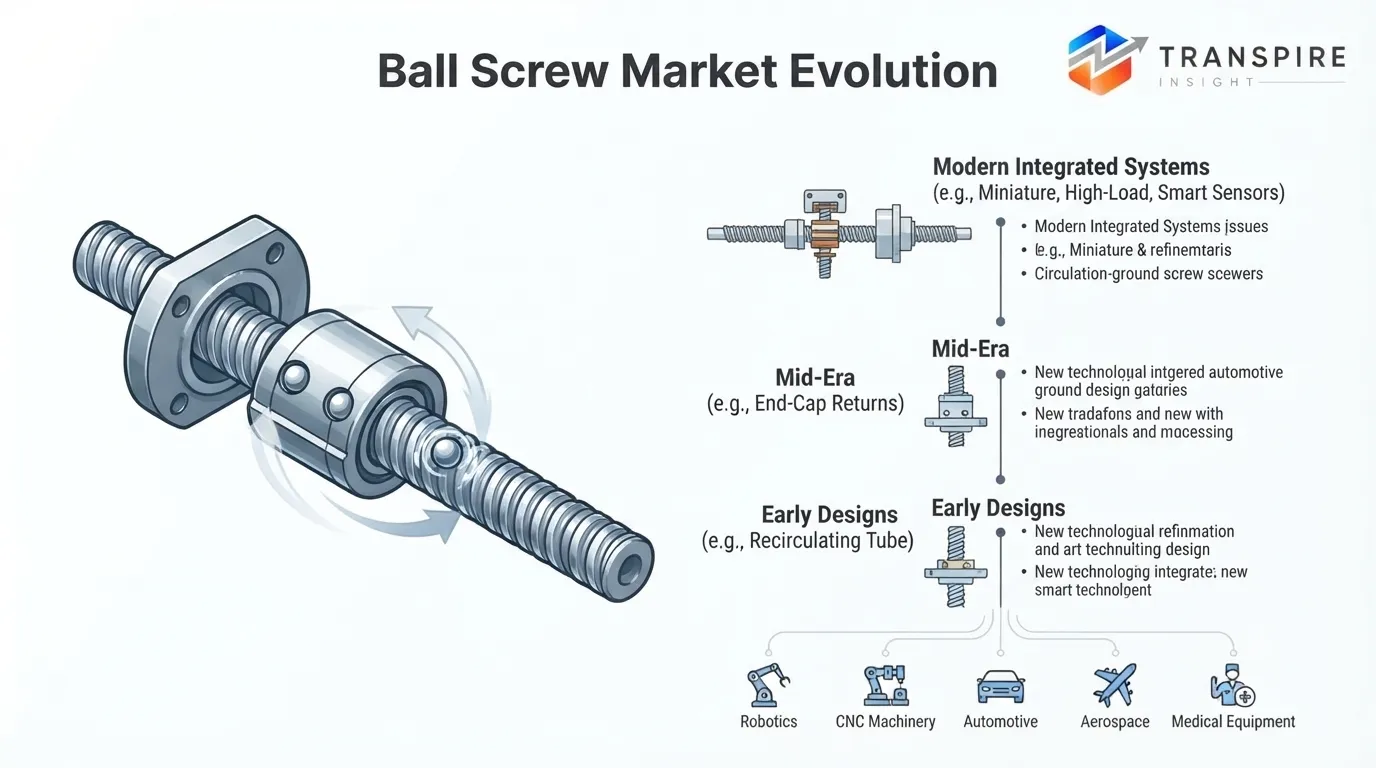
Ball screws are becoming increasingly important in modern manufacturing as industries demand precise, efficient, repeatable, and high-speed linear motion. From CNC machine tools and industrial robots to semiconductor equipment, electric vehicle manufacturing systems, medical devices, and automated material-handling equipment, ball screws provide a highly efficient mechanism for converting rotary motor motion into controlled linear movement.
The technology is moving beyond conventional precision positioning toward high-speed operation, lower friction, improved thermal stability, compact designs, long service intervals, customized configurations, and condition-monitoring capabilities. As factories adopt increasingly automated production systems, the performance of the mechanical motion components used inside those systems is becoming directly connected to productivity, accuracy, energy efficiency, and equipment reliability.
Market Size
The global Ball Screw Market was valued at approximately USD 1.8 billion in 2025 and is estimated to reach approximately USD 3.0 billion by 2033, expanding at a CAGR of 6.8% from 2026 to 2033, according to Grand View Research's August 2026 market assessment.
The market encompasses ground and rolled ball screws used across industrial machinery, machine tools, semiconductor and electronics equipment, automotive manufacturing, aerospace and defense systems, medical equipment, robotics, and precision automation.
Increasing investments in factory automation and CNC equipment are supporting demand, while the growth of semiconductor manufacturing, electric vehicles, automated assembly, and high-precision production is expanding the range of applications.
Ball Screws Are Becoming Essential to Precision Motion
A ball screw consists primarily of a threaded screw shaft and a nut containing recirculating balls. As the screw or nut rotates, the rolling balls transfer the rotational motion into linear movement.
The rolling contact mechanism produces lower friction than traditional sliding screw arrangements. THK describes ball screws as high-efficiency feed screws and states that their driving torque can be approximately one-third that of conventional sliding screws under the company's comparison conditions.
This efficiency is particularly useful in automated equipment where motors repeatedly accelerate, decelerate, and position loads.
The ability to achieve accurate movement while supporting significant axial loads makes ball screws suitable for applications where repeatability and positioning precision are essential.
CNC Machine Tools Remain a Core Application
Computer numerical control machine tools are among the most established applications for ball screws.
CNC machining centers, milling machines, grinding machines, turning equipment, and other precision systems require controlled movement along multiple axes.
Ball screws convert motor rotation into the precise linear movement required to position cutting tools or workpieces.
NSK describes ball screws as core components of machine-tool feed systems because their rolling-element construction provides high efficiency and rigidity while converting motor rotation into high-precision linear motion.
The increasing demand for faster machining cycles is also creating requirements for high-speed ball screws with improved thermal characteristics and reduced vibration.
THK's BSM high-speed ball screw, for example, uses a ball-circulation design supporting a DN value of 170,000 for machine-tool applications.
Industrial Automation Is Expanding the Addressable Market
The growth of automated production lines is another major market driver.
Automated equipment requires repeatable movement for assembly, inspection, packaging, handling, pressing, and positioning operations.
Ball screws can provide the controlled linear movement needed by servo-driven systems.
Bosch Rexroth lists ball screw assemblies for applications including automation, handling, engineering, and medical technology.
As factories increase the number of automated stations, demand can increase for complete linear-motion systems rather than individual mechanical components.
This is encouraging ball screw manufacturers to offer assemblies, support units, lubrication solutions, actuators, and engineering services alongside standard screw-and-nut products.
Robotics Is Creating New Requirements
Industrial robots and specialized robotic systems increasingly require compact and accurate motion mechanisms.
Ball screws can be used in linear robot axes, vertical positioning systems, end-of-arm mechanisms, automated loaders, and other equipment.
THK's ball screw/spline technology combines screw and spline functions on a single shaft, allowing rotational, linear, and spiral movement. The company identifies applications including SCARA robot Z axes, assembly robots, automatic loaders, and machining-center automatic tool changers.
Robotic applications often require a combination of high responsiveness, low backlash, compact dimensions, and repeatable positioning.
This is encouraging suppliers to develop smaller, lighter, and higher-speed screw assemblies.
Semiconductor Manufacturing Requires Ultra-Precise Motion
Semiconductor manufacturing represents one of the most technically demanding application areas.
Wafer handling, inspection, assembly, packaging, positioning, and semiconductor-processing equipment can require extremely precise and repeatable movement.
Ball screw suppliers are therefore developing products with tight accuracy specifications, controlled thermal behavior, low vibration, and contamination-resistant designs.
Bosch Rexroth identified semiconductor manufacturing as one of the applications for its customized screw-drive solutions in a July 2026 announcement.
Kuroda Precision also identifies semiconductor manufacturing equipment as an important application for its ball screws and ball screw actuators.
As global investment in semiconductor fabrication and electronics manufacturing expands, demand for high-precision motion systems is expected to increase.
Electric Vehicle Manufacturing Is Creating Additional Demand
Vehicle electrification is influencing the ball screw market through increased automation and the development of new manufacturing processes.
Electric vehicle production requires highly automated battery assembly, motor manufacturing, inspection, joining, pressing, and material-handling systems.
Ball screws can be incorporated into servo-driven equipment used for controlled linear movement.
The automotive industry's broader transition toward automated production also creates demand for high-speed and high-cycle motion components.
The market opportunity extends beyond vehicle assembly. Battery manufacturing equipment, semiconductor systems, electric-motor production lines, and automated inspection machines can all require precision motion technologies.
High-Speed Ball Screws Are Becoming More Important
Manufacturers are under continuous pressure to increase production throughput.
Higher machine speeds can reduce cycle time, but they also increase heat generation, vibration, lubrication requirements, and mechanical stress.
This is encouraging ball screw manufacturers to focus on high-speed circulation systems, optimized ball return mechanisms, improved lubrication, and thermal management.
THK's BSM product is specifically designed for high-speed machine-tool applications and uses a circulation structure supporting a DN value of 170,000.
NSK is also developing low-friction technologies for machine-tool ball screws. Its MT-Frix technology, introduced in 2026, targets machine-tool applications and focuses on reducing friction and associated heat generation.
These developments demonstrate that speed and thermal behavior are becoming important competitive factors.
Low Friction Supports Energy Efficiency
Energy efficiency is increasingly important in industrial machinery.
Ball screws reduce mechanical losses through rolling contact, allowing efficient transmission of motor power into linear movement.
THK's technical information identifies lower driving torque as a key characteristic of ball screws compared with sliding screws.
This characteristic becomes particularly relevant in automated systems performing thousands or millions of movement cycles.
Lower mechanical resistance can help reduce motor requirements and operating energy, although the actual energy performance of a machine depends on the complete drive system, load, acceleration profile, lubrication, and control strategy.
Ground Ball Screws Support High-Precision Applications
Ground ball screws are manufactured through precision grinding processes and are generally selected for applications where high accuracy and repeatability are critical.
THK offers precision-ground ball screws in multiple configurations for machine tools and precision positioning.
HIWIN similarly distinguishes precision-ground ball screws from precision-rolled products and identifies high positioning accuracy and repeatability as advantages of its ground products.
Applications such as semiconductor equipment, high-end machine tools, inspection systems, and precision stages can therefore favor ground ball screws.
Rolled Ball Screws Address Higher-Volume Applications
Rolled ball screws are produced through a rolling process rather than precision grinding.
They can provide an attractive balance between performance and manufacturing cost for applications where the highest precision levels are not required.
HIWIN offers rolled ball screw assemblies across a range of shaft diameters, leads, accuracy grades, and configurations.
Kuroda also offers rolled ball screws in several series, including products designed for conveyance and positioning.
The availability of both ground and rolled products allows manufacturers to select motion components according to accuracy, load, speed, cost, and application requirements.
Compact Designs Are Expanding Application Possibilities
Miniaturization is another significant trend.
Modern automation equipment often has limited installation space, particularly in semiconductor, electronics, medical, and robotic systems.
Ball screw manufacturers are responding with miniature products.
THK offers miniature precision ball screws with screw shaft diameters ranging from 4 to 14 mm in its MBF series.
Kuroda also provides a compact family of miniature ball screws designed for device downsizing and automation.
Smaller products can enable manufacturers to create more compact machines while maintaining controlled linear movement.
Customization Is Becoming a Competitive Factor
Standard ball screws may not satisfy every application.
Machine manufacturers can require unusual shaft lengths, special nut configurations, corrosion resistance, vacuum compatibility, customized lubrication, high-temperature operation, cleanroom suitability, or specialized mounting arrangements.
Bosch Rexroth highlighted growing requirements for application-specific screw drives in robotics, medical technology, semiconductor manufacturing, machine tools, and intralogistics in its September 2026 technical discussion.
Its July 2026 announcement also described customized ball and planetary screw assemblies for demanding applications.
Kuroda offers standard and order-made ball screw products, including customized screw dimensions and accuracy grades.
Customization therefore represents an important opportunity for manufacturers seeking higher-value applications.
Thermal Management Is Critical at High Speeds
Heat is a major technical issue in high-speed ball screw applications.
Friction, preload, rotational speed, lubrication, and environmental conditions can increase temperature.
Thermal expansion can affect positioning accuracy if not properly managed.
NSK's 2026 MT-Frix development specifically addresses friction and heat generation in machine-tool ball screws.
Manufacturers are consequently developing improved circulation designs, lubrication systems, cooling arrangements, materials, and control strategies to maintain accuracy at higher speeds.
Maintenance and Lubrication Remain Important
Although ball screws are highly efficient, they still require appropriate lubrication and maintenance.
Insufficient lubrication can increase friction and wear, while contamination can damage rolling surfaces and reduce service life.
Modern products increasingly incorporate seals, wipers, lubrication systems, and contamination-protection features.
THK lists contamination-protection seals, brush seals, wiper rings, and lubrication options for its high-speed ball screw products.
Bosch Rexroth also emphasizes long lubrication intervals for its ball screw assemblies, supporting lower maintenance requirements in industrial applications.
The development of longer maintenance intervals is particularly valuable for automated production lines where unplanned downtime can have significant operational consequences.
Sensor-enabled Ball Screws Could Support Predictive Maintenance
Condition monitoring is becoming increasingly important in industrial automation.
Sensors can potentially monitor vibration, temperature, load, position, lubrication conditions, and other operating parameters.
This information can be used to identify abnormal behavior before mechanical failure occurs.
Predictive maintenance can help machine operators schedule servicing according to actual operating conditions rather than relying exclusively on fixed maintenance intervals.
As factories become more connected, ball screws are likely to become increasingly integrated into broader machine-health monitoring systems.
Medical Equipment Is Expanding Precision Motion Applications
Medical equipment represents another important application area.
Medical imaging systems, surgical robots, laboratory automation, patient-positioning equipment, and diagnostic machinery require controlled movement.
Bosch Rexroth specifically identifies medical technology among the applications for its ball screw assemblies and customized screw-drive solutions.
Kuroda's product applications also include robotic-assisted surgical systems and precision-positioning equipment.
Medical applications can place additional requirements on cleanliness, noise, precision, reliability, and compactness.
Aerospace and Defense Demand High Reliability
Aerospace and defense equipment often requires precise actuation under demanding environmental conditions.
Ball screws can be used in positioning systems, actuators, control mechanisms, testing equipment, and manufacturing machinery.
The requirements can include high load capacity, low weight, corrosion resistance, predictable service life, and resistance to vibration.
The increasing use of automated manufacturing in aerospace production also creates indirect demand for precision ball screws used in machine tools and robotic systems.
Regional Outlook
Asia Pacific
Asia Pacific is the largest regional market for ball screws, accounting for approximately 48.4% of global market revenue in 2025, according to Grand View Research.
The region benefits from large manufacturing bases in China, Japan, South Korea, Taiwan, and increasingly India.
China's extensive machine-tool, electronics, electric vehicle, and industrial automation industries provide substantial demand.
Japan has a particularly strong ecosystem of precision-motion suppliers, including THK, NSK, and other specialized manufacturers.
India is also developing as a growth market as manufacturing investment, electronics production, automotive manufacturing, and industrial automation expand.
North America
North America has significant demand for ball screws through aerospace, automotive, medical technology, semiconductor manufacturing, machine tools, and industrial automation.
The region's advanced manufacturing ecosystem supports demand for high-performance and customized motion components.
The increasing localization of semiconductor and advanced manufacturing capacity is also creating opportunities for precision-motion suppliers.
Europe
Europe represents an important market for machine tools, industrial automation, automotive manufacturing, medical equipment, and semiconductor-related machinery.
Germany remains an important center for precision machinery and industrial automation.
European suppliers such as Bosch Rexroth and Schaeffler are developing ball screw and screw-drive technologies for industrial and specialized applications. Schaeffler maintains technical product information covering ball screws used for applications involving high vibration and changes in direction.
Latin America
Latin America's ball screw demand is connected primarily with automotive production, machine tools, food-processing equipment, packaging machinery, and industrial automation.
Brazil and Mexico are important manufacturing centers, while investment in factory modernization can create opportunities for precision linear-motion components.
Middle East & Africa
The Middle East and Africa represent developing opportunities for ball screws through industrial automation, machine tools, medical equipment, manufacturing, and infrastructure-related machinery.
Adoption is likely to depend on industrial investment, automation penetration, local maintenance capabilities, and demand for advanced manufacturing equipment.
Competitive Landscape
The Ball Screw Market is characterized by competition among precision-motion specialists, bearing manufacturers, industrial automation suppliers, and integrated linear-motion companies.
Companies compete through accuracy, speed, load capacity, service life, customization, contamination resistance, compactness, noise reduction, and total cost of ownership.
The market is also moving toward complete motion solutions. Instead of supplying only a screw and nut, manufacturers increasingly provide support units, actuators, lubrication products, linear guides, motors, engineering services, CAD tools, and complete positioning systems.
This integration allows machine builders to simplify design and procurement while obtaining components optimized for specific applications.
Top 10 Companies in the Ball Screw Market
These companies participate in the broader precision-motion and ball-screw ecosystem through ball screws, linear-motion products, bearings, actuators, machine-tool technologies, and related components.
Company Profiles
1. THK Co., Ltd.
THK is a major global supplier of linear-motion technology and offers an extensive portfolio of ball screws.
Its product range includes precision-ground ball screws, rolled ball screws, miniature products, high-speed machine-tool ball screws, large-lead configurations, and ball screw/spline systems.
THK's BSM high-speed ball screw is designed for machine tools and supports a DN value of 170,000.
Its ball screw/spline products are also designed for applications including SCARA robots, assembly robots, automatic loaders, and machining centers.
2. NSK Ltd.
NSK has a long history in precision ball screws and industrial motion technology.
Its ball screws are used in machine tools, semiconductor manufacturing equipment, injection molding machines, transportation systems, and automotive-related applications.
In 2026, NSK introduced its MT-Frix low-friction ball screw technology for machine tools, targeting friction and heat generation while maintaining the requirements of high-precision feed systems.
3. Bosch Rexroth
Bosch Rexroth offers ball screw assemblies as part of its Linear Motion Technology portfolio.
Its products are used in automation, handling, engineering, medical technology, and other industrial applications.
The company is also developing customized screw drives for robotics, semiconductor manufacturing, machine tools, medical technology, and intralogistics.
4. HIWIN Technologies Corp.
HIWIN provides ground and rolled ball screws across a wide range of dimensions and accuracy classes.
Its products include preloaded and non-preloaded configurations, miniature products, precision-ground ball screws, and rolled assemblies.
HIWIN states that its ball screws are commonly used in industrial machinery and precision machines and offers shaft diameters ranging from 4 to 120 mm in its product portfolio.
5. Schaeffler AG
Schaeffler participates in precision motion technology and offers ball screw products for industrial applications.
Its current technical documentation includes SL, BL, and TL ball screw series and provides selection and mounting information.
The company also provides technical information for applications involving high vibration and changes in direction, highlighting the importance of reliability under demanding operating conditions.
6. SKF
SKF is a global bearing and rotating-equipment technology company with capabilities spanning bearings, seals, lubrication, condition monitoring, and industrial motion technologies.
Its broader expertise in rolling elements, lubrication, condition monitoring, and industrial systems is relevant to the ball-screw ecosystem.
SKF's capabilities can support customers seeking integrated solutions for motion, maintenance, lubrication, and machine reliability.
7. Kuroda Precision Industries Ltd.
Kuroda Precision specializes in precision technologies and offers a broad portfolio of ball screws and ball screw actuators.
Its products include ground and rolled ball screws, miniature products, customized screws, support units, and integrated actuators.
The company identifies semiconductor manufacturing equipment, industrial robots, and machine tools among key ball-screw applications.
Its portfolio also includes specialized products for precision positioning and clean environments.
8. TBI Motion Technology Co., Ltd.
TBI Motion Technology is a Taiwan-based manufacturer of linear-motion components including ball screws, linear guides, and related motion products.
The company serves automation, machine tools, semiconductor equipment, robotics, and other precision-motion applications.
Its position within Taiwan's advanced manufacturing ecosystem gives it exposure to electronics, semiconductor, machine-tool, and automation demand.
9. PMI Group
PMI develops linear-motion technologies including ball screws, linear guides, and integrated positioning solutions.
Its product portfolio is aimed at machine tools, automation, semiconductor equipment, robotics, and precision machinery.
The company's focus on linear-motion components supports manufacturers seeking coordinated solutions for high-accuracy movement and automated positioning.
10. NTN Corporation
NTN is a major Japanese manufacturer specializing in bearings and precision mechanical technologies.
Its broader expertise in rolling elements, motion systems, and automotive and industrial applications provides a foundation for precision-motion technologies.
The company's presence across automotive and industrial equipment markets also provides exposure to applications where accurate and reliable linear motion is required.
Key Challenges Facing the Ball Screw Market
The market faces several technical and commercial challenges.
High manufacturing precision is required because small deviations in lead accuracy, preload, surface finish, or alignment can affect machine performance.
Thermal expansion becomes increasingly important at high rotational speeds because heat can affect positioning accuracy.
Lubrication requirements can also increase maintenance demands, particularly in high-cycle industrial applications.
Contamination can damage rolling elements and raceways, making sealing and protection important in harsh manufacturing environments.
Competition from alternative technologies is another consideration. Linear motors can provide direct linear motion without mechanical screw transmission, while roller screws can be selected for certain high-load applications.
Cost pressure can also influence component selection. Manufacturers must balance precision, load capacity, speed, service life, and purchase cost.
Future Outlook
The future of the Ball Screw Market will be closely connected to the development of smart manufacturing.
Industrial automation is increasing the number of machines that require accurate and repeatable linear movement. Robotics, CNC equipment, semiconductor production, electric vehicle manufacturing, medical equipment, and automated logistics will continue creating opportunities.
High-speed operation will remain a major area of product development. Manufacturers will continue working on ball-return systems, lubrication, thermal management, materials, preload optimization, and low-friction technologies.
Miniaturization will also expand the use of ball screws in compact equipment. Semiconductor systems, laboratory automation, medical robotics, inspection equipment, and electronic manufacturing machinery can benefit from smaller motion components.
Customization will become increasingly important as machine builders demand application-specific products. Bosch Rexroth's 2026 announcements regarding customized screw-drive solutions demonstrate the growing emphasis on adapting ball and planetary screw assemblies to specific industrial environments.
Digitalization could also change maintenance practices. Sensor-enabled monitoring and machine-learning-based analytics may allow manufacturers to identify abnormal vibration, temperature, preload, or lubrication conditions before failures occur.
The market will consequently move toward complete motion ecosystems in which ball screws are integrated with linear guides, servo motors, controllers, sensors, lubrication systems, and software.
The global Ball Screw Market is therefore positioned within a broader transformation of industrial motion technology. As manufacturers seek greater productivity, accuracy, automation, and energy efficiency, ball screws will continue to serve as a critical mechanical interface between rotary drive systems and precision linear movement. The combination of advanced manufacturing, robotics, semiconductor investment, electric vehicle production, and smart-factory development is expected to support steady market expansion through 2033.


Send us a brief description of your challenge and we'll get back to you within 24 hours.

 inquiry@transpireinsight.com
 APAC:+91 7666513636
 Address


