
Aug 08, 2026
By Transpire Insight
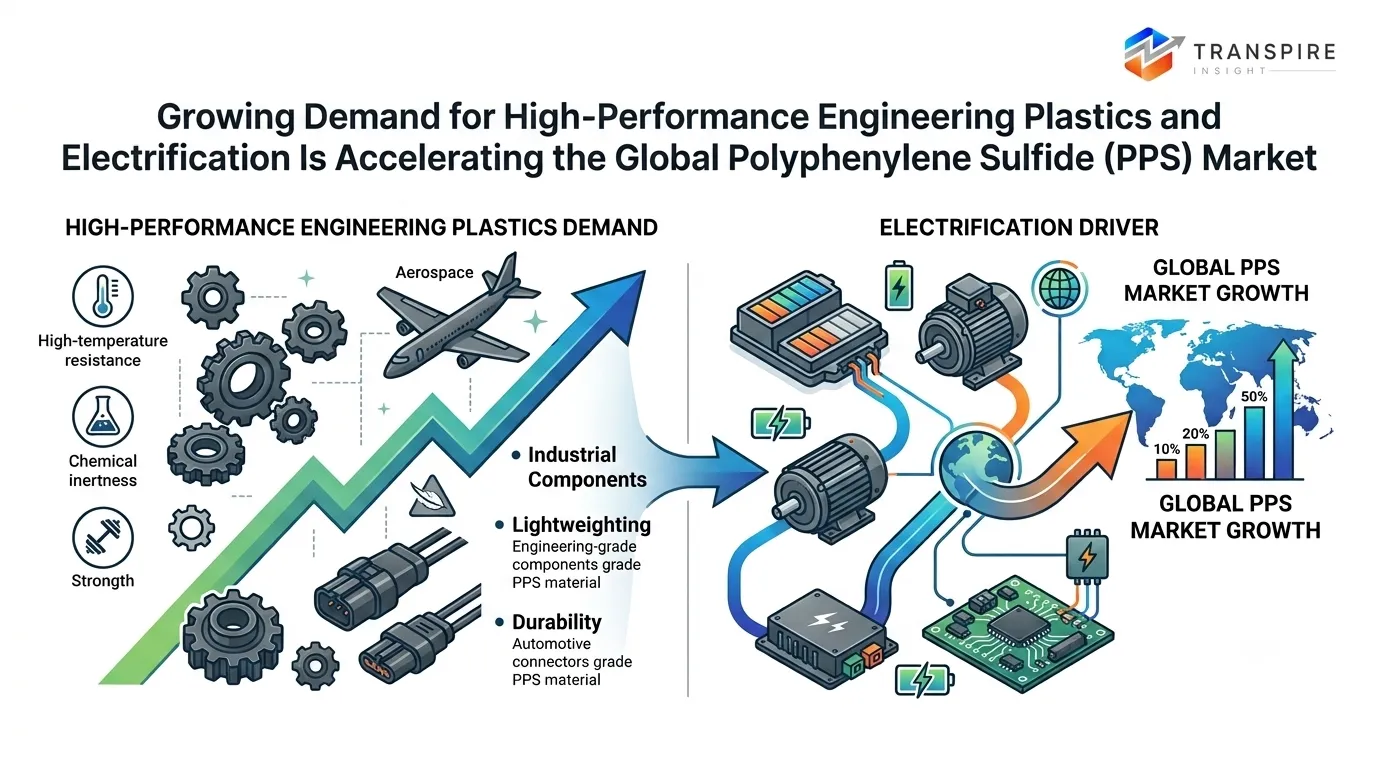
The global Polyphenylene Sulfide (PPS) Market is witnessing sustained growth as industries increasingly adopt high-performance engineering thermoplastics capable of operating under extreme temperatures, aggressive chemicals, and demanding mechanical conditions. Polyphenylene Sulfide has become one of the most important specialty polymers for manufacturers seeking lightweight materials with excellent dimensional stability, flame resistance, electrical insulation, and long service life. According to Transpire Insights, rapid industrial automation, vehicle electrification, miniaturization of electronic components, and the growing need for durable materials in aerospace and industrial equipment are significantly strengthening demand for PPS across multiple end-use industries.
According to Transpire Insights, the Polyphenylene Sulfide Market was valued at approximately USD 1.78 billion in 2025 and is projected to reach nearly USD 3.12 billion by 2033, registering a CAGR of approximately 7.3% during the forecast period. The market continues to expand as manufacturers replace conventional metals and lower-performance polymers with lightweight engineering plastics that improve energy efficiency, reduce maintenance requirements, and support increasingly compact product designs.
Polyphenylene Sulfide is a semi-crystalline high-performance thermoplastic recognized for its exceptional thermal stability, chemical resistance, inherent flame retardancy, and excellent electrical insulating properties. Unlike many conventional engineering plastics, PPS maintains its mechanical integrity at continuous operating temperatures exceeding 200°C, while certain reinforced grades can tolerate intermittent exposure approaching 240–260°C depending on application requirements. These characteristics make PPS particularly valuable in automotive powertrain systems, electric vehicles, industrial pumps, filtration equipment, semiconductor manufacturing, electrical connectors, aerospace components, and chemical processing facilities.
One of the strongest growth drivers is the rapid electrification of the automotive industry. electric vehicle production has expanded significantly, with annual EV sales now exceeding 17 million units worldwide, while hybrid vehicles continue gaining market share across major automotive markets. Modern electric vehicles utilize substantially more high-performance polymers than conventional internal combustion vehicles because lightweight materials improve driving range and energy efficiency. PPS is increasingly used in battery modules, motor insulation systems, power electronics, charging connectors, coolant pumps, inverter housings, and high-voltage electrical components where resistance to heat, chemicals, and electrical stress is essential. Industry estimates suggest that engineering plastics can reduce component weight by 20–50% compared with traditional metal alternatives, directly supporting vehicle efficiency and emissions reduction objectives.
The electrical and electronics industry represents another major growth engine for the PPS market. Rapid expansion of 5G infrastructure, artificial intelligence hardware, industrial automation, electric power distribution, and consumer electronics has increased demand for materials capable of supporting miniaturized, high-density electronic designs. PPS exhibits low moisture absorption, excellent dielectric performance, and high dimensional stability, enabling manufacturers to produce precision electrical connectors, integrated circuit components, sensor housings, relay systems, and printed circuit assemblies with enhanced long-term reliability. As semiconductor manufacturing continues expanding globally, demand for ultra-clean, chemically resistant polymer materials is expected to rise steadily.
Industrial manufacturing is also creating substantial opportunities. Chemical processing plants, oil and gas facilities, water treatment systems, and industrial filtration equipment frequently operate under highly corrosive conditions where conventional metals experience accelerated degradation. PPS components offer outstanding resistance to acids, solvents, fuels, steam, and aggressive industrial chemicals, enabling longer equipment life while reducing maintenance requirements. In many industrial pumping and valve applications, PPS components have demonstrated service lives 30–40% longer than conventional engineering plastics operating under comparable conditions, contributing to lower lifecycle operating costs.
Another important market catalyst is the emphasis on lightweight manufacturing. Aerospace, automotive, railway, and industrial equipment manufacturers are increasingly replacing metallic components with advanced thermoplastics to reduce weight without compromising structural performance. Depending on the application, PPS composites reinforced with glass fiber or carbon fiber can reduce component weight by 25–60% while maintaining high mechanical strength, fatigue resistance, and dimensional accuracy. These material characteristics are becoming increasingly valuable as manufacturers pursue energy efficiency, carbon emission reduction, and improved equipment performance.
Sustainability is emerging as another strategic growth factor. Although PPS is a specialty engineering polymer, manufacturers are investing in more energy-efficient production technologies, recycled engineering plastic formulations, and circular material management practices. Lightweight PPS components contribute indirectly to sustainability by reducing vehicle weight, lowering industrial energy consumption, extending equipment lifespan, and decreasing maintenance-related material replacement. Several leading polymer manufacturers have announced investments in low-carbon manufacturing processes and renewable energy utilization across their specialty materials production facilities, supporting broader environmental objectives throughout the advanced materials industry.
Regionally, Asia-Pacific dominates the PPS market, accounting for the largest share of production and consumption. The region benefits from extensive electronics manufacturing, rapidly expanding electric vehicle production, strong industrial investment, and the presence of major polymer producers in China, Japan, South Korea, and Taiwan. North America remains a significant market due to advanced aerospace manufacturing, semiconductor production, and automotive innovation, while Europe continues witnessing strong demand driven by premium automotive manufacturing, industrial automation, and strict environmental regulations encouraging lightweight material adoption.
Download the exclusive Polyphenylene Sulfide Market sample report today to uncover expert insights, emerging trends, and the opportunities defining the future of the industry.
Expanding Electrification, Industrial Automation, and Advanced Manufacturing Are Strengthening the Polyphenylene Sulfide (PPS) Market
The Polyphenylene Sulfide (PPS) Market is experiencing robust expansion as manufacturers across automotive, electronics, aerospace, industrial machinery, and chemical processing industries increasingly prioritize materials capable of delivering long-term performance under harsh operating conditions. According to Transpire Insights, the market is transitioning from a niche engineering plastics segment into a critical material platform supporting electrification, miniaturization, lightweight manufacturing, and industrial sustainability. The combination of rising demand for high-temperature polymers, rapid adoption of electric vehicles, and continuous technological innovation is creating long-term opportunities for PPS manufacturers worldwide.
One of the strongest market drivers is the accelerating transition toward electric mobility. Electric vehicles contain considerably more engineering plastics than conventional internal combustion engine vehicles due to the need for lightweight, electrically insulated, and thermally stable components. EV sales exceeded 17 million units in 2024, representing approximately 20% of total passenger vehicle sales, and this percentage is expected to continue rising as governments expand emission regulations and electrification incentives. PPS is increasingly utilized in battery management systems, inverter housings, electric motors, charging connectors, high-voltage switches, cooling systems, and power electronic modules because of its excellent dielectric properties and resistance to temperatures exceeding 200°C.
Another major growth factor is industrial automation. Worldwide manufacturing industries are rapidly investing in robotics, smart factories, and automated production systems that require precision components capable of operating continuously under demanding mechanical and thermal conditions. According to industry estimates, the installed base of industrial robots now exceeds 4 million units, while annual robot installations continue growing across automotive, electronics, and semiconductor manufacturing sectors. PPS components are widely used in sensors, actuators, gears, bearings, pump housings, and automation equipment because of their excellent dimensional stability, low moisture absorption, and superior wear resistance.
The semiconductor industry is creating another substantial growth opportunity. Advanced semiconductor fabrication requires ultra-clean production environments where components must resist aggressive chemicals, plasma exposure, and continuous thermal cycling. semiconductor sales exceeded USD 620 billion in recent years, with investment in new fabrication facilities continuing across Asia, North America, and Europe. PPS materials are increasingly incorporated into wafer handling equipment, chemical delivery systems, fluid management components, and precision connectors because they maintain structural integrity while minimizing particle contamination.
Miniaturization across consumer electronics also continues driving demand. Smartphones, wearable devices, electric appliances, telecommunications equipment, and data centers require compact connectors and electronic assemblies capable of operating reliably in increasingly confined spaces. PPS offers excellent electrical insulation while maintaining dimensional precision, making it particularly suitable for miniature electrical connectors and high-density electronic components.
Market Analysis
Asia-Pacific dominates the market, accounting for approximately 52–56% of total revenue. China, Japan, South Korea, and Taiwan collectively represent the largest production and consumption centers due to their extensive electronics manufacturing, electric vehicle production, semiconductor fabrication, and industrial automation industries. China alone manufactures more than 30 million automobiles annually, while remaining the world's largest producer of electric vehicles and consumer electronics. The region also hosts several leading PPS manufacturers, providing integrated supply chains for automotive and electronics customers.
North America contributes approximately 22–25% of market revenue, supported by advanced aerospace manufacturing, semiconductor investments, industrial automation, and increasing electric vehicle production. Government initiatives promoting domestic semiconductor manufacturing and advanced material research continue supporting long-term PPS demand throughout the United States and Canada.
Europe accounts for nearly 20–22% of the market and remains an important center for premium automotive manufacturing, industrial machinery, renewable energy equipment, and aerospace engineering. Germany, France, Italy, and the United Kingdom continue investing heavily in vehicle electrification and lightweight engineering, both of which support increasing adoption of high-performance thermoplastics.
From an application perspective, automotive components remain the dominant segment, contributing approximately 35–40% of total PPS consumption. Electrification, emission reduction requirements, and lightweight vehicle design continue driving adoption across battery systems, fuel delivery components, cooling systems, electrical connectors, and under-the-hood applications.
The electrical and electronics sector represents the second-largest application, accounting for nearly 28–30% of market demand. Growth is supported by increasing production of semiconductors, consumer electronics, industrial automation systems, telecommunications equipment, and power distribution infrastructure.
Glass fiber reinforced PPS continues dominating product demand, representing approximately 65–70% of consumption. Reinforced grades provide higher tensile strength, improved dimensional stability, and superior mechanical performance, making them suitable for structural automotive and industrial applications. Carbon fiber reinforced PPS is also gaining momentum within aerospace, defense, and high-performance industrial equipment due to its exceptional strength-to-weight ratio.
Competitive Landscape
Competition within the Polyphenylene Sulfide Market is driven primarily by material innovation, manufacturing capability, application engineering, and long-term partnerships with automotive and electronics manufacturers. Leading companies continue investing in advanced polymer chemistry, customized compound formulations, lightweight composite development, and sustainable production technologies.
Major participants including Toray Industries, DIC Corporation, Celanese Corporation, Solvay, SK Chemicals, Kureha Corporation, Tosoh Corporation, Polyplastics Co., Ltd., SABIC, and Ensinger GmbH collectively generate annual revenues exceeding USD 120 billion, providing significant financial resources for research, production expansion, and technological innovation.
Strategic collaborations between polymer manufacturers and automotive OEMs are becoming increasingly common as electric vehicle manufacturers seek lightweight materials capable of improving battery efficiency and extending vehicle range. Material suppliers are also working closely with electronics manufacturers to develop PPS compounds optimized for high-speed data transmission, miniaturized connectors, and advanced semiconductor applications.
Research and development remains one of the industry's strongest competitive differentiators. Leading specialty polymer manufacturers generally allocate 3–5% of annual revenue toward R&D activities focused on improving thermal conductivity, impact resistance, laser weldability, flame retardancy, and recyclability. New PPS formulations are also being designed specifically for additive manufacturing and precision injection molding applications, enabling production of increasingly complex components with reduced manufacturing waste.
Financial Impact
The PPS market creates substantial economic value across the advanced materials supply chain by supporting resin manufacturers, compounders, molders, automotive suppliers, electronics manufacturers, aerospace companies, and industrial equipment producers. Increasing adoption of lightweight engineering plastics reduces long-term operating costs by lowering equipment weight, extending service life, and minimizing maintenance requirements.
Although PPS typically costs 5–10 times more than conventional engineering plastics such as polypropylene or ABS, its superior thermal stability, chemical resistance, and durability often reduce total lifecycle costs in demanding applications. Industrial studies indicate that replacing metal components with reinforced PPS can lower component weight by 25–60%, while simultaneously reducing corrosion-related maintenance expenses.
Continuous expansion of electric vehicle manufacturing, semiconductor fabrication, renewable energy infrastructure, and industrial automation is expected to sustain long-term capital investment throughout the PPS value chain. New polymer compounding facilities, advanced injection molding technologies, precision manufacturing equipment, and specialty recycling solutions continue attracting significant investment as demand for high-performance thermoplastics grows worldwide.
Advanced Material Innovation, Digital Manufacturing, and Sustainability Are Redefining the Polyphenylene Sulfide (PPS) Market
One of the most significant technological developments is the introduction of advanced reinforced PPS compounds. Manufacturers are increasingly producing glass fiber-, mineral-, carbon fiber-, and PTFE-filled PPS grades designed for highly specialized applications. Glass-fiber-reinforced PPS, which accounts for approximately 65–70% of total PPS consumption, delivers substantially higher tensile strength, stiffness, and dimensional stability, making it suitable for automotive structural components, industrial pumps, electrical housings, and fluid management systems. Carbon-fiber-reinforced PPS is gaining rapid acceptance in aerospace and defense because it provides exceptional mechanical strength while reducing component weight by 30–50% compared with traditional metal assemblies.
Automotive electrification continues to accelerate material innovation. Battery electric vehicles (BEVs), plug-in hybrid electric vehicles (PHEVs), and fuel-cell vehicles require polymer materials capable of operating safely under high voltages and elevated temperatures. Modern electric vehicles contain 20–30% more engineering plastics than conventional internal combustion engine vehicles, creating new opportunities for PPS manufacturers. High-performance PPS grades are increasingly used in battery module insulation, busbars, inverter housings, charging connectors, electric motors, thermal management systems, and high-voltage electrical connectors where long-term dimensional stability and flame resistance are critical.
Digital Manufacturing Is Improving Production Efficiency
The production of specialty engineering polymers is becoming increasingly automated through the integration of Artificial Intelligence (AI), Industrial Internet of Things (IIoT), robotics, and advanced process control systems. Modern PPS manufacturing facilities utilize intelligent extrusion systems capable of continuously monitoring polymer viscosity, melt temperature, pressure, moisture levels, and molecular consistency throughout production.
AI-driven manufacturing analytics can improve production efficiency by approximately 15–20% while reducing raw material waste by nearly 10–15%. Predictive process monitoring enables manufacturers to identify quality deviations before they affect finished products, resulting in higher production yields and improved consistency across multiple manufacturing plants.
Digital Twin technology represents another major advancement. Manufacturers are increasingly creating virtual production models capable of simulating processing conditions before implementing changes on actual manufacturing lines. Digital simulation allows engineers to optimize extrusion parameters, cooling cycles, mold design, and production scheduling. Early industrial implementations suggest Digital Twin systems can improve manufacturing productivity by 10–18% while reducing production downtime associated with process optimization.
Proceed to Checkout to purchase the exclusive Polyphenylene Sulfide Market report and gain instant access to in-depth market intelligence, strategic analysis, and future growth opportunities.
Research and Development Continue Expanding Material Performance
Research and development remain central to the competitive evolution of the PPS industry. specialty polymer manufacturers continue investing heavily in next-generation material formulations capable of meeting increasingly demanding industrial specifications. Leading producers typically allocate 3–6% of annual revenue toward R&D, focusing on improving thermal conductivity, laser weldability, electrical insulation, impact resistance, chemical durability, and recyclability.
One rapidly growing area of innovation involves thermally conductive PPS compounds designed for electric vehicle battery systems and high-performance electronics. Conventional polymers generally exhibit thermal conductivity below 0.5 W/mK, whereas advanced thermally conductive PPS formulations can achieve values exceeding 10 W/mK, significantly improving heat dissipation in compact electronic assemblies.
Another promising research area involves PPS materials compatible with additive manufacturing. Traditionally, PPS has been processed through injection molding or extrusion, but improvements in high-temperature 3D printing technologies now allow production of complex prototype and low-volume industrial components with minimal material waste. Additive manufacturing shortens product development cycles while enabling customized designs for aerospace, medical equipment, and semiconductor applications.
Sustainability Is Becoming a Core Competitive Strategy
Sustainability is increasingly influencing material selection throughout manufacturing industries. Although PPS is a specialty polymer, manufacturers are reducing environmental impacts by improving production efficiency, lowering energy consumption, increasing recycled content where technically feasible, and adopting renewable energy across manufacturing operations.
One of PPS's greatest sustainability advantages is its durability. Components manufactured from PPS often operate reliably for 15–25 years in demanding industrial environments, reducing replacement frequency and overall material consumption. Longer equipment life also lowers maintenance costs and minimizes industrial waste throughout product lifecycles.
Lightweight engineering contributes additional environmental benefits. Replacing metal components with reinforced PPS reduces equipment weight by 25–60%, depending on the application. In automotive manufacturing, reducing vehicle weight improves fuel efficiency and extends electric vehicle driving range, directly contributing to lower greenhouse gas emissions over the vehicle's operational life.
Manufacturers are also improving energy efficiency within production facilities. Advanced extrusion equipment, intelligent heating systems, waste-heat recovery technologies, and renewable electricity integration have reduced production energy consumption by approximately 12–18% in several modern specialty polymer plants.
Customize the exclusive Polyphenylene Sulfide Market report today to receive tailored insights, country-specific analysis, and business-focused market intelligence.
Leading Companies Strengthening Innovation and Competition in the Polyphenylene Sulfide (PPS) Market
The Polyphenylene Sulfide (PPS) Market is moderately consolidated, with a limited number of multinational specialty chemical companies accounting for a significant share of production. Unlike commodity plastics, PPS manufacturing requires advanced polymerization technologies, stringent quality control, high capital investment, and extensive technical expertise. According to Transpire Insights, the top 8–10 manufacturers collectively account for nearly 65–70% of PPS production capacity, while regional compounders and specialty material suppliers continue expanding application-specific product portfolios for automotive, electronics, aerospace, and industrial sectors.
Toray Industries is one of the world's leading manufacturers of advanced materials and high-performance polymers, maintaining a strong position within the PPS market through continuous innovation in engineering plastics and composite materials. The company's PPS products serve automotive, electronics, industrial equipment, aerospace, and electrical infrastructure applications. During FY2025, Toray generated annual revenue exceeding JPY 2.6 trillion (approximately USD 17–18 billion) while operating manufacturing facilities across 29 countries and supplying customers in more than 100 countries worldwide.
DIC Corporation is among the leading suppliers of specialty chemicals and engineering materials, offering advanced PPS compounds for automotive, electrical, industrial, and consumer electronics applications. The company is recognized for developing customized formulations capable of meeting demanding thermal, chemical, and mechanical performance requirements. In 2025, DIC reported annual revenue of approximately JPY 1.1 trillion (around USD 7.5 billion). The company operates manufacturing and research facilities throughout Asia, Europe, and North America while continuously expanding specialty polymer production.
Celanese is one of the world's largest specialty materials companies, supplying engineered polymers to automotive manufacturers, electronics producers, medical device companies, and industrial equipment manufacturers. Through continuous innovation in engineered thermoplastics, Celanese has strengthened its presence within high-performance polymer applications, including PPS-based compounds. During 2025, the company generated approximately USD 10–11 billion in annual revenue while operating manufacturing facilities across North America, Europe, and Asia.
Solvay is a leader in specialty materials serving aerospace, automotive, electronics, healthcare, and industrial markets. Its high-performance polymer portfolio includes advanced PPS formulations designed for demanding structural and electrical applications requiring exceptional heat resistance and chemical durability. The company reported annual revenue of approximately EUR 5 billion (around USD 5.5 billion) during 2025, with operations spanning more than 40 countries. Solvay continues investing in next-generation composite materials, thermally conductive polymers, aerospace-grade engineering plastics, and sustainable manufacturing technologies. The company's research programs focus heavily on lightweight transportation, electrification, and advanced industrial applications where performance requirements continue increasing.
Schedule a meeting with our market experts to discuss the exclusive Polyphenylene Sulfide Market report and identify the best research solution for your organization.
Conclusion
The polyphenylene sulfide market is becoming a cornerstone of advanced industrial manufacturing as demand grows for materials capable of supporting electrification, digitalization, lightweight engineering, and sustainable production. Continuous innovation in automotive systems, semiconductor manufacturing, renewable energy infrastructure, aerospace engineering, and industrial automation is significantly expanding the application scope of PPS beyond its traditional markets./
Future industry growth will be supported by ongoing investments in intelligent manufacturing, advanced material science, AI-driven product development, high-performance composites, and sustainable production technologies. As manufacturers continue replacing heavier metals and lower-performance polymers with lightweight engineering materials, PPS is expected to play an increasingly important role across next-generation industrial applications.


Send us a brief description of your challenge and we'll get back to you within 24 hours.

 inquiry@transpireinsight.com
 APAC:+91 7666513636
 Address


