
Sep 17, 2026
By Transpire Insight
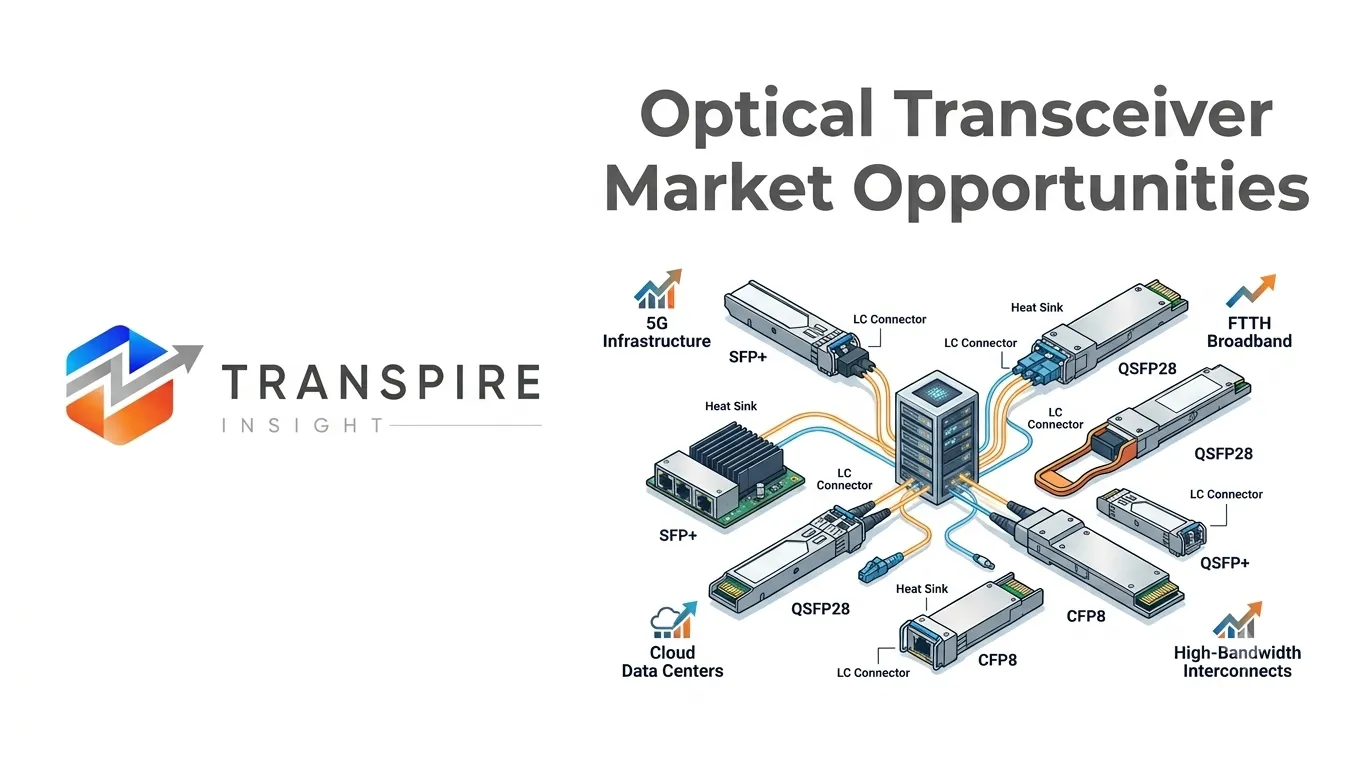
The global optical transceiver market is entering a high-growth phase as artificial intelligence, hyperscale data centers, cloud computing, 5G infrastructure and bandwidth-intensive applications accelerate the transition toward faster optical connectivity.
Optical transceivers have become fundamental components of modern communication infrastructure. They perform the conversion between electrical and optical signals, allowing enormous volumes of information to travel efficiently across fiber-optic networks. As digital services become more data intensive, the performance of these relatively compact modules is increasingly influencing the capacity, power consumption and scalability of larger network architectures.
According to Transpire Insight, the global Optical Transceiver Market was valued at USD 13.80 billion in 2025 and is projected to reach USD 32.40 billion by 2033, representing a CAGR of 11.40% from 2026 to 2033. The market is estimated at approximately USD 15.20 billion in 2026.
The industry's growth is increasingly being influenced by AI rather than traditional internet traffic alone. AI training and inference clusters require extremely high bandwidth between GPUs, switches and other computing resources. This is accelerating the transition toward 400G, 800G and emerging 1.6T optical modules. TrendForce estimates that the shipment share of 800G-and-above optical transceivers could exceed 60% in 2026, compared with 19.5% in 2024, highlighting the speed of this technology transition.
At the same time, telecom operators are upgrading fiber networks to support 5G, cloud services and growing mobile data consumption. Enterprise networks are also moving toward higher-speed connectivity as businesses increasingly depend on cloud applications, video collaboration and distributed computing.
Latest Global Market Developments
Why Optical Transceivers Matter
The modern digital economy depends on moving information rapidly between computing systems. Copper connections remain valuable for short distances, but optical fiber becomes increasingly attractive as bandwidth requirements and transmission distances increase.
Optical transceivers sit at the interface between electronic equipment and fiber networks. A transceiver receives electrical information from network equipment, converts it into an optical signal for transmission and performs the reverse conversion when information arrives at the destination.
This seemingly simple function becomes increasingly demanding as network speeds rise. Moving from 100G to 400G, 800G and eventually 1.6T requires improvements in lasers, photonic integration, signal processing, thermal management, packaging and electrical interfaces.
The importance of transceivers has therefore increased alongside the expansion of cloud infrastructure. Large data centers contain enormous numbers of optical links, meaning even small improvements in module efficiency can have significant effects on overall power consumption and operating expenses.
AI is intensifying this requirement. GPU clusters communicate continuously during model training and inference, generating a need for high-capacity connections between racks and switching infrastructure. This is turning optical connectivity into an increasingly strategic part of AI infrastructure rather than simply a telecommunications component.
Key Factors Driving the Optical Transceiver Market
AI computing is generating a new category of network demand. Large clusters of GPUs must exchange enormous quantities of data, creating communication bottlenecks if interconnects cannot scale alongside computing capacity.
Optical transceivers provide the high-bandwidth links required between servers, switches and data-center systems. As AI clusters become larger, higher-speed modules are becoming increasingly important.
This is one of the principal reasons the market is moving quickly toward 800G and above.
Cloud-service providers continue to expand data-center capacity to support storage, computing, streaming, enterprise software and AI services.
Every additional server and switching layer adds connectivity requirements. As network architectures become more distributed, data-center operators need higher-capacity optical modules that can support greater traffic without proportionally increasing physical infrastructure.
The market is undergoing a generational transition in speed.
Legacy 10G and 40G connections continue to operate in many installations, but new infrastructure increasingly uses 100G, 400G and 800G architectures. The transition is also creating a pathway toward 1.6T modules.
This upgrade cycle provides recurring demand because optical modules must evolve alongside network switches and server architectures.
5G networks require extensive fiber connectivity across front-haul, mid-haul and backhaul infrastructure.
As mobile networks carry more video, cloud applications and machine-generated traffic, operators need additional fiber capacity and more efficient optical equipment.
Emerging markets are particularly important because network expansion is still underway, while mature markets continue upgrading existing infrastructure.
High-speed optical modules can generate significant thermal and electrical demands, particularly when deployed at data-center scale.
A facility operating tens or hundreds of thousands of optical modules cannot treat power consumption as an insignificant issue. Consequently, manufacturers are working on lower-power optical engines, improved DSP architectures, better thermal designs and greater photonic integration.
Energy efficiency is increasingly becoming a purchasing criterion alongside bandwidth and price.
Silicon photonics is helping manufacturers integrate optical functions more closely with semiconductor technologies.
The technology can potentially improve manufacturing scalability, reduce package size and support higher-density optical systems. Coherent's demonstration of a silicon-photonics-based 1.6T transceiver illustrates the direction of technological development.
Five High-Potential Markets Shaping the Global Optical Transceiver Industry
The United States represents the most commercially significant market for optical transceivers because of its concentration of hyperscale cloud providers, AI infrastructure companies, data centers and advanced telecommunications networks.
The country's AI investment cycle is creating particularly strong demand for high-speed optical modules. Large-scale GPU clusters require high-capacity interconnects, pushing data-center operators toward 800G and emerging next-generation solutions.
The U.S. also has a large installed base of enterprise and telecom infrastructure requiring periodic upgrades.
Transpire Insight estimates the U.S. optical transceiver market at USD 3.82 billion in 2025, with revenue expected to reach USD 9.67 billion by 2033 at a 12.31% CAGR.
Future demand is expected to concentrate increasingly around AI clusters, hyperscale data centers, cloud connectivity and high-capacity optical networking.
China is one of the world's most important optical communication markets because of its extensive telecommunications infrastructure, large data-center ecosystem and significant domestic electronics manufacturing capabilities.
The country's operators continue to invest in fiber infrastructure and 5G networks, while cloud and AI computing are generating additional demand for high-speed data-center connectivity.
China also has a substantial domestic optical-component supply chain, giving local manufacturers opportunities to participate across lasers, photonic components, modules and networking equipment.
Future market development is expected to emphasize higher-speed modules, domestic supply chains, data-center interconnects and next-generation telecom infrastructure.
Japan offers an attractive market because of its advanced telecommunications infrastructure, semiconductor ecosystem and long-standing expertise in precision optical technologies.
Data centers, enterprise networks and telecom operators are increasingly requiring higher-capacity optical connections. Japan's strong technology ecosystem also supports development of sophisticated photonic components and high-performance modules.
The country's emphasis on energy efficiency is another important factor because high-density computing environments need to manage both bandwidth and power consumption.
Future opportunities are likely to include advanced photonic integration, high-speed modules, optical components for AI computing and next-generation data-center networks.
South Korea represents a high-potential market due to its strong semiconductor industry, high broadband penetration, telecommunications infrastructure and rapidly developing AI ecosystem.
Large-scale semiconductor and electronics companies require high-capacity data infrastructure for manufacturing, research and computing applications.
The country's telecommunications operators are also continuing to develop high-performance networks, while AI and cloud investment is creating additional demand for optical connectivity.
South Korea's combination of semiconductor expertise and advanced communications infrastructure provides a favorable environment for high-speed transceiver adoption.
India is emerging as one of the industry's most promising growth markets as telecom networks, data centers and cloud infrastructure expand.
The country's 5G rollout is increasing the need for fiber-based transport infrastructure. At the same time, businesses are adopting cloud services and digital platforms at scale, creating greater demand for enterprise connectivity.
India's data-center industry is also expanding as global and domestic technology companies seek local computing capacity.
The 5G optical transceiver segment demonstrates the country's growth potential, with the market projected to reach USD 448.8 million by 2033 from USD 104.6 million in 2026.
Over the longer term, India's combination of digital adoption, data-center construction and telecommunications investment could make it one of the industry's most important emerging markets.
Competitive Landscape
The optical transceiver industry has a complex competitive structure because manufacturers compete across different combinations of form factor, data rate, optical technology, application and transmission distance.
The competitive ecosystem includes optical-component specialists, semiconductor companies, networking-equipment manufacturers and vertically integrated photonics companies.
Major participants include:
Competition is increasingly centered on data rate, power consumption, thermal performance, optical reach, manufacturing scale, interoperability and supply-chain reliability. The shift toward AI infrastructure is also increasing the importance of rapid product development for 800G and 1.6T architectures.
Top 5 Companies in the Optical Transceiver Market
Headquarters: Saxonburg, Pennsylvania, USA
Coherent is a major photonics company with capabilities spanning lasers, optical components, photonic devices and high-speed communications technologies.
Its position is particularly relevant to the transition toward higher-speed optical connectivity. The company demonstrated a 1.6T-DR8 transceiver based on silicon photonics at OFC 2025, showing its focus on next-generation data-center interconnects.
The acceleration of AI infrastructure provides an important opportunity for Coherent because higher computing density requires corresponding improvements in optical connectivity.
Headquarters: San Jose, California, USA
Lumentum operates across optical and photonic technologies serving communications and other technology markets.
Its expertise in optical components gives it exposure to the growing requirement for high-speed networking and data-center connectivity.
As network operators move toward higher transmission rates and increasingly dense optical architectures, component-level innovation in lasers and photonic devices will remain important to the company's competitive position.
Headquarters: Palo Alto, California, USA
Broadcom is a major semiconductor and infrastructure-technology company with an important role in networking technologies.
Its broader networking portfolio creates opportunities to integrate high-speed optical connectivity with switching and data-center infrastructure.
The increasing importance of AI clusters is particularly relevant because large AI systems require close coordination between switching silicon, network architecture and optical interconnects.
Headquarters: Wuhan, China
Accelink is a major optical communication technology company serving telecommunications, data centers and other networking applications.
Its product portfolio covers optical communication components and modules used in high-speed network infrastructure.
China's large domestic telecommunications market and expanding data-center ecosystem provide the company with a significant home-market opportunity while the wider growth of high-speed optical networking creates international potential.
Headquarters: Suzhou, China
INNOLIGHT specializes in high-speed optical transceiver technologies and is particularly associated with data-center connectivity.
The company's exposure to high-bandwidth optical modules positions it within one of the industry's fastest-changing segments.
As AI clusters increase requirements for 800G and future 1.6T connectivity, manufacturers capable of delivering high-volume, high-performance modules with competitive power characteristics are likely to gain importance.
Opportunities for Small Investors
The optical transceiver market has high technical barriers at the module-manufacturing level, but smaller companies can participate through supporting segments.
One opportunity is fiber-optic installation and testing. As data centers and telecom networks expand, operators require specialized services for fiber deployment, connector inspection, testing and network commissioning.
Another opportunity exists in optical-network monitoring and maintenance. Higher network density increases the value of tools capable of identifying signal degradation, connector problems and thermal issues.
Small technology companies can also develop software for optical-network monitoring, inventory management and predictive maintenance.
Specialized component distribution, fiber assemblies, optical testing equipment, cooling solutions and data-center infrastructure services represent additional opportunities.
The rapid movement toward AI infrastructure may create particularly attractive niches for companies supplying products or services that address optical-module power consumption, thermal management and high-density deployment.
Challenges & Restraints
The industry's rapid growth is accompanied by several technical and commercial challenges.
Thermal management is becoming increasingly difficult as optical module speeds rise. Higher data rates can increase electrical and optical power requirements, making cooling an important design consideration.
Component availability is another concern. Rapid AI infrastructure expansion is placing pressure on supplies of optical components and related manufacturing capacity. TrendForce identified component shortages as a significant bottleneck for expanding AI-focused optical transceiver production in 2026.
Technology transitions can also create inventory risks. A module designed for one generation of networking architecture can lose relevance as customers rapidly move to a newer data-rate standard.
The industry additionally faces pressure to reduce cost per transmitted bit. Customers want more bandwidth but cannot indefinitely accept proportional increases in module costs and energy consumption.
Interoperability is another challenge. Optical modules must operate reliably with networking equipment from different vendors, making standards compliance and qualification increasingly important.
Finally, the supply chain remains geographically concentrated in several critical photonic and semiconductor manufacturing ecosystems. Geopolitical developments, export restrictions and component availability can therefore influence procurement strategies.
Conclusion
The Optical Transceiver Market is moving into an unusually important period as AI computing, hyperscale data centers, 5G networks and cloud infrastructure increase the amount of information that must move between machines.
The transition toward 400G, 800G and 1.6T connectivity is changing the competitive landscape and creating opportunities for manufacturers that can simultaneously improve bandwidth, energy efficiency, thermal performance and reliability.


Send us a brief description of your challenge and we'll get back to you within 24 hours.

 inquiry@transpireinsight.com
 APAC:+91 7666513636
 Address


