
Sep 16, 2026
By Transpire Insight
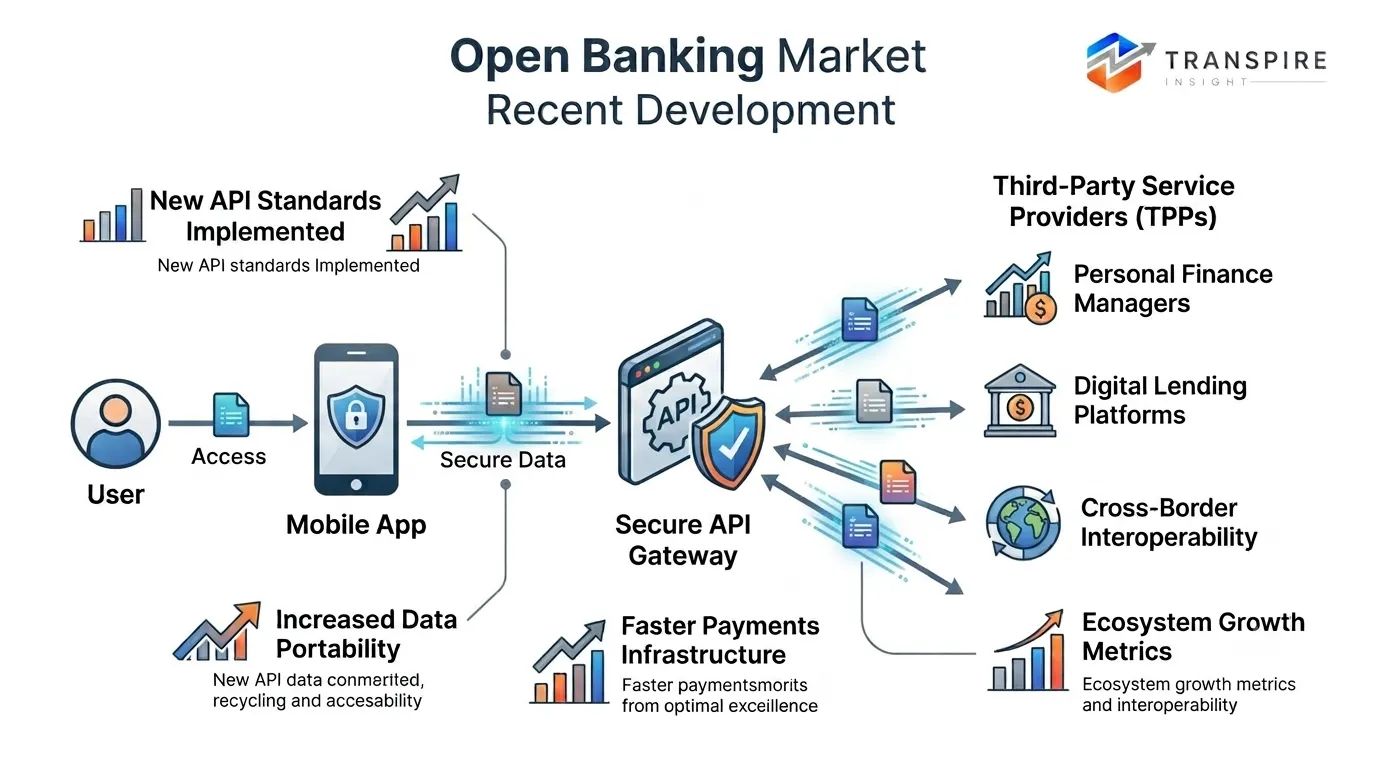
From account aggregation and faster payments to AI-powered financial services and embedded finance, open banking is transforming how consumers and businesses share, access and use financial data.
Global Open Banking Market Overview
The global open banking market is moving from a regulatory-led concept toward a core layer of digital financial infrastructure. Banks, fintech companies, payment providers and technology platforms are increasingly using secure APIs to connect financial accounts, initiate payments, verify customers and deliver personalized financial services.
The global open banking market was valued at approximately USD 38.9 billion in 2025 and is estimated to reach around USD 51.5 billion in 2026. The market is projected to expand to approximately USD 288.3 billion by 2033, representing a CAGR of about 27.2% during 2026–2033. Europe remains one of the leading regional markets, while Asia Pacific is expected to record the fastest growth over the forecast period.
The market is increasingly being shaped by account-to-account payments, payment initiation services, financial data aggregation, digital lending, fraud prevention, embedded finance and AI-driven financial intelligence. Open banking is also increasingly evolving toward open finance, where permissioned financial-data access can extend beyond traditional bank accounts to areas such as insurance, investments and pensions.
Latest Developments in the Open Banking Market
Growth Drivers of the Open Banking Market
Application programming interfaces have become the technological foundation of open banking. APIs allow authorized third-party providers to securely connect with financial institutions and access permitted account information or initiate payments.
As banks modernize their technology infrastructure, standardized APIs are making it easier for fintech applications and financial platforms to build services across multiple institutions.
Consumers increasingly expect instant, convenient and mobile-first payment experiences. Open banking enables account-to-account payment models that can reduce dependence on traditional payment methods in selected use cases.
Payment initiation is expected to remain one of the fastest-growing areas of open banking as merchants and consumers become more comfortable with direct bank-based payments.
Traditional banking systems often provide limited visibility across a customer's complete financial position. Open banking allows authorized applications to consolidate transaction and account information, enabling more personalized budgeting, financial planning, lending and wealth-management services.
The availability of richer financial data also allows institutions to develop products based on actual customer behavior rather than relying solely on conventional financial profiles.
Open banking is increasingly important in digital lending because transaction-level financial information can help lenders assess income patterns, cash flows and repayment capacity.
For small businesses and consumers with limited traditional credit histories, permissioned access to transaction data can potentially improve underwriting accuracy and expand access to financial services.
Financial services are increasingly being integrated directly into non-financial digital platforms. Open banking infrastructure can support account verification, payment initiation, financial-data access and other services required by embedded-finance applications.
This convergence is creating new opportunities for banks, fintechs, retailers, accounting platforms and software companies.
Regulation remains one of the strongest drivers of open banking adoption. In markets such as Europe and the UK, regulatory frameworks have established consumer rights around financial-data access and encouraged banks to provide standardized connectivity.
The next stage is moving toward broader open-finance models that can give consumers greater control over data held across different categories of financial services.
Financial institutions are increasingly combining transaction data with analytics and AI to identify unusual behavior, improve risk assessment and strengthen fraud prevention.
Open banking can provide a richer data foundation for these applications when customers explicitly authorize access and appropriate security and privacy controls are maintained.
Future Importance
The future of open banking will depend increasingly on its transition from a data-access framework into a broader financial-services infrastructure.
Account aggregation and payment initiation will remain important, but the next phase is likely to involve more sophisticated applications involving lending, fraud detection, personal financial management, business cash-flow analysis, wealth management and embedded finance.
The expansion toward open finance is particularly significant because it could connect previously fragmented financial information across banking, investments, insurance and pensions. This could create a more comprehensive financial profile while giving consumers greater control over how their information is shared.
Why Open Banking Matters
Open banking gives consumers greater visibility into how their financial information is shared with authorized third parties. Consent-based access can allow customers to choose services that use their financial information while maintaining greater control over the data-sharing process.
Third-party providers can build new products on top of banking infrastructure, increasing competition between established institutions and fintech companies.
Account-to-account payment infrastructure can provide alternatives to traditional payment methods and create new opportunities for merchants, marketplaces and digital platforms.
Open banking and account-aggregation models can help lenders and financial-service providers obtain richer information about customers who may not fit conventional credit-assessment models.
India's Account Aggregator ecosystem demonstrates the potential scale of this approach, particularly in lending and financial inclusion.
Standardized APIs allow fintech companies to build new applications without having to develop entire banking infrastructures themselves. This lowers technological barriers and supports faster product development.
Investment Opportunities
The open banking market offers investment opportunities across API infrastructure, payment initiation, account aggregation, fraud prevention, digital lending, financial-data analytics, identity verification and embedded finance.
Payment infrastructure is particularly attractive because the transition from card-centric payment models toward account-to-account payments can create new transaction-based revenue opportunities. The payments segment is already identified as one of the fastest-growing open banking service categories.
Investors can also explore opportunities in API security, consent management and financial-data intelligence. As open banking expands, financial institutions will require stronger infrastructure for authentication, authorization, cybersecurity, monitoring and regulatory compliance.
The transition toward open finance creates an even broader opportunity. Providers that can securely connect banking data with investment, insurance, pension and other financial information may be positioned to capture value from increasingly integrated financial ecosystems.
Top 10 Companies in the Open Banking Market
These companies compete across financial-data connectivity, API infrastructure, payment initiation, account aggregation and financial-data intelligence. Plaid has a particularly strong position in North America, while Tink, TrueLayer and Yapily have established significant positions across Europe.
1) Plaid
Plaid is one of the leading open banking infrastructure providers, connecting financial institutions with fintech applications and digital financial services. Its platform provides account connectivity and financial-data access that can support applications ranging from personal finance and lending to account verification and payments.
Plaid maintains a particularly strong position in North America, with connectivity to more than 12,000 financial institutions, according to recent industry analysis.
2) Tink
Tink, owned by Visa, is a major European open banking platform providing financial-data connectivity and payment-initiation capabilities. Its technology supports banks, fintech companies and merchants seeking to build data-driven financial experiences.
Tink's network connects with more than 3,400 European banks, strengthening Visa's position in open banking infrastructure.
3) Finicity
Finicity, a Mastercard company, provides financial-data connectivity and open banking infrastructure primarily across North America. Its capabilities support applications involving account verification, lending, financial-data access and payment-related services.
Its integration into Mastercard's broader financial technology ecosystem provides opportunities to expand open banking capabilities across the payments industry.
4) TrueLayer
TrueLayer is a UK-based open banking technology company focused on financial-data connectivity and payment initiation. Its platform is positioned around the European open banking ecosystem, where regulatory requirements have accelerated the development of standardized bank APIs.
5) Yapily
Yapily provides open banking infrastructure designed to connect businesses and financial applications with banks across multiple markets. Its technology focuses strongly on API connectivity and payment initiation, making it a participant in Europe's rapidly developing open banking ecosystem.
Challenges & Restraints
The open banking market faces several important challenges despite its rapid growth. Data privacy and cybersecurity remain among the most significant concerns because open banking requires financial information to move between banks, fintech platforms and other authorized third parties.
Consumer trust is another critical factor. Customers must understand what information they are sharing, with whom it is being shared and how it will be used. Poorly designed consent experiences can reduce adoption and create reputational risks for financial institutions.
Regulatory fragmentation also remains a challenge. Open banking frameworks differ significantly between markets, creating additional complexity for companies seeking to operate internationally. Mastercard notes that open-finance regulations vary considerably across jurisdictions even though many frameworks share the objective of giving consumers greater control over their financial data.
Market Expert View
The open banking market is evolving from an API-access model into a broader digital financial infrastructure ecosystem. The early focus was largely on account aggregation and regulatory compliance, but the commercial opportunity is now expanding toward payments, lending, fraud prevention, financial intelligence and embedded financial services.
The most important shift is the movement from simply sharing financial data to creating value from that data. AI and advanced analytics can help institutions convert transaction information into more accurate risk assessments, personalized recommendations, automated financial management and stronger fraud detection.
The next major stage will be open finance. By expanding permission-based data access beyond traditional bank accounts, financial institutions and fintech companies can create more comprehensive financial experiences. However, long-term success will depend on strong consent mechanisms, cybersecurity, interoperability and consumer trust.
Regional development will remain uneven. Europe has a strong regulatory foundation, North America has a highly developed fintech ecosystem, and Asia Pacific offers substantial growth potential as digital payments, financial inclusion and API-based financial services continue to expand.
Conclusion
The global open banking market is entering a high-growth phase as APIs, digital payments, fintech innovation and regulatory frameworks reshape the financial-services ecosystem. From account aggregation and payment initiation to digital lending, fraud prevention and embedded finance, open banking is creating new ways for consumers and businesses to interact with financial institutions.
The market's evolution toward open finance could significantly expand its long-term addressable opportunity by connecting banking data with investments, insurance, pensions and other financial services. At the same time, cybersecurity, privacy, regulatory fragmentation and consumer trust will remain critical considerations.
As financial services become increasingly interconnected, open banking is positioned to become more than a fintech trend. It is emerging as a foundational digital infrastructure layer for the next generation of personalized, data-driven and API-enabled financial services.


Send us a brief description of your challenge and we'll get back to you within 24 hours.

 inquiry@transpireinsight.com
 APAC:+91 7666513636
 Address


