
Oct 09, 2026
By Transpire Insight
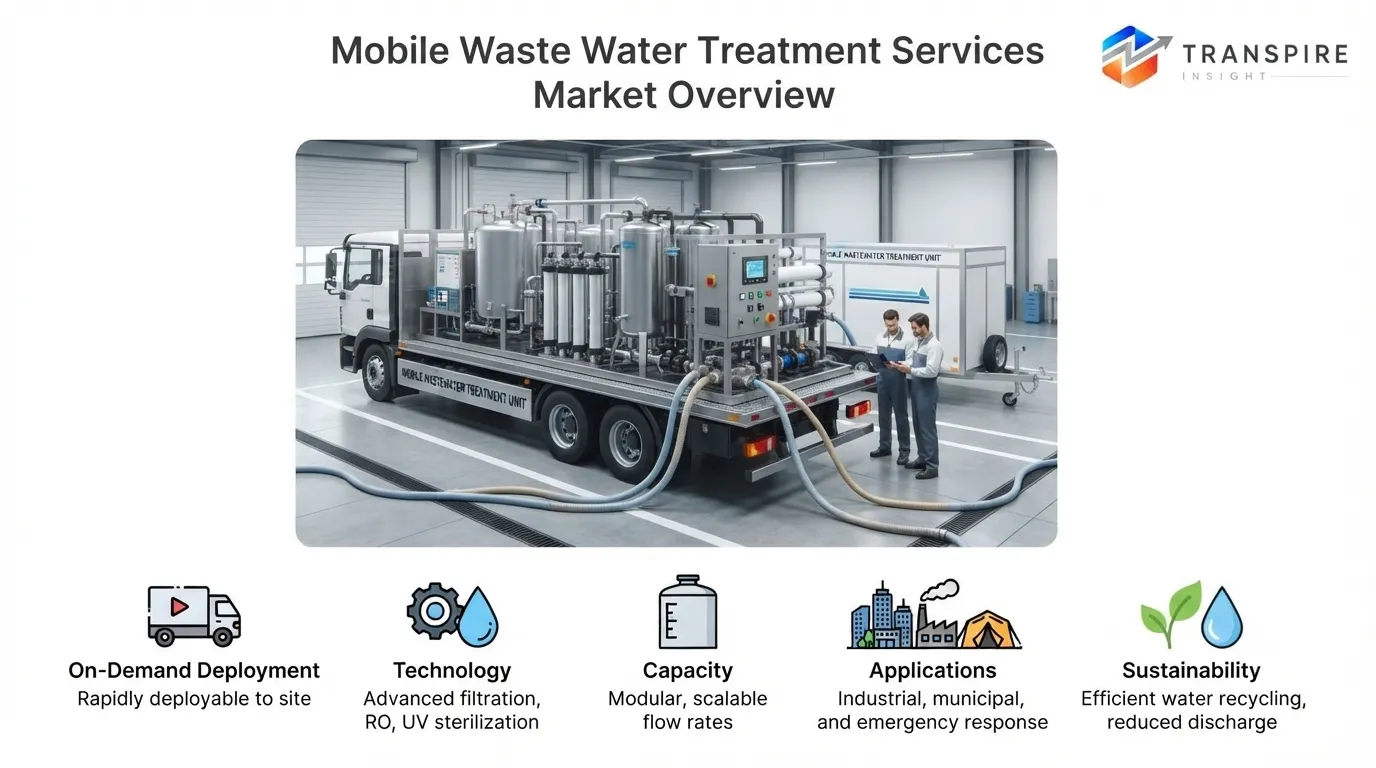
The global Mobile Waste Water Treatment Services Market is becoming an increasingly important component of flexible water infrastructure as municipalities, industrial operators, remote facilities, and emergency-response organizations seek treatment capacity that can be deployed without waiting for permanent plant construction.
Mobile Waste Water Treatment Services Market Overview
The Mobile Waste Water Treatment Services Market is evolving from a primarily emergency-oriented solution into a broader infrastructure service model. Mobile and modular treatment units can provide temporary capacity during plant maintenance, infrastructure upgrades, seasonal demand increases, construction projects, industrial shutdowns, environmental incidents, and operations in locations where permanent treatment infrastructure is difficult to justify.
According to Transpire Insight, the global market is estimated at approximately USD 4.28 billion in 2025 and is projected to reach nearly USD 7.82 billion by 2033, representing a forecast CAGR of approximately 8.01% from 2026 to 2033. The market is estimated at around USD 4.62 billion in 2026.
The market includes containerized treatment systems, portable filtration systems, mobile clarification systems, temporary treatment units, and emergency wastewater solutions. On the application side, demand extends across municipal wastewater, industrial wastewater, oil and gas facilities, mining operations, construction sites, remote camps, and other temporary or geographically dispersed operations.
A major structural change is the increasing value placed on speed of deployment and operational flexibility. A conventional wastewater facility can require substantial engineering, permitting, construction, and commissioning time. Mobile treatment services can bridge that capacity gap by allowing operators to add treatment capability for a defined period and then relocate or scale down the equipment.
The technology mix is also becoming more sophisticated. Membrane filtration, reverse osmosis, ultraviolet treatment, biological processes, advanced filtration, and automated monitoring can be combined according to the characteristics of the wastewater stream. This enables service providers to design treatment trains for different contaminant loads rather than relying on a single standardized configuration.
Latest Global Market Developments
Why Mobile Waste Water Treatment Services Matter?
Wastewater infrastructure is normally designed around relatively stable long-term demand. However, actual water-treatment requirements can change rapidly. A factory may temporarily increase production, a municipality may experience an infrastructure failure, or a mining operation may establish a new remote camp. These situations create a need for treatment capacity that is available when required rather than permanently installed regardless of utilization.
Mobile treatment services address this requirement through a combination of equipment rental, engineering, transportation, installation, monitoring, operation, maintenance, and technical support.
For industrial customers, the value proposition can be particularly significant. Instead of interrupting production during maintenance or expansion, an operator can use temporary treatment capacity to maintain wastewater compliance and reduce operational disruption.
The model is also relevant to municipalities. Aging treatment infrastructure can create temporary capacity shortages during rehabilitation or unexpected equipment failure. Mobile systems can function as a bridge until permanent infrastructure is repaired or expanded.
Climate-related events provide another application. Flooding, storms, droughts, and other disruptions can place pressure on water and sanitation systems. Portable treatment capacity can support emergency response when conventional infrastructure is damaged or temporarily inaccessible.
Key Factors Driving the Mobile Waste Water Treatment Services Market
1. Aging Wastewater Infrastructure
Many municipalities and industrial facilities are dealing with aging treatment assets that require rehabilitation, replacement, or capacity upgrades. Mobile treatment systems can provide interim capacity while permanent infrastructure is being modernized.
2. Increasing Industrial Water Management Requirements
Mining, chemicals, food processing, pharmaceuticals, energy, and manufacturing operations can generate wastewater streams with different contaminant characteristics. Temporary treatment services allow facilities to respond to changing production conditions without committing immediately to a permanent treatment plant.
3. Water Scarcity and Reuse
Water scarcity is shifting attention from wastewater disposal toward water recovery. Treatment providers increasingly have opportunities to deliver systems that enable treated wastewater to be reused for industrial processes, irrigation, dust suppression, equipment washing, and other applications where regulations permit.
4. Remote and Temporary Operations
Mining camps, construction projects, oil and gas sites, military facilities, infrastructure projects, and temporary worker accommodations often operate away from centralized wastewater networks. Mobile treatment can be transported and installed according to project requirements.
Orenco, for example, describes mobile systems capable of serving applications ranging from remote sanitation and work camps to disaster relief and temporary flow diversion.
5. Stricter Environmental Compliance
Regulatory requirements surrounding wastewater discharge and emerging contaminants are increasing the technical requirements placed on treatment systems. Service providers able to rapidly configure treatment trains for specific contaminants can therefore address a broader range of customer requirements.
6. Growth of Rental and Service-Based Models
The industry is gradually moving toward a service model in which customers pay for treatment capacity and technical support rather than purchasing every component themselves. This can reduce upfront capital requirements and make advanced treatment accessible for short-duration projects.
Five High-Potential Markets Shaping Global Mobile Waste Water Treatment Services
1. Industrial Wastewater Treatment
Industrial wastewater represents one of the largest opportunity areas because production facilities can experience changing flow volumes, contamination profiles, and compliance requirements.
Mobile treatment can be deployed during plant expansion, maintenance shutdowns, process changes, or temporary capacity shortages.
2. Mining and Mineral Processing
Mining operations frequently occur in geographically isolated environments. Treatment infrastructure must therefore be transportable, durable, and capable of operating under difficult environmental conditions.
Mobile systems can support worker camps, process-related wastewater, temporary facilities, and water-management requirements during different phases of mine development.
3. Oil and Gas Operations
Oilfield service facilities, remote camps, drilling locations, and production-support sites require wastewater solutions that can be installed without extensive permanent infrastructure.
The ability to transport treatment equipment by road, rail, or other logistics routes makes mobile treatment particularly relevant to geographically dispersed energy operations.
4. Municipal and Emergency Wastewater Services
Municipalities can use temporary systems when treatment plants experience equipment failures, capacity constraints, rehabilitation projects, or unexpected increases in wastewater volumes.
This creates an opportunity for providers to establish regional equipment fleets that can be mobilized quickly rather than maintaining all equipment at individual customer locations.
5. Construction, Infrastructure, and Temporary Facilities
Large construction projects can generate wastewater for worker accommodation, site operations, tunneling, and other activities. Once the project is completed, the treatment equipment can be relocated to another site.
This creates a repeat-use business model in which a single treatment fleet can generate revenue across multiple projects during its operating life.
Competitive Landscape
Competition in the Mobile Waste Water Treatment Services Market is increasingly based on more than equipment manufacturing. Providers are competing through fleet availability, response time, treatment expertise, engineering capabilities, monitoring systems, geographic coverage, rental structures, and long-term service contracts.
A provider with a large installed fleet can potentially respond to emergency requirements faster, while companies with specialized treatment technologies can address wastewater streams requiring advanced contaminant removal.
Digital monitoring is another competitive factor. Remote instrumentation can allow operators to monitor flow, pressure, water quality, equipment status, and treatment performance without requiring continuous physical presence at every installation.
Top 5 Companies in the Mobile Waste Water Treatment Services Market
1. Veolia
Veolia maintains a substantial mobile water and integrated-services operation serving industrial and municipal customers. The company has identified mobile water services and emergency-response capabilities as an area for continued development.
2. SUEZ
SUEZ operates across water and wastewater services and has continued investing in advanced treatment and monitoring technologies. Its focus on micropollutants and wastewater-based environmental monitoring illustrates the increasing technological depth of the broader water-treatment industry.
3. Xylem
Xylem participates across water infrastructure, pumping, treatment, monitoring, and digital water-management solutions. Its broad technology portfolio positions the company across several stages of wastewater management.
4. Evoqua Water Technologies
Evoqua has established expertise in industrial water treatment and specialized treatment systems. Its capabilities are relevant to customers requiring temporary or supplemental treatment capacity for demanding industrial applications.
5. Aquatech International
Aquatech provides water purification and wastewater treatment solutions for industrial customers and complex water-management requirements. Its technology-oriented approach gives it exposure to applications where advanced treatment and water reuse are increasingly important.
Other companies active across relevant segments include Pall Corporation, Fluence Corporation, Ovivo, WesTech Engineering, Kurita Water Industries, Ecolab, Newterra, and Organica Water.
Opportunities for Small Investors
The Mobile Waste Water Treatment Services Market is not limited to large-scale treatment-plant operators. Smaller businesses can participate through specialized service niches.
Equipment Rental and Leasing
Small and regional operators can develop rental fleets of modular treatment equipment targeted at construction companies, industrial facilities, temporary camps, and municipalities.
Mobile Dewatering Services
Dewatering, sludge management, filtration, and wastewater handling can be offered as specialized services rather than full treatment-plant solutions.
Monitoring and Automation
Remote sensors, cloud-based monitoring, alarms, and predictive-maintenance systems create opportunities for technology companies serving mobile treatment fleets.
Regional Emergency-Response Services
A strategically located fleet can serve municipalities and industrial facilities within a defined geographic area, reducing deployment times and transportation costs.
Water-Reuse Engineering
Companies with expertise in water-quality analysis and reuse planning can build consulting and engineering businesses around industrial wastewater recovery.
The strongest business models are likely to combine equipment with recurring services such as monitoring, maintenance, consumables, operator support, and compliance testing.
Challenges & Restraints
Despite its growth potential, the market faces several operational challenges.
High Transportation Costs: Mobile treatment equipment can be large and expensive to move, particularly when projects are located in remote regions.
Variable Wastewater Composition: Wastewater characteristics can change significantly between customers. A treatment system designed for one application may require substantial modification for another.
Regulatory Differences: Treatment requirements vary between countries, states, municipalities, and industrial sectors. Providers must understand local discharge and reuse regulations before deploying equipment.
Operator and Maintenance Requirements: Advanced systems may require trained personnel, regular monitoring, membrane maintenance, chemical management, and equipment servicing.
Temporary Project Economics: For very short-duration projects, transportation, installation, commissioning, and removal costs can make mobile treatment less economically attractive than other alternatives.
Competition from Permanent Infrastructure: Where treatment demand is stable and long-term, customers may prefer permanent facilities rather than recurring mobile-service contracts.
These constraints are encouraging service providers to improve modularity, remote monitoring, transportation efficiency, and standardized deployment procedures.
Conclusion
The Mobile Waste Water Treatment Services Market is moving toward a more flexible model of wastewater infrastructure in which treatment capacity can be deployed according to operational requirements rather than permanently fixed at one location.
The combination of aging infrastructure, industrial expansion, water scarcity, stricter environmental requirements, remote project development, and growing interest in water reuse is creating a broader addressable market for mobile treatment services.
The next phase of market development is likely to focus on higher treatment efficiency, faster deployment, advanced contaminant removal, automated monitoring, modular system design, and recurring service contracts. Companies capable of combining equipment with engineering, operations, digital monitoring, and emergency-response capabilities can address a wider range of customer requirements.
For municipalities, industrial operators, mining companies, construction firms, and investors, the strategic importance of mobile wastewater treatment lies in its ability to convert wastewater infrastructure from a fixed-capital requirement into a more adaptable service capability.


Send us a brief description of your challenge and we'll get back to you within 24 hours.

 inquiry@transpireinsight.com
 APAC:+91 7666513636
 Address


