
Oct 06, 2026
By Transpire Insight
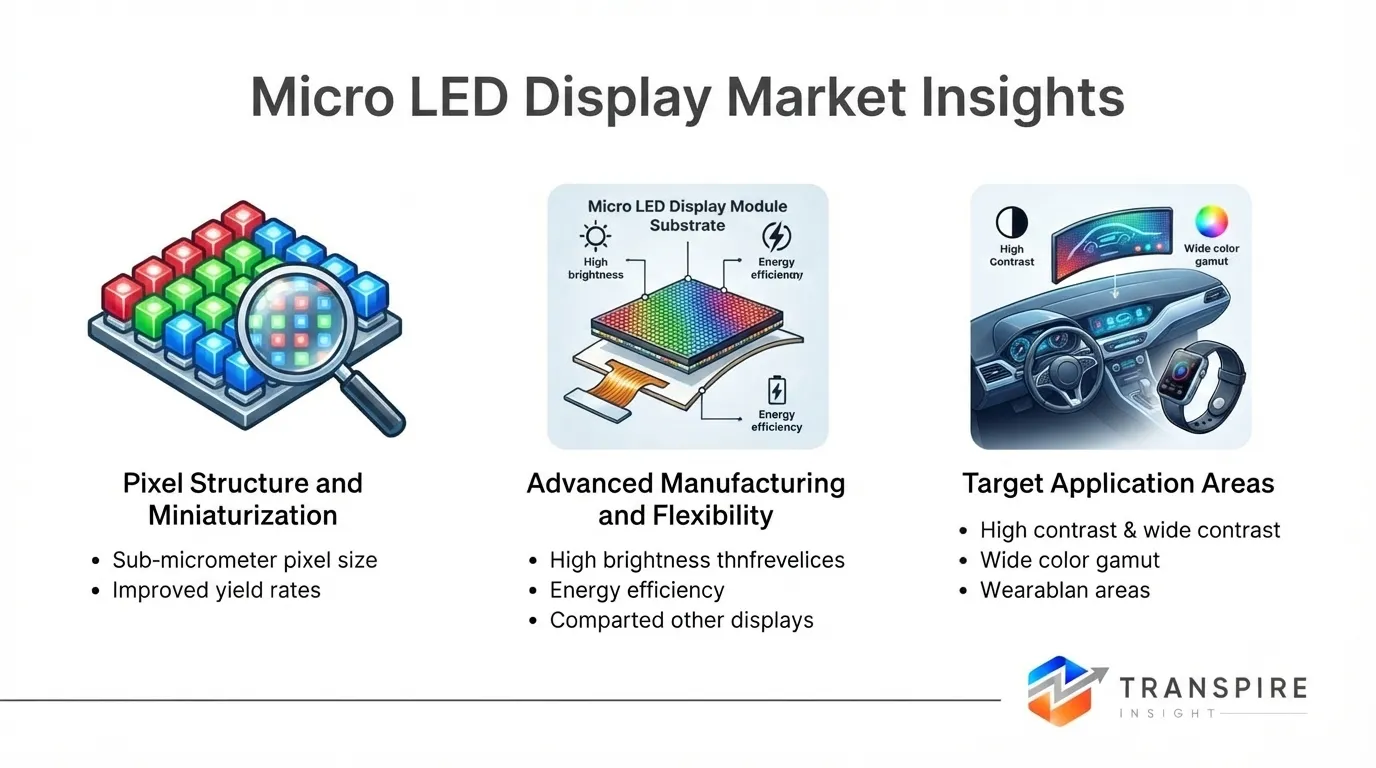
Micro LED displays are emerging as a next-generation self-emissive display technology capable of delivering high brightness, deep contrast, fast response, energy efficiency, and long operating life. As manufacturers improve mass-transfer processes and microscopic LED integration, the technology is gradually moving from laboratory demonstrations and premium commercial displays toward automotive, wearable, AR/VR, healthcare, retail, and other specialized applications.
The development of Micro LED technology is increasingly connected with semiconductor manufacturing, advanced backplanes, precision bonding, chip miniaturization, and automated defect detection. These technological developments are creating new opportunities for display manufacturers while also highlighting the importance of production yield, manufacturing cost, and supply-chain integration.
September 2026: The global Micro LED Display Market is entering a commercialization-focused phase as display manufacturers, semiconductor companies, LED specialists, and technology developers work to improve manufacturing scalability. Micro LEDs are individually controlled inorganic light-emitting devices, allowing displays to operate without conventional backlighting. Their high brightness and pixel-level control make them attractive for premium televisions, digital signage, automotive displays, wearables, augmented reality devices, and other high-performance visual systems. PlayNitride notes that Micro LED chips can be miniaturized below 50 micrometers and transferred directly onto driving backplanes, enabling applications ranging from watches and automotive displays to AR/VR systems.
Market Size
According to Transpire Insight, the global Micro LED Display Market was valued at approximately USD 10.77 billion in 2025 and is projected to reach approximately USD 317.882 billion by 2033, expanding at a CAGR of 52.70% from 2026 to 2033. The market is being supported by the increasing commercialization of ultra-large displays, high-resolution wearable displays, automotive visualization systems, and AR/VR micro-displays.
The market remains technology-intensive because Micro LED displays require millions of microscopic LEDs to be accurately transferred, aligned, bonded, electrically driven, and inspected. Improvements in mass transfer, backplane engineering, wafer processing, and automated inspection are therefore central to future cost reduction and commercialization.
Micro LED Technology Is Changing the Premium Display Landscape
Micro LED displays use microscopic inorganic LEDs as individually controlled light-emitting pixels. Unlike LCD technology, which requires a backlight, Micro LED is self-emissive. This allows individual pixels to be controlled independently, producing deep blacks, high contrast, rapid response, and strong brightness.
The absence of a conventional backlight also gives manufacturers greater flexibility in developing thin, modular, transparent, curved, and other unconventional display structures. PlayNitride identifies ultra-high brightness, low power consumption, high resolution, reliability, fast response time, and flexibility among the technology's major characteristics.
Samsung's commercial Micro LED products demonstrate how the technology is already being positioned in ultra-premium home entertainment. Its current Micro LED portfolio includes very large screen formats and uses individually controlled pixels to create high contrast and detailed images.
Growing Demand for High-Brightness and High-Contrast Displays
One of the strongest factors supporting the Micro LED Display Market is the demand for displays that maintain image quality under demanding lighting conditions.
Traditional display technologies face different performance constraints when used in direct sunlight, large commercial environments, vehicles, and outdoor locations. Micro LED technology can generate extremely high brightness because each microscopic LED functions as an independent light source.
This capability is particularly important for automotive displays, outdoor digital signage, smart wearable devices, industrial visualization, and AR applications. AUO, for example, highlights high brightness, energy efficiency, long lifespan, and transparent display capabilities within its Micro LED solutions.
Premium Television and Large-Format Displays Remain Important Applications
Large-format displays represent an important commercialization route for Micro LED technology. The technology can be assembled into modular structures, allowing manufacturers to create very large screens without being restricted to a conventional single-panel format.
Samsung's The Wall uses Micro LED technology for large-scale visual applications, while Sony's Crystal LED platform demonstrates the use of fine LED light sources in scalable large-screen systems. Sony has also highlighted Crystal LED's use in professional environments, including virtual production.
Premium home theaters, luxury hospitality, corporate visualization, entertainment venues, museums, retail environments, and virtual production studios are therefore expected to remain important application areas.
Automotive Displays Create a New Growth Opportunity
Automotive manufacturers are increasingly incorporating larger and more sophisticated digital interfaces into vehicles. Instrument clusters, head-up displays, passenger screens, center consoles, digital surfaces, and transparent display systems are creating demand for technologies that can deliver high brightness, compact form factors, reliability, and strong outdoor visibility.
Micro LED can support these requirements because of its brightness and inorganic construction. Transparent and flexible architectures can also enable new approaches to vehicle interior design.
BOE is developing Micro LED-based automotive solutions, including extremely high-brightness head-up display technologies and Micro LED smart-surface concepts.
As vehicle interiors become increasingly software-driven, displays are expected to become an important interface between passengers, vehicles, navigation systems, entertainment platforms, and advanced driver-assistance technologies.
AR and VR Applications Could Accelerate Micro LED Adoption
Augmented reality and virtual reality require extremely compact displays with high pixel density, high brightness, fast response, and low power consumption. These requirements make Micro LED an important technology under development for near-eye displays.
PlayNitride has developed silicon-driven Micro LED solutions designed for AR applications and reports that its technology can support extremely high pixel densities for micro-displays.
ams OSRAM is also advancing Micro LED array technology for next-generation AR smart glasses. In 2026, the company reported continued development of RGB Micro LED-based light engines and progress toward mass-production readiness for next-generation smart glasses.
This development illustrates how Micro LED is expanding beyond conventional televisions and signage toward compact computing and wearable platforms.
Wearable Devices Offer a Strong Commercialization Path
Smartwatches and other wearable devices require displays that remain readable in bright environments while consuming limited power. Micro LED's self-emissive structure and high brightness can provide advantages for outdoor readability and compact device designs.
Wearables also benefit from long operating life and high reliability. The small size of Micro LED chips makes the technology compatible with high pixel densities and unusual form factors.
As wearable manufacturers explore larger displays, curved surfaces, transparent components, and advanced health or contextual interfaces, Micro LED could become increasingly relevant to premium device architectures.
Mass Transfer Remains the Central Manufacturing Challenge
Despite its performance advantages, Micro LED production remains considerably more complicated than conventional display manufacturing.
A Micro LED display may require millions of microscopic LEDs to be transferred from semiconductor wafers to a display backplane. Each device must be placed with extremely high precision. A small number of defective pixels can affect overall display quality and create significant manufacturing losses.
Recent technical research identifies mass transfer as one of the fundamental challenges in large-scale Micro LED manufacturing. Laser-assisted transfer, laser lift-off, bonding technologies, and process optimization are being investigated to improve throughput and yield.
Bonding also remains technically demanding because Micro LED dies and their connection pads can be extremely small. Research published through the Society for Information Display highlights die placement, transfer, and bonding as important areas for improving production yield.
Automation and AI-Based Inspection Can Improve Production Efficiency
As Micro LED production becomes more automated, manufacturers are increasingly focusing on machine vision, defect inspection, process monitoring, and data-driven manufacturing.
Automated inspection can identify defective pixels, bonding problems, brightness variations, color inconsistencies, and alignment errors. Early detection can reduce the cost of repairing or rejecting completed display modules.
AI-assisted manufacturing may also help manufacturers identify relationships between process parameters and defect patterns. In high-volume manufacturing environments, this could contribute to improved yield and more predictable production.
Active Matrix Technology Supports High-Resolution Applications
Active Matrix Micro LED is gaining attention because it provides individual pixel control and is suitable for high-resolution display structures.
Active matrix architectures can be combined with advanced TFT or semiconductor backplanes to control large numbers of pixels. This becomes increasingly important as Micro LED displays move toward smaller pixel sizes and higher pixel densities.
AUO has described the use of active matrix technology and semiconductor processing in its Micro LED display solutions, including applications involving fine pixel densities and large-format modular displays.
Passive matrix configurations continue to have relevance for specific display structures, but active matrix technology is particularly important for advanced high-resolution systems.
Flexible and Transparent Micro LED Displays Open New Design Possibilities
Micro LED technology is not limited to conventional flat displays. Flexible backplanes can enable curved and free-form displays, while transparent Micro LED structures can allow digital content to be displayed over physical environments.
Transparent displays could be used in retail windows, vehicle windows, architectural surfaces, museums, exhibitions, and interactive installations.
AUO's Micro LED portfolio includes transparent display solutions designed to provide high transparency while maintaining image quality.
PlayNitride has also demonstrated transparent, flexible, borderless, and modular Micro LED concepts for different applications.
Regional Outlook
Asia Pacific
Asia Pacific represents the central manufacturing and innovation ecosystem for the Micro LED Display Market. Transpire Insight estimates that the region accounts for approximately 46% of the global market, supported by major display and semiconductor ecosystems in South Korea, China, Taiwan, and Japan.
South Korea has strong participation from Samsung and LG Display, while China has major display manufacturers such as BOE and TCL CSOT. Taiwan also plays an important role through LED, semiconductor, epitaxy, transfer technology, and Micro LED specialists such as PlayNitride and AUO.
The region benefits from established electronics supply chains, engineering capabilities, display manufacturing infrastructure, and strong demand for premium consumer electronics.
North America
North America is an important market for Micro LED research, AR/VR development, advanced computing, defense visualization, and high-value display applications.
The region has particular relevance for near-eye displays, spatial computing, enterprise visualization, and specialized professional systems. Micro LED's high brightness and pixel density are relevant to applications where conventional display architectures face limitations.
The expansion of smart glasses and spatial computing platforms could create additional opportunities for Micro LED suppliers and component manufacturers.
Europe
Europe is developing opportunities around automotive displays, industrial visualization, healthcare equipment, aerospace applications, and premium commercial displays.
The region's strong automotive industry provides an important potential market for high-brightness and high-reliability displays. Automotive manufacturers are increasingly integrating digital interfaces into vehicle interiors, creating opportunities for advanced display technologies.
South America and Middle East & Africa
South America and the Middle East & Africa represent smaller but developing opportunities. Demand is concentrated around premium consumer electronics, commercial signage, entertainment installations, luxury retail, hospitality, and specialized professional visualization.
As Micro LED manufacturing costs decline, these regions could see broader adoption of modular large-format displays.
Competitive Landscape
The competitive environment is characterized by collaboration between display manufacturers, LED chip companies, semiconductor suppliers, backplane specialists, and technology developers.
Companies are competing through mass-transfer techniques, chip miniaturization, active matrix architectures, transparent display structures, modular display systems, RGB integration, defect repair, and manufacturing automation.
The market includes large electronics and display companies as well as specialized Micro LED developers. This creates an ecosystem rather than a single standardized manufacturing model.
Top 10 Companies in the Micro LED Display Market
Company Profiles
1. Samsung Electronics
Samsung Electronics is one of the most visible companies commercializing Micro LED display technology. Its Micro LED portfolio targets ultra-premium large-screen entertainment, while its broader display activities include advanced LED and semiconductor technologies. Samsung's Micro LED products use individually controlled pixels and eliminate the need for conventional backlighting.
The company's involvement in large-format Micro LED provides an important commercial reference point for the broader market. Samsung's position across consumer electronics, displays, semiconductors, and televisions also supports vertical integration opportunities.
2. LG Display
LG Display is a major global display-panel manufacturer involved in advanced display technologies. Its research and development activities across OLED, automotive displays, and next-generation display architectures provide a foundation for Micro LED-related development.
The company's strong automotive and large-display businesses position it to explore applications where high brightness, reliability, and advanced form factors are important.
3. Sony Corporation
Sony has extensive experience with self-emissive LED display systems through its Crystal LED technology. Sony's Crystal LED platform uses fine LED light sources and scalable modular structures for professional and large-format visualization.
The technology has been used in professional environments including virtual production, where high brightness, image quality, and scalable screen configurations are important.
4. AUO Corporation
AUO is developing Micro LED technologies for transparent displays, large-format visualization, automotive applications, retail, and other specialized environments.
Its Micro LED technology portfolio combines active matrix driving, semiconductor processing, high pixel density, and modular display architectures. AUO also promotes transparent Micro LED systems for retail and other applications where digital content must coexist with physical objects.
5. BOE Technology Group
BOE is a major display technology company with extensive activity in Mini LED and Micro LED technologies. Its MLED business incorporates active matrix driving, chip-on-glass processes, and transfer-printing technologies.
BOE is also developing Micro LED-based automotive applications, including high-brightness head-up display concepts and smart-surface technologies.
6. PlayNitride Inc.
PlayNitride specializes in Micro LED technology and has developed solutions covering transparent, flexible, modular, wearable, automotive, and AR applications.
The company focuses on Micro LED chip miniaturization and mass transfer and has developed different driving architectures, including TFT, PCB, and silicon-based approaches.
Its technology portfolio makes the company particularly relevant to specialized Micro LED applications requiring high brightness, transparency, flexibility, and high pixel density.
7. TCL CSOT
TCL CSOT is part of the broader TCL display ecosystem and is active in advanced display technologies. Its participation in Mini/Micro LED development supports the company's broader strategy in next-generation display manufacturing.
The company is positioned around large-scale display production, advanced panel technology, and emerging applications that require high brightness and improved image quality.
8. ams OSRAM
ams OSRAM brings expertise in semiconductor light sources, photonics, automotive applications, and Micro LED arrays.
In 2026, the company reported advances in Micro LED arrays for AR smart glasses and development of highly efficient Micro LED arrays for optical interconnect applications.
Its experience with highly pixelated LED arrays provides a technological foundation that extends beyond traditional displays.
9. VueReal
VueReal is a Micro LED technology developer focused on manufacturing platforms and scalable integration. Its work addresses the production challenges associated with transferring and integrating microscopic LED devices.
The company's technology development is relevant to applications requiring small-pixel displays, high brightness, and scalable manufacturing processes.
10. Innolux Corporation
Innolux is a major Taiwan-based display manufacturer involved in advanced display technology development. Its manufacturing expertise and presence across display applications provide opportunities for Micro LED integration.
The company is relevant to automotive, industrial, commercial, and consumer display applications where next-generation panel technologies can provide improved brightness, contrast, and reliability.
Key Challenges Facing the Micro LED Display Market
The high cost of Micro LED production remains a major challenge. Manufacturing requires advanced equipment, high-precision alignment, microscopic chip handling, sophisticated backplanes, and extensive quality inspection.
Yield is another critical issue. A large display may contain millions of microscopic LED devices, meaning that even small defect rates can have a significant impact on production economics.
RGB integration is also technically demanding because red, green, and blue Micro LEDs can have different material characteristics and manufacturing requirements. Achieving consistent color, brightness, and lifetime across all three components remains an important engineering objective.
The industry must also address equipment costs, wafer utilization, transfer speed, repair methods, thermal management, and supply-chain coordination.
Future Outlook
The future of the Micro LED Display Market will depend heavily on the industry's ability to transition from demonstration-scale products to economically viable manufacturing.
Large-format commercial displays are expected to remain an important application because modular Micro LED architectures can justify higher costs in premium environments. Automotive displays, AR/VR devices, wearables, and specialized professional systems may also create attractive opportunities because these applications can place a high value on brightness, resolution, reliability, and compact form factors.
The development of high-efficiency mass transfer, improved bonding, automated inspection, defect repair, and semiconductor-style manufacturing will be central to the industry's next stage.
Over time, transparent, flexible, curved, and sensor-integrated Micro LED displays could introduce entirely new product categories. Automotive interiors could incorporate interactive surfaces, retail environments could use transparent digital windows, and AR glasses could benefit from compact high-brightness micro-displays.
The Micro LED Display Market is therefore developing across multiple technology layers rather than through a single product category. Progress in semiconductor manufacturing, LED epitaxy, backplanes, transfer technology, artificial intelligence-based inspection, and display integration will collectively determine the pace of commercialization.
With major display manufacturers and specialized technology companies continuing to invest in Micro LED development, the technology is positioned to remain an important area of next-generation display innovation through 2033.


Send us a brief description of your challenge and we'll get back to you within 24 hours.

 inquiry@transpireinsight.com
 APAC:+91 7666513636
 Address


