
Oct 09, 2026
By Transpire Insight
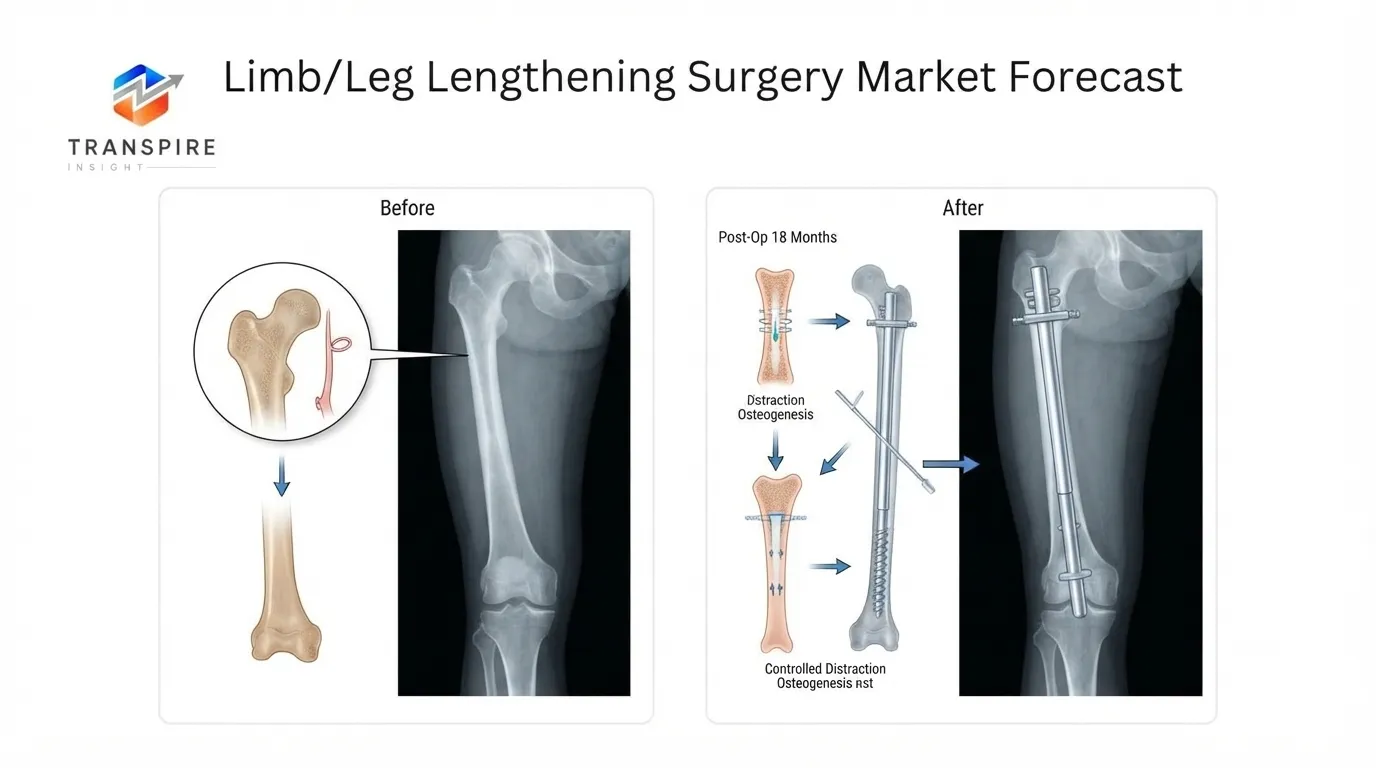
The global Limb/Leg Lengthening Surgery Market is entering a technology-driven phase as orthopedic specialists increasingly adopt implantable lengthening systems, digital deformity-planning platforms, and minimally invasive reconstruction techniques. While congenital limb differences and orthopedic reconstruction remain important clinical applications, advances in internal lengthening technology are also reshaping the treatment pathway for carefully selected patients.
Limb/Leg Lengthening Surgery Market Overview
The Limb/Leg Lengthening Surgery Market covers surgical procedures, implants, fixation systems, planning technologies, and associated clinical services used to correct limb-length discrepancies, congenital abnormalities, skeletal deformities, trauma-related shortening, and selected elective limb-lengthening requirements.
The market includes external fixation systems, internal lengthening nails, implantable devices, magnetic lengthening systems, hybrid fixation technologies, surgical planning software, and associated orthopedic services.
Transpire Insights estimates that the global market was approximately USD 6.35 billion in 2025 and could reach approximately USD 11.80 billion by 2033, representing a forecast CAGR of about 8.05% from 2026 to 2033. The market is estimated at approximately USD 6.86 billion in 2026.
The underlying Transpire report identifies orthopedic corrections, trauma recovery, congenital disorders, cosmetic limb lengthening, and other applications as important market segments. It also identifies magnetic nail systems, motorized systems, and AI-assisted orthopedic planning among the technologies shaping the market.
The market is increasingly shifting toward internal, controlled, and digitally planned lengthening procedures. Compared with conventional external fixation, implantable systems can offer an alternative treatment pathway for appropriately selected patients, although the clinical choice depends on anatomy, diagnosis, surgical expertise, device suitability, and patient-specific risk factors.
Recent clinical literature continues to examine the accuracy, bone-healing characteristics, complications, and long-term outcomes associated with magnetic intramedullary lengthening nails. A 2026 study of femoral distraction osteogenesis in patients with fibular hemimelia reported substantial correction of limb-length discrepancy but also documented complications, emphasizing that technological precision does not eliminate the need for careful patient selection and postoperative management.
Latest Global Market Developments
Why Limb/Leg Lengthening Surgery Matters?
Limb lengthening is fundamentally a reconstructive orthopedic procedure, not simply a method of increasing height.
Patients may undergo lengthening to address congenital limb differences, trauma-related shortening, skeletal deformities, growth-related discrepancies, or other orthopedic conditions. In appropriately selected cases, restoring limb symmetry can support mobility, alignment, gait, and functional rehabilitation.
The technology supporting these procedures has also changed considerably.
Traditional external fixation can require prolonged frame use and intensive management. Internal lengthening nails provide another approach in which the lengthening mechanism is placed within the bone. Magnetic systems can allow controlled gradual distraction through an implant mechanism.
The evolution of these technologies is creating demand for:
However, the market must be evaluated in the context of the complexity of the procedure. Limb lengthening can require months of monitoring and rehabilitation, and published clinical research continues to document complications such as stiffness, pain, infection, delayed healing, nerve-related problems, and additional surgery.
Key Factors Driving the Limb/Leg Lengthening Surgery Market
1. Advancement of Internal Lengthening Technology
One of the strongest technological developments is the transition toward implantable lengthening systems.
Motorized and magnetic intramedullary nails allow controlled distraction without relying exclusively on an external frame. This has encouraged continued development of implant geometry, control mechanisms, surgical instrumentation, and patient-specific planning.
2. Growing Demand for Complex Orthopedic Reconstruction
Limb-length discrepancy can arise from congenital conditions, trauma, growth abnormalities, and skeletal deformities.
As orthopedic centers develop more specialized reconstruction capabilities, patients with complex limb differences can increasingly be evaluated through dedicated multidisciplinary treatment pathways.
3. Digital Surgical Planning
Modern limb reconstruction increasingly depends on accurate assessment of bone alignment, deformity, length discrepancy, and implant positioning.
Digital planning platforms can help surgeons analyze deformities and prepare corrective procedures before entering the operating room. Orthofix's 2026 OrthoNext developments illustrate this movement toward integrated planning and surgical technology.
4. Pediatric Limb Reconstruction
Pediatric patients with congenital limb abnormalities represent an important clinical segment.
The availability of specialized internal lengthening systems designed for younger or smaller patients can expand the range of cases that specialized orthopedic centers can consider.
Orthofix's 2026 FITBONE Trochanteric system specifically targets adults and pediatric patients aged 12–21, illustrating manufacturers' efforts to broaden implant applicability.
5. Increasing Interest in Minimally Invasive Approaches
Minimally invasive surgical techniques and implantable systems are becoming important areas of orthopedic technology development.
The objective is not simply to reduce incision size; it also involves controlling bone regeneration, maintaining alignment, minimizing soft-tissue disruption, and improving the overall treatment pathway.
6. Expansion of Specialized Orthopedic Centers
Limb lengthening requires specialized expertise in orthopedic reconstruction, radiographic assessment, implant management, rehabilitation, and complication management.
The development of specialized centers therefore creates an ecosystem supporting both procedure volume and technology adoption.
Five High-Potential Markets Shaping Global Limb/Leg Lengthening Surgery
1. United States
The United States represents a major market for advanced orthopedic implants and limb reconstruction technologies.
The country's large healthcare system, concentration of specialized orthopedic centers, medical-device innovation ecosystem, and adoption of digitally enabled surgical technologies provide a strong environment for advanced limb-lengthening systems.
The U.S. is also an important launch market for new orthopedic technologies, as demonstrated by Orthofix's 2026 commercial introduction of the FITBONE Trochanteric Lengthening System.
2. Germany
Germany has a strong orthopedic and medical-device ecosystem, supported by specialized hospitals and advanced reconstructive surgery capabilities.
The country's role in European orthopedic research and complex musculoskeletal treatment creates opportunities for sophisticated limb-reconstruction technologies and digital planning systems.
European clinical research also continues to evaluate outcomes and complications associated with limb-lengthening procedures.
3. United Kingdom
The United Kingdom represents an important market for orthopedic reconstruction, specialist surgical services, and clinical research.
The market also illustrates the importance of coordinated postoperative care. Recent reporting concerning patients returning to the UK after elective procedures abroad has highlighted the clinical and healthcare-system implications of inadequate continuity of care.
4. China
China offers substantial long-term potential because of its large patient population, expanding healthcare infrastructure, increasing availability of advanced orthopedic technologies, and growing investment in specialized medical centers.
The development of domestic medical-device capabilities may also create opportunities for local manufacturers in orthopedic implants, surgical instruments, imaging, and digital planning.
5. India
India represents an emerging opportunity for specialized orthopedic reconstruction.
The combination of a large patient population, expanding private healthcare infrastructure, growing specialist capabilities, and medical-tourism activity creates opportunities for limb-reconstruction centers.
However, the growth of elective procedures also increases the importance of standardized patient evaluation, transparent clinical communication, and appropriate long-term follow-up.
Competitive Landscape
The Limb/Leg Lengthening Surgery Market is characterized by competition across implant technology, precision, surgical compatibility, patient-specific treatment options, digital planning, clinical evidence, surgeon training, and post-operative support.
Unlike conventional orthopedic implant categories, limb-lengthening technology requires close interaction between the implant manufacturer and specialist surgeon.
The competitive landscape is therefore increasingly centered on complete treatment ecosystems rather than individual devices.
Companies are developing:
The introduction of the FITBONE Trochanteric system and continued development of digital planning tools illustrate this broader product-and-software approach.
Top 5 Companies in the Limb/Leg Lengthening Surgery Market
1. Orthofix Medical
Orthofix is one of the most prominent companies in limb reconstruction and lengthening technology.
Its FITBONE portfolio covers internal limb-lengthening applications, while its 2026 product expansion and OrthoNext software development demonstrate the company's emphasis on combining implant technology with digital planning.
2. NuVasive / PRECICE
The PRECICE platform is associated with magnetic intramedullary lengthening technology and has been extensively evaluated in orthopedic research.
Recent clinical literature continues to examine PRECICE-related bone-healing outcomes and complication profiles, demonstrating the importance of long-term clinical evidence in this segment.
3. Stryker
Stryker participates broadly in orthopedic reconstruction and surgical technologies, including fixation and instruments relevant to complex orthopedic procedures.
Its extensive orthopedic portfolio gives it exposure to the broader ecosystem surrounding limb reconstruction and deformity correction.
4. Zimmer Biomet
Zimmer Biomet is a major orthopedic technology company with capabilities spanning implants, surgical systems, and reconstruction technologies.
Its broad orthopedic infrastructure provides exposure to the clinical environments in which complex limb-reconstruction procedures are performed.
5. DePuy Synthes
DePuy Synthes, part of Johnson & Johnson MedTech, operates across orthopedic trauma, fixation, reconstruction, and surgical technologies.
Its extensive trauma and orthopedic portfolio provides a platform for participation in the broader limb-reconstruction market.
Other companies relevant to the competitive ecosystem include Globus Medical, Smith+Nephew, B. Braun, Integra LifeSciences, Acumed, OrthoPediatrics, Bioretec, and Merete Medical. The Transpire market report identifies these companies among the broader competitive set.
Opportunities for Small Investors
The Limb/Leg Lengthening Surgery Market is highly specialized, but opportunities exist beyond manufacturing complete lengthening implants.
Digital Orthopedic Planning
Software companies can develop tools for deformity measurement, surgical simulation, implant planning, and patient-specific orthopedic analysis.
Rehabilitation Services
Lengthening procedures require structured rehabilitation and follow-up. Specialized physical-therapy providers can therefore participate in the post-operative care ecosystem.
Clinical Monitoring Technologies
Wearable devices, remote patient monitoring, imaging workflows, and digital patient-management systems can support long-term postoperative observation.
Surgical Training
As new internal lengthening systems enter the market, specialist training and surgeon education become increasingly important.
Specialized Orthopedic Centers
Healthcare investors can explore specialized reconstruction centers that combine surgery, imaging, rehabilitation, and long-term patient management.
Medical-Device Components
Companies supplying precision components, surgical instruments, sensors, or orthopedic materials can participate without manufacturing complete implant systems.
Challenges & Restraints
High Treatment Burden
Limb lengthening is a prolonged treatment pathway rather than a single surgical event. Patients may require repeated imaging, clinical monitoring, physical therapy, and rehabilitation.
The Transpire report identifies this combined treatment burden as one of the major structural constraints on market expansion.
Complication Risk
Clinical research continues to identify meaningful rates of complications in limb-lengthening procedures. A recent study of magnetically controlled femoral lengthening reported complications in 70% of cases, including knee stiffness and pain, while 17% required unplanned additional surgery.
High Cost
Advanced implants, specialized surgery, hospitalization, imaging, rehabilitation, and follow-up can make treatment expensive.
This can restrict access, particularly when the procedure is not covered by insurance or is considered elective rather than medically necessary.
Limited Specialist Availability
Successful limb reconstruction requires experienced orthopedic surgeons and multidisciplinary support.
A shortage of specialized centers can limit patient access and constrain adoption of sophisticated technologies.
Long Rehabilitation Period
Patients can require prolonged rehabilitation following lengthening. This can affect employment, mobility, daily activities, and overall treatment adherence.
Regulatory and Clinical Requirements
Implant manufacturers must satisfy regulatory requirements and generate sufficient clinical evidence to support adoption. Because limb-lengthening devices are used in complex procedures, surgeon confidence and long-term evidence can significantly influence purchasing decisions.
Medical-Tourism Risks
International elective procedures can create challenges when patients return to their home countries without coordinated postoperative care. Recent UK reporting has brought attention to complications requiring subsequent treatment after overseas leg-lengthening procedures.
Conclusion
The Limb/Leg Lengthening Surgery Market is developing around a combination of orthopedic specialization, implant innovation, digital planning, and increasingly individualized patient management.
The industry's technological direction is moving toward internal lengthening nails, magnetic and motorized systems, smaller implant designs, digital deformity planning, and integrated reconstruction workflows.
At the same time, clinical evidence demonstrates that technological advancement does not eliminate the inherent complexity of limb lengthening. Patient selection, surgical expertise, bone healing, rehabilitation, and complication management remain central to treatment outcomes.
Transpire Insights estimates that the global market could increase from approximately USD 6.35 billion in 2025 to USD 11.80 billion by 2033, with growth supported by advanced orthopedic reconstruction, internal lengthening technologies, specialized treatment centers, pediatric applications, and continued development of digital surgical planning.
The next stage of market development is likely to focus on greater implant versatility, improved planning accuracy, patient-specific treatment, clinical outcome monitoring, and better integration between surgery and rehabilitation.
For medical-device manufacturers, orthopedic centers, technology developers, rehabilitation providers, and healthcare investors, the opportunity lies in building a complete ecosystem around limb reconstruction rather than treating lengthening as an isolated surgical procedure.


Send us a brief description of your challenge and we'll get back to you within 24 hours.

 inquiry@transpireinsight.com
 APAC:+91 7666513636
 Address


