
Sep 16, 2026
By Transpire Insight
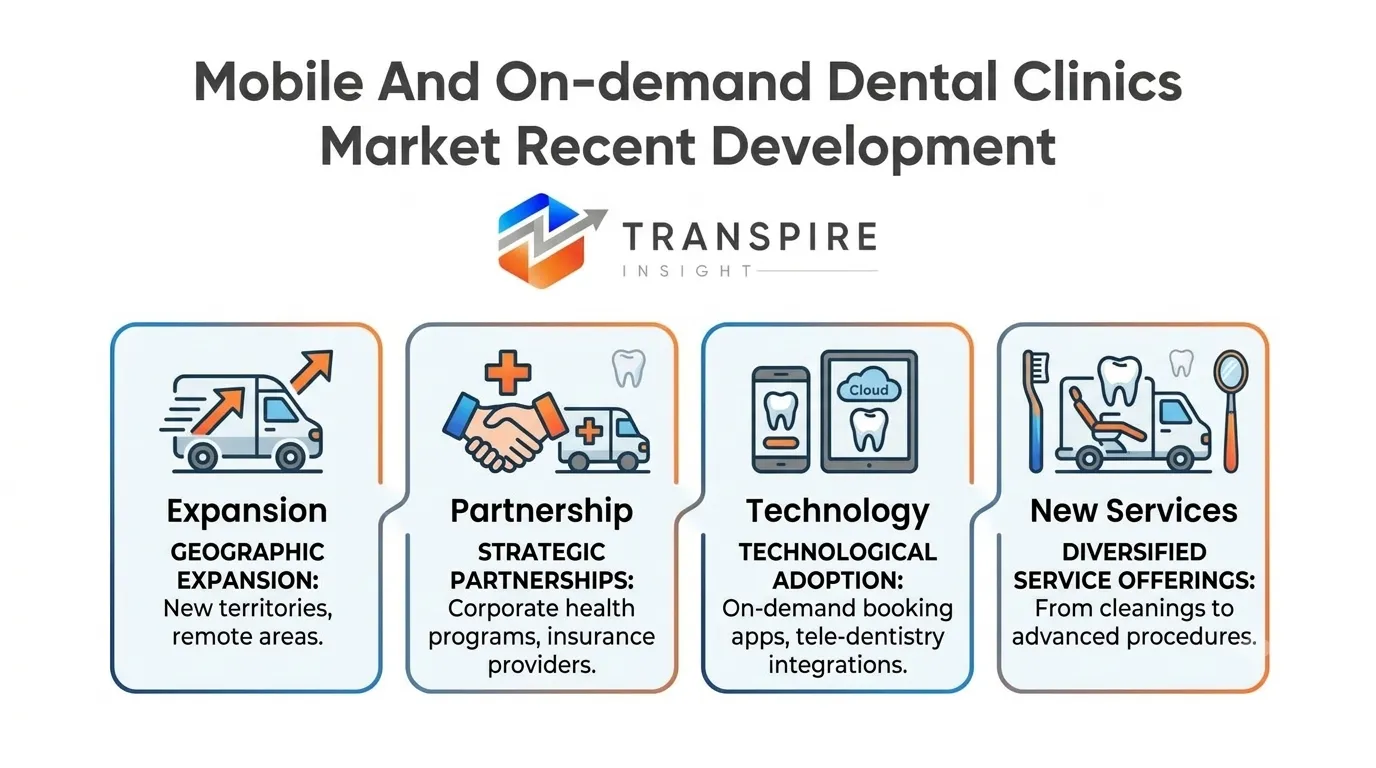
The global mobile and on-demand dental clinics market is transforming oral healthcare delivery by bringing preventive, diagnostic, restorative and emergency dental services closer to patients through mobile dental units, home visits and virtual dental consultations.
The global Mobile And On-demand Dental Clinics Market is entering a high-growth phase as healthcare providers, technology companies and public health organizations look for more flexible ways to deliver oral healthcare. Mobile dental vans, portable dental units, home-based dental visits and teledentistry platforms are increasingly being used to address geographic barriers, transportation difficulties, limited dental infrastructure and the needs of patients who cannot easily travel to conventional clinics.
The global market was valued at approximately USD 1.12 billion in 2025 and is projected to reach USD 3.43 billion by 2033, expanding at a 14.61% CAGR from 2026 to 2033. Based on this growth trajectory, the market is estimated at approximately USD 1.26 billion in 2026.
The market encompasses mobile dental clinics and on-demand/tele-dentistry services, with applications spanning preventive dental care, diagnostics, restorative treatments, cosmetic dentistry, orthodontic services and emergency dental care. Delivery models include mobile vans and units, home visits and virtual consultations, while adults, children, geriatric patients and special-needs populations represent important end-user groups.
Latest Global Market Developments
Why Mobile And On-demand Dental Clinics Matter?
Dental care has traditionally depended on patients visiting fixed-location clinics, creating significant access challenges for people living in rural communities, elderly individuals, people with disabilities, patients without reliable transportation and populations with limited healthcare infrastructure.
Mobile and on-demand dental clinics change this model by moving services closer to the patient. A fully equipped dental van can provide examinations, preventive treatments, basic restorative procedures and oral-health education at schools, community centers, care facilities and other locations. Portable equipment can similarly transform non-clinical environments into temporary dental-care sites.
The model is particularly valuable where constructing a permanent dental facility may not be economically practical. In rural India, for example, mobile dental programs have demonstrated the ability to reach populations that had previously received little or no dental treatment.
The on-demand component adds another layer of accessibility. Patients can increasingly begin their dental-care journey through virtual consultations, remote assessments, digital imaging and appointment coordination before an in-person intervention is scheduled.
This creates a hybrid model in which virtual dentistry handles initial assessment, triage, follow-up and monitoring while mobile teams provide physical treatment when required.
Key Factors Driving Mobile And On-demand Dental Clinics
Geographical distance, transportation limitations and shortages of dental professionals remain important barriers to oral healthcare. Mobile clinics can travel to communities rather than requiring every patient to travel to a fixed dental facility.
This is particularly relevant for rural populations, seniors, children, low-income communities and patients with mobility limitations. Research from India demonstrates how mobile dental programs can reach patients who have historically had limited access to conventional dental treatment.
Older adults living in residential care facilities or at home may face significant difficulty traveling to dental offices. Home visits and portable dental equipment allow providers to deliver preventive and basic restorative services closer to these patients.
Canada's recent funding for mobile dental units serving seniors and other underserved populations demonstrates the growing importance of this delivery model.
Teledentistry is becoming an important component of mobile dental care because remote dentists can evaluate clinical images, communicate with mobile teams, support treatment planning and conduct follow-up consultations.
MouthWatch's TeleDent platform, for example, is designed to connect remote dentists with mobile teams, share clinical images and treatment plans, and improve coordination between mobile providers and specialists.
Mobile clinics are increasingly being used not only for emergency treatment but also for preventive services such as examinations, cleanings, fluoride applications, oral-health education and early detection.
School-based mobile dentistry is an important example. Queensland, Australia, currently operates 135 fixed and mobile dental vans delivering preventive oral healthcare to children across schools.
Digital imaging, cloud-based records, remote consultations and AI-supported analysis are increasing the capabilities of mobile dental teams.
Technology can allow patient images to be collected in the field and reviewed remotely by dentists or specialists. Companies such as Dentulu are also combining virtual consultations, at-home imaging, mobile visits and AI-supported dental workflows into integrated care models.
Five High-Potential Markets Shaping Global Mobile And On-demand Dental Clinics
The United States is expected to remain the most commercially developed market for mobile and on-demand dental services. The country's large healthcare system, established dental technology ecosystem, demand for convenient care and significant rural and underserved populations create favorable conditions for mobile dentistry.
The U.S. mobile and on-demand dental clinics market was estimated at USD 0.98 billion in 2024 and is projected to reach USD 1.99 billion by 2033. Growth is being supported by demand from rural and low-income urban communities, along with the increasing use of mobile healthcare units and telemedicine technologies.
The market is also moving beyond traditional dental vans. Home-based visits, portable pop-up clinics and virtual-first dental services are creating multiple pathways for patients to receive care.
Future opportunities are expected across geriatric dentistry, emergency dental services, corporate wellness programs, schools, assisted-living facilities and remote communities.
India represents one of the most promising long-term markets because of its large population, substantial rural and semi-urban communities and uneven distribution of healthcare infrastructure.
Mobile dental units can provide examinations, preventive care, oral-health education, scaling, fillings, extractions and other basic procedures in communities where permanent dental facilities may be limited. A three-year rural mobile-dental program in India treated 6,326 patients, while 93.3% had not previously undergone dental treatment, highlighting the potential of mobile delivery models to expand access.
Recent research also identifies mobile dental clinics as an important approach for addressing geographical, financial and informational barriers to oral healthcare in underserved Indian populations.
Future growth is likely to come from rural outreach, school dentistry, corporate healthcare programs, NGO initiatives, hospital partnerships, home visits and technology-enabled mobile dental units.
Canada is emerging as a strong market for mobile dental services because of the country's geographically dispersed population and the challenge of providing consistent oral healthcare to remote communities.
Government-backed initiatives are increasingly supporting mobile delivery. In 2025, Canadian Oral Health Access Fund projects included mobile dental services for rural Alberta communities, long-term care populations and other underserved groups.
In June 2026, Health Canada announced funding for a mobile dental clinic designed to serve French-speaking seniors and children, further demonstrating public-sector interest in mobile oral healthcare.
The market's future potential is particularly strong in rural provinces, senior-care facilities, Indigenous communities, schools and community health programs.
Australia has a long history of using mobile dental services to reach populations that cannot easily access fixed dental clinics.
The Australian Dental Association recognizes mobile dental services as an important option where fixed clinics are unsuitable, particularly for schools, aged-care facilities and rural and remote communities.
Government programs are also expanding the model. New South Wales announced a AUD 37.5 million investment in its Mobile Dental Van program, with the expansion expected to reach up to 7,500 additional people per year.
Australia's market is therefore positioned around preventive dentistry, school programs, aged-care dentistry, rural healthcare and portable dental equipment.
The United Kingdom represents another high-potential market as demand grows for flexible community-based healthcare delivery and improved access for vulnerable populations.
Mobile dental services can be particularly useful for homeless populations, children, elderly people, care-home residents and communities where conventional dental access is limited.
The UK's opportunity is increasingly connected with preventive dentistry and community outreach rather than simply emergency treatment. Mobile clinics can combine oral-health education, screening and basic treatment while digital tools can support referrals and follow-up.
Future development is expected to focus on community dental programs, care-home services, school-based dentistry, portable equipment and digitally supported dental consultations.
Competitive Landscape
Major companies and organizations active across mobile dentistry, on-demand dental care, teledentistry, dental technology and mobile clinical infrastructure include:
The competitive environment is increasingly characterized by collaboration between dental providers, telehealth platforms, technology companies, mobile-unit manufacturers and healthcare organizations.\
Top 5 Companies in the Mobile And On-demand Dental Clinics Market
Dentulu operates a technology-enabled dental-care ecosystem combining virtual consultations, mobile dentistry, at-home diagnostics and digital patient-management capabilities.
Its platform enables patients to access virtual dental consultations and mobile dentistry services, while its current ecosystem also incorporates at-home imaging and AI-supported workflows.
Dentulu's model reflects the broader shift toward combining virtual and physical dental care rather than treating them as separate services.
MouthWatch is a significant technology provider in the teledentistry and mobile-dentistry ecosystem. Its TeleDent platform allows mobile teams to capture clinical information and connect with remote dentists and specialists.
The company specifically positions its technology for mobile dental programs, enabling remote supervision, clinical-image sharing, treatment planning and improved coordination between field teams and dental professionals.
The TeleDentists specializes in virtual dental care and on-demand access to licensed dental professionals.
In March 2025, the company announced a partnership with Online Telemedicine to expand access to urgent and preventive virtual dental services. The service model is designed for patients in remote areas, people with mobility challenges and patients requiring after-hours dental support.
The company's recent partnerships demonstrate how virtual dentistry is becoming an important extension of traditional and mobile dental care.
Henry Schein is one of the world's major dental products and healthcare-distribution companies, providing equipment, technology, consumables and services to dental professionals.
Its position across the dental supply chain gives the company exposure to the infrastructure required to establish and operate modern dental-care facilities, including technology-enabled and portable care models.
As mobile dentistry expands, suppliers with broad dental equipment and technology capabilities can benefit from increasing demand for portable clinical equipment, digital workflows and connected dental-care systems.
Aspen Dental is a major U.S. dental-care organization with an extensive network of dental practices.
Its broad provider footprint provides exposure to changing consumer expectations around accessibility, appointment convenience and coordinated dental services. The continued growth of mobile and digitally enabled care models creates opportunities for established dental networks to extend services beyond conventional clinic settings.
Opportunities for Small Investors
The mobile and on-demand dental clinics market offers several opportunities for small and specialized investors.
Potential business models include:
The most attractive opportunities are likely to be businesses that combine physical mobile care with digital scheduling, tele-dentistry, remote diagnostics and electronic patient records.
This integrated approach can improve utilization of dental professionals while reducing unnecessary travel and helping patients move between virtual and physical care.
Challenges & Restraints
Despite strong growth potential, the Mobile And On-demand Dental Clinics Market faces several operational and regulatory challenges.
The initial investment required for a fully equipped dental van can be substantial. Vehicles need specialized clinical equipment, sterilization systems, power infrastructure, water systems, imaging equipment and appropriate safety controls.
Maintaining consistent clinical quality across different locations is another challenge. Mobile services must meet the same professional and safety standards expected from fixed dental facilities. The Australian Dental Association specifically emphasizes that mobile dental services should maintain safety and quality standards comparable with fixed clinics and ensure continuity of care and follow-up.
Workforce availability can also limit expansion. Mobile programs require dentists, hygienists, dental assistants and other trained professionals who are willing to operate across multiple locations.
Technology introduces additional considerations. Tele-dentistry platforms require reliable connectivity, secure handling of patient information and appropriate integration with clinical records.
Finally, mobile dentistry should not operate as an isolated treatment model. Patients requiring complex procedures may still need referral to permanent dental facilities. Building strong referral networks and maintaining continuity of care will therefore remain essential for long-term market development.
Conclusion
The Mobile And On-demand Dental Clinics Market is evolving from a niche outreach model into an increasingly sophisticated component of modern oral healthcare. The combination of mobile dental vans, home visits, portable equipment, tele-dentistry, digital imaging and AI-supported workflows is creating new ways to deliver dental services outside traditional clinics.
The market is projected to grow from approximately USD 1.12 billion in 2025 to USD 3.43 billion by 2033, reflecting a 14.61% CAGR from 2026 to 2033.
The United States is positioned as a major commercial market, while India, Canada and Australia offer strong opportunities through rural outreach, government programs, aged-care services and underserved communities. The next phase of market development will increasingly depend on connecting mobile treatment with virtual consultations, digital diagnostics and continuous patient monitoring.
Companies that can successfully combine accessibility, clinical quality, technology and continuity of care are likely to be best positioned to capture the expanding global demand for mobile and on-demand dental services.


Send us a brief description of your challenge and we'll get back to you within 24 hours.

 inquiry@transpireinsight.com
 APAC:+91 7666513636
 Address


