
Oct 03, 2026
By Transpire Insight
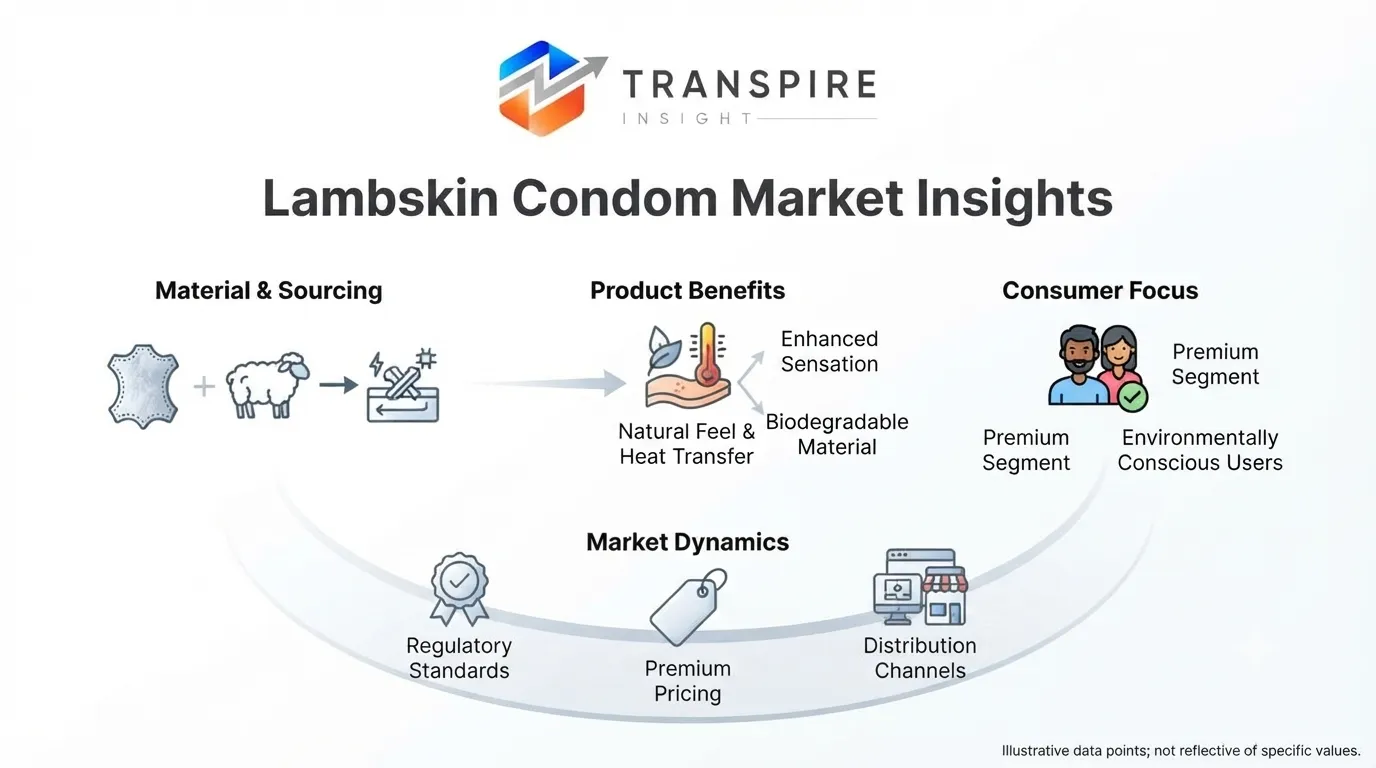
The global sexual wellness industry is becoming increasingly diverse as consumers seek products that address comfort, material preferences and individual lifestyle requirements. Within the broader condom industry, lambskin condoms occupy a specialized niche because they are manufactured from natural membrane material rather than conventional synthetic latex.
The category continues to attract consumers interested in natural materials and a differentiated product experience. At the same time, its limitations in protection against sexually transmitted infections mean that consumer education, accurate product labeling and responsible positioning remain critical to the development of the market.
September 2026: Lambskin condoms, also referred to as natural-membrane condoms, are a specialized category of male condoms manufactured using natural animal membrane, traditionally derived from sheep intestinal membrane. Unlike latex, polyisoprene or polyurethane condoms, lambskin products use a natural membrane structure.
The category has historically been positioned around pregnancy prevention and a natural-material experience. However, lambskin condoms should not be treated as equivalent to latex or other condoms for STI protection. The U.S. Food and Drug Administration specifically states that natural-skin condoms should carry information explaining that they do not protect against HIV and other sexually transmitted diseases.
This distinction is one of the defining characteristics of the market.
The lambskin condom segment remains considerably smaller than the overall global condom industry. However, its specialized positioning, established consumer base and presence in premium and specialty sexual-wellness channels provide opportunities for continued development.
Market Size
The global Lambskin Condom Market was estimated at approximately USD 30.1 million in 2025 and is projected to reach around USD 42.9 million by 2032, expanding at an estimated CAGR of 5.2% during 2026–2032.
Recent market research estimates vary considerably. One 2026 study estimates the market at USD 28.5 million in 2025 and USD 40.42 million by 2032 at a 5.12% CAGR. Another 2026 estimate places the market at USD 64.36 million in 2025 and forecasts USD 95.54 million by 2033 at a 5.09% CAGR. The variation is largely attributable to differences in market definitions, geographic coverage and inclusion of adjacent natural-condom categories.
For this Transpire Insight analysis, the market is defined narrowly around lambskin and natural-membrane condoms, excluding conventional latex, polyurethane and polyisoprene products.
North America represents the largest regional opportunity, while Europe remains a significant mature market. Asia Pacific is expected to provide additional growth as sexual-wellness awareness, e-commerce and premium consumer-product adoption expand.
Natural Materials Create a Distinct Market Position
The primary differentiator of lambskin condoms is their material.
Conventional condoms are commonly manufactured from latex or synthetic alternatives such as polyurethane and polyisoprene.
Lambskin condoms use natural membrane.
This gives the category a different consumer proposition.
Some consumers specifically seek natural-material products because of personal preferences concerning material feel or latex avoidance.
The category therefore competes less directly on mass-market pricing and more heavily on material differentiation, consumer awareness and specialized positioning.
Latex Sensitivity Creates Alternative-Product Demand
Latex sensitivity is one factor encouraging consumers to investigate non-latex condom options.
However, lambskin is only one of several alternatives.
Synthetic non-latex condoms, including polyurethane and polyisoprene products, provide alternatives for consumers seeking latex-free products while also offering STI-protection characteristics that differ from natural-membrane products.
This creates a competitive challenge for lambskin manufacturers.
Consumers looking primarily for latex avoidance may have several choices.
Consequently, lambskin products need to communicate their specific attributes accurately rather than relying solely on a latex-free positioning.
Product Feel Supports Premium Positioning
The perceived sensory characteristics of natural-membrane condoms are an important part of the category's positioning.
Consumers who choose lambskin products may prioritize the material experience and comfort.
This supports premium pricing compared with some conventional mass-market condom products.
Premium positioning can also be reinforced through packaging, brand heritage and specialty distribution.
However, manufacturers must balance marketing claims with regulatory requirements and scientifically supported product information.
Pregnancy Prevention Remains a Core Application
The primary functional application of lambskin condoms is pregnancy prevention.
Natural-membrane condoms have been marketed as contraceptive products for decades.
FDA guidance specifically categorizes natural-skin condoms among contraceptive devices and indicates that labeling should communicate their limitations regarding STI protection.
This makes responsible consumer education a critical part of the market.
Consumers need to understand that pregnancy prevention and STI prevention are different product functions.
STI Protection Is a Major Market Limitation
One of the most important characteristics of the lambskin condom market is its limitation regarding sexually transmitted infections.
The FDA's contraceptive-labeling guidance states that natural-skin condoms do not protect against HIV infection and other sexually transmitted diseases and recommends latex condoms when STI-risk reduction is required.
This differentiates lambskin condoms from condoms designed and labeled to provide a barrier against many STIs.
The limitation influences healthcare communication, consumer education and product positioning.
It also means that lambskin condoms should not simply be marketed as interchangeable with latex condoms.
Sexual Wellness Awareness Supports Specialty Demand
The broader sexual-wellness market has expanded beyond contraception.
Consumers increasingly consider sexual health, comfort, personal preferences and wellness as components of overall health.
This trend is creating opportunities for specialized products.
Lambskin condoms benefit from being a distinctive product within this broader ecosystem.
Specialty sexual-wellness retailers can provide consumers with information about material characteristics and product limitations.
Online Retail Is Expanding Product Accessibility
E-commerce is an important distribution channel for niche sexual-wellness products.
Physical retail stores may carry only a limited number of condom varieties.
Online retailers can provide a much broader assortment.
Consumers can also research product materials, compare specifications and purchase products discreetly.
This is particularly relevant to specialized products such as lambskin condoms.
Digital retail therefore allows niche brands to reach consumers without requiring extensive physical distribution.
Pharmacy and Drugstores Remain Important
Pharmacies and drugstores remain relevant because consumers often associate them with health-related products.
Recent market research estimates pharmacy and drugstore channels represented approximately 41.6% of global lambskin-condom distribution in 2025.
The channel provides visibility and accessibility.
It also places greater importance on appropriate packaging and regulatory information because consumers may consider the products within a healthcare context.
Individual Consumers Dominate Demand
Individual consumers represent the primary customer base.
One 2026 market estimate places individual consumers at approximately 84% of the global market in 2025.
This is consistent with the nature of the product.
Purchasing is generally driven by individual preference rather than large institutional procurement.
Institutional buyers can nevertheless represent opportunities through sexual-health programs, specialty retailers and healthcare-related distribution.
Specialty Sexual-Wellness Retailers Provide Market Opportunities
Specialty retailers can help consumers understand differences among condom materials.
This is especially relevant to lambskin products because their benefits and limitations differ from other condom categories.
Specialty retailers can provide product information while also carrying premium and niche sexual-wellness products.
The channel may therefore support higher-value purchases.
Premium Packaging Can Support Differentiation
Because the lambskin category is relatively small, packaging can play an important role.
Premium presentation can communicate product quality and differentiation.
At the same time, packaging needs to communicate material composition, intended use and important safety limitations clearly.
The combination of premium design and transparent information can strengthen consumer trust.
Regulatory Compliance Is Central to Market Development
Regulatory requirements represent an important factor in the industry.
Condoms are medical devices in several major markets and are subject to regulatory requirements concerning manufacturing, quality and labeling.
Natural-membrane condoms have specific considerations because their barrier characteristics differ from latex.
In the United States, FDA guidance explicitly distinguishes natural-membrane products from latex condoms in its labeling framework.
Manufacturers therefore need robust quality systems and accurate consumer communication.
Manufacturing Requires Specialized Material Processing
Natural membrane is fundamentally different from synthetic polymer materials.
Manufacturing requires specialized processing, inspection and quality-control procedures.
The consistency of the membrane is particularly important.
Manufacturers need to control thickness, integrity and physical performance.
These manufacturing requirements create barriers to entry and contribute to the relatively concentrated competitive environment.
Supply Chain Considerations Affect the Market
Natural raw materials create supply-chain considerations that differ from synthetic condom manufacturing.
Material availability, processing quality, manufacturing capacity and regulatory requirements can influence supply.
The specialized nature of the category means that large-scale expansion cannot necessarily be achieved using the same infrastructure employed for conventional latex products.
North America Leads the Market
North America represents the largest regional market.
One 2026 estimate places North America's 2025 market value at approximately USD 12.35 million, equivalent to around 43.3% of the global lambskin-condom market.
The region benefits from established sexual-wellness distribution, strong e-commerce penetration and consumer awareness of specialty products.
The United States is the principal market within North America.
Europe Remains an Established Market
Europe represents another important market.
One recent estimate places Europe at approximately 30.4% of global market value in 2025.
The region has mature pharmacy networks and developed sexual-health markets.
Consumers in European countries also have access to a broad range of condom materials and specialty products.
Competition from synthetic alternatives remains an important consideration.
Asia Pacific Presents Emerging Opportunities
Asia Pacific represents a smaller share but provides significant long-term potential.
One recent market estimate places the region at approximately 18.2% of global lambskin-condom revenue in 2025.
China, Japan, India, Australia and South Korea are important markets for sexual-wellness products.
Rising urbanization, e-commerce adoption and expanding consumer awareness can improve accessibility to specialty products.
However, cultural attitudes, regulatory frameworks and differences in consumer awareness can influence adoption.
Latin America Offers Additional Potential
Latin America represents an emerging opportunity.
Brazil and other large markets have established condom industries and expanding online retail.
Greater awareness of sexual wellness can support demand for specialized products.
However, lambskin products face competition from conventional condoms, which are generally more widely available.
Middle East and Africa Remain Developing Markets
The Middle East and Africa currently represent smaller portions of the market.
Distribution infrastructure and consumer awareness vary significantly between countries.
As modern retail and e-commerce expand, specialty sexual-wellness products may gain greater accessibility.
Competitive Landscape
The lambskin condom market is considerably more concentrated than the overall condom industry.
Church & Dwight's Trojan Naturalamb is one of the most prominent commercially recognized lambskin products. Recent market research identifies Church & Dwight as the key participant in the specialized lambskin category.
The broader natural and condom market includes companies such as Reckitt, LifeStyles Healthcare, Okamoto, Karex, Pasante Healthcare, Mayer Laboratories and other sexual-wellness companies. However, not every company in this broader competitive group manufactures lambskin products specifically.
Top 10 Companies Associated With the Lambskin and Natural-Condom Market
1. Church & Dwight Co., Inc.
Headquarters: Ewing, New Jersey, USA
Church & Dwight is the company most directly associated with the lambskin-condom category through its Trojan brand.
Trojan Naturalamb is marketed as a natural-membrane condom made from lamb cecum.
The product's positioning emphasizes natural material and pregnancy prevention while clearly communicating that it does not protect against HIV or other STIs.
The company's established Trojan brand provides substantial consumer recognition and retail distribution.
2. Reckitt
Headquarters: Slough, United Kingdom
Reckitt is a major consumer-health company with a broad sexual-wellness portfolio.
Its Durex brand is one of the world's most recognized condom brands.
Although Durex's portfolio is primarily associated with latex and synthetic condom technologies rather than lambskin, the company's presence in the broader condom market makes it relevant to competitive analysis.
Its extensive distribution network demonstrates the scale of competition facing specialized natural-membrane products.
3. LifeStyles Healthcare
Headquarters: Australia
LifeStyles Healthcare operates a large sexual-wellness portfolio including condom and personal-care products.
Its brands include SKYN, a well-known non-latex condom line.
SKYN products use polyisoprene rather than natural lambskin, making the brand an important alternative for consumers seeking a non-latex experience.
This creates indirect competition with lambskin products.
4. Okamoto Industries
Headquarters: Tokyo, Japan
Okamoto is a major Japanese condom manufacturer.
The company develops a wide range of condom technologies and has strong expertise in thin and specialty condom products.
Its product-development capabilities position it as an important competitor within the wider premium and specialty condom market.
5. Karex Berhad
Headquarters: Kajang, Malaysia
Karex is one of the world's major condom manufacturers.
The company produces condoms for branded and private-label markets.
Its manufacturing scale and international customer relationships make it an important participant in the broader condom industry.
The company competes primarily through large-scale manufacturing, quality and product diversification.
6. Pasante Healthcare
Headquarters: United Kingdom
Pasante Healthcare specializes in sexual-health products.
Its portfolio includes condoms and other sexual-wellness products distributed across international markets.
The company has exposure to specialty and online channels, which are particularly relevant to niche condom categories.
7. Mayer Laboratories
Headquarters: Oakland, California, USA
Mayer Laboratories is a sexual-health products company associated with condom brands including Kimono.
The company has developed a reputation for specialty condom products and innovative product positioning.
Its presence in premium and specialty condom categories makes it relevant to the competitive environment surrounding lambskin products.
8. Cupid Limited
Headquarters: Nashik, India
Cupid Limited is an Indian manufacturer of condoms and other sexual-health products.
The company supplies products to domestic and international markets.
Its manufacturing capabilities and geographic reach make it relevant to the broader global condom industry.
India's expanding sexual-health market provides additional opportunities for condom manufacturers.
9. Fuji Latex Co., Ltd.
Headquarters: Tokyo, Japan
Fuji Latex develops latex and medical products, including condom-related technologies.
The company has a long history in specialty rubber and healthcare products.
Its manufacturing expertise allows it to participate in premium and technologically differentiated condom segments.
10. RFSU
Headquarters: Stockholm, Sweden
RFSU is a Swedish sexual-health organization and brand offering condoms and related products.
Its portfolio includes multiple condom formats and sexual-wellness products.
The organization's strong association with sexual-health education provides a differentiated position within the broader market.
Outlook: Could Lambskin Condoms Maintain a Premium Niche Despite Strong Competition From Synthetic Alternatives?
The lambskin condom market is likely to remain a specialized segment rather than becoming a mass-market alternative to conventional condoms.
Its greatest advantage is differentiation.
Natural membrane provides a product identity that cannot be directly replicated by standard latex.
Consumers seeking natural materials, specialty products or a particular product experience can continue to support demand.
However, the category faces an important structural limitation.
Consumers seeking protection against sexually transmitted infections have access to condom technologies specifically designed and labeled for STI-risk reduction.
The FDA explicitly recommends latex condoms when protection against HIV and other STIs is required and states that natural-skin condoms do not provide that protection.
Consequently, future growth depends heavily on responsible positioning.
Manufacturers and retailers need to communicate the difference between pregnancy prevention and STI prevention clearly.
The market's premium positioning could also create opportunities for specialized e-commerce.
Online platforms can explain material differences and provide discreet purchasing options.
Digital marketing may therefore be particularly important for this niche category.
Geographic diversification is another opportunity.
North America currently represents the largest market, but Asia Pacific and selected emerging markets can provide additional growth as online sexual-wellness retail expands.
Product innovation could focus on improved consistency, packaging, lubrication compatibility and consumer education rather than attempting to position lambskin as a universal replacement for synthetic condoms.
The competitive environment will also continue to include non-lambskin alternatives.
Polyisoprene, polyurethane and other synthetic materials offer manufacturers additional ways to target consumers who want non-latex products.
This means lambskin brands will need to maintain a clearly differentiated value proposition.
The long-term market is therefore likely to be defined by premium positioning, natural-material differentiation, specialty retail, e-commerce expansion, consumer education and strict regulatory communication.
Rather than competing directly with the mass-market condom industry on volume, lambskin products are likely to remain focused on consumers seeking a specialized natural-membrane option.
As the broader sexual-wellness industry becomes more segmented and consumers gain access to a wider range of products, this niche can maintain relevance through clear positioning and responsible product communication.


Send us a brief description of your challenge and we'll get back to you within 24 hours.

 inquiry@transpireinsight.com
 APAC:+91 7666513636
 Address


