
Oct 03, 2026
By Transpire Insight
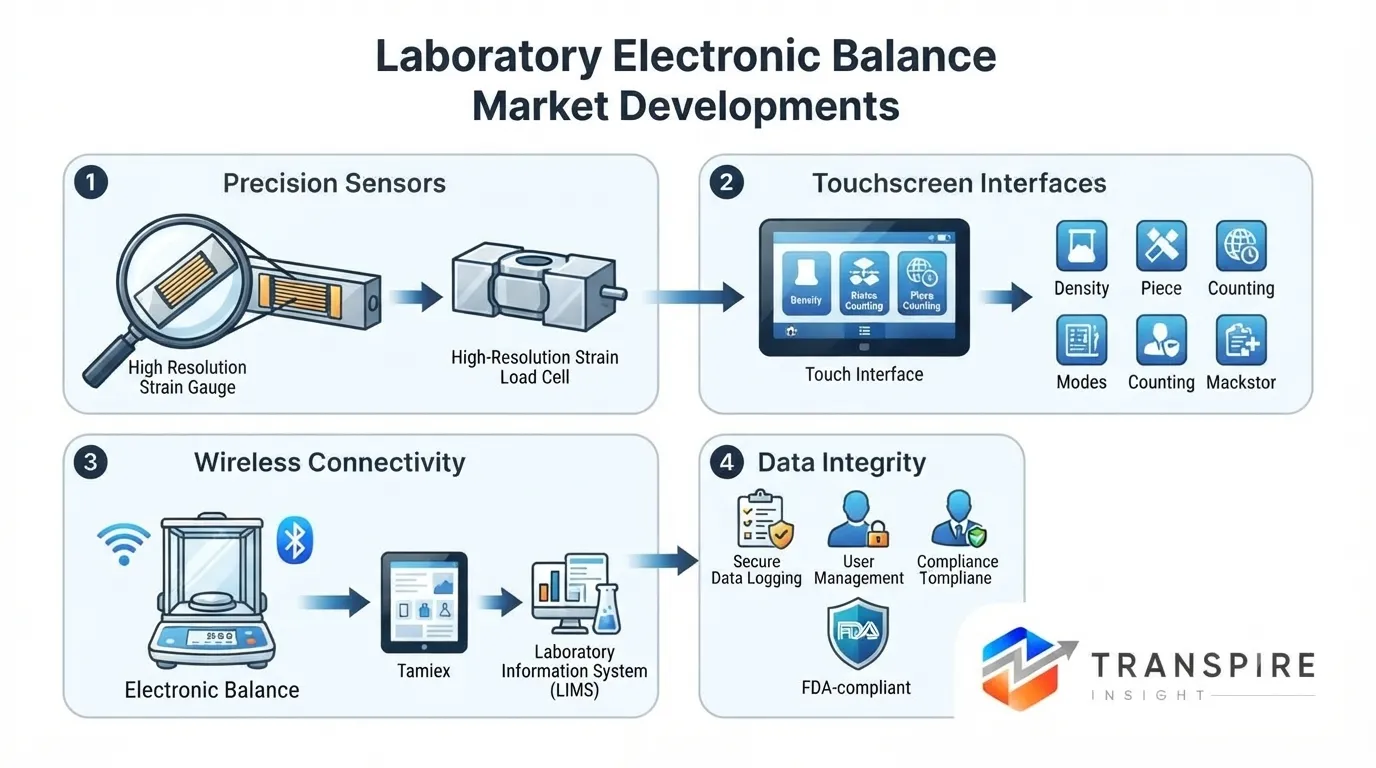
The Laboratory Electronic Balance Market is moving toward a more connected, automated, and data-driven phase as laboratories increasingly require accurate, reproducible, and traceable measurement of samples and materials. Electronic balances have evolved from basic weighing instruments into sophisticated laboratory systems incorporating automatic calibration, touchscreen interfaces, data-management capabilities, connectivity, environmental compensation, and workflow automation.
The expansion of pharmaceutical research, biotechnology, chemical testing, food-quality analysis, environmental monitoring, academic research, and industrial laboratories is supporting demand for high-precision weighing equipment. At the same time, stricter quality requirements and increasing emphasis on data integrity are encouraging laboratories to replace conventional instruments with connected electronic balances capable of integrating weighing results into digital laboratory workflows.
September 2026: The global Laboratory Electronic Balance Market is estimated at approximately USD 2.9 billion in 2025 and is projected to reach around USD 4.4 billion by 2032, expanding at an estimated 6.1% CAGR during the forecast period. Published estimates vary considerably because some research providers define the market broadly to include precision, analytical, micro, top-loading, and semi-micro laboratory balances, while narrower studies focus only on analytical balances. A June 2026 market study, for example, estimates the broader laboratory electronic balance market at USD 2.7 billion in 2025 and USD 4.1 billion by 2032, while Fairfield Market Research places the 2025 market at USD 3.85 billion.
Market Size
Laboratory electronic balances are precision instruments used to determine the mass of samples, chemicals, formulations, powders, reagents, and other materials in laboratory environments. Depending on the application, laboratories can select precision balances, analytical balances, semi-micro balances, microbalances, top-loading balances, and other specialized systems.
For this analysis, the market includes electronic laboratory balances used across pharmaceutical, biotechnology, academic, chemical, food and beverage, environmental, clinical, and industrial testing applications.
The market's expansion is being supported by increasing demand for measurement accuracy and reproducibility. Laboratories increasingly need instruments that not only provide a numerical weight but also support calibration, documentation, user management, connectivity, and compliance.
A separate August 2026 study estimates the narrower laboratory balance and scales market at USD 1.27 billion in 2025 and USD 1.84 billion by 2032, demonstrating why published market values differ according to product scope.
The analytical-balance segment represents a particularly important part of the industry. Analytical balances commonly provide readability around 0.1 mg, while advanced semi-micro and microbalances can measure substantially smaller quantities. Sartorius, for example, describes analytical balances with typical capacities between 60 g and 520 g and 0.1 mg readability.
Increasing Demand for High-Precision Measurement
Precision is fundamental to laboratory operations.
Small errors in weighing can affect formulation concentration, chemical reactions, pharmaceutical dosage calculations, analytical results, and product quality.
This makes laboratory balances important across the entire research and manufacturing process. A pharmaceutical laboratory may use an analytical balance to prepare an active ingredient, while a food laboratory may use precision weighing equipment for compositional testing.
Chemical laboratories similarly depend on accurate mass measurement for preparing solutions and conducting quantitative analysis.
As scientific procedures become increasingly sensitive, laboratories are placing greater emphasis on repeatability, minimum sample weight, environmental compensation, and calibration.
Pharmaceutical and Biotechnology Research Drives Adoption
Pharmaceutical and biotechnology companies represent major users of laboratory electronic balances.
Drug discovery, formulation development, quality control, stability testing, analytical chemistry, and manufacturing laboratories all require accurate weighing.
In regulated pharmaceutical environments, the balance is not simply a measurement device. It forms part of a documented laboratory process in which results must be traceable and reproducible.
Modern instruments increasingly incorporate features designed for regulated environments. METTLER TOLEDO's XPR analytical balances, for example, support data-integrity functions, user management, automated documentation, and compatibility with LabX software.
The continued expansion of pharmaceutical and biotechnology research is therefore expected to remain a significant demand driver.
Automation Is Reshaping Laboratory Weighing
Automation is becoming one of the most important developments in laboratory weighing.
Traditional weighing requires an operator to place a container or sample on the balance, record the result, remove the sample, and repeat the process. Automated systems can reduce manual steps and improve consistency.
Advanced balances can support automated powder and liquid dispensing, sample preparation, and digital result transfer.
METTLER TOLEDO's latest automated XPR systems are designed for automated dispensing of powders and liquids and can integrate sample-changer functions for higher-throughput workflows. The company states that automated weighing can reduce user errors and improve sample utilization.
This transition is particularly relevant to pharmaceutical and biotechnology laboratories where high-value materials may be used in repeated preparation procedures.
Digital Connectivity Is Becoming a Core Feature
Modern laboratory balances are increasingly designed to communicate with external systems.
USB, Ethernet, Bluetooth, RS-232, software interfaces, and cloud-connected laboratory environments can allow weighing results to be transferred electronically instead of being manually copied.
This has several advantages.
Digital transfer can reduce transcription errors, improve traceability, simplify recordkeeping, and make weighing information available to laboratory information management systems.
METTLER TOLEDO's XPR Essential balances, for example, provide Ethernet, USB, and other connectivity options and can connect with LabX software for automated result management and traceability.
Connectivity is likely to become increasingly important as laboratories transition toward paperless workflows.
Data Integrity and Compliance
Data integrity has become a major consideration in laboratory equipment purchasing.
Pharmaceutical and other regulated laboratories need confidence that weighing records are accurate, traceable, and protected against inappropriate modification.
Electronic balances are therefore increasingly equipped with user authentication, password management, audit trails, electronic records, automatic documentation, and compliance-oriented software.
METTLER TOLEDO's XPR systems include features supporting 21 CFR Part 11-compatible weighing workflows when used with appropriate software configurations.
This development is changing the competitive environment. Vendors are increasingly competing not only on measurement specifications but also on software, connectivity, validation support, and lifecycle services.
Artificial Intelligence and Smart Weighing
Artificial intelligence and advanced software are gradually becoming part of the laboratory weighing ecosystem.
AI-enabled systems can potentially identify unusual measurement patterns, support predictive maintenance, optimize weighing procedures, and help operators detect conditions that could compromise results.
Smart instruments can also incorporate environmental information such as temperature, humidity, vibration, and electrostatic conditions.
The objective is to reduce uncertainty and ensure that measurements are performed under acceptable conditions.
While AI adoption in laboratory balances is still developing, the broader laboratory-equipment industry is moving toward connected instruments that continuously monitor operating conditions and provide automated assistance.
Static Electricity Remains an Important Measurement Challenge
Static electricity can create significant problems during high-precision weighing.
Electrostatic charges can cause samples and containers to attract or repel one another, producing unstable or inaccurate readings.
This issue becomes particularly important when laboratories weigh very small quantities.
Advanced balance manufacturers are introducing technologies designed to detect or reduce the impact of static electricity.
METTLER TOLEDO's XPR analytical balances incorporate StaticDetect technology, which detects electrostatic charges on samples and containers and alerts users when static conditions could affect measurement quality.
The growing availability of such features illustrates how manufacturers are addressing sources of error beyond the balance's basic weighing mechanism.
Analytical Balances Maintain Strong Market Importance
Analytical balances are among the most important product categories within laboratory electronic weighing.
They are designed for applications where very small differences in mass matter.
Their enclosed weighing chambers help protect measurements from air currents and environmental disturbances.
Sartorius identifies analytical balances as core laboratory instruments and offers models spanning routine laboratory applications through highly advanced micro and ultra-micro weighing.
Analytical balances are widely used in:
As analytical procedures become more sensitive, demand for higher-resolution weighing technologies is expected to continue.
Precision Balances Support Routine Laboratory Operations
Precision balances generally offer higher weighing capacities than analytical balances while maintaining the accuracy required for many laboratory procedures.
They are commonly used for routine sample preparation, formulation, quality control, material testing, and industrial laboratory operations.
Research from June 2026 estimates that precision balances represent a significant growth segment within the laboratory electronic balance market, with the segment projected to reach approximately USD 2.0 billion by 2032 in that study.
The broad application range of precision balances makes them important to laboratories that require dependable weighing but do not necessarily require ultra-high analytical resolution.
Microbalances and Semi-Microbalances
Microbalances and semi-microbalances address applications involving very small sample quantities.
They are important in pharmaceutical research, materials science, chemical research, nanotechnology, and other fields where small differences in sample mass can influence experimental outcomes.
The technical requirements of these instruments are considerably more demanding than those of standard laboratory balances.
Environmental disturbances, vibration, temperature changes, air movement, and static electricity can all affect measurements.
Sartorius currently offers micro and ultra-micro laboratory balances with very high readability for applications involving extremely small sample quantities.
Food and Beverage Testing
Food laboratories use electronic balances for ingredient analysis, formulation, moisture-related testing, quality control, and laboratory sample preparation.
Accuracy is particularly important when testing products against specifications or regulatory requirements.
Food manufacturers are also investing in laboratory automation and digital quality systems, increasing the importance of connected weighing equipment.
The ability to transfer results directly into digital records can help laboratories reduce manual documentation and improve workflow efficiency.
Environmental Testing
Environmental laboratories analyze soil, water, air, waste, and other materials.
These procedures frequently involve weighing samples before chemical or physical analysis.
As environmental monitoring requirements expand, demand for reliable laboratory equipment is also increasing.
The growing focus on contamination, water quality, air pollution, and environmental compliance provides additional applications for laboratory electronic balances.
Academic and Research Institutions
Universities, research centers, and government laboratories remain important users of electronic balances.
Research institutions require different levels of precision depending on the discipline.
Chemistry laboratories may require analytical balances, while materials science or nanotechnology facilities may require microbalances.
Academic institutions also increasingly seek equipment that can support multiple users and maintain reliable measurement performance over long periods.
Regional Market Analysis
North America
North America remains a major market for laboratory electronic balances due to its established pharmaceutical, biotechnology, healthcare, food-testing, environmental-testing, and academic research infrastructure.
The United States has a particularly large concentration of laboratories and pharmaceutical research facilities.
Strict quality requirements and strong adoption of laboratory automation support demand for advanced electronic weighing instruments.
6Wresearch identifies North America and Europe as significant regional markets because of established research facilities and stringent quality standards.
Europe
Europe is another important market for laboratory electronic balances.
Germany, the United Kingdom, France, Switzerland, and other European countries have extensive pharmaceutical, chemical, biotechnology, food, and academic research sectors.
The region's emphasis on quality management, laboratory standards, and traceable measurement supports adoption of precision instruments.
European manufacturers also have a strong presence in the global weighing-equipment industry.
Asia-Pacific
Asia-Pacific is emerging as a major growth center.
China, India, Japan, South Korea, and other Asian economies are expanding pharmaceutical manufacturing, biotechnology research, chemical production, diagnostics, food testing, and academic research.
The expansion of laboratory infrastructure is increasing the requirement for reliable weighing equipment.
6Wresearch specifically identifies Asia-Pacific as a rapidly growing region, supported by expanding research and development activity in economies including China and India.
India is particularly relevant because of its expanding pharmaceutical, generic-drug, biotechnology, food-testing, and academic laboratory infrastructure. A dedicated India laboratory electronic balance study covers analytical, precision, micro, top-loading, and portable balances across pharmaceutical testing, chemical analysis, clinical diagnostics, food and beverage testing, and industrial applications.
Latin America
Latin American demand is supported by pharmaceutical manufacturing, food production, chemical industries, universities, and testing laboratories.
As laboratory infrastructure modernizes, organizations are gradually replacing older weighing systems with digital instruments that offer improved accuracy and documentation.
Middle East & Africa
The Middle East and Africa represent developing markets supported by healthcare expansion, pharmaceutical production, food testing, environmental monitoring, academic research, and industrial laboratories.
The expansion of laboratory infrastructure and international quality requirements could provide additional opportunities for global balance manufacturers.
Competitive Landscape
The Laboratory Electronic Balance Market is moderately concentrated, with several established manufacturers competing through precision, product reliability, software capabilities, automation, connectivity, service networks, and regulatory support.
Mettler-Toledo, Sartorius, Thermo Fisher Scientific, Shimadzu, A&D Company, OHAUS, RADWAG, KERN & SOHN, Adam Equipment, and Precisa are among the companies identified across current laboratory electronic balance market research.
Competition is increasingly shifting beyond hardware specifications.
Manufacturers are developing connected instruments, automated workflows, data-management platforms, improved environmental compensation, and compliance-oriented features.
Premium manufacturers can also differentiate through calibration services, application support, validation assistance, global service infrastructure, and long-term instrument reliability.
Top 10 Companies in Laboratory Electronic Balance Market
Company Profiles
1. Mettler-Toledo International Inc.
Mettler-Toledo is one of the most prominent companies in laboratory weighing technology.
Its portfolio includes analytical balances, precision balances, microbalances, automated weighing systems, software, calibration solutions, and laboratory workflow technologies.
The company's XPR range incorporates advanced features such as automatic static detection, user management, data-integrity support, connectivity, and automated powder and liquid dispensing.
Its combination of weighing hardware, software, automation, and service infrastructure supports applications across pharmaceutical, chemical, food, and research laboratories.
2. Sartorius AG
Sartorius is a major life-science and laboratory technology company with a broad portfolio of laboratory balances.
Its offerings include analytical, precision, micro, ultra-micro, and high-capacity balances.
The Cubis family provides configurable laboratory weighing solutions, while other Sartorius instruments target routine and research applications.
The company's strong position in biopharmaceutical research provides an important application base for advanced weighing technology.
3. Thermo Fisher Scientific Inc.
Thermo Fisher Scientific operates across laboratory instruments, analytical technologies, life sciences, diagnostics, and scientific supplies.
Its laboratory weighing portfolio is distributed through its laboratory-equipment ecosystem and associated brands and channels.
The company's extensive presence across pharmaceutical, biotechnology, academic, clinical, and chemical laboratories gives it broad access to end users requiring precision measurement.
4. Shimadzu Corporation
Shimadzu is a major Japanese scientific-instrument manufacturer with expertise spanning analytical instruments, testing systems, medical equipment, and laboratory technologies.
Its weighing products support analytical and research applications.
The company's broader analytical-instrument portfolio creates opportunities to integrate weighing systems into laboratory workflows involving chromatography, spectroscopy, pharmaceutical testing, and quality control.
5. A&D Company, Limited
A&D is a Japanese measurement-equipment manufacturer with extensive expertise in weighing and measurement technologies.
The company provides laboratory balances designed for analytical and precision applications.
Its portfolio emphasizes accuracy, reliability, usability, and measurement performance across laboratory and industrial environments.
A&D also competes in medical and industrial measurement markets, giving it experience across multiple precision-measurement applications.
6. OHAUS Corporation
OHAUS is widely recognized for laboratory and industrial weighing products.
Its portfolio includes analytical balances, precision balances, moisture analyzers, portable balances, and other weighing solutions.
The company targets research, education, pharmaceutical, food, industrial, and quality-control applications.
Its product range allows OHAUS to address both routine laboratory weighing and more specialized analytical applications.
7. RADWAG Balances and Scales
RADWAG is a Polish weighing-technology manufacturer with a broad portfolio of laboratory balances.
Its product range includes analytical balances, microbalances, precision balances, moisture analyzers, and specialized weighing systems.
RADWAG competes through high-resolution weighing technologies and application-specific equipment for laboratory and industrial users.
8. KERN & SOHN GmbH
KERN & SOHN is a German manufacturer specializing in precision weighing technology.
Its portfolio includes analytical balances, precision balances, laboratory scales, industrial scales, and specialized measurement equipment.
The company serves laboratories, universities, healthcare organizations, manufacturing operations, and other professional users.
Its long-standing focus on weighing technology supports its position in the global laboratory balance industry.
9. Adam Equipment
Adam Equipment manufactures balances and scales for laboratory, education, industrial, medical, and commercial applications.
Its laboratory portfolio includes analytical balances, precision balances, compact balances, moisture analyzers, and other weighing systems.
The company emphasizes practical laboratory functionality and offers products across different levels of weighing precision and capacity.
10. Precisa Gravimetrics AG
Precisa Gravimetrics is a Swiss manufacturer focused on precision weighing and laboratory technologies.
Its product range includes analytical balances, precision balances, moisture analyzers, and specialized laboratory weighing systems.
The company competes through measurement precision, laboratory usability, and specialized weighing applications.
Its presence in analytical and precision weighing allows it to serve research, pharmaceutical, industrial, and quality-control environments.
Key Trends Shaping the Laboratory Electronic Balance Market
Several technology and operational trends are expected to influence the market during the next decade.
Connected laboratory instruments: Electronic balances are increasingly being integrated into digital laboratory environments.
Automated weighing: Automated powder and liquid dispensing can reduce manual intervention and improve repeatability.
Paperless documentation: Direct electronic data transfer is reducing dependence on handwritten records.
AI-supported workflows: Intelligent software can help identify abnormal weighing conditions and optimize laboratory processes.
Improved static detection: Manufacturers are developing technologies that identify electrostatic conditions that can compromise measurement accuracy.
Regulatory compliance: Data-integrity requirements are encouraging laboratories to invest in systems with audit trails, user management, and electronic documentation.
Cloud and LIMS integration: Laboratories increasingly want balances to communicate directly with laboratory information systems and enterprise platforms.
Sustainable laboratory equipment: Energy efficiency, longer equipment life, reduced waste, and improved sample utilization are becoming more important purchasing considerations.
Challenges Facing the Market
Despite its growth prospects, the Laboratory Electronic Balance Market faces several challenges.
High-end analytical and microbalances can be expensive, particularly when laboratories require advanced software, automation, calibration, validation, and service packages.
Environmental conditions can also affect weighing accuracy. Temperature fluctuations, vibration, air movement, humidity, and static electricity can create measurement uncertainty.
Laboratories must therefore maintain appropriate operating environments and follow suitable calibration and testing procedures.
Integration with legacy laboratory systems can also create challenges. Different instruments may use different communication protocols and data formats.
Another issue is competition from lower-cost manufacturers, particularly in price-sensitive markets. Premium manufacturers must demonstrate the value of accuracy, reliability, compliance support, software, and lifecycle services to justify higher acquisition costs.
Future Outlook
The Laboratory Electronic Balance Market is expected to maintain steady expansion as laboratories increasingly prioritize accuracy, traceability, automation, and digital connectivity.
The next stage of development will likely involve greater integration between weighing instruments and laboratory information systems. Rather than operating as isolated devices, balances will increasingly function as connected components within broader laboratory workflows.
Automation is expected to become particularly important in pharmaceutical and biotechnology laboratories where repeated sample preparation can consume significant amounts of operator time.
Artificial intelligence and advanced software could further improve weighing processes by monitoring environmental conditions, identifying unusual measurements, recommending corrective actions, and supporting predictive maintenance.
The broader laboratory balances and scales market is forecast to expand from approximately USD 1.4 billion in 2025 to USD 2.2 billion by 2035, while other research covering laboratory electronic balances forecasts substantially larger market values depending on the included product categories.
This variation demonstrates the importance of defining the market carefully when evaluating its size and growth.
Overall, laboratory electronic balances are evolving from standalone precision instruments into connected measurement platforms. As pharmaceutical research, biotechnology, chemical testing, food analysis, environmental monitoring, and academic research become increasingly digital, the demand for accurate, traceable, automated, and connected weighing solutions is expected to remain an important component of modern laboratory infrastructure.


Send us a brief description of your challenge and we'll get back to you within 24 hours.

 inquiry@transpireinsight.com
 APAC:+91 7666513636
 Address


