
Oct 10, 2026
By Transpire Insight
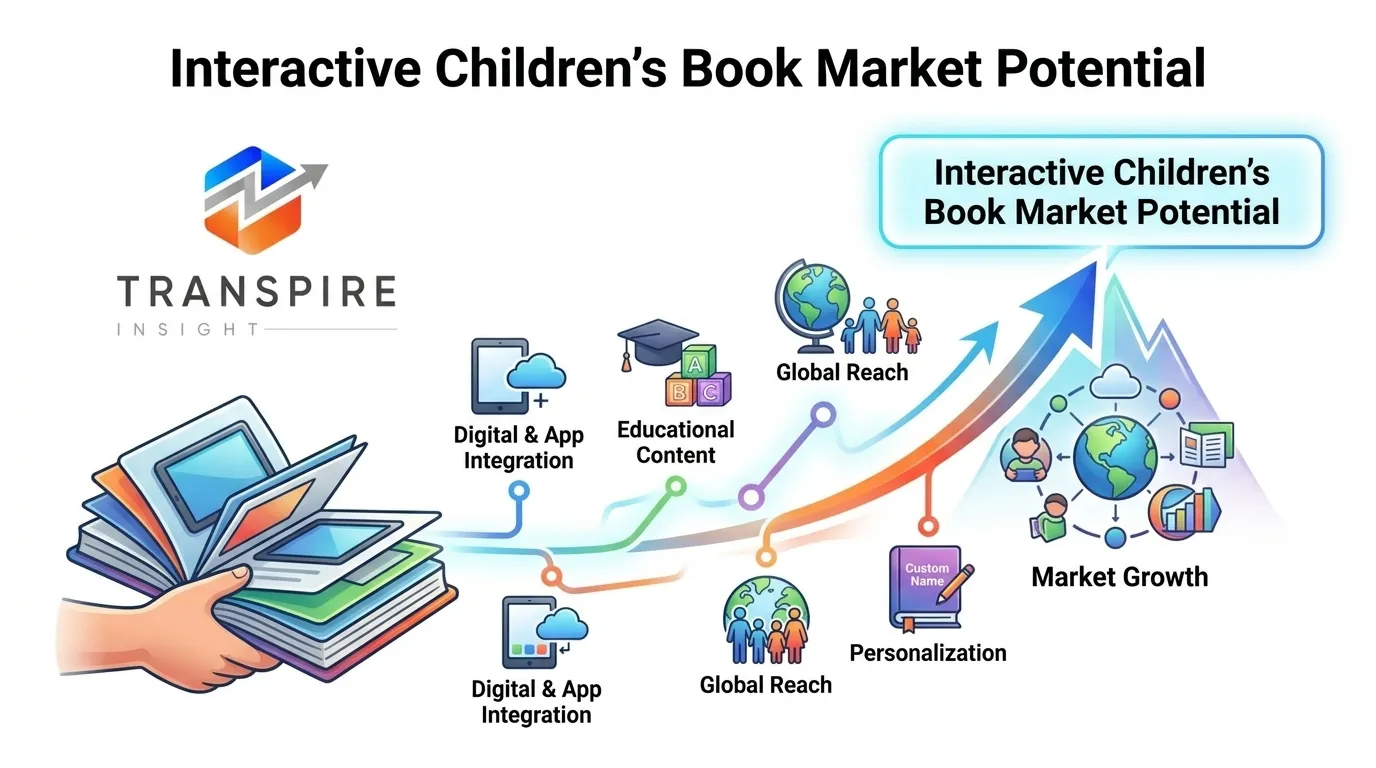
The global Interactive Children's Book Market is developing at the intersection of publishing, education, entertainment, augmented reality, audio technology, and artificial intelligence. Publishers and educational companies are increasingly transforming conventional books into multisensory learning experiences that combine physical pages with audio, animation, games, QR-linked activities, AR experiences, and adaptive digital content.
Interactive Children's Book Market Overview
The Interactive Children's Book Market includes books and learning products that incorporate additional interactive elements beyond conventional printed storytelling.
These products include AR-enabled books, audio books, educational storybooks, pop-up books, AI-interactive books, activity-based books, touch-enabled books, QR-linked learning materials, and hybrid print-digital titles.
Transpire Insights estimates that the global Interactive Children's Book Market was valued at approximately USD 732 million in 2025, increased to approximately USD 765 million in 2026, and is projected to reach nearly USD 1.05 billion by 2033, representing a CAGR of approximately 4.60% from 2026 to 2033.
The market is segmented by product type, application, distribution channel, and end user, with early-childhood education, language learning, skill development, entertainment reading, schools, parents, and libraries representing important demand centers.
Latest Global Market Developments
AI has become increasingly prominent across children's publishing, with publishers exploring personalized content, interactive storytelling, digital learning assistance, and automated content experiences.
The 2026 Beijing International Book Fair highlighted the growing importance of digital publishing, audiobooks, e-learning platforms, and knowledge-based services within children's content.
Interactive books are increasingly being positioned as educational resources rather than simply entertainment products, particularly for early learning, STEM education, language development, and classroom engagement.
Interestingly, the interactive-book opportunity does not depend exclusively on screens. U.S. children's activity-book sales reached 16.7 million units in 2025, up 18% year over year, according to Circana BookScan data cited by Publishers Weekly. Sales were still tracking 18% above the prior-year level through May 2026.
The partnership between CrunchLabs and Scholastic demonstrates the convergence of children's publishing, STEM education, branded entertainment, activity books, and school-based discovery experiences.
AR can transform static illustrations into animated characters, three-dimensional models, interactive maps, educational demonstrations, and guided activities.
Audio narration, sound effects, pronunciation assistance, and interactive listening activities can make books more accessible to younger children and multilingual learners.
Regional languages, culturally relevant stories, local characters, and curriculum-aligned content provide publishers with opportunities to expand beyond standardized global titles.
Why Do Interactive Children's Books Matter?
Interactive children's books combine the familiarity of traditional books with additional engagement mechanisms.
Their applications include:
The commercial value of interactive books increasingly depends on the quality of the learning experience, not simply the number of technological features.
A well-designed interactive book can create a progression from reading to listening, observing, answering, exploring, and applying knowledge.
Key Factors Driving the Interactive Children's Book Market
1. Digital Learning Adoption
Schools and families are increasingly using digital learning tools alongside conventional books.
2. Demand for Experiential Education
Parents and educators increasingly seek educational materials that encourage participation rather than passive reading.
3. AI and AR Integration
Artificial intelligence and augmented reality can create more responsive and immersive reading experiences.
4. Growth of STEM Education
Interactive books can make engineering, science, mathematics, and technology concepts easier to demonstrate visually.
5. Multilingual Learning
Audio and digital layers can support pronunciation and language learning across multilingual households and classrooms.
Five High-Potential Markets Shaping Global Interactive Children's Books
1. United States
The U.S. represents a major market for children's publishing, educational technology, STEM content, activity books, and branded educational experiences.
2. China
China represents an important growth market because children's publishing is increasingly connected with digital learning, audiobooks, e-learning, animation, and broader content ecosystems.
3. United Kingdom
The U.K. benefits from a mature publishing ecosystem, strong children's literature traditions, educational content demand, and established digital distribution channels.
4. Japan
Japan offers opportunities for interactive children's products because of its advanced consumer-electronics ecosystem, strong publishing industry, and established interest in educational and character-based content.
5. India
India represents a high-potential market because of its large child population, multilingual environment, expanding edtech ecosystem, and increasing demand for educational resources.
Competitive Landscape
The market combines traditional publishers with educational technology companies, children's entertainment businesses, toy manufacturers, app developers, and digital-content platforms.
Top 5 Companies in the Interactive Children's Book Market
Scholastic combines children's publishing with school distribution, educational resources, book fairs, and interactive learning experiences.
Penguin Random House maintains a broad children's publishing portfolio and benefits from established global publishing and distribution infrastructure.
Disney combines children's books with highly recognizable entertainment intellectual property, creating opportunities for interactive storytelling and multimedia experiences.
LeapFrog focuses heavily on technology-enabled educational experiences for children, including interactive learning products.
VTech operates across electronic learning products and children's educational technology, providing exposure to the convergence of books, play, and interactive learning.
Opportunities for Small Investors
Challenges & Restraints
Development costs can be significantly higher than those of conventional books because interactive products may require software, animation, audio production, AR development, testing, and ongoing platform maintenance.
Other challenges include:
The fragmented nature of interactive content across devices and operating systems can also make international scaling more complicated.
Conclusion
The Interactive Children's Book Market is transitioning from a niche publishing format into a broader education, entertainment, and digital-learning ecosystem.
The strongest opportunities are emerging where publishers combine traditional storytelling with carefully designed technology rather than adding technology simply for novelty.
AI, AR, audio, STEM content, localized storytelling, and personalized learning can create new commercial models while maintaining the physical and educational value of books.
As publishing companies increasingly combine books with digital services, educational platforms, and entertainment IP, interactive children's content is likely to become an increasingly important part of the global children's publishing landscape.


Send us a brief description of your challenge and we'll get back to you within 24 hours.

 inquiry@transpireinsight.com
 APAC:+91 7666513636
 Address


