
Aug 17, 2026
By Transpire Insight
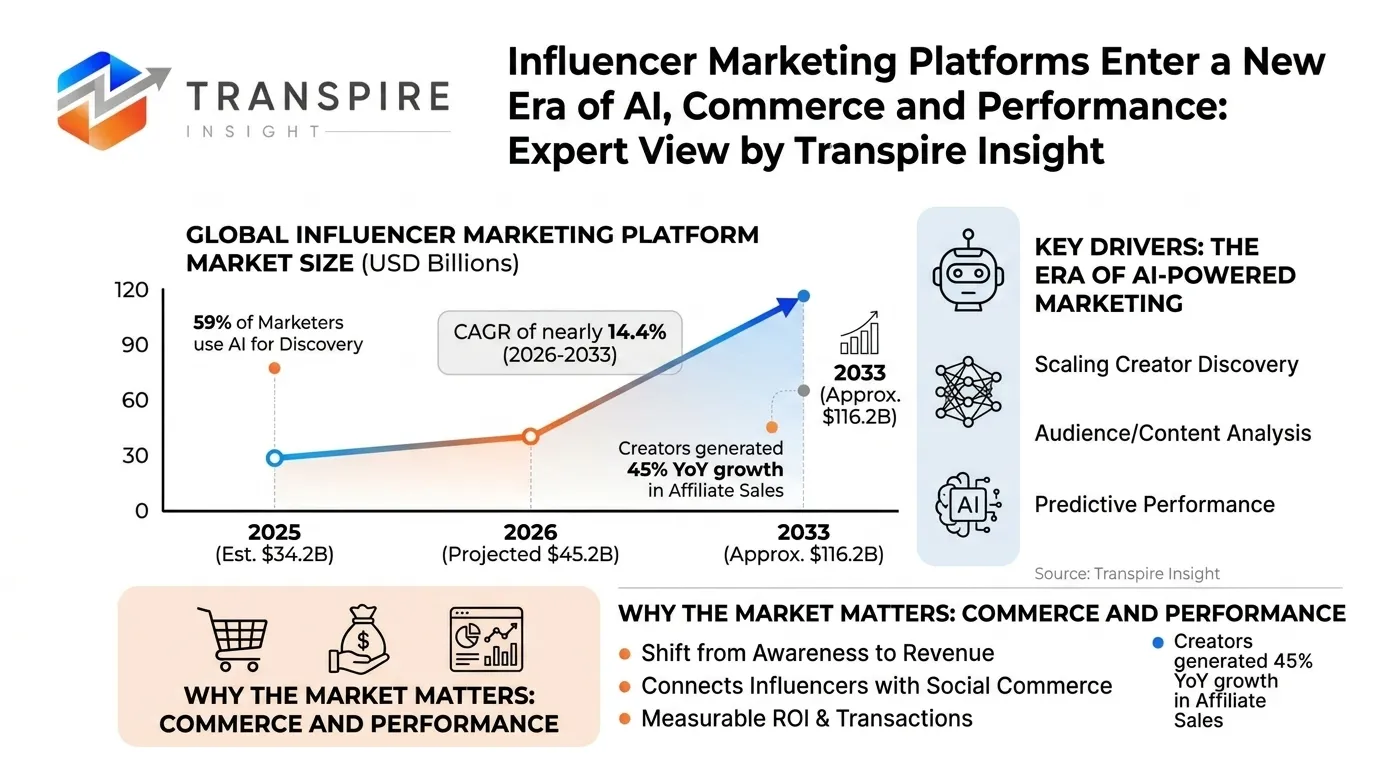
According to Transpire Insight, a market research and consulting firm tracking digital marketing, advertising technology, creator economy, social commerce, and emerging technology markets, the global Influencer Marketing Platform Market is entering a major phase of transformation as brands increasingly shift influencer programs from awareness-focused campaigns toward measurable revenue generation.
Current industry estimates place the global influencer marketing platform market at approximately USD 34.2 billion in 2025, with the market projected to reach around USD 45.2 billion in 2026 and approximately USD 116.2 billion by 2033, expanding at a CAGR of nearly 14.4% during the forecast period from 2026 to 2033.
The global digital marketing industry is entering a more performance-oriented phase as brands increasingly rely on influencer marketing platforms to identify creators, manage partnerships, measure campaign performance, automate workflows, and connect creator activity with commerce outcomes. Influencer marketing is no longer limited to sponsored social media posts. It is becoming an integrated marketing function connecting content creation, paid advertising, affiliate commerce, customer acquisition, brand building, and community engagement.
Here, the development also signals a broader transformation in how companies evaluate creator partnerships. Instead of selecting influencers primarily according to follower counts, marketers are increasingly assessing audience quality, engagement patterns, brand affinity, content performance, conversion potential, and demographic relevance.
The industry analysis indicates that the next stage of influencer marketing platform growth will be shaped by artificial intelligence, creator discovery, automated campaign management, social commerce integration, performance analytics, and stronger brand-safety capabilities. Platforms that can combine these functions within a single ecosystem are positioned to gain strategic importance as brands increase creator marketing budgets.
Influencer Marketing Platforms Move Toward AI-Powered Marketing
For years, influencer marketing was managed through spreadsheets, emails, social media searches, manual negotiations, and fragmented analytics tools. The rapid expansion of the creator economy is now changing that model.
The age of AI-powered influencer marketing has arrived. Modern platforms increasingly use artificial intelligence to identify suitable creators, evaluate audience characteristics, analyze content, automate outreach, recommend partnerships, and optimize campaigns.
According to Aspire's 2026 industry data, 59% of marketers are already using AI to scale creator discovery, workflows, and analytics. The same research indicates that 74% of marketers plan to increase influencer marketing budgets during 2026, demonstrating that creator marketing is moving from an experimental activity toward a more structured investment category.
AI is particularly important because the number of potential creators available to brands has expanded dramatically. Instead of manually reviewing thousands of profiles, marketers can use natural-language search and intelligent recommendation systems to identify creators according to specific campaign requirements.
For example, platforms can increasingly evaluate creator audience demographics, engagement quality, content themes, historical partnerships, brand affinity, and performance signals before recommending potential collaborators.
Aspire currently positions AI-powered creator discovery around natural-language search and verified creator metrics, while CreatorIQ describes its platform as an AI-native creator marketing solution that combines creator intelligence, discovery, measurement, workflows, and brand safety.
Download the exclusive Influencer Marketing Platform Market sample report today to uncover expert insights, emerging trends, and the opportunities defining the future of the industry.
Why the Influencer Marketing Platform Market Matters
The expansion of influencer marketing platforms comes at a time when digital advertising is becoming increasingly fragmented.
Consumers now interact with brands across short-form video, social networks, creator communities, livestreaming environments, online marketplaces, affiliate links, and social commerce platforms. This fragmentation makes it more difficult for brands to manage creator relationships and measure the complete customer journey using traditional marketing systems.
Influencer marketing platforms address this challenge by creating centralized environments where businesses can discover creators, negotiate partnerships, distribute products, approve content, monitor campaigns, process payments, and evaluate results.
The market is also benefiting from the growing demand for measurable marketing ROI. Brands increasingly want to understand not only how many people viewed creator content, but also whether those views generated website visits, product purchases, affiliate revenue, customer acquisition, or long-term brand value.
Industry research shows that influencer marketing is becoming increasingly connected to commerce. Aspire's 2026 benchmark data reports that creators on its platform generated approximately $52 million in attributed affiliate sales, representing 45% year-over-year growth.
This transition from influence to measurable transactions represents one of the most important structural developments within the influencer marketing platform market.
Financial Impact
The expansion of influencer marketing platforms could have significant implications for the global advertising and marketing technology ecosystem.
Brands are increasingly reallocating marketing budgets toward creator-generated content because it can serve multiple purposes across the marketing funnel. A single creator partnership can generate organic social content, paid advertising assets, affiliate sales, product demonstrations, customer testimonials, and community engagement.
This shift creates a significant opportunity for marketing technology companies.
The economic value of influencer platforms increasingly comes from their ability to connect creator activity with measurable commercial outcomes. Platforms that can demonstrate direct relationships between creator campaigns and revenue may command greater strategic importance within enterprise marketing departments.
The growth of social commerce is further strengthening this opportunity. As creators increasingly operate as product discovery and purchasing channels, influencer marketing platforms can become an important layer between brands, creators, social networks, and digital commerce systems.
A Direct Challenge to Traditional Digital Advertising
Traditional digital advertising has historically relied on audience targeting, impressions, clicks, and automated bidding. Influencer marketing introduces a different mechanism based on creator credibility, community relationships, content relevance, and social proof.
This does not mean influencer marketing will replace traditional advertising. Instead, the two models are increasingly converging.
Brands are now using creator-generated content as advertising assets and amplifying high-performing creator posts through paid media. This creates a hybrid model in which the creator produces the original content while advertising systems provide additional reach.
The development is strategically important because it changes how brands calculate the value of creators. Influencers are no longer simply media placements. Their content can become reusable marketing infrastructure across multiple channels.
Proceed to Checkout to purchase the exclusive Influencer Marketing Platform Market report and gain instant access to in-depth market intelligence, strategic analysis, and future growth opportunities.
Why Brands Are Increasingly Focused on Micro and Niche Creators
The influencer marketing industry is also experiencing a shift away from follower count as the primary measure of creator value.
Large creators continue to provide significant reach, but micro- and niche creators can offer brands highly targeted communities, stronger relevance, and specialized audience relationships.
For example, a beauty brand may receive greater commercial value from several specialized skincare creators than from a single general entertainment influencer with a significantly larger audience.
Influencer marketing platforms are therefore becoming increasingly sophisticated in their ability to classify creators according to audience interests, engagement quality, content categories, location, demographics, historical brand relationships, and purchasing behavior.This change is likely to become one of the defining characteristics of the influencer marketing platform market over the next several years.
AI Is Becoming the New Competitive Battlefield
Artificial intelligence is quickly becoming one of the most important competitive differentiators among influencer marketing platforms. The strategic value of AI extends beyond simple creator recommendations.
Advanced systems can potentially help marketers predict creator performance, detect suspicious engagement, analyze audience quality, identify brand-safety risks, automate creator communication, recommend campaign budgets, and determine which content should receive paid amplification.
This creates a competitive environment where the quality of proprietary data becomes increasingly important.
The strongest platform may not necessarily be the one with the largest number of AI features. Instead, long-term advantage may depend on the quality, depth, freshness, and reliability of the creator and audience data used to train and operate those systems.
Strategic Partnerships Reshape the Market
The influencer marketing platform market is also moving toward deeper integration with enterprise marketing ecosystems.
In June 2026, Dentsu and CreatorIQ announced a partnership designed to connect media audience targeting with creator selection. The integration enables marketers to match target audience attributes with creator audience data, allowing brands to evaluate creators based on how closely their audiences align with campaign targets.
Earlier, in March 2026, Sprinklr and CreatorIQ announced a strategic partnership connecting creator intelligence with enterprise social media systems. The objective is to provide more unified measurement across creator, paid, and owned social activity.
In April 2026, CreativeX and CreatorIQ also announced an integration developed with Nestlé to connect creator content with paid media workflows. The initiative reflects the industry's movement toward treating creator-generated content as a core component of broader advertising operations rather than as a standalone marketing channel.
These developments indicate that the competitive landscape is moving beyond influencer discovery toward broader marketing infrastructure.
Market Impact: From Influencer Campaigns to Creator-Led Commerce
The growth of influencer marketing platforms highlights a fundamental transformation in the digital marketing ecosystem.
Influencers are increasingly functioning as content producers, community builders, product advocates, affiliates, and sales channels simultaneously.
This convergence has implications across multiple industries, including beauty and personal care, fashion, food and beverages, consumer electronics, travel, fitness, entertainment, retail, and e-commerce
The growing integration of creator content with paid advertising and social commerce also creates opportunities for brands to build more flexible marketing systems.
Instead of producing a small number of expensive advertising assets internally, brands can work with large networks of creators to produce diverse content tailored to different audiences and platforms.
The resulting model is more distributed, data-driven, and responsive to changing consumer behavior.
Customize the exclusive Influencer Marketing Platform Market report today to receive tailored insights, country-specific analysis, and business-focused market intelligence.
The Key Players Shaping the Influencer Marketing Platform Market
Founded In: 2014
Headquarters: Los Angeles, California, United States
CreatorIQ has developed into a major enterprise-focused creator marketing technology provider. Its platform combines creator discovery, AI-powered intelligence, campaign management, measurement, brand safety, and workflow capabilities. The company states that more than 1,300 brands and agencies use its platform, positioning it strongly within enterprise creator marketing. CreatorIQ's recent partnerships with Dentsu, Sprinklr, and CreativeX demonstrate its strategy of integrating creator intelligence with broader media, social, and advertising ecosystems.
Founded In: 2013
Headquarters: San Francisco, California, United States
Aspire provides an all-in-one creator marketing platform covering influencer discovery, campaign management, content approval, affiliate marketing, creator relationships, analytics, and commerce integration. Its platform increasingly emphasizes AI-powered creator discovery and workflow automation. Aspire's 2026 industry research also highlights the growing importance of AI, paid amplification, social commerce, and measurable creator-driven revenue.
Founded In: 2013
Headquarters: New York, United States
Upfluence provides influencer and affiliate marketing technology designed to help brands discover creators, manage campaigns, track performance, and connect creator activity with revenue. The company states that its marketplace provides access to more than 12 million creators and increasingly incorporates AI-driven matching, campaign automation, and creator relationship management.
Founded In: 2008
Headquarters: Santa Barbara, California, United States
impact.com operates across partnership management, affiliate marketing, creator partnerships, and commerce technology. Its broader partnership infrastructure positions the company within the convergence of influencer marketing, affiliate marketing, and performance-based commerce. The company's positioning reflects an increasingly important market trend: brands want creator programs to be connected directly to measurable commercial outcomes rather than managed solely as awareness campaigns.
Schedule a meeting with our market experts to discuss the exclusive Influencer Marketing Platform Market report and identify the best research solution for your organization.
Transpire Insight Experts View
According to Transpire Insight analysis, the Influencer Marketing Platform Market is entering a transition similar to the transformation experienced by digital advertising when marketers moved from traditional media buying toward data-driven performance marketing.
Historically, influencer marketing success was largely evaluated through reach, follower counts, likes, and engagement. The next stage will increasingly be measured through audience quality, content effectiveness, conversions, customer acquisition, attributable revenue, and long-term creator relationships. The most significant change is that artificial intelligence is transforming the operational layer of influencer marketing.
AI can reduce the time required to discover creators, evaluate audiences, manage campaigns, analyze content, and optimize performance. However, the long-term competitiveness of platforms will depend not only on automation but also on data quality, transparency, brand safety, creator authenticity, and the ability to integrate with the wider marketing technology ecosystem.


Send us a brief description of your challenge and we'll get back to you within 24 hours.

 inquiry@transpireinsight.com
 APAC:+91 7666513636
 Address


