
Oct 08, 2026
By Transpire Insight
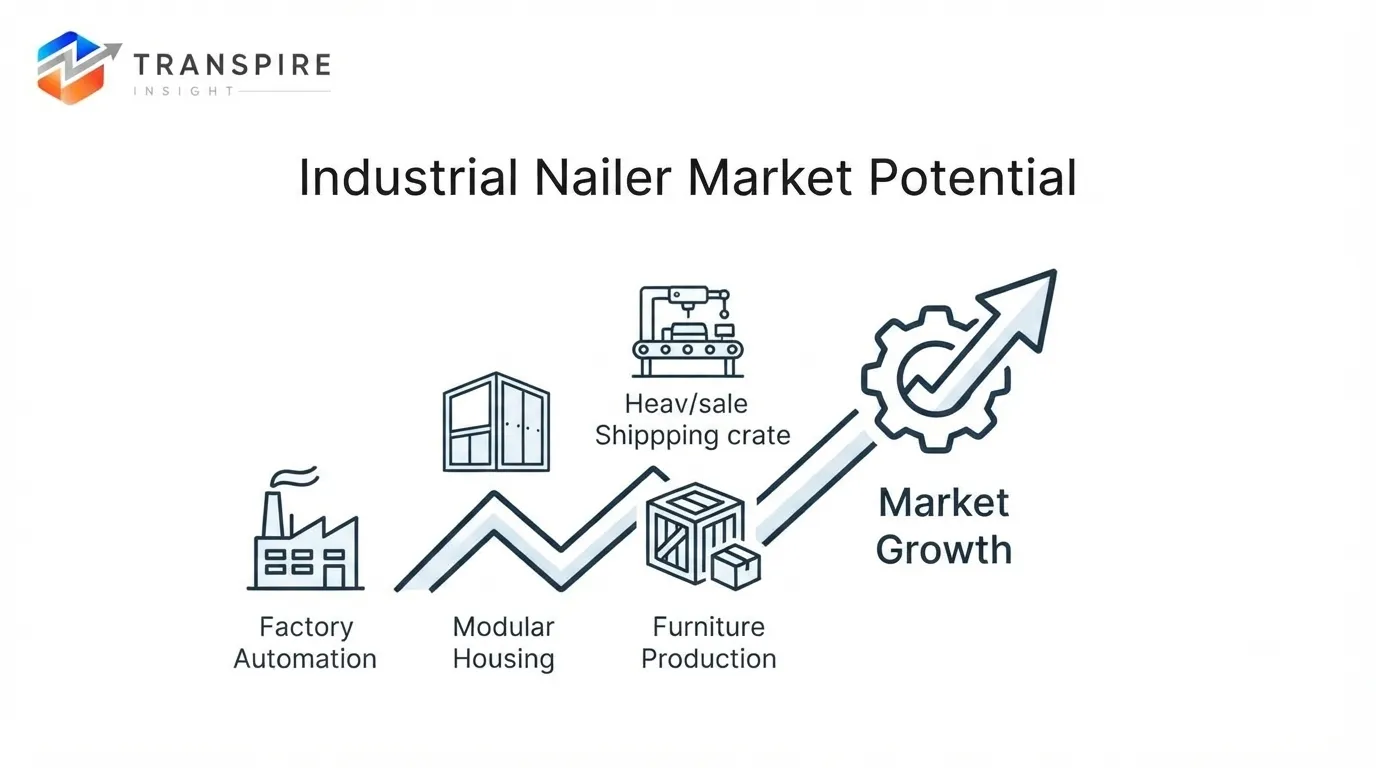
Industrial Nailers are increasingly important fastening tools across construction, woodworking, furniture manufacturing, packaging, pallet production, and industrial assembly. By enabling rapid and consistent fastening, industrial nailers can improve production throughput while reducing manual effort compared with conventional hammer-based fastening.
The market is evolving through pneumatic, electric, and cordless technologies. Manufacturers are focusing on lightweight construction, improved ergonomics, higher firing speeds, reduced vibration, longer operating life, improved battery technology, and application-specific fastening systems.
September 2026: The global Industrial Nailer Market was valued at approximately USD 759.43 million in 2025 and is projected to reach USD 1.334 billion by 2033, representing a CAGR of 7.30% during 2026–2033.
Market Size
Industrial nailers are designed to automate fastening operations in applications where speed, consistency, and productivity are important.
The market's expected expansion from USD 759.43 million in 2025 to USD 1.334 billion by 2033 reflects increasing demand from construction, manufacturing, woodworking, packaging, and other industrial applications.
Another industry assessment covering industrial nailers and staplers places the combined market at USD 1.22 billion in 2024 and forecasts USD 1.68 billion by 2033, highlighting the continuing role of automated fastening in industrial production.
Construction Industry Demand
Construction remains a major application for industrial nailers. Nail guns are used for framing, roofing, flooring, siding, decking, and other fastening tasks.
The ability to drive fasteners quickly can improve productivity, particularly in large-scale construction projects.
As construction companies face pressure to reduce project timelines and labor requirements, pneumatic and cordless fastening tools are becoming increasingly important.
Furniture and Woodworking
Furniture manufacturing represents another significant application.
Industrial nailers can be integrated into production lines or used by skilled operators to attach frames, panels, trim, upholstery components, and other wooden parts.
High-speed fastening is especially useful for manufacturers producing large quantities of standardized products.
Packaging and Pallet Manufacturing
Wooden pallets, crates, shipping boxes, and industrial packaging frequently require rapid fastening.
Automated nailers can increase production efficiency and reduce repetitive manual labor.
Packaging manufacturers also benefit from specialized nailers capable of operating at high cycles while maintaining consistent fastening depth.
Pneumatic Nailers
Pneumatic nailers remain widely used in industrial applications because compressed air can provide consistent driving performance and support intensive operation.
They are particularly suitable for production environments where compressed-air infrastructure is already available.
However, pneumatic systems require hoses, compressors, maintenance, and appropriate workplace arrangements.
Cordless Nailers
Cordless nailers are gaining attention because they offer greater mobility and eliminate the need for air hoses.
Battery technology improvements are increasing operating time while reducing tool weight.
Cordless systems are particularly attractive for construction sites where operators move frequently between work locations.
Electric Nailers
Electric nailers provide an alternative to pneumatic tools and can be useful in environments where compressed-air infrastructure is unavailable or impractical.
Manufacturers continue to improve motor technology, firing mechanisms, controls, and energy efficiency.
Automation and Production Lines
Industrial fastening is increasingly being incorporated into automated manufacturing systems.
Robotic and semi-automated equipment can position components and apply fasteners at consistent intervals.
Industrial nailers can therefore become components within broader manufacturing automation rather than standalone handheld tools.
Ergonomics and Worker Productivity
Ergonomics is an increasingly important product-development consideration.
Repeated fastening can cause fatigue when tools are heavy or generate substantial vibration. Manufacturers are therefore focusing on improved balance, lighter materials, reduced vibration, optimized handles, and better trigger designs.
Regional Outlook
North America benefits from large construction, furniture, packaging, and home-improvement markets and widespread adoption of professional power tools.
Europe is supported by advanced manufacturing, woodworking, furniture production, packaging, and construction activities.
Asia-Pacific represents a major growth opportunity due to large-scale construction, manufacturing, furniture production, export-oriented industries, and expanding industrial automation.
Latin America is supported by construction activity, furniture manufacturing, packaging, and infrastructure investment.
Middle East & Africa provide opportunities through construction, industrial development, logistics, and infrastructure projects.
Competitive Landscape
The industrial nailer market includes specialist fastening companies as well as diversified power-tool manufacturers.
Competition is focused on firing speed, durability, fastener compatibility, battery performance, operating cost, ergonomics, safety, and maintenance requirements.
Manufacturers are also expanding product portfolios to cover multiple fastening applications.
Top 10 Companies in Industrial Nailer Market
Company Profiles
Stanley Black & Decker
Stanley Black & Decker operates major professional power-tool brands and provides fastening equipment for construction, woodworking, and industrial applications. Its broad tool portfolio enables it to serve professional users across multiple industries.
Makita Corporation
Makita is a major power-tool manufacturer with pneumatic, cordless, and electric fastening equipment. Its cordless technology is particularly relevant to the industry's shift toward portable fastening solutions.
ITW Paslode
Paslode specializes in professional fastening systems and is strongly associated with construction nailers. Its portfolio includes pneumatic and cordless fastening technologies designed for framing, roofing, and related construction applications.
Senco Brands
Senco focuses on professional fastening systems, including nailers, staplers, compressors, fasteners, and related equipment. Its products serve construction, woodworking, manufacturing, and industrial applications.
MAX Co.
MAX develops fastening tools and industrial equipment, including pneumatic and cordless nailers. Its products serve construction, woodworking, and manufacturing markets.
Bostitch
Bostitch is a recognized fastening-tool brand with products covering nailers, staplers, compressors, and fasteners. Its equipment is used in construction, woodworking, and industrial applications.
HiKOKI
HiKOKI develops professional power tools and fastening equipment, including battery-powered nailers. Its focus on cordless technology positions it within the industry's transition toward mobile electric tools.
Metabo
Metabo provides professional power tools and fastening equipment for construction and industrial users. Its portfolio emphasizes durability and professional jobsite applications.
Apach Industrial
Apach Industrial manufactures pneumatic tools and fastening equipment used in woodworking, furniture, packaging, and industrial applications.
Meite
Meite specializes in pneumatic fastening tools and related equipment, with products serving furniture manufacturing, woodworking, construction, packaging, and other industrial markets.
Challenges in the Industrial Nailer Market
The market faces challenges related to tool durability, battery performance, compressed-air requirements, maintenance, fastener compatibility, and workplace safety.
Pneumatic systems require compressors and hoses, while cordless systems depend on battery capacity and charging infrastructure.
Tool manufacturers must also address noise, vibration, accidental firing, and operator fatigue.
Future Outlook
Industrial nailers are expected to become increasingly cordless, connected, lightweight, and automated.
Battery-powered platforms will continue to gain attention as battery energy density improves. Digital monitoring may also enable tool diagnostics, usage tracking, maintenance alerts, and fleet management.
Manufacturers are likely to develop more specialized tools for high-volume furniture, pallet, packaging, and construction applications.
With the industrial nailer market projected to reach approximately USD 1.334 billion by 2033, demand will continue to be closely linked to construction activity, industrial manufacturing, furniture production, packaging, and automation.


Send us a brief description of your challenge and we'll get back to you within 24 hours.

 inquiry@transpireinsight.com
 APAC:+91 7666513636
 Address


