
Sep 23, 2026
By Transpire Insight
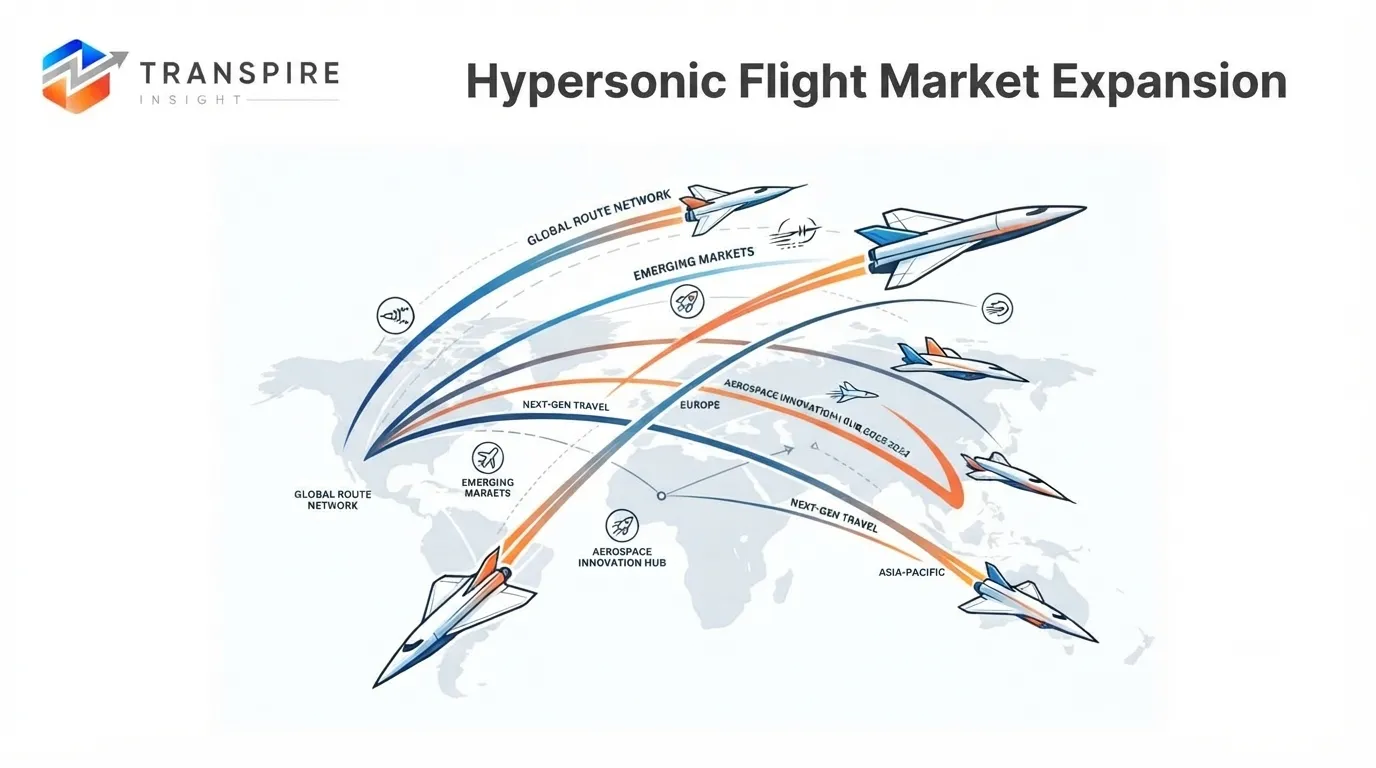
Hypersonic flight is moving from a highly specialized research field toward a strategic aerospace technology with applications across defense, space access and potentially future commercial transportation.
Advances in propulsion, high-temperature materials, guidance systems and aerodynamics are supporting the development of vehicles capable of operating at speeds above Mach 5.
September 2026: Hypersonic flight represents one of the most technologically demanding areas of aerospace engineering.
Vehicles traveling at hypersonic speeds experience extreme aerodynamic heating, high thermal loads, complex propulsion requirements and challenging control conditions.
Despite these difficulties, governments and aerospace companies are increasing investment in hypersonic technologies because of their potential to provide rapid response, extended range and new mission capabilities.
Market Size
The global hypersonic flight market was estimated at approximately USD 2.55 billion in 2025 and is projected to reach around USD 6.05 billion by 2034, expanding at a CAGR of approximately 10.1% during 2026–2034.
A current industry estimate places the 2025 market at USD 2.48 billion and forecasts USD 5.86 billion by 2034, demonstrating the strong growth expected from defense programs, propulsion development and space applications.
North America remains the leading market, while Asia Pacific is expected to experience strong growth as countries increase investment in advanced aerospace and defense technologies.
Defense Spending Drives Market Development
Defense applications remain the primary driver of hypersonic technology development.
Hypersonic vehicles can potentially provide high-speed maneuverability and reduced response times compared with conventional systems.
Governments are therefore investing in research programs involving hypersonic glide vehicles, air-breathing propulsion systems and advanced missile technologies.
Large defense contractors are working with government agencies, research institutions and specialized suppliers to develop propulsion, materials and guidance technologies.
Scramjet Propulsion Receives Significant Attention
Scramjet propulsion is one of the most important technologies associated with hypersonic flight.
Unlike conventional jet engines, scramjets can operate using airflow at extremely high speeds and are designed for sustained hypersonic operation.
However, maintaining stable combustion at hypersonic speeds is a major engineering challenge.
Companies and government research organizations are therefore investing heavily in combustion technology, thermal management and high-speed testing.
Advanced Materials Are Critical
Hypersonic vehicles require materials capable of surviving extreme temperatures and mechanical stresses.
Traditional aerospace materials may not be sufficient for sustained hypersonic flight.
This is increasing demand for high-temperature alloys, ceramics, ceramic-matrix composites and advanced thermal-protection systems.
Material development is therefore becoming a critical part of the hypersonic ecosystem.
The ability to manufacture these materials consistently at commercial scale could become an important competitive advantage.
Sensors and Avionics Become More Sophisticated
Hypersonic vehicles require highly advanced guidance and control systems.
At extreme speeds, small changes in aerodynamic conditions can significantly affect vehicle behavior.
Sensors must therefore operate under severe temperature and vibration conditions while providing accurate information to control systems.
Advances in artificial intelligence, high-speed computing and sensor fusion could contribute to improved navigation and mission management.
Space Applications Could Create Long-Term Opportunities
Although defense currently dominates the market, space applications could create additional opportunities.
Hypersonic technologies can contribute to reusable spaceplanes, atmospheric re-entry systems and high-speed aerospace vehicles.
The development of reusable systems could potentially reduce launch and transportation costs over the long term.
However, commercial applications remain more technologically and economically uncertain than defense programs.
North America Maintains Leadership
North America represented approximately 42% of the global hypersonic flight market in 2025 according to current market estimates.
The United States benefits from substantial government funding, established aerospace companies and advanced research infrastructure.
Asia Pacific is also becoming increasingly important as countries such as China, India and Japan invest in advanced aerospace capabilities.
Europe is developing its own hypersonic research and counter-hypersonic capabilities through multinational defense programs.
Competitive Landscape
The hypersonic technology market includes major aerospace and defense companies with capabilities across propulsion, missile systems, avionics and materials.
Current industry research identifies Lockheed Martin, RTX, Northrop Grumman, Boeing, L3Harris, BAE Systems, MBDA, Thales and other companies among the leading participants.
Top 10 Companies in Hypersonic Flight Market
1. Lockheed Martin
Headquarters: Bethesda, Maryland, USA
Lockheed Martin is one of the largest aerospace and defense companies involved in hypersonic technology development. Its activities include advanced missile systems, propulsion partnerships and high-speed aerospace research.
2. RTX
Headquarters: Arlington, Virginia, USA
RTX participates in hypersonic technology through its Raytheon and Pratt & Whitney businesses, with capabilities covering advanced weapons, propulsion and defense systems.
3. Northrop Grumman
Headquarters: Falls Church, Virginia, USA
Northrop Grumman provides propulsion, missile and aerospace technologies relevant to hypersonic systems. Its manufacturing and engineering capabilities support advanced defense programs.
4. Boeing
Headquarters: Arlington, Virginia, USA
Boeing participates in advanced aerospace and hypersonic research through its defense and space businesses. The company brings extensive experience in aircraft, missile and spacecraft development.
5. L3Harris Technologies
Headquarters: Melbourne, Florida, USA
L3Harris supplies communications, sensors, electronics and defense technologies that can support advanced aerospace and hypersonic systems.
Outlook: Could Hypersonic Flight Move Beyond Defense?
Hypersonic flight is likely to remain strongly connected to defense programs throughout the near term.
However, advances in thermal protection, propulsion, reusable vehicles and high-temperature materials could eventually expand the technology into space transportation and specialized commercial aerospace applications.
The next stage of market development will depend on the ability of aerospace companies and governments to reduce development costs, improve reliability and transition experimental technologies into repeatable production.
As hypersonic research advances, the market could become one of the most strategically important segments of next-generation aerospace technology.


Send us a brief description of your challenge and we'll get back to you within 24 hours.

 inquiry@transpireinsight.com
 APAC:+91 7666513636
 Address


