
Aug 17, 2026
By Transpire Insight
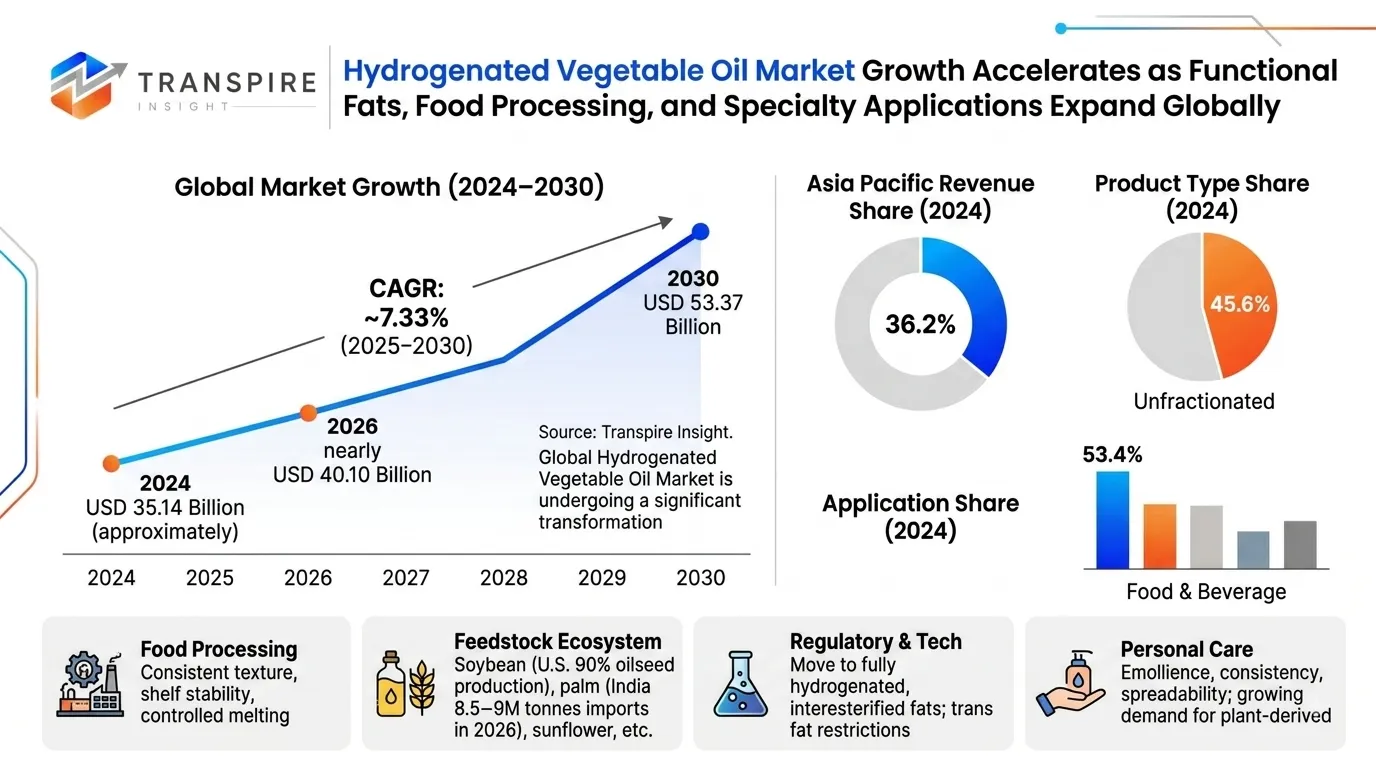
According to Transpire Insight, the global Hydrogenated Vegetable Oil Market is undergoing a significant transformation as food manufacturers, personal-care companies, and specialty-ingredient producers increasingly demand fats with controlled texture, melting behavior, oxidation resistance, and processing stability. The market was valued at approximately USD 35.14 billion in 2024 and is projected to reach nearly USD 40.10 billion in 2026 and USD 53.37 billion by 2030, reflecting a CAGR of approximately 7.33% from 2025 to 2030.
Asia Pacific represented approximately 36.2% of global revenue in 2024, while unfractionated hydrogenated vegetable oil accounted for around 45.6% and food & beverage applications represented approximately 53.4% of industry revenue.
The industry is increasingly moving away from the traditional concept of hydrogenated oils as a commodity ingredient and toward customized fat systems engineered for specific applications. Food processors require fats that provide consistent crystallization, structure, aeration, shelf stability, and controlled melting, while personal-care manufacturers prioritize emollience, consistency, spreadability, and formulation stability.
At the same time, regulatory restrictions on industrial trans fats have fundamentally changed product development. Producers are increasingly emphasizing fully hydrogenated products, interesterified fats, fractionated oils, and blends that can deliver the functional characteristics required by manufacturers without relying on traditional partially hydrogenated formulations.
The resulting market sits at the intersection of vegetable-oil processing, specialty ingredients, food manufacturing, cosmetics, personal care, and industrial formulations, creating a diverse demand base for manufacturers with advanced processing and formulation capabilities.
Hydrogenated Vegetable Oil Becomes a Strategic Functional Ingredient
Vegetable oils in their natural liquid form do not always provide the physical characteristics required for industrial food production. Hydrogenation changes the degree of saturation within the oil and can increase its firmness, oxidative stability, and resistance to degradation.
These characteristics are important in products such as bakery shortenings, margarine, confectionery fillings, coatings, spreads, creams, and other formulated foods.
For industrial food producers, consistency is particularly important. A fat must behave predictably during mixing, heating, cooling, storage, transportation, and final preparation.
This explains why demand is increasingly shifting toward application-specific fat formulations rather than generic vegetable oils.
The development of these products also involves technologies such as fractionation and interesterification. Fractionation separates fats according to their melting characteristics, while interesterification modifies the distribution of fatty acids within triglycerides to obtain a different physical profile.
Download the exclusive Hydrogenated Vegetable Oil Market sample report today to uncover expert insights, emerging trends, and the opportunities defining the future of the industry.
The Raw-Material Base Creates a Large Supply Ecosystem
The hydrogenated vegetable oil industry depends heavily on the availability of vegetable-oil feedstocks.
The major raw materials include soybean oil, palm oil, sunflower oil, rapeseed/canola oil, cottonseed oil, and other plant-derived oils.
The USDA's oil-crops database covers 6 major oilseeds and 11 vegetable oils, illustrating the diversity of agricultural feedstocks available to the global vegetable-oil processing industry.
Soybeans are particularly important to the global oilseed economy. In the United States, soybeans account for approximately 90% of total oilseed production, according to the USDA Economic Research Service.
This extensive feedstock base gives hydrogenated vegetable-oil manufacturers flexibility when selecting raw materials, although each oil produces different functional characteristics.
For example, palm-based fats can provide strong structure and favorable crystallization characteristics, while soybean and sunflower oils can offer different fatty-acid profiles and formulation possibilities.
The availability and price of these feedstocks consequently have a direct influence on manufacturing economics.
Food Processing Remains the Primary Demand Engine
The food industry represents the largest demand center for hydrogenated vegetable oils because fats perform multiple technical functions within processed foods.
Bakery manufacturers use structured fats to influence dough handling, tenderness, volume, texture, and shelf stability. Confectionery producers require controlled melting characteristics for fillings, coatings, and creams.
Margarine and spread manufacturers similarly need carefully balanced solid-fat profiles to achieve the desired consistency at refrigeration and room temperatures. The importance of this demand base is amplified by the global scale of processed-food manufacturing.
However, the market is not limited to traditional bakery and confectionery applications. Hydrogenated vegetable oils and related specialty fats can also be used in instant foods, sauces, dairy alternatives, snack products, foodservice formulations, nutritional products, and industrial food ingredients. This broad application base reduces dependence on any single food category.
India's Vegetable-Oil Demand Creates a Significant Opportunity
India represents an important downstream market because of its large population, extensive food-processing sector, and structural dependence on imported vegetable oils.
India's total vegetable-oil consumption is estimated at approximately 25 million tonnes in 2026, while domestic production is expected to remain around 9–9.5 million tonnes. This creates an import requirement of approximately 15.5–16 million tonnes.
Palm oil is expected to account for approximately 8.5–9 million tonnes of India's 2026 imports, according to industry estimates cited by Reuters.
These figures are significant for hydrogenated vegetable-oil manufacturers because the country's large edible-oil processing ecosystem creates an extensive downstream base for specialty fats.
The opportunity extends from packaged foods and bakery products to confectionery, foodservice, personal care, and industrial applications.
India's dependence on imported oils also means that international commodity prices can materially influence domestic formulation costs.
Palm Oil Remains an Important Feedstock
Palm oil is particularly important within the broader vegetable-oil ecosystem because of its extensive production, processing infrastructure, and versatility.
Its use extends across food products, personal care, oleochemicals, and industrial applications.
India's estimated 8.5–9 million tonnes of palm-oil imports in 2026 demonstrates the scale of the country's dependence on this feedstock.
For hydrogenated-fat manufacturers, palm-based feedstocks can provide useful physical properties for applications requiring structure and controlled melting.
However, palm-derived ingredients also face greater sustainability scrutiny than many other feedstocks. Customers increasingly require traceability, responsible sourcing, and evidence of compliance with environmental standards. This has encouraged large producers to invest in supply-chain monitoring and certification systems.
Proceed to Checkout to purchase the exclusive Hydrogenated Vegetable Oil Market report and gain instant access to in-depth market intelligence, strategic analysis, and future growth opportunities.
Soybean Processing Creates Additional Feedstock Security
Soybean oil represents another major source of feedstock for hydrogenated and specialty vegetable-fat production.
The USDA forecast U.S. soybean crush at approximately 2.65 billion bushels for the 2025/26 marketing year, supported by strong demand for soybean products and favorable crushing economics.
Globally, soybean processing is also expanding in response to demand from food, feed, and renewable-fuel markets.
The USDA estimates global soybean crush at approximately 383.1 million metric tonnes for the 2026/27 marketing year, demonstrating the enormous scale of the soybean-processing ecosystem that supplies both oil and meal.
This creates a large and diversified supply base for manufacturers using soybean oil as an input.
However, increasing demand for soybean oil from renewable fuels can create competition between food and energy applications, potentially affecting raw-material pricing and availability.
Regulation Is Reshaping Hydrogenated Oil Formulation
The biggest structural change in the industry has been the regulatory and nutritional pressure surrounding industrial trans fats.
Partially hydrogenated oils were historically valued because they provided desirable semi-solid characteristics and improved oxidative stability. However, the trans-fatty acids formed during partial hydrogenation led regulators and food manufacturers to seek alternatives.
As a result, the industry has increasingly moved toward fully hydrogenated oils, interesterification, fractionation, and blending technologies.
This does not eliminate the need for structured fats. Instead, it changes how those fats are engineered.
The technological challenge is to obtain the desired melting point, texture, stability, and functionality while maintaining an acceptable nutritional profile. This is creating a strong opportunity for specialty-fat manufacturers with advanced formulation capabilities.
Interesterification Strengthens the Specialty-Fat Opportunity
Interesterification is becoming increasingly important because it can alter the physical properties of fats without depending on the same mechanism responsible for industrial trans-fat formation during partial hydrogenation.
The process rearranges fatty acids among triglyceride molecules, allowing manufacturers to change characteristics such as melting behavior and solid-fat content
This gives producers greater flexibility when designing bakery fats, spreads, confectionery ingredients, and other specialized formulations.
The commercial significance is substantial because food manufacturers increasingly want tailored fat systems rather than standardized commodity ingredients.
A bakery manufacturer may require one melting profile for laminated pastry, another for biscuits, and a different formulation for cake applications.
The ability to customize these properties gives specialty-fat producers an opportunity to capture higher-value applications.
Personal Care Expands the Addressable Market
Food processing is the largest application area, but personal care and cosmetics provide another important demand channel.
Hydrogenated vegetable-derived ingredients can contribute to consistency, emollience, texture, and stability in creams, lotions, balms, lip products, and other formulations.
Cosmetic companies are increasingly interested in plant-derived ingredients that can deliver predictable technical performance while supporting consumer preferences for renewable or naturally sourced ingredients
The functional requirements are different from those of food manufacturers. Cosmetics formulators may prioritize skin feel and spreadability, whereas bakery manufacturers focus more heavily on aeration, shortening performance, crystallization, and melting characteristics. This difference creates opportunities for suppliers to develop specialized grades for individual industries.
Asia Pacific Maintains Its Strategic Position
Asia Pacific's approximately 36.2% share of global hydrogenated vegetable-oil revenue in 2024 reflects the region's strong combination of raw-material availability, food-processing capacity, population scale, and expanding consumer markets.
China, India, Indonesia, Malaysia, Japan, and other Asian markets contribute to regional demand through food processing and consumer-product manufacturing.
Southeast Asia is particularly important because of its position within the global palm-oil supply chain.
Meanwhile, China and India provide large downstream food markets where packaged-food consumption, bakery products, confectionery, and convenience foods continue to develop.
The region's competitive advantage therefore comes from both sides of the value chain: feedstock access and downstream consumption.
Customize the exclusive Hydrogenated Vegetable Oil Market report today to receive tailored insights, country-specific analysis, and business-focused market intelligence.
North America Focuses on Reformulation and Specialty Products
North America represents a mature market in which regulatory developments have pushed manufacturers toward advanced fat systems.
The U.S. hydrogenated vegetable-oil market is estimated at approximately USD 7.35 billion in 2025 and is projected to reach around USD 10.39 billion by 2030, representing a CAGR of approximately 7.2%.
The market's development is increasingly centered on reformulated products, specialty fats, and application-specific ingredients.
Food companies operating in the United States require suppliers capable of delivering functional performance while complying with increasingly sophisticated nutritional and labeling requirements.
This creates opportunities for companies with strong R&D capabilities rather than simply large processing volumes.
Commodity Prices Remain a Major Industry Risk
The economics of hydrogenated vegetable oils remain closely connected to agricultural commodity markets.
Changes in soybean, palm, sunflower, and rapeseed production can influence feedstock availability and processing margins.
The 2026 Indian vegetable-oil market demonstrates this relationship clearly. Crude palm oil was recently reported at approximately USD 1,165 per metric tonne, compared with approximately USD 1,281 per tonne for soybean oil in the Chinese market.
These price differences can influence purchasing decisions by refiners and food manufacturers.
Companies therefore increasingly seek diversified sourcing strategies and long-term supplier relationships.
Large integrated producers have an advantage because they can manage multiple stages of the supply chain, from agricultural sourcing and crushing to refining and specialty-fat production.
Wilmar Demonstrates the Scale of Integrated Vegetable-Oil Operations
Wilmar International illustrates how scale and vertical integration influence the global vegetable-oil industry.
The company reported USD 70.42 billion in revenue for 2025, alongside approximately USD 1.41 billion in net profit.
Its global operations include more than 1,000 manufacturing plants across 36 countries and regions, supported by a multinational workforce of approximately 100,000 employees.
This scale provides access to agricultural sourcing, processing, manufacturing, logistics, distribution, and downstream food products.
For the hydrogenated vegetable-oil market, vertically integrated networks can help manufacturers manage raw-material availability while serving customers across multiple geographic markets.
Cargill Adds Scale Across the Global Agricultural Supply Chain
Cargill is another major participant in the broader agricultural and food-ingredient ecosystem supporting specialty vegetable oils.
The company reported approximately USD 154 billion in fiscal 2025 revenue, demonstrating the scale of its global agricultural operations.
Cargill's activities across agricultural commodities, food ingredients, processing, and supply-chain services allow it to participate at several stages of the vegetable-oil value chain.
Its broad footprint is particularly relevant because specialty-fat manufacturers increasingly need reliable access to feedstocks across multiple geographic markets.
The ability to combine sourcing, processing, logistics, and ingredient development can create an important competitive advantage when commodity markets become volatile.
The commercial implications are significant.
Sustainability credentials can influence supplier qualification, long-term contracts, brand reputation, and access to multinational customers.
Consequently, environmental performance is increasingly becoming a competitive factor rather than simply a corporate-responsibility issue.
Technology Will Define the Next Generation of Hydrogenated Vegetable Oils
The future market will increasingly depend on processing technologies capable of delivering precise functional characteristics.
Hydrogenation, fractionation, interesterification, blending, deodorization, and other refining technologies can be combined to develop highly customized fat systems.
Digital process monitoring and advanced analytical tools can further improve consistency by controlling variables such as temperature, pressure, catalyst activity, crystallization, and final product composition.
This is particularly important for manufacturers supplying multinational food companies, which often require identical product performance across multiple manufacturing facilities.
The shift toward precision formulation should therefore create opportunities for companies that invest in R&D and process engineering.
Market Impact: From Commodity Oil to Customized Fat Systems
The Hydrogenated Vegetable Oil Market is becoming increasingly sophisticated.
Its development is being influenced by five major forces: processed-food expansion, regulatory reformulation, specialty-fat innovation, agricultural commodity volatility, and sustainability requirements.
The industry is no longer defined solely by the conversion of liquid vegetable oils into semi-solid fats.
Instead, manufacturers are developing increasingly sophisticated ingredient systems designed around specific technical requirements. This shift increases the value of formulation expertise. A supplier that can help a food manufacturer achieve the desired texture, shelf life, melting behavior, and nutritional profile can become a strategic ingredient partner rather than simply a commodity supplier.
The same principle applies to cosmetics and personal care, where manufacturers increasingly seek ingredients with precise sensory and functional characteristics.
Schedule a meeting with our market experts to discuss the exclusive Hydrogenated Vegetable Oil Market report and identify the best research solution for your organization.
Transpire Insight Experts View
According to Transpire Insight analysis, the Hydrogenated Vegetable Oil Market is entering a period in which specialization and technical performance will become more important than conventional commodity-volume competition. The strongest opportunities are expected to develop around fully hydrogenated oils, low-trans-fat formulations, interesterified fats, fractionated ingredients, customized bakery fats, specialty confectionery fats, and plant-derived personal-care ingredients.
The broader vegetable-oil supply chain provides a substantial foundation for this expansion. Global soybean crushing, for example, is projected at approximately 383.1 million metric tonnes, while India's vegetable-oil import requirement is estimated at 15.5–16 million tonnes in 2026. Companies that can provide consistent functionality while responding to nutritional regulations and sustainability requirements are likely to capture the greatest value from the market's next stage of development.


Send us a brief description of your challenge and we'll get back to you within 24 hours.

 inquiry@transpireinsight.com
 APAC:+91 7666513636
 Address


