
Sep 17, 2026
By Transpire Insight
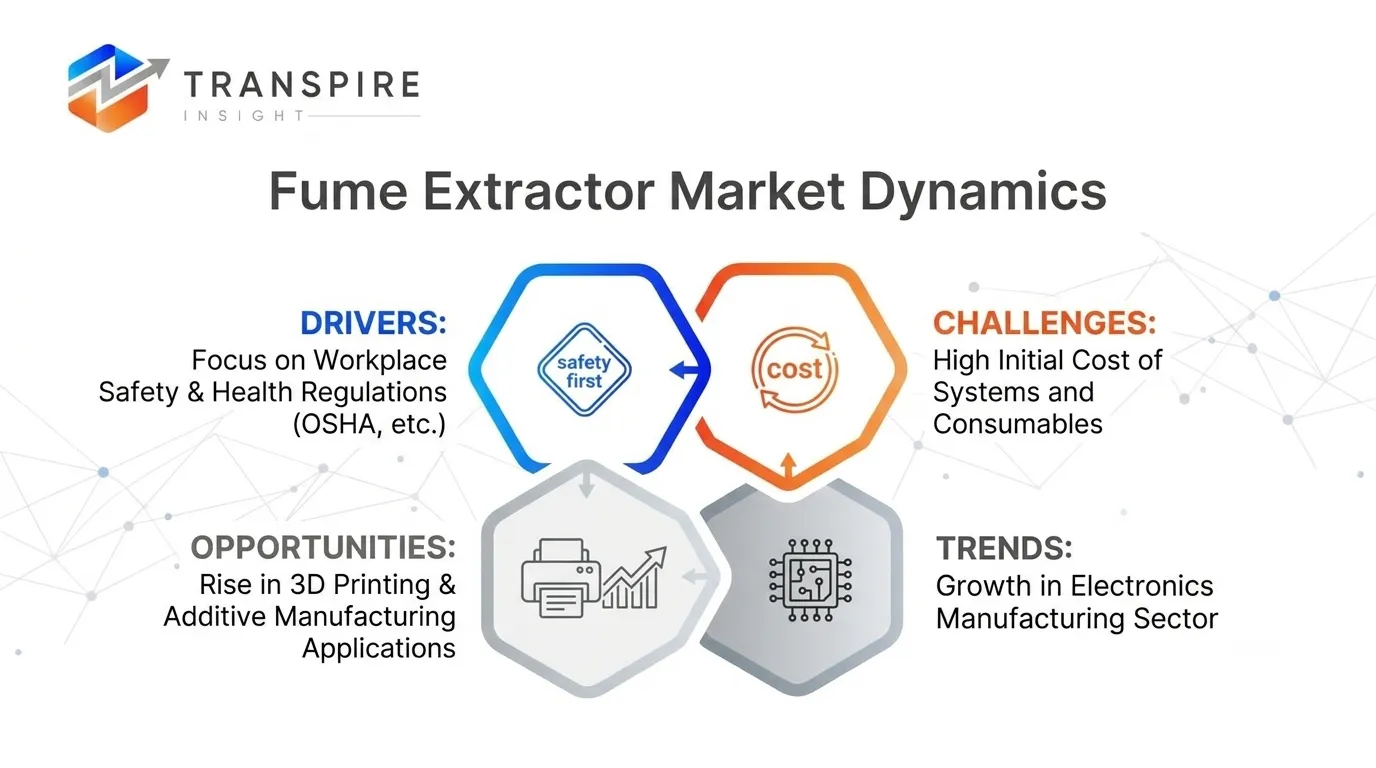
Growing awareness of occupational exposure, stricter workplace requirements and expanding manufacturing activity are increasing demand for efficient fume extraction systems across industrial and laboratory environments.
Fume extraction is becoming an increasingly important part of workplace engineering as industries pay greater attention to airborne contaminants generated during welding, manufacturing, laboratory work and other processes.
Modern extractors are evolving beyond basic filtration equipment. Manufacturers are introducing portable systems, multi-stage filtration, energy-efficient motors, smart monitoring and connected controls.
Market Size
The global fume extractor market was estimated at USD 2.7 billion in 2025 and is projected to reach approximately USD 4.5 billion by 2035, expanding at a CAGR of 5.4%. Asia Pacific is both the largest and fastest-growing regional market.
Fume Extraction Is Moving From Equipment to Workplace Infrastructure
Fume extractors are used to capture smoke, particulate matter, gases and other airborne contaminants before they spread through working environments.
Their importance is increasing as manufacturers operate higher-output welding and cutting equipment and laboratories handle increasingly sophisticated chemical and biological processes.
Companies are increasingly evaluating extraction systems as part of overall workplace engineering rather than as standalone equipment.
Portable Systems Are Expanding
Portable fume extractors generated approximately USD 1.39 billion in 2025, according to Global Market Insight.
Portable units are attractive because they can be moved between workstations and deployed without major modifications to existing facilities.
This flexibility is particularly valuable for welding shops, maintenance facilities and smaller manufacturing operations where fixed extraction infrastructure may not be economically practical.
Manufacturing Remains a Major Demand Centre
Manufacturing accounted for approximately 30.1% of the fume extractor market in 2025.
Welding, cutting, grinding and other industrial processes can generate airborne particles that require controlled capture.
As manufacturing facilities modernise, companies are increasingly seeking extraction equipment that can operate efficiently while minimising energy consumption and maintenance requirements.
Laboratories Are Creating Higher Filtration Requirements
Laboratory environments require a different approach from heavy industrial facilities.
Extraction systems may need to manage chemical vapours, aerosols or fine contaminants while maintaining controlled airflow.
Laboratory applications represented approximately 37.7% of the market in 2025, highlighting the importance of specialised extraction systems beyond welding and manufacturing.
Smart Monitoring Is Changing Maintenance
Connected extraction systems are increasingly capable of monitoring airflow, filter condition and system performance.
This enables facility managers to identify declining performance before the extraction system becomes ineffective.
IoT-enabled monitoring can also support preventive maintenance and improve energy management by adjusting extraction performance according to operating requirements.
Asia Pacific Is Becoming the Core Growth Engine
Asia Pacific currently represents both the largest and fastest-growing regional market. China alone generated approximately USD 260 million in 2025 and is projected to grow at around 5.7% annually through 2035.
Industrial expansion, welding activity and manufacturing investment are strengthening demand throughout China, India and other Asian manufacturing economies.
Top 10 Fume Extractor Companies
The five leading companies—KEMPER, Plymovent, Nederman, Donaldson and RoboVent—collectively held approximately 37% of the market in 2025.
1) KEMPER
KEMPER has a strong position in welding-fume extraction, with products designed for mobile and shop-floor capture. The company focuses on practical installation, retrofit compatibility and serviceability.
2) Plymovent
Plymovent offers extraction arms, mobile units and filtration systems for welding, cutting and industrial applications. Its global distributor network supports access to workshops and manufacturing customers.
3) Nederman
Nederman provides industrial air-treatment and extraction technologies designed to improve workplace air quality. Its portfolio spans extraction, filtration and connected environmental-management solutions.
4) Donaldson
Donaldson supplies filtration technologies across industrial applications. Its expertise in particulate filtration gives it a strong position in industrial fume and dust-management systems.
5) RoboVent
RoboVent focuses on industrial ventilation and fume-extraction systems, particularly for welding environments. Its products address high-volume manufacturing operations where effective source capture is critical.
Future Outlook
The fume extractor market is expected to reach approximately USD 4.5 billion by 2035, supported by manufacturing growth, occupational-health awareness and technological improvements.
The next phase of market development will centre on smart monitoring, energy-efficient motors, modular filtration and automated performance management.
Manufacturers that can deliver lower operating costs while maintaining high capture efficiency will be well positioned as industrial customers increasingly evaluate total ownership cost rather than initial equipment price alone.


Send us a brief description of your challenge and we'll get back to you within 24 hours.

 inquiry@transpireinsight.com
 APAC:+91 7666513636
 Address


