
Sep 17, 2026
By Transpire Insight
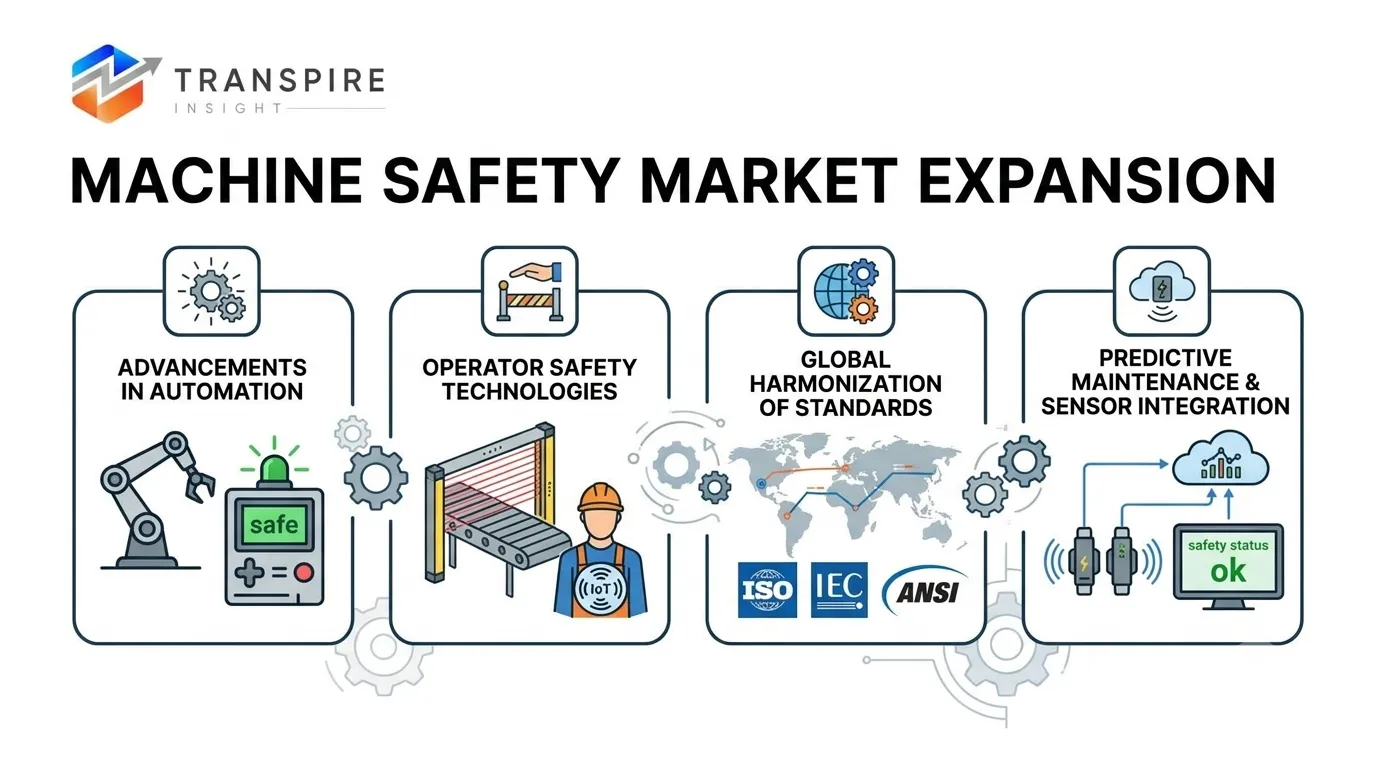
The rise of industrial automation, robotics and connected machinery is creating demand for machine safety systems that protect workers while maintaining production uptime.
Industrial safety is changing as factories become more automated. Traditional physical guards and emergency controls are increasingly being combined with sensors, safety controllers, programmable systems and real-time monitoring.
Market Size
The global machine safety market was estimated at USD 6.4 billion in 2025 and is projected to reach approximately USD 11.9 billion by 2035, growing at a CAGR of 6.6% from 2026 to 2035. Asia Pacific held approximately 28.9% of the market in 2025.
Automation Is Increasing the Need for Intelligent Protection
Factories are introducing robots, automated guided vehicles, high-speed production lines and interconnected machinery at an unprecedented pace.
These systems increase productivity but also create new interaction risks between workers and automated equipment. Machine safety technologies help detect unsafe conditions and initiate appropriate responses before an accident occurs.
As production environments become more complex, safety is increasingly being designed into machines rather than added as a separate layer after installation.
Presence Detection Is Becoming the First Line of Defence
Presence sensing safety sensors represented the leading component segment, generating approximately USD 2.3 billion in revenue in 2025.
Light curtains, laser scanners and related sensing systems can detect the presence of people within hazardous areas and initiate machine responses.
Their importance is increasing with collaborative manufacturing environments where workers and machines operate in closer proximity.
Robotics Is Creating a New Safety Requirement
Robotics is one of the strongest growth drivers for machine safety.
Industrial robots can operate at high speed and with substantial force, making controlled interaction essential. Collaborative robots add another dimension because they are specifically designed to work closer to people.
Safety systems therefore increasingly need to evaluate position, speed, force and environmental conditions in real time.
Predictive Safety Is Emerging
Traditional safety systems respond to immediate hazards. Newer approaches increasingly use data to identify abnormal machine behaviour before it develops into a dangerous condition.
Machine-learning algorithms, sensor analytics and continuous monitoring can support predictive safety strategies.
This approach can simultaneously improve worker protection and reduce unplanned downtime because potential faults can be identified before they cause a production interruption.
Regulations Are Supporting Long-Term Demand
Safety standards and regulations remain a fundamental market driver. Manufacturers selling machinery across multiple regions must meet functional-safety requirements and demonstrate appropriate risk reduction.
Standards such as IEC 61508 and ISO 13849 are influencing system design and procurement decisions across industrial sectors.
The increasing complexity of automation means compliance is becoming more technically demanding, supporting demand for specialised safety components and engineering services.
Top 10 Machine Safety Companies
The leading five—Rockwell Automation, Siemens, Schneider Electric, OMRON and ABB—collectively accounted for around 30% of the market in 2025, according to Global Market Insight.
1) Rockwell Automation
Rockwell Automation has a strong position in industrial machine safety through safety controllers, sensors and integrated automation systems. Its ability to connect safety with production control provides manufacturers with a unified approach to machine protection.
2) Siemens
Siemens integrates safety functions with industrial automation and digital manufacturing systems. Its safety PLCs and connected automation architecture allow manufacturers to implement safety functions without separating them from wider machine-control environments.
3) Schneider Electric
Schneider Electric provides safety relays, controllers, sensors and automation technologies designed for scalable machine-protection architectures. Its Preventa portfolio supports applications requiring integrated functional safety.
4) OMRON
OMRON combines sensing, control and safety technologies for manufacturing environments. Its safety products are widely applicable to automated production and machine-guarding requirements.
5) ABB
ABB supplies safety and automation solutions for industrial environments, including robotics and automated production systems. Its position across robotics and automation gives it a strong opportunity to integrate machine safety with advanced manufacturing systems.
Future Outlook
Machine safety is moving toward intelligent, connected and predictive protection.
The global market is expected to reach nearly USD 11.9 billion by 2035, supported by robotics, smart factories, stricter safety requirements and increasing demand for real-time monitoring.
Asia Pacific is likely to remain a critical growth region as manufacturing capacity expands. India is particularly attractive, with its machine safety market projected to increase from USD 254.5 million in 2025 to USD 380 million by 2030, representing an 8.4% CAGR.
The future competitive advantage will increasingly belong to suppliers that combine safety certification with connectivity, analytics and seamless integration into automation platforms.


Send us a brief description of your challenge and we'll get back to you within 24 hours.

 inquiry@transpireinsight.com
 APAC:+91 7666513636
 Address


