
Sep 18, 2026
By Transpire Insight
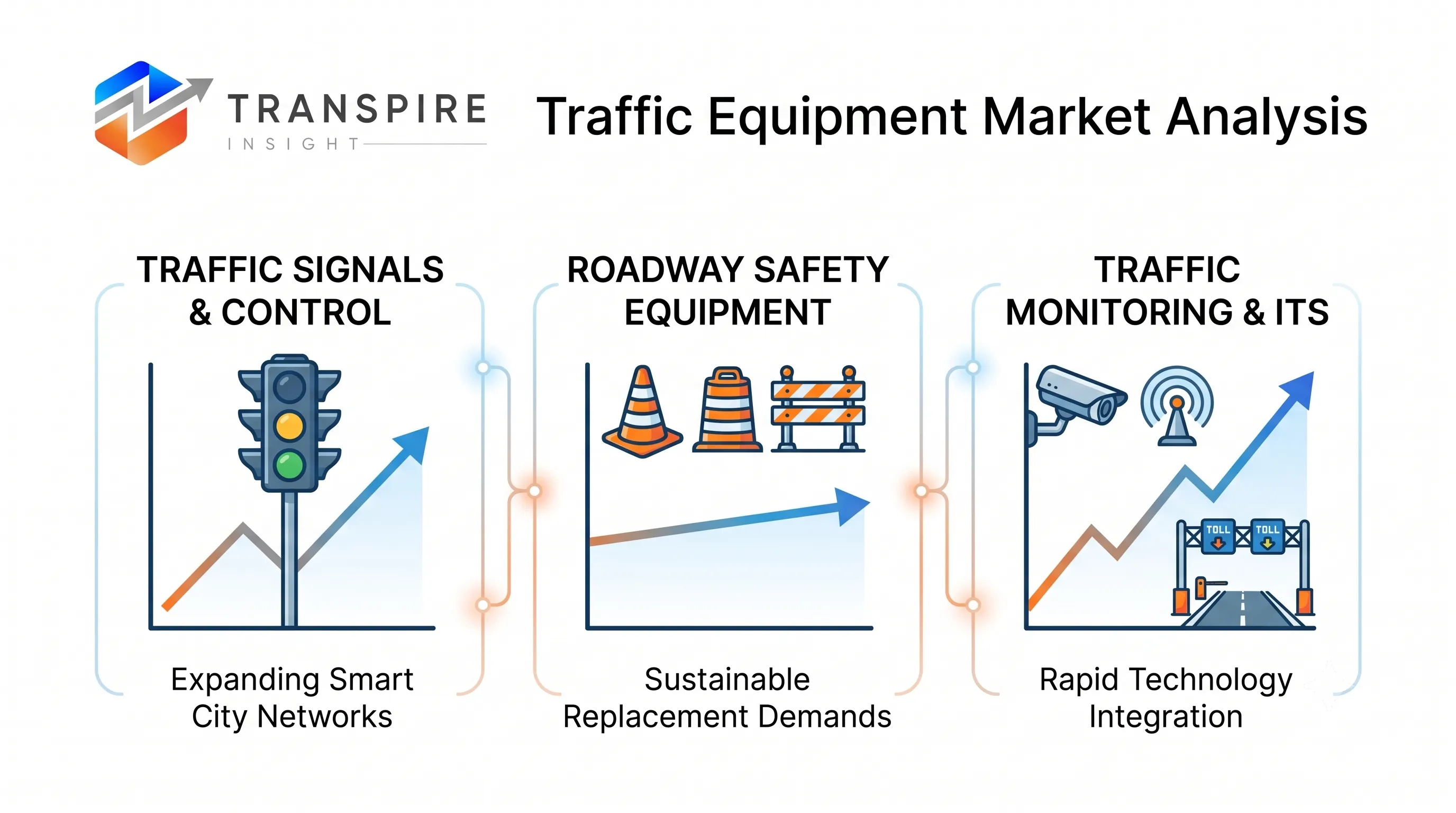
The global traffic equipment market is moving from conventional roadside hardware toward connected, sensor-enabled infrastructure as governments prioritize road safety, congestion management, smart cities and intelligent transportation systems.
Traffic equipment forms the physical foundation of modern road infrastructure. Traffic signals, signs, barriers, pavement-marking systems, work-zone equipment and pedestrian-control devices remain essential to maintaining safe and organized transportation networks.
However, the industry is undergoing a technology-driven transformation. Sensors, cameras, connectivity, analytics and adaptive control systems are increasingly being integrated into conventional traffic infrastructure. This is allowing cities to monitor road conditions and traffic volumes while responding more dynamically to congestion and safety challenges.
Global Market Insight estimates the traffic equipment market at approximately USD 13.3 billion in 2025 and projects it toward USD 24.2 billion by 2035 at a CAGR of around 6.4%. North America remains the largest regional market, while Asia Pacific is expected to record strong growth.
Market Size
The global traffic equipment market is estimated at approximately USD 13.5 billion in 2025 and could reach about USD 24.5 billion by 2035, representing an estimated CAGR of around 6.4%.
Traffic lights remain a leading product category, while conventional equipment continues to represent a substantial share because of established infrastructure requirements and cost considerations.
The market is benefiting from road modernization, urbanization, smart-city investments and increasing attention to pedestrian and work-zone safety.
Traffic Signals Are Becoming Intelligent Infrastructure
Traffic signals have traditionally relied on fixed timing schedules. However, congestion patterns can vary substantially during the day, making fixed cycles inefficient in many locations.
Adaptive traffic systems can use sensors and traffic data to adjust signal timing. This enables traffic authorities to respond to changing vehicle volumes, queues and pedestrian activity.
The move toward adaptive systems is creating demand for cameras, radar, connected controllers and software platforms alongside conventional signal hardware.
As cities seek to improve road capacity without continuously expanding physical infrastructure, intelligent signal management is becoming increasingly attractive.
Smart Cities Are Increasing Technology Adoption
Smart-city programs are changing procurement priorities. Governments increasingly want infrastructure that can communicate with centralized management systems.
Connected traffic equipment can provide information about equipment condition, traffic volumes and incidents. This data can be analyzed to improve traffic management and infrastructure planning.
The result is a shift in value from individual pieces of equipment toward integrated systems.
Companies capable of supplying both physical hardware and digital platforms may therefore have an advantage in large municipal projects.
Road Safety Remains a Fundamental Demand Driver
Despite the technology transition, safety remains the primary objective of traffic equipment.
Signs, barriers, reflective materials, signals and pedestrian systems continue to be required even in highly automated transportation networks.
Improved visibility is particularly important at night and in adverse weather conditions. Reflective materials and illuminated systems therefore remain essential.
Manufacturers that combine improved visibility with digital connectivity can serve both traditional and emerging infrastructure requirements.
Pedestrian Protection Is Expanding
Urban authorities are increasingly focusing on vulnerable road users.
Pedestrian signals, crossing beacons, barriers and detection technologies can improve the safety of people crossing busy roads.
Connected pedestrian systems can also communicate with traffic-control centers, allowing authorities to monitor equipment status.
This creates an opportunity for suppliers to develop systems that combine physical safety equipment with real-time monitoring.
Work-Zone Traffic Equipment Is Evolving
Road construction and maintenance projects require temporary traffic-management equipment. Cones, barriers, signs and portable signals remain essential.
However, work zones are increasingly adopting LED lighting, battery-powered systems, wireless communication and remote monitoring.
Connected work-zone equipment can help authorities identify whether signs or barriers have been moved and whether temporary signals are operating correctly.
This improves visibility and can reduce the risk associated with improperly maintained work zones.
IoT Is Expanding Equipment Capabilities
Internet-of-Things connectivity is allowing traffic equipment to become part of larger infrastructure networks.
Sensors can collect information about traffic flow, equipment condition and environmental conditions. This information can then be transferred to centralized platforms.
For equipment manufacturers, connectivity creates an additional value proposition. Instead of selling a signal or barrier as a standalone product, companies can provide monitoring and analytics services.
This creates opportunities for recurring revenue through software and maintenance contracts.
Predictive Maintenance Can Reduce Infrastructure Downtime
Traffic infrastructure is often distributed across large geographic areas, making manual inspection expensive.
Connected equipment can support predictive maintenance by identifying faults or abnormal operating patterns.
For example, a traffic signal controller could automatically report a malfunction, allowing technicians to respond before the failure creates a major traffic problem.
Predictive maintenance can reduce service disruption and improve the efficiency of municipal maintenance teams.
Government Procurement Is Becoming More Technology-Focused
Public-sector procurement traditionally emphasized compliance, durability and purchase price. Increasingly, governments are considering lifecycle costs and digital capabilities.
Equipment that can be monitored remotely may justify a higher initial investment if it reduces maintenance costs over time.
Long-term infrastructure contracts also create opportunities for companies that can provide installation, maintenance, software and upgrades.
Competitive Advantage Is Moving Toward Integrated Solutions
The market includes major technology companies as well as specialized road-safety manufacturers.
3M has strong capabilities in reflective materials and work-zone safety, while Siemens participates across traffic management and intelligent transportation systems. Lindsay, Honeywell and Tennants also participate in different segments of the broader market. Current industry research identifies these companies among major market participants.
Competition is increasingly based on the ability to combine physical products with digital infrastructure.
Top 10 Traffic Equipment Companies
1) 3M
3M has extensive expertise in reflective materials, traffic signs, pavement-marking products and work-zone safety.
Its materials-science capabilities allow it to serve conventional traffic infrastructure while also supporting increasingly sophisticated road-safety applications.
2) Siemens
Siemens has a strong position in intelligent transportation systems, traffic signals and centralized traffic-management technologies.
Its competitive advantage comes from integrating hardware, software and analytics into broader mobility platforms.
3) Honeywell
Honeywell brings expertise in automation, sensing and connected systems. These capabilities can support intelligent traffic infrastructure where monitoring and centralized management are increasingly important.
Its broader industrial technology portfolio gives it opportunities to participate in connected mobility systems.
4) Lindsay Corporation
Lindsay develops infrastructure and intelligent transportation solutions for roadway applications.
Its expertise in outdoor infrastructure and transportation systems supports applications where equipment must remain reliable under demanding environmental conditions.
5) Tennants
Tennants supplies traffic-management and road-safety products for infrastructure and work-zone applications.
Its product breadth allows it to serve contractors, public authorities and infrastructure operators requiring conventional and specialized traffic equipment.
Future Outlook
The traffic equipment market is expected to benefit from continued road modernization, urbanization and smart-city investment.
The market could reach approximately USD 24.5 billion by 2035. Conventional traffic equipment will remain essential, but the fastest-value opportunities are likely to emerge from connected signals, adaptive control, predictive maintenance and data-driven transportation management.
The next generation of traffic infrastructure will increasingly combine hardware with software. Governments will seek systems that not only control traffic but also collect information, identify problems and support faster decision-making.
For manufacturers, this means that success will increasingly depend on technology integration, reliability and lifecycle service rather than equipment manufacturing alone.


Send us a brief description of your challenge and we'll get back to you within 24 hours.

 inquiry@transpireinsight.com
 APAC:+91 7666513636
 Address


