
Sep 17, 2026
By Transpire Insight
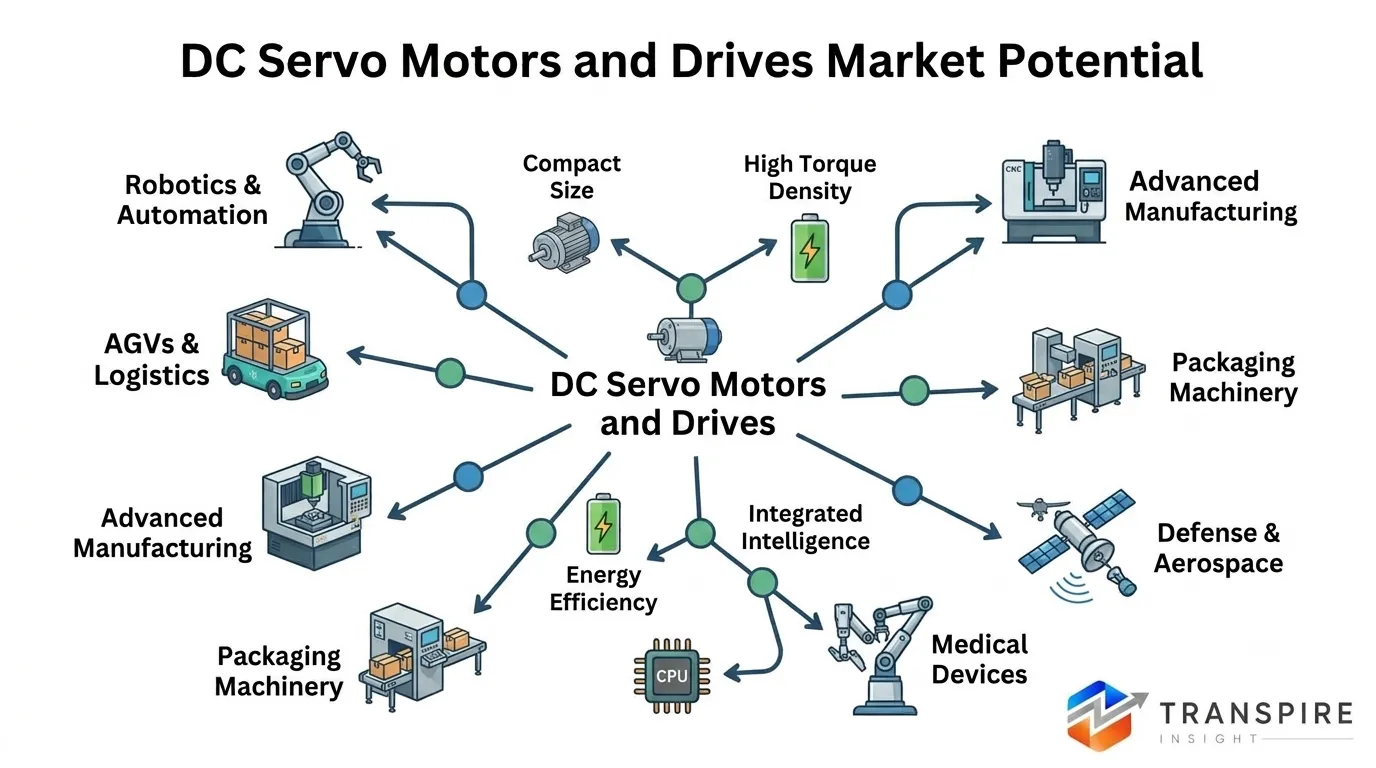
The shift toward high-precision automation, robotics and energy-efficient machinery is creating new demand for DC servo motors and drives across manufacturing and advanced industrial applications.
Industrial automation is moving toward increasingly precise, compact and intelligent motion systems. DC servo motors and drives remain important in applications where accurate speed, torque and position control are required, particularly in robotics, medical equipment, laboratory automation, semiconductor machinery and mobile platforms.
The market is also benefiting from the increasing use of low-voltage motion systems. Battery-powered autonomous equipment, automated guided vehicles, mobile robots and compact machinery require servo systems capable of delivering dynamic performance without relying on conventional high-voltage architectures.
The global DC servo motors and drives market was estimated at USD 5.3 billion in 2025 and is projected to reach approximately USD 9.5 billion by 2035, expanding at a CAGR of 5.9% from 2026 to 2035. Europe currently represents the largest regional market, while Asia Pacific is expected to provide the fastest growth opportunity.
Market Size
The global DC servo motors and drives market was valued at approximately USD 5.3 billion in 2025. It is expected to reach around USD 5.6 billion in 2026 and nearly USD 9.5 billion by 2035, representing a CAGR of approximately 5.9% during 2026–2035.
From Conventional Motion Control to Intelligent Precision Systems
DC servo systems are increasingly being used where machinery requires rapid acceleration, controlled torque and accurate positioning. Unlike basic motor systems, servo architectures combine motor, feedback and drive technologies to continuously adjust machine movement.
Modern systems increasingly incorporate high-resolution encoders, digital control and network connectivity. This enables manufacturers to improve repeatability while collecting operational information that can be integrated into broader automation platforms.
The development of compact low-voltage servo products is particularly important for robotics and autonomous machinery. Applications such as mobile robots, automated material-handling equipment and portable medical systems require high power density within restricted physical spaces.
As manufacturers modernise equipment, servo technology is therefore becoming less of an isolated motion component and more of an integrated part of the machine-control architecture.
Robotics Is Expanding the Addressable Market
The rapid expansion of industrial and mobile robotics is creating additional demand for compact DC servo systems.
Robotic applications require controlled movement across multiple axes, often under changing loads and operating conditions. Servo motors provide the feedback-based control needed to achieve repeatable positioning, while drives regulate torque and speed.
The opportunity extends beyond traditional industrial robots. Autonomous mobile robots, laboratory automation systems, medical equipment and emerging robotic platforms are increasingly adopting low-voltage motion systems.
This diversification is helping DC servo manufacturers reduce dependence on traditional factory automation and enter higher-value application areas.
Energy Efficiency Is Becoming a Design Requirement
Energy efficiency is becoming an increasingly important consideration for machine builders. Servo systems can reduce unnecessary energy consumption by delivering torque according to actual operating requirements rather than continuously operating at a fixed output.
Manufacturers are consequently evaluating servo systems not only on precision but also on power density, thermal performance and overall machine efficiency.
The combination of efficient motor design, intelligent drives and regenerative capabilities can improve the energy profile of automated equipment. This is particularly valuable in facilities where machines operate continuously or where multiple axes operate simultaneously.
Compact Servo Architecture Is Changing Machine Design
One of the strongest trends in the industry is the development of smaller and more integrated servo products.
Machine builders increasingly need components that occupy less cabinet space while maintaining high dynamic performance. Integrated electronics, compact drives and high-resolution feedback systems are allowing manufacturers to build smaller automated equipment.
This trend is particularly relevant to semiconductor equipment, laboratory automation, medical devices and precision manufacturing, where available machine space can be limited.
The transition toward compact architectures also encourages suppliers to compete on thermal management, communication compatibility and ease of commissioning rather than motor specifications alone.
Competition Is Moving Toward Complete Motion Solutions
The competitive landscape is increasingly centred on complete motion-control ecosystems. Companies that combine motors, drives, controllers, software and industrial communication technologies can provide machine builders with more integrated solutions.
The leading five companies—Siemens, Panasonic Industry, Allied Motion, Kollmorgen and Moog—collectively accounted for approximately 32% of the market in 2025, with Siemens holding the leading position at more than 15%.
Top 10 DC Servo Motors and Drives Companies
1) Siemens
Siemens provides DC servo technologies designed for compact and precise motion applications. Its portfolio includes drive technologies capable of integration with SIMATIC control architectures, supporting automated machinery that requires coordinated motion and reliable positioning.
2) Panasonic Industry
Panasonic Industry offers low-voltage MINAS servo technologies designed for compact automation applications. Its DC servo solutions target environments where space efficiency, torque density and energy performance are important design considerations.
3) Allied Motion
Allied Motion develops compact motion-control products for industrial, medical, defense and automation applications. Its DC-input servo drive solutions focus on controlled torque and speed within compact machine architectures.
4) Kollmorgen
Kollmorgen supplies low-voltage servo motors designed for applications including mobile robotics, medical equipment and automated guided vehicles. Its technology portfolio emphasises dynamic response and precision under demanding operating conditions.
5) Moog Inc.
Moog provides high-performance motion-control technologies for aerospace, defense, industrial and robotic applications. Its servo drives are designed for demanding environments requiring precise control and high reliability.
Future Outlook
The DC servo motors and drives industry is expected to benefit from continued automation investment, robotics deployment and demand for compact motion-control architectures.
The market is projected to reach approximately USD 9.5 billion by 2035, with growth supported by Industry 4.0 investments, energy-efficiency requirements and increasing demand for precision motion systems.
Future competition will increasingly focus on integrated motor-drive packages, intelligent feedback, network connectivity and application-specific solutions. Manufacturers able to combine precision with compactness and energy efficiency are likely to capture the strongest opportunities as automation expands into robotics, medical technology and autonomous equipment.


Send us a brief description of your challenge and we'll get back to you within 24 hours.

 inquiry@transpireinsight.com
 APAC:+91 7666513636
 Address


