
Sep 18, 2026
By Transpire Insight
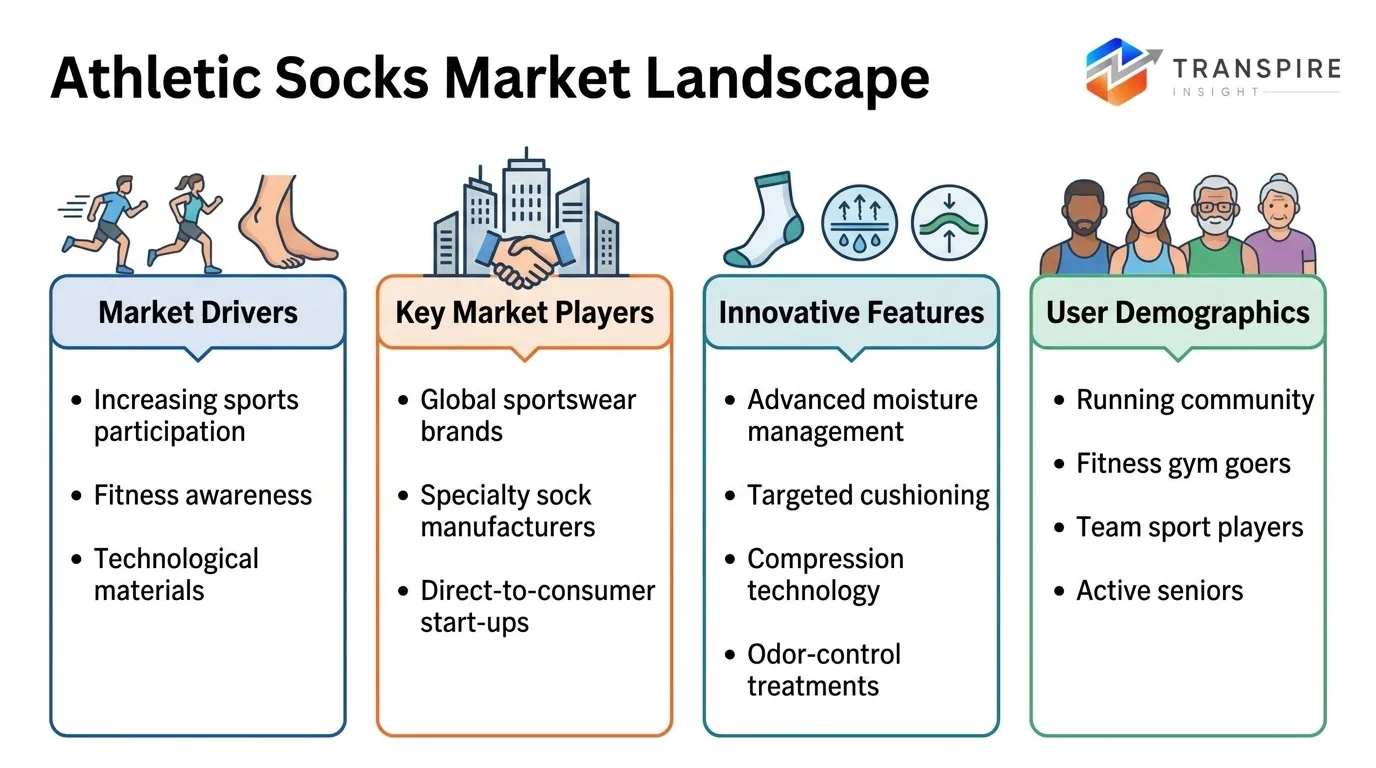
The global athletic socks market is moving beyond conventional sportswear, with performance materials, athleisure fashion, wellness awareness and digital retail creating new opportunities for brands, manufacturers and specialized textile suppliers.
Athletic socks are increasingly becoming an important part of the performance-apparel ecosystem rather than simply a basic accessory worn during exercise. Rising participation in running, fitness, cycling, hiking and recreational sports is encouraging consumers to pay greater attention to comfort, moisture management, cushioning, compression and fit. At the same time, the rapid expansion of athleisure is turning athletic socks into everyday wardrobe products, widening the addressable consumer base.
The market is also benefiting from advances in textile engineering. Manufacturers are developing socks using synthetic blends, recycled fibers, antimicrobial finishes, seamless construction and targeted ventilation zones. These innovations allow brands to position products around specific activities and consumer needs rather than competing only on price, color or design.
Current industry estimates vary according to market definition. Global Market Insight estimates the athletic socks market at approximately USD 6.3 billion in 2025 and projects it to reach around USD 10.9 billion by 2035, representing a CAGR of about 5.5%. Future Market Insight uses a broader definition and estimates the market at approximately USD 7.7 billion in 2025, rising to USD 13.6 billion by 2035.
For this analysis, the narrower performance-focused market definition is used. To maintain editorial consistency, market values are presented as approximate figures rather than as direct quotations from any individual research provider.
Market Size
The global athletic socks market is estimated at approximately USD 6.4 billion in 2025 and could approach USD 11.0 billion by 2035, expanding at an estimated CAGR of around 5.5%. The market's development is being supported by increasing sports participation, consumer awareness of foot comfort, premiumization of sportswear and the integration of athletic products into everyday fashion.
North America remains a major demand center because of strong sportswear adoption, established fitness cultures and high consumer spending on branded performance apparel. Asia Pacific is also becoming increasingly important as urbanization, disposable income, organized sports participation and online retail expand.
Running socks remain one of the most prominent product categories. Future Market Insight estimates that running socks accounted for approximately 29.4% of the athletic socks market in 2025. Synthetic fiber socks also represented a major material segment, supported by their moisture-wicking, durability and stretch characteristics.
Athletic Socks Are Evolving From Basic Accessories to Performance Equipment
The traditional athletic sock was primarily designed to protect the foot from friction and provide a comfortable interface between the foot and footwear. That role is changing. Modern products are increasingly engineered around specific athletic requirements.
Runners may seek lightweight construction, moisture control and anti-blister properties. Basketball players may prefer cushioning and ankle support, while hikers often require thermal regulation, durability and abrasion resistance. Compression socks can target circulation and muscle support, while training socks increasingly emphasize stability and sweat management.
This specialization gives manufacturers more opportunities to create premium products. Instead of selling a single general-purpose athletic sock, companies can build product families around running, training, outdoor activities, recovery and lifestyle use.
The result is a market in which technical specifications are becoming important purchase criteria. Consumers increasingly compare fabric composition, cushioning levels, ventilation zones, compression ratings and fit before making a purchase.
Athleisure Is Expanding the Consumer Base
One of the most important structural changes in the athletic socks industry is the continued growth of athleisure. Sportswear is increasingly worn outside gyms and sporting environments, allowing athletic socks to become part of everyday fashion.
Consumers may pair performance socks with sneakers, casual trousers, shorts or streetwear. This has encouraged brands to combine technical functionality with stronger visual design. Bright colors, patterns, logos and limited-edition collaborations are becoming more common.
This trend creates an important opportunity for established sportswear companies because they can use their existing footwear and apparel brands to sell coordinated sock collections. Specialist sock manufacturers can also compete by focusing on distinctive designs and technical expertise.
Athleisure is particularly significant because it increases purchase frequency. A consumer does not need to participate in organized sports to purchase athletic socks. Daily use creates additional replacement demand, while multipacks and seasonal collections encourage repeat purchases.
Material Innovation Is Changing Product Performance
Materials remain one of the strongest areas of competition in athletic socks. Cotton continues to be widely recognized for comfort, but synthetic fibers such as polyester and nylon are increasingly favored in performance applications because they can deliver moisture management, durability and shape retention.
Blended fabrics allow manufacturers to combine different properties within a single product. A sock can use synthetic fibers for moisture movement, elastane for stretch and targeted cushioning materials for impact protection.
Wool and wool blends remain relevant in outdoor activities because of their thermal regulation and moisture-management properties. Meanwhile, recycled polyester and other lower-impact fibers are gaining attention as sustainability becomes more important in apparel purchasing.
Future Market Insight identifies synthetic fiber socks as a leading material segment, with an estimated 33.8% share in 2025.
The competitive challenge is to achieve sustainability without sacrificing durability. Consumers may support recycled materials, but athletic socks still need to withstand repeated washing, stretching and high-friction use.
Compression and Recovery Products Are Creating Premium Niches
Compression is another area creating higher-value opportunities. Compression socks have expanded beyond traditional medical and recovery applications into running, travel, training and general wellness.
Athletes may use compression products during or after activity, while consumers with active lifestyles may purchase them for perceived comfort and recovery benefits. This broader positioning is allowing manufacturers to create premium products with specialized compression zones.
The opportunity is especially attractive because compression products can command higher prices than basic athletic socks. However, brands need strong product design and clear communication of benefits to justify the premium.
Recovery-oriented products may become even more important as consumers increasingly connect sports participation with long-term wellness rather than competition alone.
E-Commerce Is Reshaping Athletic Sock Distribution
Online retail is changing the way consumers discover and purchase athletic socks. Digital platforms make it easier to compare prices, materials, designs and customer reviews across dozens of brands.
For smaller companies, this reduces the dependence on physical sporting-goods stores. A specialist running-sock company can reach customers globally through its website or major marketplaces without requiring a large retail footprint.
Customer reviews are particularly important for socks because fit and comfort are difficult to evaluate before purchase. Positive reviews can reinforce trust, while negative feedback can quickly expose sizing or durability problems.
Digital channels are also supporting direct-to-consumer strategies. Brands can collect customer information, recommend products based on activity and purchasing history, and launch limited collections without relying entirely on traditional distributors.
Smart Textile Technology Could Open a New Market Layer
Technology is beginning to enter the athletic sock category through smart textiles. Research and development initiatives are exploring conductive fibers and embedded sensors capable of monitoring factors such as temperature, moisture and pressure.
Future smart socks could potentially provide information about gait, foot pressure distribution or movement patterns. Such capabilities could be valuable to athletes, coaches, rehabilitation professionals and consumers interested in performance tracking.
However, commercialization remains challenging. Sensors must survive repeated washing, movement and stretching, while electronic components need to remain lightweight and comfortable.
The technology therefore represents a longer-term opportunity rather than an immediate mass-market driver. As wearable electronics become smaller and more affordable, smart socks could eventually develop into a specialized premium segment.
Sustainability Is Becoming Part of Product Positioning
Environmental considerations are increasingly influencing apparel purchasing decisions. Athletic sock manufacturers are responding through recycled fibers, organic cotton, reduced packaging and improved manufacturing efficiency.
Recycled polyester can reduce reliance on virgin materials, while regenerated nylon offers another route toward circular textile production. Some brands are also emphasizing product durability as part of their sustainability proposition.
The challenge is balancing environmental goals with performance. Athletic socks are exposed to friction, sweat and repeated washing, so weak durability can shorten product life.
As a result, the next generation of sustainable athletic socks is likely to focus not only on recycled content but also on longer service life, repairability and more responsible manufacturing processes.
Competitive Advantage Is Moving Toward Brand and Product Specialization
The athletic socks market remains competitive because major sportswear companies can leverage global branding, athlete sponsorships and extensive distribution networks. Nike, Adidas, Under Armour, New Balance and Stance are among the leading participants identified across current market research.
Global Market Insight estimates that Nike held more than 15% of the market in 2025, while its top five identified players collectively represented approximately 38%.
However, market leadership does not eliminate opportunities for specialists. Companies focused exclusively on running, compression, hiking or performance recovery can develop deeper product expertise and cultivate highly loyal customer communities.
This creates a two-level competitive environment: large brands compete through scale and visibility, while specialists compete through technical innovation, community engagement and product credibility.
Top 10 Athletic Socks Companies
1) Nike, Inc.
Nike remains one of the most recognizable names in athletic socks, supported by its global sportswear ecosystem. Its stock portfolio benefits from integration with running, training, basketball and lifestyle footwear.
The company's competitive advantage comes from its ability to combine recognizable design with performance features such as moisture management, cushioning and activity-specific construction. Its large retail and digital network also allow it to introduce new sock collections alongside footwear and apparel launches.
2) Adidas AG
Adidas competes across running, football, training, basketball and lifestyle categories. Its athletic socks benefit from the company's extensive sportswear brand recognition and its close relationship with footwear.
The company has an opportunity to expand premium performance socks by combining technical materials with its strong design identity. Its global distribution network provides access to both professional athletes and everyday consumers.
3) Under Armour, Inc.
Under Armour has built its brand around performance apparel and training. This positioning gives its athletic socks a natural place within its broader technical-product portfolio.
The company can leverage its expertise in moisture management, compression and performance textiles to target athletes and fitness consumers seeking specialized products. Its brand is particularly relevant to training-oriented customers.
4) New Balance Athletics, Inc.
New Balance has strong credibility in running and performance footwear, creating a natural opportunity for coordinated athletic sock products.
Its sock strategy can benefit from the company's understanding of runners and foot mechanics. Products emphasizing cushioning, fit, comfort and running-specific performance can strengthen the brand's broader ecosystem.
5) Stance Inc.
Stance has differentiated itself through design-driven socks that combine performance characteristics with strong lifestyle appeal. Its approach allows socks to become visible fashion products rather than purely functional accessories.
This positioning gives Stance an opportunity to attract consumers who want technical performance but also value distinctive colors, graphics and designs.
Future Outlook
The global athletic socks market is expected to maintain steady growth as sports participation, fitness awareness and athleisure continue to expand. The category is gradually moving away from commodity-style competition toward differentiated products built around performance, comfort, sustainability and design.
The market could reach approximately USD 11.0 billion by 2035 under the selected market definition. The strongest opportunities are likely to emerge from running, compression, outdoor activities, premium synthetic blends and digitally sold specialist products.
Technology will also influence the longer-term direction of the industry. Smart textiles, sensor-enabled products and data-driven fit systems could create new premium categories, while sustainable fibers and responsible manufacturing will increasingly influence brand reputation.
For manufacturers, success will depend on balancing performance with affordability. For established sportswear companies, athletic socks provide another opportunity to strengthen customer relationships across footwear, apparel and accessories. For specialist brands, technical credibility and community engagement can provide a path to differentiation.
Ultimately, athletic socks are becoming more than an accessory. They are evolving into a specialized performance and lifestyle product where material science, comfort engineering, fashion and digital commerce increasingly intersect. As consumers become more informed about what they wear during physical activity, the value proposition of a well-designed athletic sock is likely to become increasingly visible across the global sportswear market.


Send us a brief description of your challenge and we'll get back to you within 24 hours.

 inquiry@transpireinsight.com
 APAC:+91 7666513636
 Address


