
Sep 17, 2026
By Transpire Insight
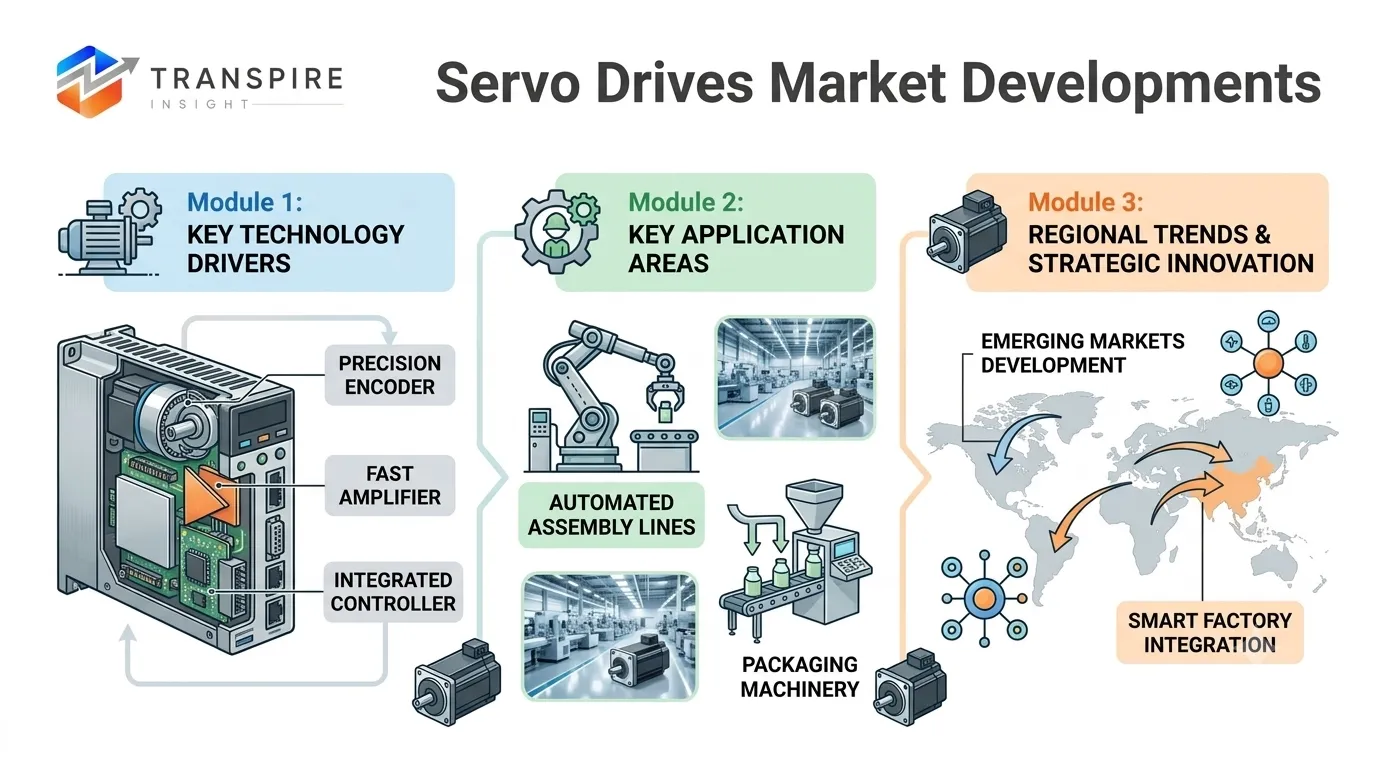
The expansion of smart factories, robotics and connected production systems is increasing demand for servo drives that deliver precise motion while connecting machine-level control with digital manufacturing platforms.
Servo drives are moving beyond their traditional role as motor-control devices. Modern manufacturing systems increasingly depend on drives that can communicate with controllers, provide operational data and optimise machine movement in real time.
Market Size
The global servo drives market was valued at USD 2.4 billion in 2025, is estimated at USD 2.5 billion in 2026, and is projected to reach approximately USD 3.5 billion by 2035 at a CAGR of 3.5%. Asia Pacific represents the largest regional market, supported by manufacturing automation and robotics investment.
Servo Drives Are Becoming Intelligent Machine Nodes
Servo drives traditionally converted electrical commands into controlled motor movement. Today, their role is expanding as factories become increasingly connected.
Modern servo drives can communicate through industrial networks, monitor machine behaviour and support sophisticated motion profiles. This makes the drive an important source of machine-level information.
Manufacturers are therefore increasingly evaluating servo drives based on connectivity, diagnostics and integration capabilities alongside conventional measures such as torque and speed.
Robotics Is Driving Higher Precision Requirements
Robotics remains one of the most important application areas for servo drives. Robotic systems require precise control across multiple axes and must respond rapidly to changes in position and load.
The increasing use of collaborative robots and automated production equipment is broadening the addressable market. Servo drives provide the dynamic response and positioning accuracy necessary for coordinated robotic movement.
AC servo drives accounted for more than 70% of the servo drives market in 2025, reflecting their widespread use in high-performance industrial automation and robotics.
Digital Connectivity Is Reshaping Drive Selection
Industrial Ethernet, IoT connectivity and intelligent diagnostics are increasingly influencing purchasing decisions.
A connected servo drive can provide information related to temperature, operating load, motion cycles and abnormal conditions. This information can support predictive maintenance and reduce unexpected downtime.
The ability to integrate drives with factory-level software is therefore becoming an important competitive differentiator.
Energy Efficiency Is Moving Into the Drive Architecture
Energy consumption has become a major consideration for automated production facilities. Servo drives can regulate motor output according to real-time machine requirements, reducing unnecessary energy use during variable operating conditions.
Manufacturers are consequently developing drives with improved control algorithms and regenerative functions.
Energy optimisation is especially important in large factories where hundreds of motors may operate simultaneously.
Competitive Advantage Is Shifting Toward Integrated Automation Platforms
The leading five companies—Siemens, Yaskawa Electric, Schneider Electric, Panasonic Industry and Danfoss—collectively accounted for around 46% of the market in 2025.
The competitive environment is increasingly shaped by the ability to combine drives with motors, PLCs, robotics, software and industrial networking.
Top 10 Servo Drives Companies
1) Siemens
Siemens develops servo drives for applications ranging from light-duty motion to highly precise medium- and heavy-load automation. Its strength comes from integrating motion control with broader industrial automation architectures.
2) Yaskawa Electric
Yaskawa combines servo motors and digital SERVOPACK amplifiers to provide high-speed motion control. Its Sigma series incorporates functions such as automatic tuning, vibration suppression and friction compensation.
3) Schneider Electric
Schneider Electric offers Lexium servo-drive technologies focused on precise motion, connectivity and energy-efficient automation. Its broader industrial automation portfolio enables integration between motion and machine-control systems.
4) Panasonic Industry
Panasonic Industry supplies servo systems for high-precision automation and machine-building applications. Its portfolio benefits from integration with broader factory automation technologies.
5) Danfoss
Danfoss participates in the motion-control market with drive technologies designed to improve machine performance and energy efficiency. Its established industrial customer base supports adoption across manufacturing applications.
Future Outlook
The servo drives market is expected to expand steadily as manufacturers invest in smart factories, robotics and connected automation.
Future product development will increasingly focus on AI-assisted control, digital twins, predictive diagnostics and multi-protocol connectivity. Companies capable of providing both hardware and software capabilities will have an advantage as servo drives become integrated into broader industrial digitalisation strategies.


Send us a brief description of your challenge and we'll get back to you within 24 hours.

 inquiry@transpireinsight.com
 APAC:+91 7666513636
 Address


