
Sep 18, 2026
By Transpire Insight
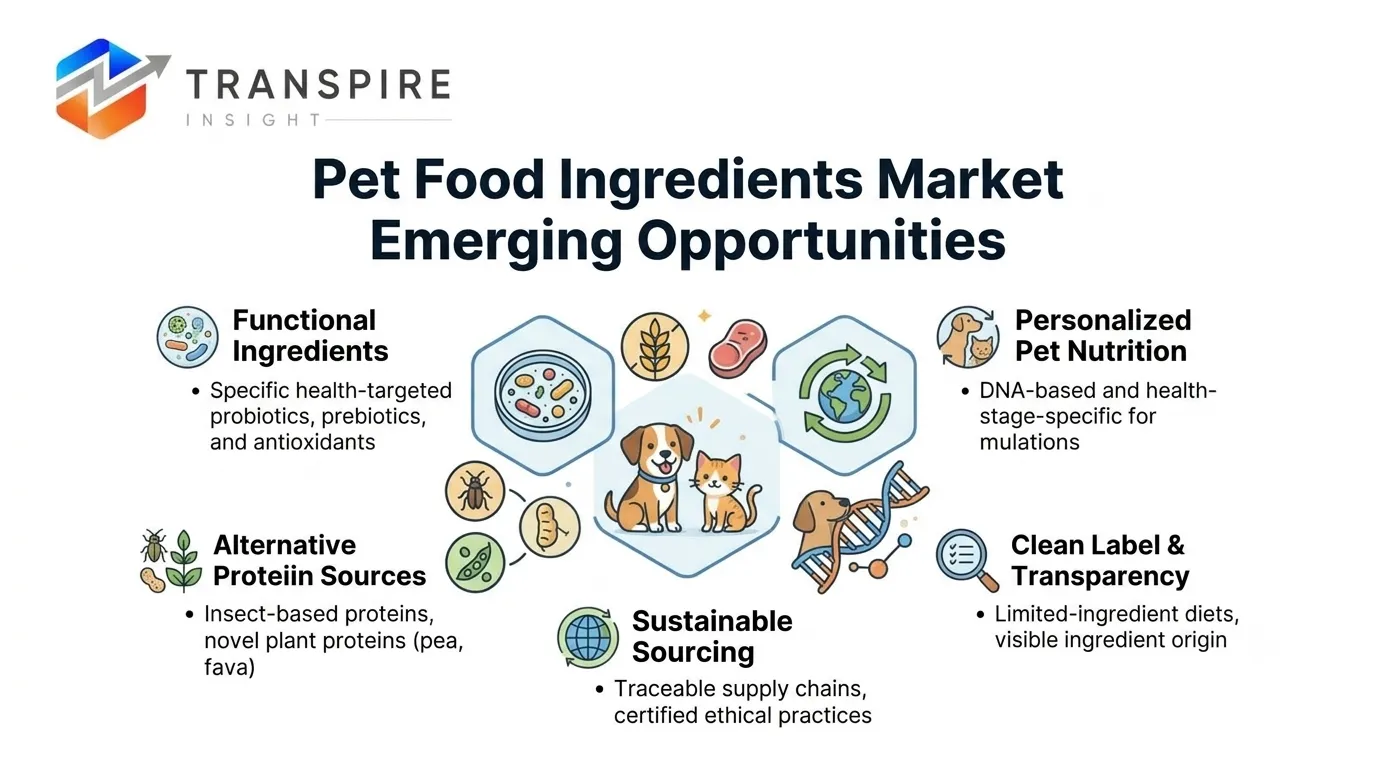
The global pet food ingredients market is evolving from a commodity-driven supply chain into a science-led nutrition industry, supported by pet humanization, premium diets, functional ingredients, alternative proteins and growing demand for transparent sourcing.
The global pet food industry is undergoing a significant transformation as pet owners increasingly consider nutrition a central component of animal health and longevity. This behavioral change is directly influencing ingredient manufacturers, which are moving beyond conventional proteins, grains and fats toward specialized nutritional solutions designed for digestion, immunity, mobility, skin and coat health, weight management and healthy aging.
The shift is closely connected with the humanization of pets. Dogs and cats are increasingly treated as members of the household, encouraging owners to purchase premium foods with recognizable ingredients, specialized nutritional profiles and functional benefits. Pet food manufacturers are responding by reformulating products and seeking ingredient suppliers capable of providing consistency, traceability and scientific support.
Current industry estimates vary considerably depending on the definition of the market. Global Market Insight estimates the pet food ingredients market at approximately USD 37.8 billion in 2025 and projects it toward USD 64.5 billion by 2035 at a CAGR of approximately 5.5%. Broader studies covering additional ingredient categories report higher market values.
For this analysis, the narrower ingredient-market definition is followed consistently.
Market Size
The global pet food ingredients market is estimated at approximately USD 38.1 billion in 2025 and could approach USD 64.8 billion by 2035, representing an estimated CAGR of about 5.5%.
North America remains a major regional market because of high pet ownership, established premium pet-food categories and strong spending on companion-animal nutrition. Europe also represents a substantial market, while Asia Pacific continues to offer long-term growth opportunities as urbanization, disposable income and organized pet-care channels expand.
Animal-derived ingredients remain a leading category, supported by demand for meat, poultry, fish, fats and other protein-rich inputs. Plant-derived ingredients and functional additives are also gaining importance as manufacturers seek nutritional balance and differentiated formulations. Novel and functional ingredients represent a smaller portion of the market but offer attractive growth prospects.
Pet Humanization Is Changing Ingredient Requirements
Pet owners are increasingly applying the same standards to pet food that they apply to their own diets. This has resulted in greater interest in clean-label formulations, recognizable proteins, natural additives and targeted nutritional benefits.
Instead of simply selecting food based on price, consumers increasingly consider whether a product supports digestion, immunity, joint health or healthy skin. This is encouraging pet-food companies to communicate ingredient-level benefits.
Ingredient suppliers therefore have an opportunity to move further upstream in the value chain. Companies that provide formulation assistance, nutritional research and technical documentation can become strategic partners rather than simple raw-material vendors.
Protein Remains the Foundation of Premium Pet Food
Protein continues to be one of the most important components in pet-food formulation. Animal-derived proteins remain widely used because of their nutritional density and consumer familiarity.
However, the definition of premium protein is becoming broader. Consumers increasingly want information about the source, processing and traceability of protein ingredients. This is creating opportunities for suppliers offering specialized poultry, fish, meat and hydrolyzed proteins.
Plant-based proteins are also attracting interest, although their suitability depends heavily on species, formulation and nutritional requirements. Manufacturers are increasingly evaluating blended protein systems that balance nutritional performance, palatability, cost and sustainability.
Functional Ingredients Are Moving Into Mainstream Products
Functional ingredients are becoming an important growth engine for the market. Vitamins, minerals, amino acids, antioxidants, probiotics, prebiotics, enzymes and specialty fibers can support specific nutritional objectives.
Digestive health is particularly relevant because consumers increasingly recognize the connection between gut health and overall wellness. Probiotic and prebiotic ingredients can therefore provide manufacturers with opportunities to differentiate products.
Mobility is another growing application. Ingredients associated with joint support can be incorporated into formulas designed for older animals or breeds with particular mobility requirements.
These trends create opportunities for ingredient companies with strong research capabilities because pet-food brands increasingly need evidence to support nutritional claims.
Novel Ingredients Could Reshape the Competitive Landscape
Alternative proteins and novel ingredients are likely to become more important over the longer term. Insect-derived proteins, fermentation-based ingredients, algae and other emerging sources are attracting attention because they may reduce resource requirements while providing nutritional functionality.
Adoption will depend on cost, regulatory acceptance, palatability and consumer perception. Pet owners may be willing to accept unconventional ingredients when the benefits are clearly communicated, but food safety and nutritional consistency remain essential.
Fermentation technology is particularly interesting because it can potentially produce specific proteins and functional compounds with controlled characteristics. As production technology improves, such ingredients could move from niche products toward broader commercial applications.
Sustainability Is Becoming a Procurement Priority
Environmental considerations are influencing how pet-food companies evaluate suppliers. The industry is examining responsible sourcing, upcycled ingredients, alternative proteins and more efficient processing methods.
Animal by-products can play an important role in resource efficiency when appropriately processed and used within established nutritional and safety standards. Upcycling can turn materials that might otherwise have limited economic value into functional food ingredients.
Plant proteins and fermentation-derived ingredients may also help reduce pressure on certain resource-intensive inputs. However, sustainability cannot come at the expense of digestibility, safety or nutritional performance.
As a result, ingredient suppliers increasingly need to demonstrate both environmental responsibility and technical reliability.
Supply Chain Resilience Is Becoming a Competitive Advantage
Pet-food manufacturers depend on stable access to proteins, fats, grains, vitamins, minerals and specialty additives. Disruptions in agricultural production, transportation or commodity pricing can affect formulation costs and product availability.
This is encouraging manufacturers to diversify supplier networks and build stronger long-term relationships with ingredient companies.
Suppliers that can guarantee consistent specifications across production locations may gain an advantage. Traceability is also becoming increasingly important because brands need to understand where ingredients originate and how they are processed.
Digital supply-chain monitoring could further improve visibility by allowing manufacturers to track inventory, quality and shipment conditions in real time.
Premiumization Is Expanding the Addressable Market
Premium pet food is becoming an increasingly important source of ingredient innovation. Higher-priced products can support more specialized formulations and create room for premium proteins, functional additives and carefully sourced ingredients.
This creates a positive cycle: consumers demand better products, manufacturers develop differentiated formulas and ingredient suppliers invest in technologies that support those formulations.
The trend is particularly relevant in urban markets where pet ownership is increasing and consumers have greater access to specialized products through online retailers and veterinary channels.
Top 10 Pet Food Ingredients Companies
1) Cargill, Incorporated
Cargill is a major global supplier across agricultural commodities, animal nutrition and specialty ingredients. Its broad capabilities in proteins, fats, plant-based inputs and nutritional solutions allow it to serve multiple areas of pet-food formulation.
Its competitive advantage is supported by supply-chain scale and technical expertise, giving pet-food manufacturers access to both conventional ingredients and specialized nutritional solutions.
2) Archer Daniels Midland Company
ADM operates across agricultural processing, nutrition and specialty ingredients. Its portfolio includes plant-based proteins, fibers, oils and other materials that can be incorporated into pet-food formulations.
The company's agricultural sourcing network provides a strong foundation for developing ingredient solutions as manufacturers seek reliable and scalable alternatives.
3) DSM-Firmenich AG
DSM-Firmenich is strongly positioned in nutrition and specialty ingredients. Its portfolio includes vitamins, nutritional compounds and functional solutions used across animal nutrition.
Its competitive strength is linked to scientific research and formulation expertise, enabling the company to support manufacturers developing products around specific health benefits.
4) BASF SE
BASF supplies vitamins, carotenoids, enzymes and other nutritional ingredients. Its expertise in life sciences and specialty chemicals provides opportunities in functional pet-food formulations.
The company's ability to develop standardized ingredients can help manufacturers maintain consistency across large production volumes.
5) Darling Ingredients Inc.
Darling Ingredients operates across animal by-product processing, specialty ingredients and sustainable resource utilization. Its business model provides proteins and fats that can be used in feed and pet-food applications.
Its circular-economy approach gives the company a distinctive position as manufacturers increasingly evaluate resource efficiency and sustainable sourcing.
Future Outlook
The global pet food ingredients market is expected to continue moving toward higher-value nutritional solutions. Pet humanization, premiumization and growing awareness of animal wellness will support demand for specialized proteins, functional additives and scientifically supported formulations.
The market could approach USD 64.8 billion by 2035 under the selected definition. The strongest opportunities are likely to emerge from functional nutrition, digestive-health ingredients, alternative proteins, sustainable sourcing and species-specific formulations.
For ingredient suppliers, the competitive environment will increasingly depend on more than production capacity. Traceability, research capabilities, formulation support and reliable global supply will become important differentiators.
As pet owners continue to view food as an investment in the health and longevity of their animals, ingredient manufacturers will play an increasingly strategic role in the evolution of the global pet-care industry.


Send us a brief description of your challenge and we'll get back to you within 24 hours.

 inquiry@transpireinsight.com
 APAC:+91 7666513636
 Address


