
Sep 18, 2026
By Transpire Insight
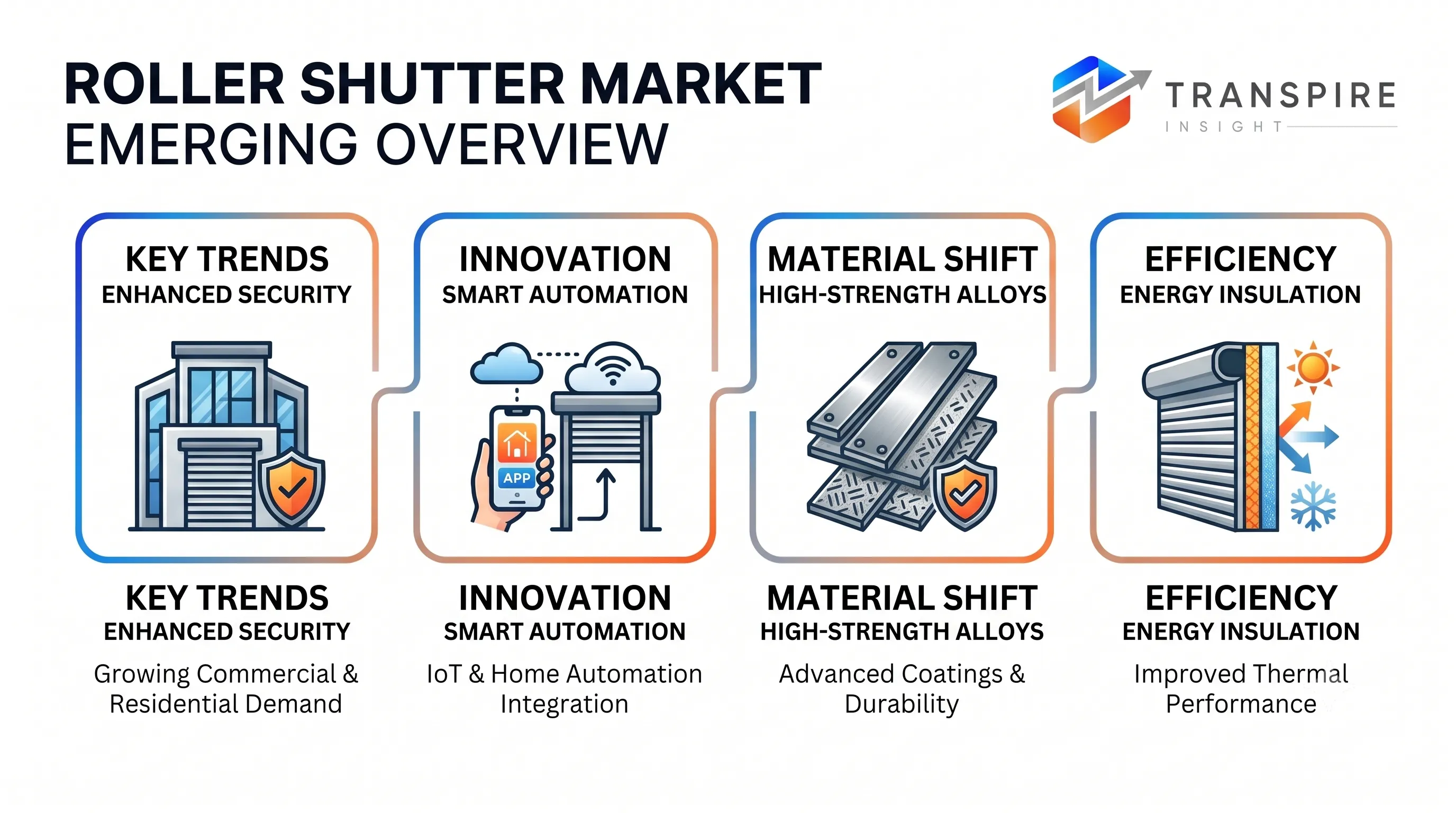
The global roller shutter market is moving beyond conventional security applications as automation, energy efficiency, smart-building integration and industrial modernization create new demand across commercial, residential and industrial properties.
Roller shutters have traditionally been associated with physical security, privacy and protection against weather conditions. However, technological development is expanding their role within modern buildings. Automated motors, remote controls, sensors, access-management systems and connected controls are transforming roller shutters into intelligent building components.
Demand is also being supported by construction and renovation activity. Commercial properties, warehouses, manufacturing facilities, retail outlets and residential buildings increasingly require doors and shutters that combine durability with convenient operation.
Market estimates vary significantly because research organizations use different definitions. A broad Global Market Insight definition places the roller shutter market at approximately USD 62.6 billion in 2025 and projects it toward USD 107.4 billion by 2035 at about 5.6% CAGR. Narrower studies focusing specifically on roller shutter doors report substantially smaller market values.
This analysis follows the broader market definition.
Market Size
The global roller shutter market is estimated at approximately USD 63.0 billion in 2025 and could reach nearly USD 108.0 billion by 2035, representing an estimated CAGR of around 5.6%.
Manual shutters continue to represent a significant portion of installed systems, particularly in cost-sensitive applications. However, automated shutters are gaining ground as property owners prioritize convenience, safety and integration with building-control systems.
Europe remains a major market, while Asia Pacific offers strong long-term growth potential because of construction activity, urbanization and expanding industrial infrastructure.
Security Remains the Core Demand Driver
Security continues to be one of the primary reasons property owners install roller shutters. Retail stores, warehouses, offices and industrial facilities require physical barriers outside operating hours.
Roller shutters provide a relatively simple way to protect entrances and openings from unauthorized access. The availability of stronger materials and improved locking mechanisms is helping manufacturers serve applications where security is a major requirement.
The increasing adoption of automated systems is adding another layer of security. Shutters can be connected to alarms, access-control systems and building-management platforms, allowing opening and closing to follow predefined schedules.
Automation Is Redefining Product Value
Manual operation remains practical for smaller openings, but automation is increasingly attractive in high-frequency environments.
Electric motors allow shutters to be opened and closed with remote controls, wall switches, sensors or centralized systems. In industrial facilities, automation can reduce the time employees spend manually operating large and heavy shutters.
Automated operation can also improve safety by reducing direct interaction with moving components. Sensors can detect obstacles and stop or reverse the shutter when necessary.
As automation becomes more affordable, it is likely to move from premium installations toward mainstream commercial and residential applications.
Energy Efficiency Is Creating a New Market Opportunity
Energy efficiency is becoming increasingly important as buildings face higher operating costs and stronger sustainability expectations.
Properly designed roller shutters can provide an additional barrier between indoor and outdoor environments. Insulated systems can reduce heat transfer, while tighter seals can minimize air leakage.
The benefit is particularly relevant for warehouses, industrial facilities and commercial properties with large openings. Automated operation can further improve efficiency by ensuring shutters are closed when access is not required.
This is changing the way customers evaluate shutters. Instead of considering only the initial purchase price, property owners are increasingly considering lifecycle costs and potential energy savings.
Industrial and Logistics Facilities Are Important Growth Areas
Warehouses and logistics centers require high-performance doors that can withstand frequent opening cycles. The continued expansion of e-commerce and distribution infrastructure is therefore supporting demand.
Industrial shutters may need to handle large openings, high operating frequency, dust, wind exposure and temperature differences.
Manufacturers that can provide complete solutions—including doors, motors, controls, sensors and maintenance—can create stronger relationships with industrial customers.
High-speed shutters are also becoming more relevant where rapid vehicle movement is important. Faster opening and closing can improve operational efficiency while limiting exposure to outside conditions.
Smart Buildings Are Creating Connected Shutters
The development of smart buildings is gradually changing how shutters interact with other systems.
Sensors can monitor the position of a shutter, while connected controls can provide information about operating cycles and equipment status. Building managers can potentially use this information to identify abnormal behavior before a complete failure occurs.
Integration with access-control systems can also allow shutters to respond automatically to authorized credentials. In larger facilities, centralized management can control multiple openings from a single interface.
This trend creates opportunities for technology companies as well as traditional shutter manufacturers.
Material Selection Is Becoming More Specialized
Steel and aluminum remain important materials, but customers increasingly select materials according to application requirements.
Steel offers strength and durability, making it suitable for demanding security applications. Aluminum provides lower weight and corrosion resistance and can be attractive for residential and commercial installations.
Material innovation is also supporting better thermal insulation and improved resistance to environmental conditions.
The result is a market where product specifications increasingly depend on application rather than simply on price.
Renovation Is Creating Replacement Demand
New construction is not the only source of market growth. Existing buildings represent a significant replacement opportunity.
Older shutters may have outdated motors, poor insulation or inadequate security features. Renovation programs provide opportunities to replace manual systems with automated alternatives.
Building owners can also use renovation projects to integrate shutters with broader energy-management or security systems.
This replacement cycle provides manufacturers with recurring demand even in periods when new construction slows.
Installation and Maintenance Are Becoming Strategic
Roller shutters are relatively simple compared with some building systems, but installation quality has a major impact on performance.
Incorrect alignment can increase wear, while inadequate electrical installation can affect motor reliability. Regular maintenance is also important for facilities with frequent operating cycles.
Manufacturers that offer installation, inspection and maintenance services can create additional revenue beyond the initial product sale.
Service-based relationships may become increasingly important as commercial customers seek predictable operating costs and reduced downtime.
Top 10 Roller Shutter Companies
1) Hörmann
Hörmann has a broad portfolio of doors, shutters and industrial access systems. Its strength comes from extensive engineering capabilities and a wide product range covering residential, commercial and industrial applications.
The company's ability to combine doors with automation and access technologies supports its positioning in the evolving market.
2) ASSA ABLOY
ASSA ABLOY operates across access solutions, security and automated door technologies. Its broad portfolio provides opportunities to integrate roller shutters with wider access-control systems.
As buildings become increasingly connected, the company's expertise in security and automation provides a strong competitive foundation.
3) Somfy
Somfy specializes in motorization and control systems for building openings. Its technology supports automated shutters, blinds and other access-related applications.
Its strongest opportunity lies in the transition from manually operated shutters toward connected systems controlled through sensors, remote devices and smart-building platforms.
4) Nice S.p.A.
Nice develops automation and control solutions for gates, doors and building-access systems. Its technology can support automated roller shutter installations across residential and commercial environments.
The company's focus on connected automation provides opportunities as consumers increasingly expect remote-control functionality.
5) Came S.p.A.
Came supplies automation and access-control solutions for residential, commercial and industrial applications.
Its expertise in automated access gives it a natural position as roller shutters increasingly become integrated with broader building security and control systems.
Future Outlook
The roller shutter market is expected to continue expanding as construction, renovation, security requirements and automation reinforce demand.
The market could approach USD 108 billion by 2035 under the broad market definition. Automation, energy efficiency and smart-building connectivity will increasingly influence purchasing decisions alongside traditional security requirements.
For manufacturers, the strongest opportunities will likely come from integrated solutions rather than standalone shutters. Motors, sensors, controls, access systems and maintenance services can increase customer value and create recurring revenue.
The industry is therefore gradually shifting from a hardware-only market toward an integrated building-access market where security, energy management and automation converge.


Send us a brief description of your challenge and we'll get back to you within 24 hours.

 inquiry@transpireinsight.com
 APAC:+91 7666513636
 Address


