
Oct 09, 2026
By Transpire Insight
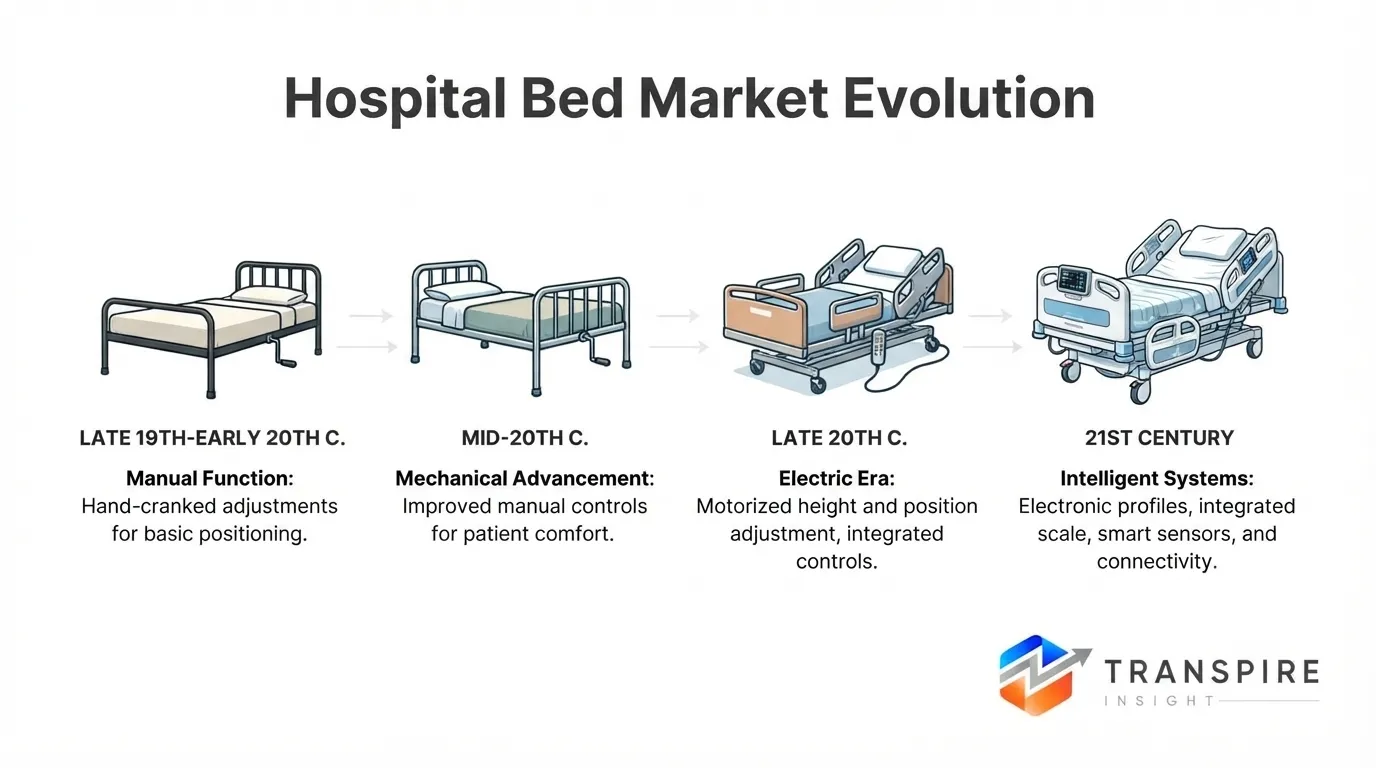
The global Hospital Bed Market is evolving from a conventional healthcare-equipment category into a technology-enabled patient-care segment. Increasing hospital capacity, aging populations, rising chronic-disease prevalence, growing demand for intensive and long-term care, and the adoption of connected and electronically adjustable beds are reshaping procurement priorities across healthcare systems.
Hospital Bed Market Overview
The Hospital Bed Market includes medical beds designed for inpatient care, critical care, long-term treatment, rehabilitation, maternity services, pediatric care, bariatric patients, and home-based healthcare.
The market encompasses manual beds, semi-electric beds, fully electric beds, ICU beds, bariatric beds, pediatric beds, smart beds, remote-monitoring beds, and AI-enabled hospital beds.
According to Transpire Insights, the global Hospital Bed Market is estimated at approximately USD 4.50 billion in 2025 and is projected to reach nearly USD 8.30 billion by 2033, representing a forecast CAGR of approximately 7.99% from 2026 to 2033. The market is estimated at around USD 4.85 billion in 2026.
The market is supported by demand from hospitals, clinics, rehabilitation centers, elderly-care facilities, homecare providers, and specialized treatment centers.
The product category is also becoming more technology-intensive. Traditional manual beds remain relevant in cost-sensitive and basic-care environments, but electric and electronically adjustable beds are gaining importance where positioning, mobility assistance, patient safety, pressure management, and caregiver efficiency are priorities.
The smart-bed segment is developing particularly rapidly. One current market assessment estimates that the global hospital smart-bed segment generated approximately USD 585 million in 2025 and could reach around USD 1.14 billion by 2033, illustrating the increasing role of connected functionality within the broader hospital-bed industry.
Latest Global Market Developments
Why Do Hospital Beds Matter?
Hospital beds are fundamental components of healthcare infrastructure. A hospital can expand its treatment capacity only when sufficient beds, clinical staff, equipment, and supporting infrastructure are available.
The importance of hospital beds extends beyond simply increasing the number of inpatient spaces.
Modern beds can influence:
For intensive-care environments, bed functionality can become particularly important because critically ill patients may require frequent repositioning and close monitoring.
For long-term care, rehabilitation, elderly-care, and homecare applications, beds need to address different requirements such as mobility support, height adjustment, caregiver access, and patient independence.
This diversification is encouraging manufacturers to develop specialized products rather than relying on a single universal hospital-bed design.
Key Factors Driving the Hospital Bed Market
1. Expansion of Hospital Infrastructure
New hospitals, specialty facilities, medical centers, and hospital expansions directly increase demand for inpatient beds.
Emerging healthcare markets are particularly important because governments and private healthcare groups continue to expand treatment infrastructure.
Recent hospital investments in India illustrate how expansion programs can translate into substantial additional bed requirements.
2. Aging Population
The global increase in older populations is supporting demand for acute care, rehabilitation, long-term care, and home-based healthcare.
Older patients are also more likely to require mobility assistance and specialized positioning, increasing the importance of adjustable and supportive bed systems.
3. Increasing Chronic-Disease Burden
Cardiovascular disease, respiratory disorders, diabetes, neurological conditions, cancer, and other chronic conditions contribute to hospitalization and long-term care requirements.
The resulting demand is supporting hospital infrastructure expansion as well as replacement of aging bed inventories.
4. Growth of Intensive Care Capacity
ICU and critical-care facilities require specialized beds capable of supporting complex treatment environments.
Features such as electronic positioning, integrated weighing, lateral rotation, pressure redistribution, and mobility assistance can make advanced ICU beds significantly different from standard inpatient beds.
5. Shift Toward Electric Beds
Electric beds offer multiple positioning functions that can be controlled by caregivers or patients.
The technology can improve workflow efficiency and reduce the physical effort required to adjust patient positioning, particularly in facilities managing large numbers of immobile or critically ill patients.
6. Development of Smart Hospitals
Hospitals are increasingly connecting medical devices to centralized digital systems.
Smart hospital beds can potentially contribute information regarding bed occupancy, patient movement, bed-exit events, position, and other operational or clinical parameters.
This makes the hospital bed an increasingly relevant component of the connected-hospital ecosystem.
Five High-Potential Markets Shaping Global Hospital Bed Demand
1. United States
The United States remains a major market for advanced hospital beds because of its large healthcare system, high healthcare expenditure, extensive hospital infrastructure, and adoption of sophisticated medical equipment.
Demand extends across acute-care hospitals, ICUs, rehabilitation facilities, long-term care centers, and homecare.
The U.S. is also an important market for smart-bed adoption because hospitals increasingly seek technologies that can support patient safety and operational efficiency.
2. Germany
Germany represents an important European market supported by an extensive hospital network, an aging population, and established medical-device manufacturing capabilities.
Demand is spread across acute care, rehabilitation, elderly care, and specialized treatment facilities.
German healthcare providers also place substantial emphasis on equipment reliability, engineering quality, infection control, and lifecycle costs.
3. China
China represents one of the largest long-term opportunities because of its enormous healthcare system and continued investment in hospital infrastructure.
Demand comes from public hospitals, private medical facilities, elderly-care institutions, rehabilitation centers, and specialized healthcare facilities.
Domestic manufacturing capabilities can also support competitive pricing and regional exports.
4. India
India represents a high-growth market for hospital beds because of expanding healthcare infrastructure, private hospital investment, medical tourism, specialty hospitals, and increasing demand for critical and chronic-care services.
Recent investment by major hospital operators demonstrates the scale of capacity expansion occurring within the Indian healthcare market. Max Healthcare's announced plan to add 2,800 beds is one example of this broader infrastructure trend.
5. Japan
Japan represents a structurally important market because of its aging population and extensive demand for elderly care, rehabilitation, long-term care, and technologically advanced medical equipment.
The country's healthcare environment also creates demand for beds designed around patient mobility, caregiver efficiency, and long-term care requirements.
Competitive Landscape
The Hospital Bed Market includes global medical-device companies, specialized hospital-equipment manufacturers, and regional manufacturers competing across product functionality, safety, durability, technology integration, price, service networks, and customization.
The competitive landscape is increasingly divided between:
Advanced beds increasingly function as part of a larger clinical environment.
Manufacturers are therefore investing in digital connectivity, sensor technology, patient monitoring, automated positioning, pressure-management systems, and compatibility with hospital information infrastructure.
Top 5 Companies in the Hospital Bed Market
1. Stryker
Stryker is a major medical-technology company with a substantial presence in hospital beds and patient-handling equipment.
Its hospital-bed portfolio includes solutions designed for acute care and critical-care environments, with emphasis on patient safety, mobility, positioning, and caregiver workflow.
2. Hillrom / Baxter
Hillrom, now part of Baxter, has historically maintained a strong position in hospital beds, patient-care equipment, and connected healthcare solutions.
Its portfolio includes beds designed for acute care, critical care, and patient mobility, with technology supporting clinical workflows and patient monitoring.
3. Getinge
Getinge provides healthcare equipment and technologies for intensive care, operating rooms, infection control, and other clinical environments.
Its involvement in critical-care infrastructure provides exposure to the advanced hospital-bed segment, particularly where bed functionality must integrate with broader ICU workflows.
4. Invacare
Invacare has a broad portfolio of medical and mobility products, including beds and equipment designed for homecare and long-term care environments.
Its exposure to post-acute care and home healthcare makes it relevant to the expanding demand for beds outside traditional hospitals.
5. Paramount Bed
Paramount Bed is a major Japanese manufacturer specializing in medical beds and related healthcare equipment.
Its product portfolio includes hospital beds, long-term-care beds, and advanced patient-support solutions, with particular relevance to markets where aging populations are increasing demand for specialized care infrastructure.
Other companies participating across the broader competitive environment include LINET Group, Medline Industries, Joerns Healthcare, Stiegelmeyer, Savaria, Arjo, Drive DeVilbiss Healthcare, Midmark, and Antano Group.
Opportunities for Small Investors
The Hospital Bed Market provides opportunities beyond manufacturing complete hospital beds.
Smart-Bed Components
Companies supplying sensors, electronic actuators, control systems, pressure sensors, and connectivity components can participate in the transition toward intelligent beds.
Hospital Equipment Distribution
Regional distributors can supply beds to smaller hospitals, nursing facilities, rehabilitation centers, and homecare providers where direct manufacturer coverage may be limited.
Bed Rental and Leasing
Rental and leasing models can help healthcare facilities acquire advanced beds without making the entire purchase as an upfront capital expenditure.
Refurbishment Services
Hospital beds are durable assets, creating opportunities for refurbishment, component replacement, electrical servicing, frame repair, and lifecycle-management businesses.
Homecare Beds
The shift toward treatment outside hospitals is expanding the need for specialized homecare beds that can provide adjustable positioning and caregiver support.
Digital Bed Management
Software platforms that track bed availability, utilization, maintenance status, and patient movement can become increasingly valuable as hospitals digitize their operations.
Pressure-Injury Prevention Technology
Pressure redistribution and patient-positioning systems represent specialized opportunities because prolonged immobility can increase the risk of pressure injuries.
Challenges & Restraints
High Cost of Advanced Beds
Fully electric, ICU, smart, and connected beds can be considerably more expensive than basic manual models.
This can limit adoption in smaller hospitals and price-sensitive emerging markets.
Product Maintenance
Hospital beds experience frequent use and must remain operational. Motors, electronic controls, wheels, brakes, side rails, and adjustment mechanisms require regular maintenance.
Procurement Constraints
Healthcare providers often operate under strict capital budgets and procurement procedures.
Even when advanced technology provides operational benefits, hospitals may prioritize essential infrastructure or other medical equipment.
Product Recalls and Safety Requirements
Hospital beds are patient-contact medical devices, meaning manufacturers must meet stringent safety and regulatory requirements.
A recent market assessment identifies product recalls as one of the challenges affecting the hospital-bed industry.
Interoperability
Connected beds must increasingly interact with hospital information systems and other medical devices.
Lack of interoperability can limit the practical value of smart-bed technology.
Training Requirements
Advanced beds may contain numerous functions that require staff training. Poor utilization can reduce the operational benefit of technologically sophisticated equipment.
Space Constraints
Hospitals must consider room dimensions, corridor widths, elevators, storage areas, and emergency access when deploying larger or more feature-rich bed systems.
Conclusion
The Hospital Bed Market is shifting from a traditional medical-furniture category toward an increasingly sophisticated component of healthcare infrastructure.
The expansion of hospitals, aging populations, increasing chronic-disease burden, critical-care requirements, long-term care demand, and home healthcare are supporting underlying market growth.
At the same time, technology is changing the product itself. Electric adjustment, smart sensors, remote monitoring, pressure management, mobility assistance, digital connectivity, and AI-enabled functionality are gradually expanding the role of hospital beds within modern clinical environments.
Transpire Insights estimates that the global Hospital Bed Market could increase from approximately USD 4.50 billion in 2025 to USD 8.30 billion by 2033, with growth supported by healthcare infrastructure expansion and increasing adoption of advanced patient-care equipment.
The fastest technology opportunities are likely to emerge where hospital beds connect with broader digital-health infrastructure. Current smart-bed market estimates already indicate a substantial and growing opportunity for connected hospital-bed technologies.
For medical-device manufacturers, healthcare investors, hospital operators, distributors, technology developers, and service providers, the market increasingly offers opportunities across advanced beds, smart monitoring, homecare equipment, refurbishment, digital bed management, and specialized patient-support technologies.
The next stage of development will likely focus on making hospital beds not only safer and more comfortable, but also more connected, measurable, and integrated into the hospital's overall clinical and operational workflow.


Send us a brief description of your challenge and we'll get back to you within 24 hours.

 inquiry@transpireinsight.com
 APAC:+91 7666513636
 Address


